02 August 2013

Butterflies Galore! : Aberrant Oakblue

Butterflies Galore! 
The Aberrant Oakblue (Arhopala abseus abseus)


The diminutive Oakblue is one of many species in the genus Arhopala.  The many lookalike species in the genus is a nightmare to identify and distinguish the different species.  The Aberrant Oakblue is more distinctive in its markings, and is much easier to separate from the other species in the genus.  It is a fast flyer and is usually skittish.  It lurks in the shady forested understory in Singapore's nature reserves, but is quite widespread and is often observed in urban parks and gardens as well.

This Aberrant Oakblue was photographed by ButterflyCircle member Koh Cher Hern. It was perched on a leaf in its usual pose, with its wings folded upright. The hindwing features three pairs of threadlike white-tipped tails of which the longest pair is at vein 2b of the hindwing. The brilliant purple blue upperside can sometimes be seen as the butterfly takes off when disturbed.

01 August 2013

Butterflies Galore! : Lime Butterfly

Butterflies Galore!
The Lime Butterfly (Papilio demoleus malayanus)


The caterpillars of the Lime Butterfly are often considered a pest of the domestic lime plant that is commonly cultivated as a garden plant. Used in Asian cooking, the green fruit of the lime plant is a common ingredient in many local dishes, usually as a garnishing. We have heard of the caterpillars of this species feeding on lime plants along the corridors at the 13th storey of our local public housing!

The butterfly is large and pretty, with black and yellow markings giving the butterfly an almost chequered appearance. The underside is predominantly yellow with black markings. The Lime Butterfly is fast flying but can often be photographed whilst it is visiting flowers, puddling, or just perching on shrubbery to rest. This shot, taken by ButterflyCircle member Nona Ooi, shows the butterfly at rest.

31 July 2013

Butterflies Galore! : Banded Swallowtail

Butterflies Galore!
The Banded Swallowtail (Papilio demolion demolion)


The Basket Stinkhorn (Dictyophora indusiata) can be found in our nature reserves.  However, to encounter this beautiful mushroom, one has to go out early, as the netlike white veil will collapse and rot off by noon. The putrid odour emanating from this mushroom attracts flies, carrion beetles and the occasional butterfly.

The Banded Swallowtail shown here, was photographed feeding on the bulbous head of the Basket Stinkhorn. It returned repeatedly to the mushroom to feed and was 'tame' enough to be photographed although it flapped its forewings continuously as it fed, typical of the Papilio species.

Read more about the Stinkhorn mushroom at the Bird Ecology Study Group's website where Dr Wee Yeow Chin elaborates about this species of mushroom found in Singapore's forests.

30 July 2013

Butterflies Galore! : Sumatran Sunbeam

Butterflies Galore!
The Sumatran Sunbeam (Curetis saronis sumatrana)


The Sumatran Sunbeam is one of two species of the genus Curetis that exists in Singapore. Although other species were recorded before, they remain elusive and besides the Malayan Sunbeam (Curetis santana malayica) the other species recorded by the early authors have not been reliably identified yet.

The Sumatran Sunbeam is usually found in the mangrove habitats in places like Sg Buloh Wetland Reserve, Pasir Ris Park Mangrove swamp and Pulau Ubin. It is a fast flyer, and females are more often seen than the males of this species. The Sumatran Sunbeam has a habit of flying rapidly, then perching on the underside of a leaf to hide. Two weekends ago, ButterflyCircle member Chng CK managed to capture a shot of this species, perched on the underside of a leaf with its wings folded upright.

29 July 2013

Butterflies Galore! : White Banded Flat

Butterflies Galore!
The White Banded Flat (Celaenorrhinus asmara asmara)


A colony of the White Banded Flat was re-discovered in Singapore by Nelson Ong and Yiming some time back in Feb 2011. Until then, it had been assumed that this species, recorded in the checklists of the early authors, was extinct. The surprising find ensured that the White Banded Flat would be re-instated to the Singapore Checklist once again.

Last week, ButterflyCircle member Sunny Chir shot the White Banded Flat at its very local hideout. We are glad to know that the colony still thrives and does not appear to be in danger of disappearing just yet. But its existence in the Singapore butterfly list remains highly threatened.

27 July 2013

Life History of the Malay Lacewing v2.0

Life History of the Malay Lacewing (Cethosia hypsea hypsina)
An earlier version of the life history of the Malay Lacewing can be viewed by clicking this link.


Butterfly Biodata:
Genus: Cethosia Fabricius, 1807
Species: hypsea Doubleday, 1847
Subspecies: hypsina C. & R. Felder, 1867
Wingspan of Adult Butterfly: 60-80mm
Caterpillar Local Host Plant: Adenia macrophylla var. singaporeana


A female Malay Lacewing showing its underside.

A female Malay Lacewing showing its upperside.

Physical Description of Adult Butterfly:
Above, the forewings are black with a white subapical band beyond the cell; the basal area is orange-red for the male (with the red confined to the base of the wings) and black for the female (with a yellowish-white patch in mid space 1b). The hindwing is entirely orange-red (paler in the female) except for the scalloped black distal border. Underneath, the wings are orange-red with white fasciae and adorned with black spots. The forewing cell has several black-edged, pale blue transverse stripes. The wing borders are dark coloured and deeply indented with lace-like pattern of white markings. One distinguishing feature to separate Malay Lacewing from other Cethosia species is the absence of a white submarginal band on the hindwing underside.

A male Malay Lacewing showing its underside.

A male Malay Lacewing showing its upperside.


Field Observations of Butterfly Behaviour:
The Malay Lacewing is essentially a forest dweller and its local occurrence is confined within the sanctuary of the nature reserves in the catchment areas. It is not uncommon in the reserves, and adults can be spotted visiting flowers of flowering plants such as Leea indica in forest clearings or alongside forest trails. At times, females can also be seen checking out leaves of various plants in search of an ovipositing site.

25 July 2013

Down Memory Lane - Singleton

Down Memory Lane
The Singleton (Una usta usta)


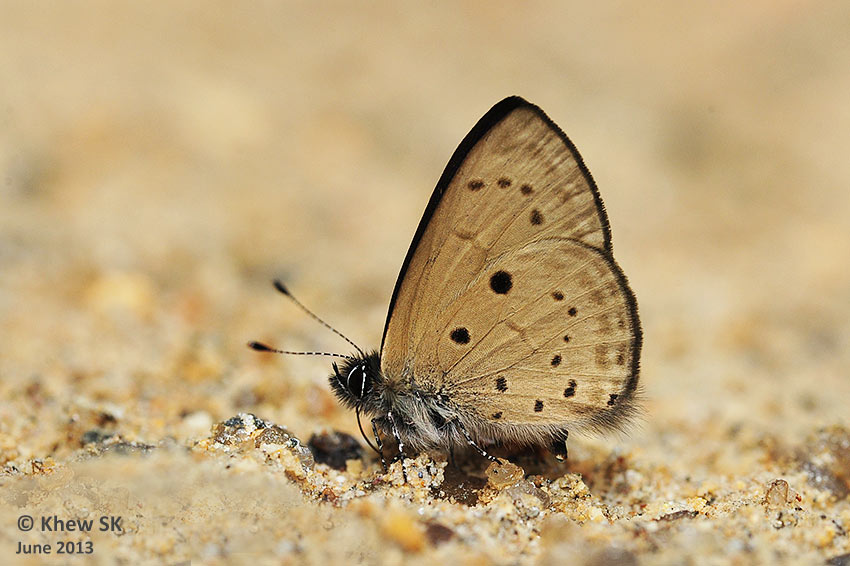
This small butterfly, known as the Singleton, was recorded in the checklists of the early collectors and the authors of the two main reference books on butterflies of Malaysia and Singapore. The male of the Singleton is deep brownish purple above, whilst the female is lighter but has a broad border on both wings. The underside is pale buff brown with prominent black spots on both wings.


It is not known why the butterfly disappeared from Singapore, or when it did. It is reported that the Singleton is nowhere considered common, even in Malaysia. However, on ButterflyCircle members' trips up north, males of this species are quite regularly encountered puddling on damp riverbanks. In looking back at the numerous butterfly surveys in Singapore, starting in the early 1990s, no one has thus far seen the Singleton. Will it be back here again one day? Or will it remain only in our memories and is gone forever from Singapore?