24 December 2012

Merry Christmas and a Happy New Year!

Merry Christmas and a Happy 2013!
From ButterflyCircle

Here's wishing a Merry Christmas and a Happy New Year to all our readers and members of ButterflyCircle.


The feature butterfly this year is the recently-discovered Yellow Flat (Mooreana trichoneura trichoneura). Perched as a "tree-topper" decoration on a Christmas tree, this Flat celebrates the end of another good year for ButterflyCircle and its members.

As we prepare for the festive cheer of the season, do be happy and thankful for the little things that we enjoy in life (like butterflies!) and to appreciate everything that we have.

Merry Christmas and a Happy New Year!!!

22 December 2012

Life History of the Banded Swallowtail

Life History of the Banded Swallowtail (Papilio demolion demolion)


Butterfly Biodata:
Genus: Papilio Linnaeus, 1758
Species: demolion
Cramer, 1776
Subspecies: demolion
Cramer, 1776VUWingspan of Adult Butterfly: 75-95mm
Caterpillar Host Plants: Luvunga crassifolia (Rutaceae), Luvunga scandens (Rutaceae), Melicope lunu-ankenda (Rutaceae).

A male Banded Swallowtail resting at a leaf perch.

A female Banded Swallowtail resting at a leaf perch.

Partial upperside views of the Banded Swallowtail showing one key difference (circled) between the two sexes.

Physical Description of Adult Butterfly:
Above, both sexes are black with a macular band of pale greenish spots extending from the forewing apex to the hindwing's mid-dorsum. The hindwing has a series of submarginal pale greenish lunules and a black tornal spot embedded in a much larger orange spot. The female has the inner half of the lunule in space 2 further coloured in orange (see above pic). Underneath, both sexes are similar with the macular band and submarginal lunules in the hindwing much broader and the area between them subdivided into two series of black spots by patches of orange and bluish-green scales. There is a moderately long spatulate black tail at end of vein 4 in the hindwing. Mirroring the difference in the hindwing upperside, the female has half of the submarginal lunule in space 2 coloured orange (see highlight A in below pic). The sinusoidal marginal black band is continuous in spaces 6 and 7 in the male, but broken in the female (see highlight B in below pic).

Partial underside views of the Banded Swallowtail showing two key differences (circled, marked A, B) between the two sexes.

A male Banded Swallowtail puddling on wet ground.

A puddling male Banded Swallowtail.

Another puddling male Banded Swallowtail.

Field Observations of Butterfly Behaviour:
Banded Swallowtail is moderately common in Singapore. The adults can be found in the nature reserves, wastelands, mangrove habitats and in offshore islands like Pulau Ubin and Pulau Tekong. The fast flying adults are frequently seen in flights along trails/tracks and while making occassional stops to visiting flowers growing in the surrounding vegetation. During cooler hours in early morning and late afternoon, adults could be found resting on leaf perches in an open wing manner. The males have been observed to puddle on wet grounds.

20 December 2012

Random Gallery - Common Palmfly

Random Butterfly Gallery
The Common Palmfly (Elymnias hypermnestra agina)


The Common Palmfly is a common urban butterfly, usually observed in areas where its host plants - various species of Palms are cultivated. The species is widely distributed across Singapore, paricularly in locations where the host plants are found - whether in public parks, gardens or in the nature reserves. The Common Palmfly has bluish-black forewings with a series of light blue submarginal spots on the upperside. The underside is speckled with reddish-brown striae and is very variable.

This shot of the Common Palmfly was taken by ButterflyCircle member Henry Koh, using a 300mm f/4 lens with a 1.4x teleconvertor. Besides dedicated macro lenses, using long lenses (usually associated with bird photography) can sometimes be useful for skittish butterflies like the Common Palmfly.


18 December 2012

Random Gallery - King Crow

Random Butterfly Gallery 
The King Crow (Euploea phaenareta castelnaui)


The King Crow is the largest of the "crow" butterflies from the sub-family Danainae.  Measuring over 100mm in wingspan, this species is relatively common in Singapore, and sometimes several individuals can be observed, particularly when there is a flowering tree or shrub that the species likes. It can usually be found where its caterpillar host plant, the Pong-Pong tree (Cerbera odollam) is cultivated. In Singapore, this species can regularly be observed at the Pasir Ris Park Mangrove Walk where the host plants are common in the mangrove environment.

This shot of the King Crow was taken by ButterflyCircle member Loke PF during his weekend outing.  The predominantly black butterfly has a slow and unhurried gliding flight.  The wings may show a slight purple wash in a side light.


15 December 2012

Butterfly of the Month - December 2012

Butterfly of the Month - December 2012
The Fluffy Tit (Zeltus amasa maximinianus)


This December 2012 is the fifth anniversary of ButterflyCircle's Butterfly of the Month series. We first introduced this monthly series with a Malay Lacewing back in 2007, and with this month's feature butterfly, the Fluffy Tit, we have showcased a total of 62 species (two were featured in Dec 2008) from Singapore's butterfly fauna over a period of 61 months!


December has been a very wet month for the region, with the monsoon rains drenching most afternoons here in Singapore. From the Meterological Station data, it was reported that Singapore received an "above average rainfall over almost all of Singapore... with the highest rainfall of 253 mm to 289 mm (110% to 140% above average) in the western parts of Singapore". Indeed, butterfly watchers and photographers have been experiencing relatively low counts of butterflies as the cooler and wetter weather appears to have reduced the numbers in many parts of the island.


Over in Singapore, an industrial strike by some foreign bus workers dominated the local news for a while.  It has been at least 26 years since such an "adversarial and confrontational industrial relations" last happened in Singapore.  The strike made world news as the Singapore authorities moved swiftly to punish the ringleaders of the strike - an event that is new and unfamiliar to many young Singaporeans.  A taste of things to come, if wage disputes and living conditions of foreign workers continue to be issues that remain unresolved?  


In the US, a 26-year old gunman massacred 20 children and six adults at a school in Connecticut. It is always difficult for many countries in this part of the world to understand why firearms are still relatively easily available in the US. When will we see the end of such tragedies where innocent victims, in this case, young children, are slaughtered for no rhyme or reason?


Despite the tragedies, many Americans continue to oppose restrictions on what they consider to be a constitutional right to keep powerful firearms at home. In Singapore, possession of firearms (with the exception of the army and police) is an offence punishable by death. It is my personal hope that this Singapore law continues to be in force for as long as we want to remain a peaceful and safe country.


December always brings memories of Christmas, cold weather and presents!  It always brings back memories of songs and tunes of significance from my childhood days.  An old favourite is this one by Engelbert Humperdinck called Winter World of Love.


The flower of the month in December is the Narcissus, usually represented by the white and orange-yellow cultivar. The flower has a trumpet shaped corona that is surrounded by a ring of petals. They are also poisonous and can be fatal if eaten so no parts of the flower should be ingested. 
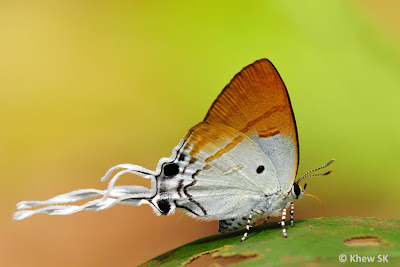


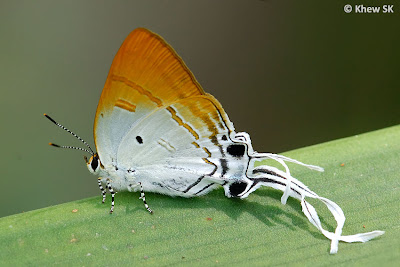
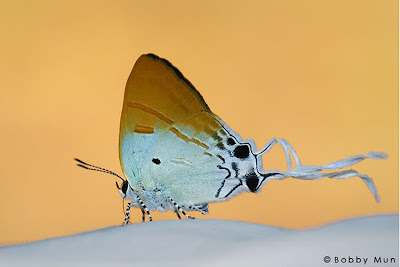
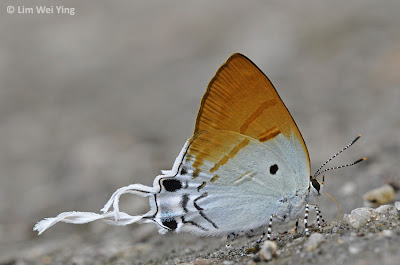
For our December butterfly, we feature a pretty white-and-orange long-tailed Lycaenidae, the Fluffy Tit (Zeltus amasa maximinianus). It is a moderately common butterfly that can be found in Singapore's urban parks and gardens, as well as in the forested nature reserves. It prefers open sunlit spots and forages amongst the vegetation.
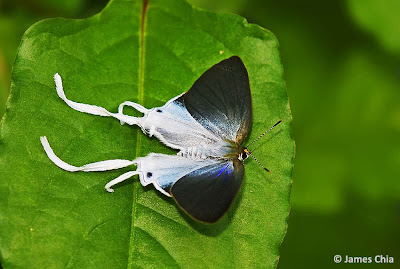
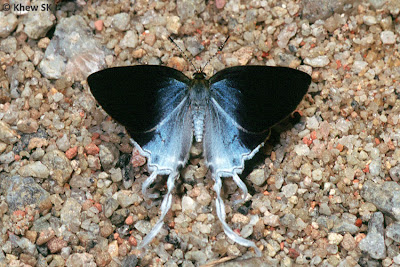


Males of the Fluffy Tit have the basal area of the forewing and a large part of the hindwings a pale azure blue on the uppersides. The rest of the wings are black, shot with a deep purple when viewed at certain angles. The female is dull brown above with a whitish tornal area on the hindwings.


The underside is pale bluish white with orange apical areas on both wings.  There are deeper orange streaks on the wings with large and distinctive black spot in space 7 of the hindwing.  The tornal area has black streaks and black spots. The hindwing features two long tails at vein 1b and 2, of which the longer tail is at vein 1b.
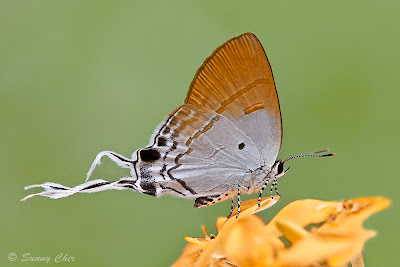
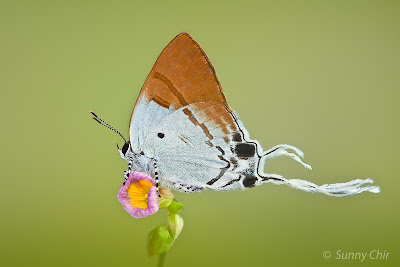


The butterfly is quite a sight to behold when it flies with its long white tails trailing elegantly behind. The tails are curly and twisted, often twirling in the breeze and moving, as though independently from the rest of the butterfly. Males of the species are observed to puddle at roadside seepages and sandy banks of forest streams.
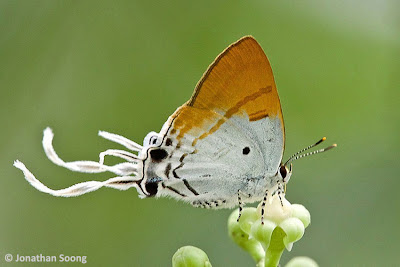


The species can sometimes be encountered feeding on flowers in the forests, especially those of the Bandicoot Cherry (Leea indica). Males are also partial to human sweat, and can be observed feeding on sweaty backpacks and sometimes can be attracted to feed on a sweaty finger!
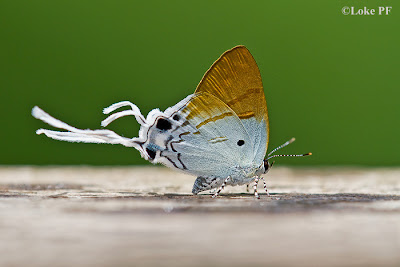


The life history of the Fluffy Tit has been fully recorded on this blog. The caterpillar host plant in Singapore is Clerodendrum laevifolium.
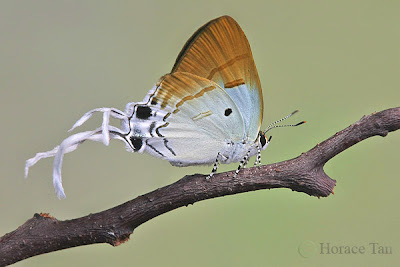


Text by Khew SK : Photos by James Chia, Sunny Chir, Khew SK, Koh CH, Lim WY, Liyana Zolpakar, Loke PF, Jonathan Soong, Horace Tan, Anthony Wong & Benjamin Yam

* This feature article is dedicated to ButterflyCircle member Pung Liphing, who now resides in Kuching, Sarawak, East Malaysia.  She has, for a long long time, spent a lot of effort to hunt this species down to photograph, but somehow, whenever she turns up, the Fluffy Tit always disappears like magic!  So here's to Liphing and a note of encouragement to keep trying.  Somewhere out there, is a Fluffy Tit waiting for you!


13 December 2012

Random Gallery - Blue Glassy Tiger

Random Butterfly Gallery
The Blue Glassy Tiger (Ideopsis vulgaris macrina)


Last weekend, at Pasir Ris Park, there were a number of Danainae that were attracted to the drying flowers of what looks like a Dill herb (Anethum graveolens) at the Kitchen Garden. A few Blue Glassy Tigers (Ideopsis vulgaris macrina) were so "drunk" on feeding that you could pick them off with your fingers!


There must be some chemical compound in the plant that attracts these Danainaes (which also included a King Crow), that is similar to the drying plant of the Indian Heliotrope (Heliotropium indicum) - a well-known Danainae magnet. Perhaps some botanist may be able to shed some light on what attracts these butterflies to the Dill herb. Here are two shots taken by ButterflyCircle members Jonathan Soong and Loke PF of Blue Glassy Tigers perched and feeding on the flowers of the herb.


12 December 2012

12-12-12

12-12-12
The Final Triplet of the Millennium


As far as numerology goes, we are currently in a period of eleven years all of which have a day with the last two digits of the year repeated as a triplet in mm/dd/yy format (or dd/mm/yy or yy/mm/dd). Starting on 1 Jan 2001 which was 01-01-01, progressing to 2 Feb 2002 (or 02-02-02) and so on, today, Wednesday 12 Dec 2012 will be the last of the triplets until the next millennium or the 22nd Century comes around!

Even ButterflyCIrcle chose an auspicious 10-10-10 to launch its Field Guide to the Butterflies of Singapore two years ago on 10 Oct 2010. So, the final triplet of the century is probably worth some mention, as most of us will probably not be alive to see the next round of these triplets starting in 2101!

It is noteworthy to also mention that today in Singapore, a total of 540 couples have applied to be married - a number that is eight times the daily average in the previous year. Notwithstanding the fact that some geomancers consider 12 Dec 2012 as an "average" day in terms of luck, these couples have chosen the final triplet of the millennium to celebrate their nuptials.

To commemorate this date, we feature a collage of butterfly 'couples' by ButterflyCircle members. So do something worthwhile and memorable on 12-12-12, for you are not likely to enjoy another such date again in your lifetime.  Have a great day!

Text by Khew SK : Photos by Chng CK, Koh CH, Khew SK, Bobby Mun, Simon Sng, Tan BJ, Bene Tay & Mark Wong