25 July 2012

Random Gallery - Narrow Spark

Random Butterfly Gallery
The Narrow Spark (Sinthusa nasaka amba)


The Narrow Spark is a very small Lycaenid that was a new discovery to the Singapore Butterfly Fauna in the mid-90's.  It was not recorded by the early authors but was first discovered in a patch of forested area in the Central Catchment Reserves adjacent to the reservoir.  Subsequent to that, it has been regularly seen over the years, although not common, and its life history has been recorded in full.  The butterfly prefers to remain in the shadiest understorey of the forests and is difficult to photograph as it is usually skittish.  Here, ButterflyCircle member Nelson Ong gets an excellent shot of the Narrow Spark perched on the edge of a leaf.

21 July 2012

Life History of the Bifid Plushblue

Life History of the Bifid Plushblue (Flos diardi capeta)


Butterfly Biodata:
Genus: Flos Doherty, 1889
Species: diardi Hewitson, 1862
Subspecies: capeta Hewiton, 1878
Wingspan of Adult Butterfly: 37-41mm
Caterpillar Local Host Plants:
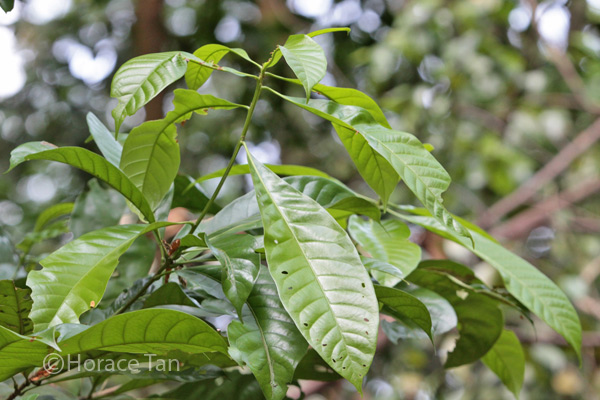
Lithocarpus elegans (Fagaceae, common name: Spike Oak), Lithocarpus conocarpus (Fagaceae), Lithocarpus ewyckii (Fagaceae).


Physical Description of Adult Butterfly:
Above, the male is dark purplish blue with no border; the female is pale purplish blue with broad dark brown borders. Below, the markings are purplish brown contrasting strongly with pale brownish to whitish ground colour on the hindwing. There are red patches at the base of costa on both wings.  The hindwing has  a black tornal spot and a black marginal spot in space 2, both of which are surrounded by brassy scales which cover the marginal spaces from the tornal area to space 2. A distinguishing feature of Flos diardi  is the presence of two conjoined clavate spots (hence its common name: Bifid Plushblue) in  mid space 7. However these two spots could be separated in certain aberrated specimens. There is  a moderately long  white-tipped tail at the end of vein 2, and a minute tooth, one each at  the end of veins 1b and 3 respectively.


An upperside view of a sun-bathing female Bifid Plushblue.

Field Observations of Butterfly Behaviour:
The Bifid Plushblue is rare in Singapore and sightings of adults have been restricted to  shady forested locations or in the vicinity of its host plants within the 
central catchment reserve. The adults are strong flyers and  they typically perch with their wings closed, but in sunny weather the females have been observed to open their wings fully to sunbathe in between ovipositing runs.  


Early Stages:
Bifid Plushblue (as well as Flos fulgida and Flos anniella) was found in Singapore to be utilizing  Lithocarpus ewyckii as its larval host  about a half century ago (Morrell, 1956). Recent field studies have established that Lithocarpus elegans and Lithocarpus conocarpus are its larval host plants too. It is likely other Lithocarpus spp. or other non-Lithocarpus members of the Fagaceae family could serve the same role. Caterpillars of the Bifid Plushblue feed on young and immature leaves of the host plant, and have the habit of building shelters on a  leaf  for security and concealment. Sometimes several individuals could share the same shelter. In field observations, the caterpillars are invariably found to be attended by ants.

Host plant #1: Lithocarpus elegans.

Host plant #2: Lithocarpus conocarpus.

A female Bifid Plushblue laying eggs.

Eggs are laid singly or in  small groups of 2-3 on the petiole, stem or a leaf underside of a branchlet of the host plant. Each egg is about 0.8-0.9mm in diameter, white with a light dull  green tinge. It is shaped like a pressed bun with a slightly depressed micropylar area atop. The surface has a coarsely reticulated pattern of intersecting ridges with intersection points pointedly raised.

Two views of an egg of the Bifid Plushblue.

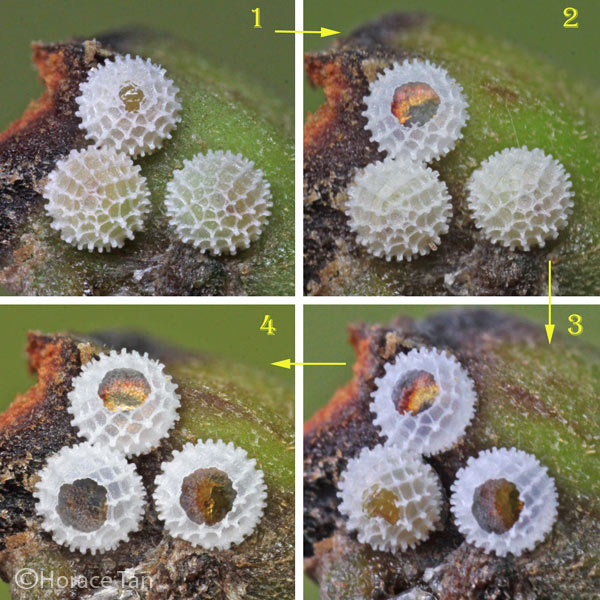
A sequence of 4 pictures showing the development of three eggs which hatched several hours apart.

It takes 2.5-3 days for an egg of the Bifid Plushblue to hatch. The caterpillar emerges after nibbling away sufficiently large part of the egg shell. The newly hatched shows no interest in devouring the remaining egg shell. The body  is   yellowish brown  in color and has a length of about 1.8mm. It has a rather flattened woodlouse appearance with a large semicircular prothorax, featuring a yellowish brown head and long dorso-lateral and lateral setae. There are also a fair number of very short setae on the body surface.


Two views of a newly hatched caterpillar, length: 1.8mm.

The 1st instar caterpillar feeds on surface of a young leaf leaving small holes on the leaf lamina as a result. Larval stages of the Bifid Plushblue are gregarious and a few caterpillars have been observed in the field sharing a feeding site with no animosity towards each other. Towards the end of 1st instar, pinky red patches appear on the front portion of the prothorax and the posterior abdominal segments. After 2 days of growth and reaching a length of about 2.5mm, the caterpillar moults to the next instar.

Two views of a 1st instar caterpillar, early in this stage, length: 2.3mm.

A 1st instar caterpillar, late in this stage, dormant prior to its moult,  length: 2.5mm.

A late 1st instar caterpillar in the company of an ant in the field.

The 2nd instar caterpillar features long lateral hairs and a black head. Long dorso-lateral setae are no longer present, but many short setae appear on the entire body surface. A number of narrow bands, alternating in paler and darker tones of yellowish green, run  lengthwise. The prothorax is marked by a large black patch with a leading edge in pinky red. The dorsal nectary organ (DNO), ringed in dark reddish brown,  is already visible on the 7th abdominal segment.  It is flanked on its upper edge by a  small dark reddish patch, and on its lower edge, a much larger one which covers the dorsum of the 8th abdominal segment. The pair of tentacular organs on the 8th abdominal segments are also present. A large black anal plate dominates the remaining posterior segments. This instar lasts for 2-3 days with the body length reaching about 4mm before the moult to the 3rd instar.

Two views of a newly moulted 2nd instar caterpillar.

Two views of a 2nd instar caterpillar, early in this stage, length: 2.5mm.

2nd instar caterpillar, late in this stage, dormant prior to its moult, length: 4mm.

The 3rd instar caterpillar resembles the 2nd instar caterpillar closely. . The DNO is now rather prominent with a broad dark brown oval ring  marking its outer boundary. The red dorsal patch on the 8th abdominal segment now has two lateral arms, though faint in appearance, reaching up to the tentacular organs. The 3rd instar takes about 3-4 days to complete with the body length reaching about 7mm.

Two  3rd instar caterpillars with the one on the left newly moulted.

Two views of a 3rd instar caterpillar, early in this stage, length: 4.9mm.

Two views of a 3rd instar caterpillar, late in this stage, length: 7mm.

Two 3rd instar caterpillars attended by ants.

The 4th instar caterpillar has similar markings as the 3rd instar caterpillar. One notable change is in the prothoracic dark patch which now has two small white markings embedded at its posterior edge. Another change is in the red side arms on the 8th abdominal segment, being longer and more prominent. The dorsal band becomes darker and prominent in this instar too. The 4th instar takes about 4-5 days to complete with the body length reaching about 12mm.

Two views of a newly moulted 4th instar caterpillar, length: 6.5mm.

Two views of a 4th instar caterpillar, late in this stage, length: 12mm.

Top: Dormant 4th intar catepillar prior to its moult. Bottom: Newly moulted 5th instar caterpillar.

Compared to the 4th instar, the 5th instar caterpillar has similar but more striking markings. Visible changes are 1) The  dark prothorax patch is now flanked in white  on its side and nearly  all its anterior edge; 2) The black anal plate is flanked in white on its side.

Ants attending to a Bifid Plushblue caterpillar while the moult to the 5th instar was in progress.

Two views of a 5th intar caterpillar, early in this stage, length: 14.5mm.

Two views of a  5th intar caterpillar, late in this stage, legnth: 20.5mm.

After 6-8 days of feeding and reaching a length of about 23mm, the caterpillar stops food intake for about 1 day. During this time, its body gradually shortens and the longitudinal bands on its body disappear. Soon the caterpillar becomes an immobile pre-pupa confined to  its leaf shelter. The pre-pupal caterpillar prepares for pupation by spinning a silk girdle and a silk pad to which it attaches via claspers at its posterior segment. The silk threads spun is lemon yellow to golden yellow in colour.

Two views of a pre-pupa of the Bifid Plushblue.

After 1 day as a pre-pupa, pupation takes place. The pupa, with a length of 14-15mm, has a shape typical of any Lycaenid species and has a somewhat produced anal segment. It is pale yellowish green initially, but within a day, the colour changes to golden brown.

Two views of an early pupa of the Bifid Plushblue.

Two views of a pupa of the Bifid Plushblue, length:12mm.

9 to 10 days later, the pupa turns dark brown to black in its wing pads, the thorax and the dorsum of its abdomen. The next morning, the pupal stage comes to an end with the emergence of the adult butterfly.

Two views of a mature pupa of the Bifid Plushblue.

A newly eclosed Bifid Plushblue waiting for its wings to be fully firmed up.

Unlike most of the Lycaenidae species, the caterpillars of the Bifid Plushblue have the habit of constructing leaf shelters in which they rest and seek safety between feeds on the lamina of nearby leaves and part of the shelter. Pupation also takes place within a leaf shelter.

A leaf shelter  used by Bifid Plushblue caterpllars on L. conocarpus, constructed by binding the opposite edges near the leaf base.

A leaf shelter on a young leaf of L. elegans.

References:
  • The Butterflies of The Malay Peninsula, A.S. Corbet and H.M. Pendlebury, 4th Edition, The Malayan Nature Society.
  • A Field Guide to the Butterflies of Singapore, Khew S K, Ink on Paper Comm. Pte. Ltd., 2010.
  • Butterflies of Thailand, Pisuth Ek-Amnuay, 1st Edition, 2006.
  • Notes on the life histories of a number of butterflies of the subfamily Theclinae (Lycaenidae), Morrell R.,  Malay. Nat. J. 10: 104-108, 1956.
Text by Horace Tan, Photos by Nelson Ong, Federick Ho and Horace Tan.

19 July 2012

My Green Space

My Green Space (NParks e-newsletter)
The Fascinating World of Caterpillars


When Horace and I launched the book "Caterpillars of Singapore's Butterflies" in May 2012, we were also invited to write a short article to introduce the book in NParks' e-newsletter, My Green Space. 

The article has just been recently published in Issue 14 Vol 3/2012, together with three other short articles on marine biodiversity and our fragile rainforests.

The articles can be found at NParks' My Green Space e-newsletter link here.  Our article, titled the Fascinating World of Caterpillars can be found here.

18 July 2012

Random Gallery - Yellow Grass Dart

Random Butterfly Gallery
The Yellow Grass Dart (Taractrocera archias quinta)


The genus Taractrocera is unique amongst the Hesperiidae (or Skipper family) where the antennae does not have an apiculus (that's the hook at the end of the clubbed antennae that most Skippers feature). Here, the Yellow Grass Dart (Taractrocera archias quinta) perches on a flower of the Elephant's Foot weed.  ButterflyCircle member Loke PF got this well-composed shot on a wet day where the flower was still wet with droplets of water. 


14 July 2012

A Butterfly Holiday in Hong Kong

A Butterfly Holiday in Hong Kong
Mark Wong's travelogue in the Fragrant Harbour
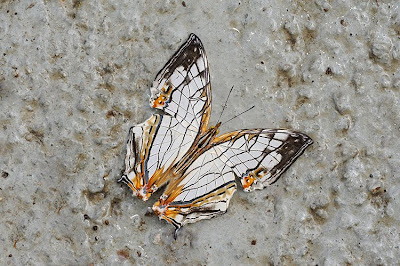


It started with my company announcing our annual R&R trip to Hong Kong this year. I decided to extend my trip to check out the butterfly fauna in Hong Kong and to observe species that I am not likely to encounter in Singapore. After a brief exchange of messages over Facebook with our friends from the Hong Kong Lepidopterists Society (HKLS), we made plans for outings to the popular butterfly watching locations. I was rather excited to catch up with bunch that we brought around Singapore as we have not seen each other in about a year.

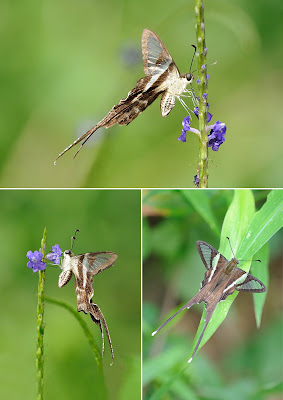
On the arranged date, I headed straight to Fung Yuen Butterfly Reserve, where I met Rachel, and some of the HLKS members who showed me around. Being awed by the beauty of the Lamproptera curius (White Dragontail), I was rather determined to get a decent shot of it.  Without a doubt, Fung Yuen is the place to go for L. curius as the host plant can be found in abundance at the park.  Every now and then, the L. curius can be observed fluttering, feeding and resting among the bushes.


The Heliophorus epicles (Purple Sapphire) was also on my wish list from Hong Kong.  It didn’t take long before Rachel spotted one very cooperative individual and I had an easy time to document it.
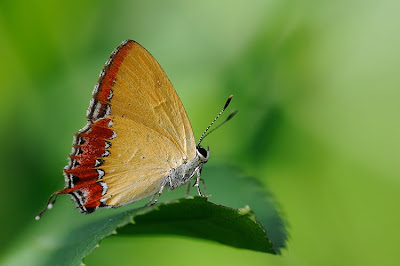


I was also brought to a less accessible area around Fung Yuen by the HKLS members, which provided more opportunities to spot and watch more butterflies.  Among the other butterflies shot at Fung Yuen are: Zemeros flegyas (Punchinello), Isoteinon lamprospilus (Shiney-spotted Bob), Polyura nepenthes (Shan Nawab) and Lethe confusa (Banded Tree Brown).
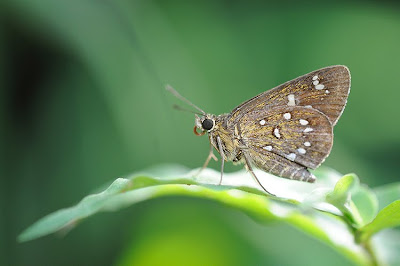
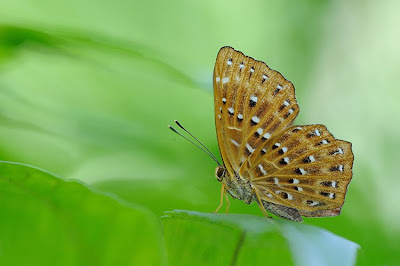


The day ended with Gigi picking Rachel and myself up from Fung Yuen and I headed for a quick shower and straight to dinner with the rest of the gang with whom we have acquainted ourselves quite well when they visited us in Singapore back in 2011, HKLS members: Ah Yin, Arex, Doctor Lee, Gigi, Manson, and Rachel.   We had a great time catching up and discussed the next locations to head to over the next few days.


Top image, from right to left: Doctor Lee Ping Chung, Arex Li, Mark Wong, Ah Yin, Manson Chan, Rachel Chan and Gigi Lai

The next morning, I dragged myself out of bed to have breakfast to make sure I had enough energy to last throughout the day.  I met Gigi at Fung Yuen, and headed to an elevated area behind Fung Yuen.  It drizzled a bit at the lower altitudes but it was pretty much clear at the top. There were many Papilios fluttering around to whet our appetite for what is about to come.  The scenic landscape of Hong Kong also made the hiking up and down the mountain very pleasurable. I had a great time butterfly watching and shooting the ones that were more cooperative.  We even had a good number of puddlers that were feeding on the damp soil from the slight drizzle earlier.
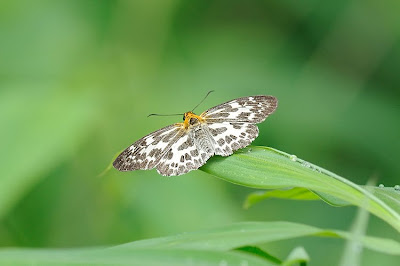

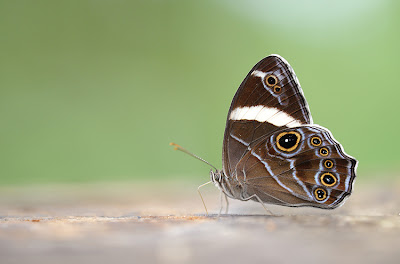

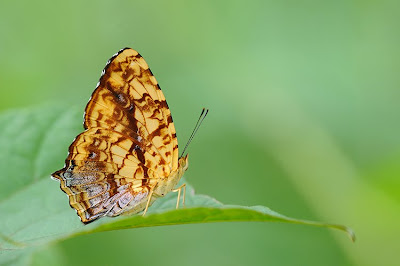


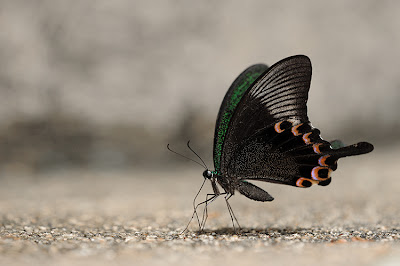
Before leaving, one of the gems of Hong Kong, Papilio paris (Paris Peacock) came down to puddle beside Gigi’s car.  It was an opportunity for the both of us to shoot this rather skittish butterfly.


We then headed to Wu Gau Tan Country Park after lunch.  The weather had cleared up with blue skies.  We were greeted by a Taraka hamada (Lesser Forest Blue) at the entrance.  It is a Lycaenidae whose caterpillars feed on aphids, quite similar to the Miletinaes here in Singapore.   Upon closer inspection, the more pristine specimens have furry legs as well.


Our other target at Wu Gau Tan Country Park is, Pithecops corvus (Forest Quaker).  Fortunately I manage to catch a glimpse of this wee beauty fluttering around high up at the canopy level.  Although I did not manage to get a shot, it was a good opportunity to observe its behaviour. Along the way, we have also many opportunities to shoot other butterflies.
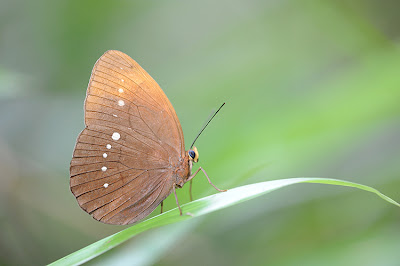
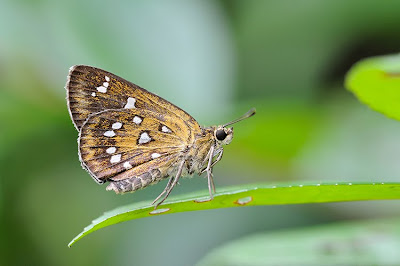


We headed back to Fung Yuen to search for other butterflies as it was getting late and we wanted to make full use of the available sunlight left in the day.  While looking for the Awls and skippers basking in the last rays of the setting sun, we encountered a cooperative Melanitis phedima WSF (Dark Evening Brown) and Zemeros flegyas (Punchinello) to keep us company until it was time to head back for dinner.

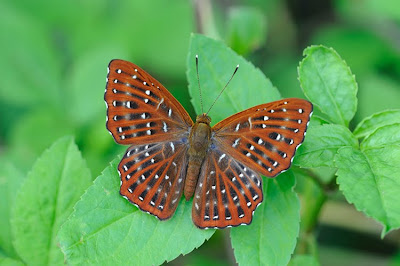


Manson picked me up from my hotel and headed to Mong Kok to meet up with Arex and Ah Yin.  Shopping for electronics goods there was great, and unlike Singapore; it is Tax Free, making some of the deals pretty attractive.  Arex then brought us to a Dim Sum café for dinner.  The food was awesome in all ways possible.

The next day started with bad weather, as it rained quite heavily throughout the morning.  I met Ah Yin at Sha Tin station for breakfast and waited for the weather conditions to improve.  We decided to head to Fung Yuen as it is geographically located at the centre of all the country parks. We took the opportunity to shoot some butterflies that came out despite the rain.


We met up with James Young, the chairman of HKLS, and he brought us out for lunch.  He recommended that we head to Tai Po Kau Nature Reserve for more butterfly shooting.
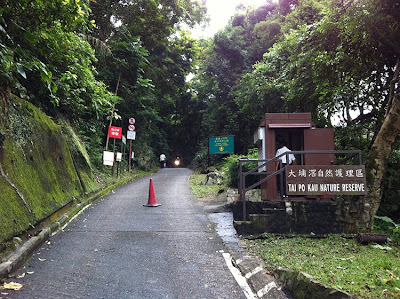


Tai Po Kau is one of the oldest Nature Reserves in Hong Kong, and almost untouched for nearly a century.  There are host plants for the Lamproptera curius (White Dragontail) around, but perhaps due to our late timing and the rain, we did not manage to spot any.

The butterfly activity was notably good despite the bad weather.  We still saw quite a number of puddlers.  We were quite lucky to be able to shoot the Graphium doson (Common Jay) which is not that common in Hong Kong as well as Singapore.  They were puddling along the road below a man-made. Although the Common Jay is very skittish typical of the Graphiums, we still manage to nail a few good shots after persisting for a while. 
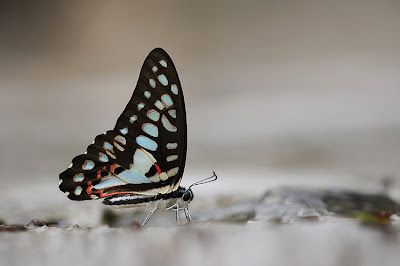


We also had a chance to shoot the Graphium cloanthus (Glassy Bluebottle), which according to Ah Yin, are also not very common in Hong Kong and are seasonal.  Picking a pristine one among the lot is quite a challenge as they are also rather skittish and do not stay still when puddling.  Once again after some persistence from the butterfly photographers, we manage to have some decent shots.

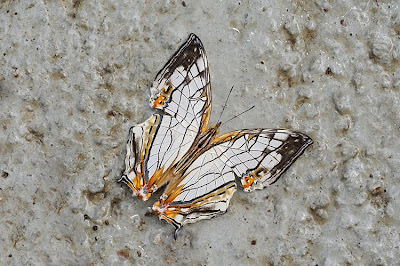
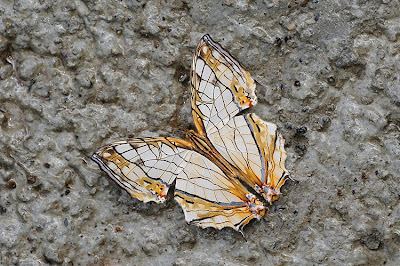


On my final day, I checked out of the hotel and met James Young, who he brought me to Sai Kung, a marine conservation area at the extreme east of Hong Kong.  On a clear day, one can see mainland China across the sea.  Sai Kung also boasts many spectacular landscape scenes.  The colour of the water from the dam is a deep blue with hints of green, surrounded by the mountainous landscape of Hong Kong. It is a contrast from the Hong Kong Island and Kowloon Peninsular itself.  James mentioned that 70-80% of Hong Kong is filled with country parks.  Much of what Hong Kong is known internationally is for its immensely dense cityscapes, but one must visit one of its many country parks to experience the true Hong Kong.


We took a hike down to the coast line in search for the Thoressa monastyrskyi (Monastyrskyi's Ace).   This particular skipper is rather unique.  It was discovered by a Russian; hence the species adopts somewhat a Russian name.  It is also endemic to Hong Kong, with the exception of it being found at a small nature reserve in Vietnam.  The life cycle of T. monastyrskyi is also unique, the larvae feeds on bamboo, but its life cycle lasts a full year.  James had been monitoring this species for the last year and knows exactly when they will be out in full force.  The T. monastyrskyi was quite abundant at Sai Kung when I visited, and they are almost at every turn basking in the sun or puddling on damp surfaces.


Throughout the hike up and down, it was very enjoyable to listen to James share his vast knowledge of the early stages of butterflies with me.  


We then headed back to James Young’s “research apartment” where I witnessed his dedication to the research of butterflies and the detailed life histories.   I was like a child watching an expert working his craft by asking all sorts of questions to what James was doing.  I am delighted and appreciative that James took the time and effort to explain to me what he was doing although he was busy taking care of his “caterpillar farm”.
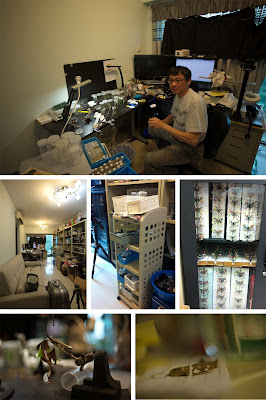


We headed off for dinner around the corner of his block and had some mouth-watering roast goose, before heading off to the airport for my departure back home to Singapore.

Text & Photos by Mark Wong ; Edited by Khew SK

Acknowledgements : 

I would like to express my sincerest gratitude to the HKLS members who took their precious annual leave to bring me about during my stay in Hong Kong.  I am very touched by the great hospitality shown by the HKLS members that made my stay an incredibly enjoyable one. It was also wonderful that all the members shared their vast knowledge of the Hong Kong butterflies with me, which gave me a more profound appreciation of the winged jewels of Hong Kong.

On the behalf of Butterfly Circle, we would like to thank Dr Lee from HKLS who generously gave us copies of the “Photographic Handbook of Hong Kong Butterflies (4th Edition)” and the HKLS pins to distribute among our members.  I would also like to thank the management of Fung Yuen Butterfly Reserve on giving me the book “A Haven for Butterflies and People – A Hong Kong Story Fung Yuen Butterfly Reserve”.  And also special thanks to James Young who gave me a personally signed copy of “The butterflies of Tai Po Kau Nature Reserve”.  This trip was also made possible by Gigi and Arex who helped me plan my butterfly watching itinerary with the the rest of the HKLS members.