25 April 2012

Random Gallery - The Brown Awl

Random Butterfly Gallery
The Brown Awl (Badamia exclamationis)


This week's random butterfly was a newly-eclosed individual of the Brown Awl (Badamia exclamationis) shot by veteran ButterflyCircle member, Sunny Chir.  His excellent shot of the Brown Awl on a colourful flower won him various accolades in nature and photography online websites including Image of the Week at NatureScapes.Net and Photo of the Month at Nature Photographic Society Singapore. 

21 April 2012

A Trio of Rarities

A Trio of Rarities
Recent Observations of Rare Butterfly Species


The months of March and April 2012 experienced rather unpredictable weather patterns with abnormally heavy rains inundating various parts of Singapore on many days of the months, and then alternating with hot sunny and humid days. These months usually coincide with the beginning of the butterfly season in SouthEast Asia, and generally where more butterflies are sighted, and in larger numbers.

However, the heavy monsoon rains may have somewhat dampened the local butterfly season. It was therefore surprising that ButterflyCircle members managed to encounter three species that are classified "Very Rare" in the 2010 "A Field Guide to the Butterflies of Singapore" book.


#1 : The White Tipped Baron (Euthalia merta merta)


The first encounter was by ButterflyCircle member Federick Ho. He was on his weekend butterfly photography outing on 17 Mar 2012 at Upper Peirce Reservoir Park. He was exploring the usual tracks in the forested areas of the nature reserves when he spotted something unusual. The puddling butterfly was foraging amongst some leaf litter on the forest floor.


Upon closer examination, and after taking shots of the upper and under sides of the butterfly, it was identified as a White Tipped Baron (Euthalia merta merta). This rare Nymphalinae, particularly the female of this species, was last seen by ButterflyCircle members on 31 Jul 2005! It was then recorded as the 286th species in the Singapore Butterfly Checklist.


It was a good record of this very rare forest species after nearly seven years! It is also great that we know that this species continues to thrive and survive in our forests although very rarely spotted. The males of the White Tipped Baron resembles the Malay Baron and the Baron, and has also been seen infrequently, but this is only the 2nd observation of the female after a long absence.


#2 : The Banded Royal (Rachana jalindra burbona)


The 2nd rarity to be observed was on the afternoon of 3 April 2012. Teenaged ButterflyCircle member Jerome Chua decided to take a venture into the nearby forested area near his home to photograph butterflies after school. However, the butterfly activity was low, he left and was heading home along the edge of the forests, when he spotted a butterfly that he had not seen before.


The butterfly was moderately docile, but wary and skittish of movements around it. After spending nearly an hour tracking and allowing the butterfly to be used to his presence, Jerome managed to take a few shots of the butterfly. It turned out to be a pristine specimen of the very rare Banded Royal (Rachana jalindra burbona).


A field shot of this species was first photographed by ButterflyCircle Janet Hong back on 15 Jan 2006 and recorded as species #272 on the Singapore checklist. There were several subsequent encounters of this species in various areas close to the Central Catchment Area. However, the butterfly is still rare and skittish, and not often encountered.


#3 : The Malayan Crow (Euploea camaralzeman malayica)


The last of the trio of rarities encountered in the past two months, is the large and black Malayan Crow (Euploea camaralzeman malayica). This Crow is described to be the 2nd largest of the genus in Malaysia and Singapore after the King Crow. It is very rare, and the first confirmed encounter of this species was a female voucher specimen taken near Upper Peirce Reservoir Park on 22 Feb 1998, during an NParks biodiversity survey. It was feeding at the flowers of a Syzygium tree.


Hence it has been over fourteen years since the last reliable observation of this very rare species was made. This recent observation was in the forests of the Dairy Farm Nature Park, where this male was seen resting on a leaf in the shade, just after 10am. It took off quickly as I approached it for a closer look. Repeated searches of the area on subsequent days were in vain, as the species was not seen again.

It is always a wonder, how rare species appear in the most unexpected places, then disappear for years before the next individual is seen again. Are the forested areas in Singapore large enough for them to hide for so long? Or are they migratory, and appear seasonally? Or perhaps the people who encounter them were just fortunate to be at the right place at the right time?

We'll never know for sure. But that's what makes butterfly-watching interesting and full of surprises. Who knows, just round the corner, at the next flowering bush, is a butterfly species that is new to Singapore, waiting to be discovered!

Text by Khew SK : Photos by Sunny Chir, Jerome Chua, Federick Ho, Janet Hong & Khew SK

18 April 2012

Random Gallery - The Pale Mottle

Random Butterfly Gallery
04 - The Pale Mottle (Logania marmorata damis)


This week's random butterfly is the Pale Mottle (Logania marmorata damis) which belongs to the group of butterflies known as The Harvesters (Subfamily : Miletinae). The caterpillars of this family are carnivorous and feed on aphids, mealy bugs, coccids, ant larvae and so on. The butterfly often flies restlessly for long periods. This opportunistic shot of a resting Pale Mottle was taken by Anthony Wong whilst out on his weekend outing at the Zhenghua Park Connector.

14 April 2012

Life History of the Striped Blue Crow

Life History of the Striped Blue Crow (Euploea mulciber mulciber)


Butterfly Biodata:
Genus: Euploea Fabricius, 1807
Species: mulciber Cramer, 1777

Subspecies: mulciber Cramer, 1777
Wingspan of Adult Butterfly: 80-90mm
Caterpillar Local Host Plants: 
Calotropis gigantea (Asclepiadaceae, common name: Giant Milkweed), Gymnanthera oblonga (Apocynaceae, common name: Sea Rubber Vine), Nerium oleander (Apocynaceae, common name: Oleander), and various members of the Ficus genus including Ficus microcarpa (Moraceae, common name: Chinese Banyan), F. grossularioides (common name: White-leafed Fig) and F. lamponga.

A female Striped Blue Crow  visiting a flower of Bidens alba.

Another female  Striped Blue Crow visiting a cluster of Lantana flowers.

A sunbathing male Striped Blue Crow displaying its upperside.

Physical Description of Adult Butterfly:
Above, the male is bright blue in the forewing with diffuse white spots in the distal half; while the female is blue with embedded white spots in the distal half of the forewing and several white spots and streaks in the brown basal half. Both sexes have a brown hindwing  with the female having additional narrow white streaks arranged as per the Ideopsis species.  Underneath, the wings are brown with white spots/streaks arranged similarly to those on the upperside though with variation in size of the spots/streaks.

A  female Striped Blue Crow feeding on  Syzygium flowers in an open-wing posture.

A male Striped Blue Crow visiting Syzygium flowers.

Another male Striped Blue Crow on a leaf perch.

Field Observations of Butterfly Behaviour:  
The sexually dimorphic Striped Blue Crow is the most common Crow species in Singapore. Though not abundant, the adults have been observed in many locations, including the nature reserves, mangrove habitats,  wastelands and even in urban parks and gardens. The adults are attracted to flowers, and are easiest to approach for photo-taking when they are occupied during their flower visits.  


Early Stages:
The Striped Blue Crow is polyphagous and has many larval host plants in the Moraceae, Apocynaceae and Asclepiadaceae families.  The fact that it can utilize some many hosts which grow in multiple types of habitats account for its wide distribution  and the common status in Singapore. The caterpillars of Striped Blue Crow feed on leaves and young shoots of the host plants, typically with the early instars focusing on  young tender leaves and  later instars moving on to the more mature leaves. The caterpillar has the habit of first cutting the mid-rid or the petiole of a leaf  before eating the leaf lamina beyond the severed point. A web of silk threads helps to secure the severed or nearly severed part.

Local host plant: Ficus microcarpa.

Local host plant: Gymnanthera oblonga.

A mother Striped Blue Crow laying egg on the underside of a young leaf of F. microcarpa.

The eggs of the Striped Blue Crow are laid singly on the underside of a leaf (typically young leaf) of the host plant. The creamy yellow eggs are tall (about 1.8-1.9mm in height) and somewhat cylindrical (diameter: 1.2mm) with a rounded top. The egg surface is ribbed.

Two views of an egg of the Striped Blue Crow.

Two views of a mature egg of the Striped Blue Crow.

The egg takes about 3 days to hatch. The young caterpillar emerges by eating away part of the egg shell. The rest of the egg shell becomes the first meal for the newly hatched, which has a length of about 3.2mm. The newly hatched has a pale yellowish  body and black legs. The large head capsule is black in color. A pair of very short and inconspicuous protuberances can be found on the dorsum of each of the following four segments: 2nd and 3rd thoracic segments, the 2nd and 8th abdominal segments.

Two views of a newly hatched caterpillar, length: 3.2mm.

Once the newly hatched moves on to feed on the leaf lamina, its body starts to take on a green undertone. The newly hatched has this interesting  habit of marking out a  portion of the leaf with  a series of small spots before eating away the marked out portion. In the final half day of the 1st instar, the body takes on yellowish brown transverse stripes on all segments. This instar lasts for 2-2.5 days with the  the body length doubled up to 7 mm.

Two views of a 1st instar caterpillar,  length: 5mm

Two views of a 1st instar caterpillar, late in this stage, length: 6.9mm.

The body of the 2nd instar caterpillar has a yellow ground color. There are dark brown  transverse rings interspersed with whitish stripes on each of the body segments except for the very 1st segment. The most obvious change is the lengthening of the 8 tiny protuberances seen in the 1st instar to short processes, each of which is almost entirely dark brown to black. There are two small black spots on the dorsum of the prothorax, and one large black patch (anal plate) on the posterior end of the body. This instar lasts only 1.5 days with the body length reaching 12mm before the moult to the 3rd instar.

Two views of a 2nd instar caterpillar, early in this stage, length: 7.5mm

Two views of a 2nd instar caterpillar, length: 9mm

The 3rd instar caterpillar is similar in appearance to the 2nd instar caterpillar with the only obvious change being the proportionally longer processes. Less obvious is the lengthening of a whitish transverse stripe on each segment to below the sub-spiracular area.  In some specimens, two faint whitish lateral streaks appear on the black head capsule. This instar takes about 1.5 days to complete with body length reaching up to 16-18mm.

Top: Late L2 prior to the moult. Bottom: newly moulted 3rd instar caterpillar, length: 11.5mm.

Two views of a 3rd instar caterpillar, length: 13.5mm.

Compared to the 3rd instar, the 4th instar caterpillar has proportionally longer processes.  On the body segments, the transverse white stripes are now prominent with one stripe being broader on the dorsum of each abdominal segment. The lower end of a white transverse stripe on each of the first seven abdominal segment is  constricted to form a white triangular patch.  The black head capsule features two frontal, and oblique  white stripes and  an outer peripheral white ring. This instar lasts 1.5 to 2 days with the body length reaching about 24-28mm.

Top: Late L3 prior to the moult. Bottom: newly moulted 4th instar caterpillar, length: 17mm.

Two views of a 4th instar caterpillar, length: 28mm.

The 5th instar caterpillar again has proportionately longer processes. An obvious change is in  the basal third or quarter of each process being coloured carmine in place of dark brown/black. Another change is in the head capsule where the frontal and peripheral white stripes are now much broader and joined.The white and dark-colored transverse stripes dominate the body surface so much that the yellow coloration is only confined to the prothorax, small lateral patches and the posterior segment.

Two views of a 5th instar caterpillar, length: 34mm.

The Striped Blue Crow caterpillar, unlike the Blue Spotted Crow (E. midamus singapura) and the King Crow (E. phaenareta castelnaui), does not have an adenosma (or prostenal gland, located just ahead of the 1st pair of thoracic legs). When the caterpillar was  intentionally agitated, no eversion of any structure can be seen (at the expected location) in multiple observations. The caterpillar merely adopted a head-tugged defensive stance in such occasions.

A 5th instar caterpillar found in the nature reserve on Ficus lamponga, adopting a defensive stance.

In some specimens, the colour change to carmine in the basal part of the processes  also extend to the dark brown transverse stripes on the body segments and even to the head capsule. In another colour variant, the usual bright yellow coloration on body markings is replaced by  a pale shade of  yellow.

Two views of a 5th instar caterpillar with more extensive carmine coloration length: 29mm.

Two views of a 5th instar caterpillar, late in this instar,  length: 43mm.

Two views of a 5th instar caterpillar, with more extensive carmine and paler yellow coloration, late in this instar,length: 46mm.

The 5th instar lasts for 3.5-4 days, and the body length reaches up to 51-53mm. On the last day, the caterpillar ceases feeding, and its body becomes shortened and decolorised to a shade of pale beige brown. For pupation, the caterpillar typically chooses a spot on the mid-rib of a leaf underside. At this pupation site, the caterpillar spins a silk pad from which it then hangs vertically to take on the pre-pupatory pose.

A pre-pupatory larva of the Striped Blue Crow.

Pupation takes place 0.5 days after the caterpillar assumes the hanging posture. The pupa  suspends itself from the silk pad with no supporting silk girdle. Initially, the pupa is in a light shade of yellowish brown, but the surface gradually takes on a silvery metalic glitter about a day later. The pupa is rather rotund, and has a few tiny black spots  on the dorsum. Length of pupae: 19-21mm.

Three views of a fresh pupa of the Striped Blue Crow, several hours after pupation.

Three views of a shining pupa of the Striped Blue Crow, one day  after pupation.

Three views of a mature pupa of the Striped Blue Crow, night before eclosion.

After about 6-7 days of development, the pupal turns black as the development within the pupal case comes to an end. The white spots on the forewing upperside become discernible through the now translucent skin. In the following morning, the adult butterfly emerges from the pupal case, and  perches nearby to expand and dry its wings before taking its first flight.

A newly eclosed male Striped Blue Crow drying its wings on its pupal case.

A newly eclosed female Striped Blue Crow drying its wings on its pupal case.

References:
  • [C&P4] The Butterflies of The Malay Peninsula, A.S. Corbet and H.M. Pendlebury, 4th Edition, The Malayan Nature Society.
  • Butterflies of Thailand, Pisuth Ek-Amnuay, 1st Edition, 2006
  • A Field Guide to the Butterflies of Singapore, Khew S K, Ink on Paper Comm. Pte. Ltd, 2010.
Text by Horace Tan, Photos by Benedict Tay, Federick Ho,  Sunny Chir, Khew SK  and Horace Tan

11 April 2012

Random Gallery - The Malay Tailed Judy

Random Butterfly Gallery
03 - The Malay Tailed Judy (Abisara savitri savitri)


This week's random butterfly is the Malay Tailed Judy (Abisara savitri savitri) a moderately rare species from the family Riodinidae, collectively known as "Metalmarks". The Malay Tailed Judy appears to be more common this month, with many individuals being sighted in various areas in the nature reserves of Singapore. This shot was taken by ButterflyCircle member, Benjamin Yam, over the Easter weekend.

07 April 2012

Photographing Swallowtails

Photographing Swallowtails
Shooting in-flight Papilionidae feeding at flowers


A Lime Butterfly fluttering and balancing itself whilst it feeds on a Lantana flower

Several butterfly species of the Papilionidae family are known for their distinctive flight characteristic - whenever they alight at a flower to feed, the forewings of the butterflies flap rapidly, whilst the hindwings are kept relatively still. Shooting and freezing these butterflies in action can be considered one of the most challenging pursuits in the field of butterfly photography.

A female Common Mormon's proboscis reaching into the flower of Asystasia gangetica

Unlike species of other families which stop and remain momentarily stationary to feed on flowers with their wings folded shut or opened flat, Swallowtails are hence quite challenging to photograph whilst feeding at flowers, due to their constant motion.


A Great Helen balances on Ixora flowers as it feeds

Swallowtails from the Papilionidae family are large and attractive butterflies, although many species do not have tails. Most of the species found in Singapore are relatively common, with the exception of a few. They belong to the genera Papilio, Chilasa, Graphium, Pachliopta and Pathysa (Graphium).


A Blue Helen fluttering and feeding at the flower of a Syzygium tree

Many of the species in the genus Papilio are restless flyers, and when in flight, are extremely challenging to photograph. However, when they alight to feed on flowers, this gives the photographer the best opportunity to get close and take shots of them.

A Common Rose balancing itself whilst feeding on a Pagoda Flower

However, as they are always fluttering and on the move, getting the ideal shot of the butterfly on a flower depends on quick preparation and anticipation, coupled with a combination of skill and luck. The feeding butterfly is always alert for predators, so any sudden movements by the photographer would spook the butterfly off and spoil any further chances of photographing it.


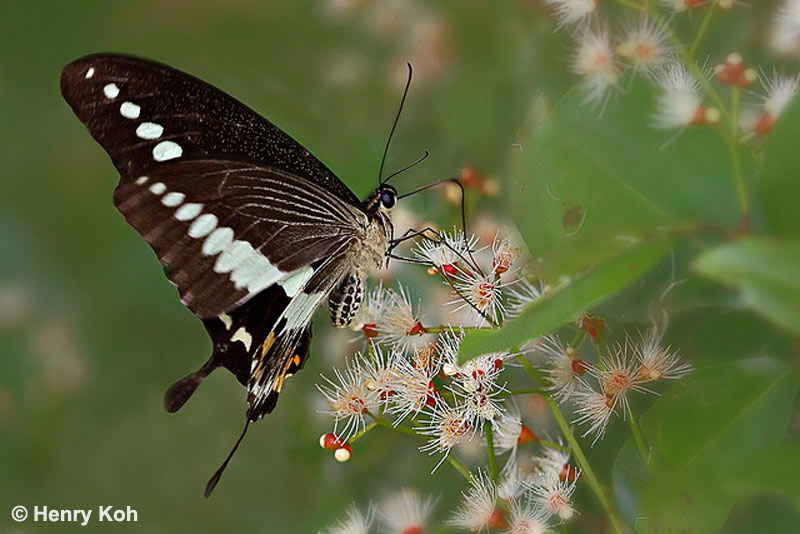
It is always a delight to see a Common Mormon or a Lime Butterfly, with its legs extended, proboscis probing into a flower to drink the nectar, and wings outstretched. However, such shots are often split-second opportunities in butterfly photography. In the field, the photographer has to get into position at a flower and anticipate the next flower that the butterfly is likely to visit, focus on the flower and get ready to re-focus as the butterfly comes into view, and let off a series of shots at the opportune moment.


Freezing the action is where digital SLRs have an advantage; particularly those with a high frame-per-second rate (referred to as fps). The high end DSLRs have a frame rate of anything between 8-12 shots per second. This helps to even the odds of trying to shoot a butterfly that is in flight, constantly moving and alighting at a flower to feed for a fraction of a second.


When tracking a feeding Swallowtail, observe which flowers it prefers to feed on. Often the butterfly tends to do a "circuit", visiting certain favourite flowers and then coming back to the same flowers for another round of nectar. Position yourself at a few preferred flowers and then focus your lens on that flower, keeping watch over the butterfly that is busily feeding nearby. When it comes into view, blast away!


A male Great Mormon feeding at the flower of the Pagoda Flower (Clerodendron sp)

A feeding Swallowtail typically spends less than a second at the flower. The accuracy with which it extends its proboscis and inserts it into the flower and sucks the nectar is quite amazing. It does this whilst balancing itself with its flapping forewings and using its legs to hold on to the flower.


A Great Helen feeds on the flower of Ixora sp.

As the forewings are flapping constantly, try to position yourself in plane with the butterfly's wings to maximise your depth of field. Hold your camera and lens steady, and refrain from any sudden movements that would scare off the feeding butterfly.


Two for the price of one! A male Lime Butterfly courting a female as she feeds on a Lantana flower

For species like the Lime Butterfly, Common and Great Mormon, where the wing flap rate is slower, a shutter speed of at least 1/500s and above would be ideal to freeze the wing movement. In situations like these, it may be necessary to use a higher ISO to ensure that the shutter speeds are maintained so that the flapping wings can be frozen (unless the photographer intentionally wants to feature motion of the wings in his shot)

The fast-flying Tailed Jay feeds at the flowers of a Syzygium tree

The faster flying species like the Tailed Jay, Common Bluebottle, Blue Jay, Banded Swallowtail and so on, often require shutter speeds of 1/800s or more and very fast reflexes on the part of the photographer to nail a good shot.

A Common Bluebottle feeding at the flower of the Bandicoot Cherry (Leea indica). Note the rapid movement of the flapping forewings

These species fly at very high speeds as they move from flower to flower. Frequently, all the frustrated photographer gets, is a fleeting glimpse of the butterfly as it zooms past at breakneck pace.


A female Common Mormon flutters and takes nectar from a Lantana flower

An ideal shot of a Swallowtail, with proboscis extended into a flower, wings frozen in space, with a clean out-of-focus background is a satisfying achievement, and one that is not easy to get. However, if one is patient and persistent, (and with a good dose of luck) it will be a most rewarding experience to photograph an in-flight Swallowtail feeding at a flower.

Now you see me, now you don't! A Tailed Jay zooms past, stops at a Lantana to feed and takes off, all within half a second.


Text by Khew SK : Photos by Sunny Chir, Henry Koh, Khew SK & Tan CP