19 March 2011

Life History of the Chocolate Pansy

Life History of the Chocolate Pansy (Junonia hedonia ida)


Butterfly Biodata:

Genus: Junonia
Hübner, 1819
Species: hedonia Linnaeus, 1764
Subspecies: ida Cramer, 1775
Wingspan of Adult Butterfly: 55-60mm
Caterpillar Local Host Plants: Ruellia repens (Acanthaceae)
, Hemigraphis reptans (Acanthaceae)


A Chocolate Pansy displaying its upperside.


A Chocolate Pansy giving us a view of its underside.

Physical Description of Adult Butterfly:
Above, the wings are orangy brown with several indistinct but darker brown bands traversing from the costa towards the dorsum. There are two cell spots on the forewing and a prominent series of reddish brown post-discal ocelli on the hindwing. A much less prominent series of post-discal ocelli is also present on the forewing. Underneath, both fore- and hindwings are in duller brown but each has a dark stripe traversing from the costa to the dorsum. The stripes appear to be continuous across the two wings. A large white spot is present next to the stripe in space 7 of the hindwing. A post-discal series of ocelli is present on both wings, and these ocelli are yellowish brown on pristine specimens.


A Chocolate Pansy visiting flowers.


An adult Chocolate Pansy taking up its position on a leaf.

Field Observations of Butterfly Behaviour:
This species is rather common across multiple habitats in Singapore, with ubiquitous presence in nature reserves as well as urban and suburban areas. It flies in the usual gliding manner of the Junonia spp. and typically several individuals can be seen together in one location. Under sunny conditions, they have a habit of opening their wings wide to sunbathe while resting on a perch.


Early Stages:
The caterpillars of the Chocolate Pansy feed mainly on leaves of the two recorded local host plants, Ruellia repens and Hemigraphis reptans. Both plants belong to the Acanthaceae family, and occur as widespread weeds in Singapore. It is likely that more members of this family serve as the larval food plants for Chocolate Pansy.


Local host plant #1: Hemigraphis reptans.


Local host plant #2: Ruellia repens.


A mating pair of the Chocolate Pansy.


A mother Chocolate Pansy laying an egg on the underside of a leaf of Hemigraphis reptans.

The eggs of the Chocolate Pansy are laid singly on the young leaves or shoots of the host plants. The greenish egg is somewhat globular in shape but with a blunt top. Twelve raised ridges run from this top end to the base of the egg. Each egg has a diameter of about 0.75mm.


Two views of an egg of the Chocolate Pansy. Diameter: 0.75mm.


Two views of a mature egg of the Chocolate Pansy.

The egg takes about 3 days to hatch. The young caterpillar emerges by eating away part of the egg shell, and then proceeds to eat the rest of the egg shell from the outside. The initial length of the newly hatched is about 1.5mm. The
cylindrical and pale yellowish body is covered with many small tubercles. Long dark setae emanate from those tubercles occurring dorso-laterally, and long whitish setae occur sub-spiracularly. The head capsule is pale yellowish with two large lateral dark patches.


Two views of a newly hatched caterpillar, length: 1.5mm.

The 1st instar caterpillar feeds on the lamina of young leaves and grows rapidly. After reaching about 3mm in 1.5 days, the caterpillar moults to the 2nd instar.


Two views of a 1st instar caterpillar, length: 2.8mm.


Two views of a 1st instar caterpillar, late in this stage, length: 3mm.

The body of the 2nd instar caterpillar is yellowish brown mainly and is darker brown on the dorsum. Moderately long and branched brownish processes run along the length of the body. Fine setae emanate from these processes and from other small tubercles on the body surface. The head capsule is yellowish to orangy brown and featuring two small dark brown lateral patches. This instar lasts about 2 days with the body length reaching about 5mm.


Two views of a 2nd instar caterpillar, newly moulted, length: 2.5mm


Two views of a 2nd instar caterpillar, late in this stage, length: 4.5mm

The 3rd instar caterpillar has proportionately longer dorso-lateral and lateral processes. The body is mostly dark brown to black, except for the posterior end which is yellowish to orangy brown. This instar takes about 2 days to complete with body length reaching about 8.5mm.


Two views of a 3rd instar caterpillar, newly moulted, length: 4.5mm.


Two views of a 3rd instar caterpillar, late in this stage, length: 8mm.


Two views of a 3rd instar caterpillar, about to moult. Inset: head capsule.

The 4th instar caterpillar closely resembles the 3rd instar caterpillar, except for the proportionately longer processes and the change to an orange base color for the head capsule. The body color is almost entirely black except for a short section of yellowish brown at the posterior end. A fair number of small white specks appear on the body surface. The 4th instar lasts 2-2.5 days with the body length reaching about 12mm.


Two views of a 4th instar caterpillar, early in this stage, length: 9mm.


Two views of a 4th instar caterpillar, late in this stage, length: 11mm.


Two views of a 4th instar caterpillar, about to moult, length: 11.5mm.

The 5th (and penultimate) instar caterpillar is similar to the 4th instar caterpillar.One discernible difference is the presence of a dense set of moderately long fine setae covering the entire body surface. This instar lasts for 2.5-3 days, and the body length increases rather dramatically and reaches up to 23.5mm.


A 5th instar caterpillar, newly moulted, length: 11mm.


Two views of a 5th instar caterpillar, early in this stage, length: 12.5mm. Inset: head capsule.


Two views of a 5th instar caterpillar, about to moult, length: 22mm.

The 6th (and final) instar caterpillar is similar to the 5th instar caterpillar but has an even denser carpet of whitish fine setae on the body surface. Upon closer examination, pitch black triangular patches, one to each body segment, can be discerned against a lighter shade of black for the body base colour. The head capsule is bright orange and has two black patches on both sides of the "face".


Two views of a 6th instar caterpillar, early in this stage, length: 23mm.


Two views of a 6th instar caterpillar, length: 36mm.

The 6th instar lasts for 4-4.5 days, and the body length reaches up to 40mm. The caterpillar ceases feeding and wanders around. Eventually it stops at a spot on the underside of a leaf, young shoot/stem and spins a silk pad from which it hangs vertically to take on the pre-pupatory pose.


A pre-pupa of the Chocolate Pansy.


The pupation event of a Chocolate Pansy caterpillar.

Pupation takes place about 0.5 days later. The pupa suspends itself from the silk pad with no supporting silk girdle. It is entirely greyish brown with a series of dorso-lateral pairs of short and pointed processes, one pair to each segment. The dorsum is sharply raised at the mesothorax. Black markings are also featured in the wing pads. Length of pupae: 18-19mm.


Three views of a pupa of the Chocolate Pansy.


Three views of a mature pupa of the Chocolate Pansy.

After about 5 days of development, the pupal skin of the mature pupa turns translucent and the pupa turns dark brown as a result. Patches of orangy brown can also be noticed in the wing pad. The adult butterfly emerges from the pupa the next day.


The eclosion event of a Chocolate Pansy caterpillar.


A newly eclosed Chocolate Pansy resting on its pupal case.

References:

  • [C&P4] The Butterflies of The Malay Peninsula, A.S. Corbet and H.M. Pendlebury, 4th Edition, Malayan Nature Society.
  • A Field Guide to the Butterflies of Singapore, Khew S.K., Ink On Paper Communications, 2010.
Text by Horace Tan, Photos by Simon Sng, Federick Ho, Sunny Chir and Horace Tan

13 March 2011

300 !!!

300 !!! - Discovery of the Yellow Streak Darter
Species #300 on the Singapore Checklist


And so, after many years, Singapore's Butterfly Checklist has passed the 300 mark once again. The early authors had recorded at least up to 361 species (Ref : Butterflies of the Malay Peninsula and Butterflies of West Malaysia and Singapore), but many have gone extinct or have not been reliabily seen in the past two decades. At the same time, many new species not recorded by the early authors have also be documented and added to the checklist.

It was a memorable outing for ButterflyCircle members on 26 Feb 2011. It was on this day that BC members re-discovered the Wanderer. Amidst the excitement of finally seeing that elusive species in Singapore, there was another less attractive butterfly that was shot by BC member Simon Sng. Coincidentally, this outing was organised by Simon and it is a well-deserved 'prize' that Simon bagged with the shot of this skipper which will be recorded as Singapore's 300th species.


Simon's shot is the first one taken of this species in Singapore

Although Simon's record shot was not of his usual standard of photography, it was sharp enough to show that this species was not anything that has been seen in Singapore before. The deep yellow undersides marked with rather distinctive markings revealed that this was a species that is new to Singapore.


A bit of artistic licence to dramatise the celebration of the 300th species in Singapore! Image copyright © Warner Bros

With this species, we have reached the 300 mark - a long way from the time when veteran Steven Neo started recording a checklist for Singapore in the early 90's. Species that Steven documented, like the Red Base Jezebel, Common Pierrot and Pointed Palmfly, to name a few, have yet to be seen again in Singapore since the days he was active in maintaining the Singapore Checklist.


Another shot of the Yellow Streak Darter taken by Simon on 26 Feb 2011

Steven and I co-wrote a paper in the Gardens' Bulletin Singapore, a refereed journal by the National Parks Board in 1997. The paper, entitled "Butterfly Biodiversity in Singapore with Particular Reference to the Central Catchment Nature Reserve" was published in Issue 49 (1997) of the Gardens Bulletin. The paper appears on pages 273-296 of the publication. Back then, armed with film SLRs and a net, we managed to record only 236 butterfly species in Singapore.

With the growth of ButterflyCircle's membership in the 2000's and especially after 2005, and over the past 5-6 years, we have added a total of 64 additional species to the Singapore Checklist. With more eyes (and sharp lenses) over the years, and hardworking members of ButterflyCircle have added a number of rare species to the Checklist. When ButterflyCircle launched its Field Guide to the Butterflies of Singapore in Oct 2010, we had reached a total of 296 species.


Coming back to our little "Spartan" species #300, - Long-time butterfly photographer, Simon knew at once that he had shot something different, though the butterfly sped off after he shot it. When Simon showed me the skipper, I was also stumped as I'd never seen this species before in my years of collecting and studying butterflies.

At BC's forums, other experts joined in and we narrowed it to a Salanoemia sp. with the closest recorded species being Salanoemia similis in Malaysia. Determined to nail down the ID of this mystery species, I went to the same location on Pulau Ubin the next day, and after about 3 hours of searching, the yellow skipper zipped right in front of me. With better shots of the skipper, we concluded that the skipper is a Yellow Streak Darter (Salanoemia tavoyana), as the distinctive markings of this individual puts the ID well beyond doubt, after cross-referencing to various books and internet resources.


What is surprising is that C&P4 states that this species is found in Kedawi (Kedah and Langkawi in the north of the Malay Peninsula) and Myanmar. How it appeared so far south of its normal geographical distribution is beyond our comprehension. We found a caterpillar near the location where this individual was shot, so we hope that we may have discovered the early stages of this species as well.

The pristine individual observed suggests that it may have eclosed recently, and is definitely not the condition that a butterfly would be in, if it had migrated to Singapore after a long flight. So will we see more of this species in future? It's anybody's guess. But in future, we will surely take a second look at any yellow skipper that flies in our paths.

So Singapore welcomes its 300th species on 26 Feb 2011. There will certainly be more to come, and we have already confirmed the existence of species #301! Watch this space!

Text by Khew SK ; Photos by Khew SK & Simon Sng
References :
  • [C&P4] The Butterflies of The Malay Peninsula, A.S. Corbet and H.M. Pendlebury, 4th Edition, Malaysian Nature Society.
  • Butterflies of West Malaysia & Singapore, W.A. Fleming, 2nd Edition, Longmans
  • Butterflies of Thailand, Pisuth Ek-Amnuay, 1st Edition, 2006

Acknowledgements :

  • Special thanks to Dr Laurence Kirton of FRIM for his comments on the ID of this species.

09 March 2011

Metallic Caerulean - Dark Days Ahead?

The Metallic Caerulean - Dark Days Ahead?


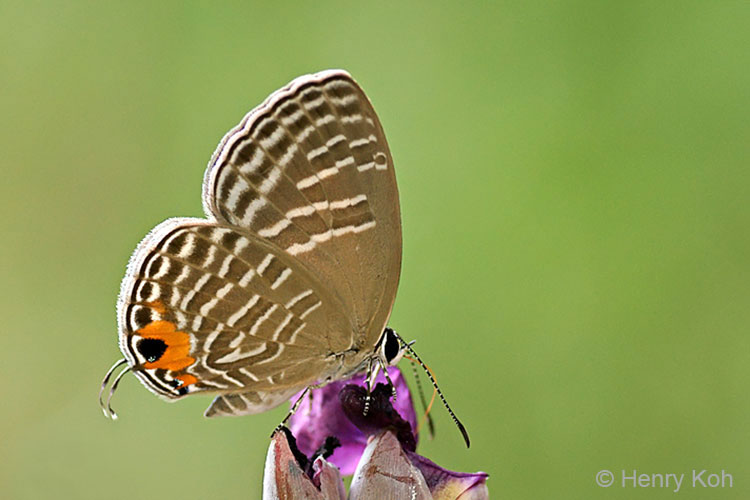
What's the future of the Metallic Caerulean in Singapore?

With the government's plans to go ahead with the Mandai Nature Cluster to complement existing nature attractions in that area, it was confirmed in Dec 2010 that the Mandai Orchid Garden as many of us know it, will be no more. The Mandai Orchid Garden, which was set up in 1951, will make way for new attractions, which are yet to be announced. So ends a 60-year tourist attraction and a favourite 'playground' of many nature photographers in Singapore.


A female Metallic Caerulean lays her eggs on the mature flower of the Torch Ginger

Mandai Orchid Garden (or MOG) is also the location where the Metallic Caerulean (Jamides alecto ageladas) can be regularly observed. Often, this little Lycaenid can be seen in numbers, fluttering around in the vicinity of their caterpillar host plant - the Torch Ginger (Nicolaia elatior), also known as Bunga Kantan. The caterpillars feed on the flowers of the Torch Ginger. The complete life history of the Metallic Caerulean has been recorded in this blog.


The caterpillar of the Metallic Caerulean feeds on the mature flowers of the Torch Ginger

The flower buds of the Torch Ginger has been described as "the soul" of many Peranakan dishes, the most famous of which is Penang (Assam) Laksa. Without this critical ingredient, the aromatic dish loses its flavour. The Torch Ginger is hence cultivated and the flower buds harvested for this culinary purpose.


There are many gardens in Singapore where the Torch Ginger is cultivated, like the Singapore Botanic Gardens' Ginger Garden. A very large clump of the plant can also be found at the Secret Garden on Pulau Ubin, but the flower buds are harvested (probably by the villagers) long before they bloom, leaving the clump usually devoid of flowers for the caterpillars of the Metallic Caerulean.


With the closing down of MOG, the Metallic Caerulean's favourite haunt may soon be gone. It is not known what the plans for the site where they are regularly seen are, but it is likely that the Water Garden of MOG may be cleared as it is being redeveloped with the new proposals.


ButterflyCircle engaged a couple of organisations with the hope of translocating the species to a habitat where there is a large clump of Torch Ginger and where the habitat is conducive for the Metallic Caerulean to thrive.


The Singapore Zoo responded to the call with much enthusiasm. After a visit to the location with Wildlife Reserves' CEO, Ms Fanny Lai and her staff to survey the MOG site where the Metallic Caerulean were often seen, the Zoo staff swung into action the following week, starting with a phased transplanting of the Torch Ginger to a new location in the Zoo.


Given the proximity of the Zoo to MOG, and the creation of a habitat that is hopefully attractive to the Metallic Caerulean, the first batch of the Torch Ginger plants from MOG was transplanted to a patch opposite the Fragile Forest. Some mature flowers were already amongst the plants that were transplanted, and hopefully these contain the next generation of the butterflies.


The Torch Ginger plants are transplanted to their new home at the Singapore Zoo

As the MOG site still has a bit of time before being cleared for the new development, the transplanting and translocation of the Metallic Caerulean will be carried out in phases. This is to allow the butterflies to adapt to the new location, whilst their original "home" can still continue to allow the butterflies to breed as they have done over the years. Full transplanting of all the Torch Gingers to the Zoo will take place when the plans for MOG are fully made known.


Whilst it is a pity that the MOG will be gone, and that the Metallic Caerulean is threatened, there is still a glimmer of hope that this translocation exercise will be successful and the butterfly species will continue to thrive in their new home at the Zoo.


ButterflyCircle would like to express its thanks to the Singapore Zoo's staff, and in particular their CEO, Ms Fanny Lai, for supporting this effort to conserve Singapore's butterfly biodiversity. Whilst there is no guarantee that the species can be conserved successfully, this is an important collaborative effort made by organisations like the Singapore Zoo to promote the conservation of Singapore's natural heritage.


We hope that the Metallic Caerulean will continue to survive in Singapore for the years to come.

Text by Khew SK ; Photos by Khew SK, Henry Koh, Horace Tan, Anthony Wong, Mark Wong, and the Singapore Zoo.

Article on the Torch Ginger Transplant courtesy of the Singapore Zoo, taken from its online magazine "Wildlife Times"