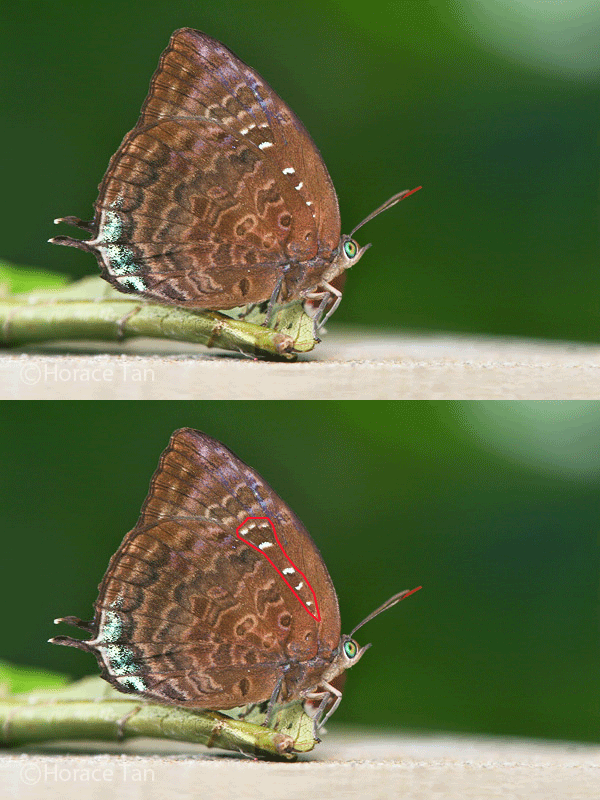
05 February 2011

Life History of the Harlequin

Life History of the Harlequin (Taxila haquinus haquinus)


Butterfly Biodata:
Genus: Taxila Doubleday, 1847
Species: haquinus Fabricius 1793
Subspecies:
haquinus Fabricius 1793
Wingspan of Adult Butterfly: 45mm
Caterpillar Local Host Plants:
Ardisia elliptica (Myrsinaceae).


A female Harlequin on a leaf perch.


Uppersides of a male Harlequin (left) and a female Harlequin (right).

Physical Description of Adult Butterfly:
Above, the male is dark brown except for the sub-apical portion of the forewing which is pale reddish brown; the female is reddish brown, marked with a fair number of black spots and has a sub-apical white band not crossed by dark veins. Underneath, for both sexes, the underside is reddish brown, and marked by a number of silvery-white spots and white-edged black spots. The female has a broader and more prominent white sub-apical patch on the forewing.


Field Observations of Butterfly Behaviour:
The shade-lovng adults are typically found in forested areas in the vicinity of its host plants. They are often seen perching on upper surface of leaves with half-open wings, turning and hopping from one perch to the next. So far, this species was sighted at only one habitat on the main island of Singapore where the unique environment allows the species to thrive. However, the impending re-development of that area threatens to wipe out that colony (More on the effort to save this species can be found in earlier blog articles here and here).


Early Stages:
The host plant, Ardisia elliptica, is a large shrub or small tree. The leaves are simple, alternate, grandulate, obovate and leathery, 8-12 cm long and have nearly invisible nerves. In the wild, the plant grows in tidal swamps and muddy river banks. The immature stages of the Harlequin feed on the relatively young leaves of the host plant, typically on the underside. The first instar caterpillars graze on the leaf surface, and the later instars nibble along the leaf edges. Between feeds, the caterpillars of all instars rests on the leaf underside.


Host plant : Ardisia elliptica

In the wild, the female lays its eggs singly on the surface, usually on the underside, of a leaf of the host plant. However, in an indoor breeding environment, the females have been observed to lay multiple eggs within close proximity of each other. Each egg is pale translucent yellow, somewhat conical in shape with a base diameter of about 0.7mm. The surface is smooth and has a mid-level inconspicuous belt of fine hairs encircling the egg.


Two views of an egg of the Harlequin. Diameter: 0.7mm.


Two views of a mature egg of the Harlequin. Both the mandible and setae are visible through the egg shell.


A newly hatched caterpillar of the Harlequin, length: 2mm.

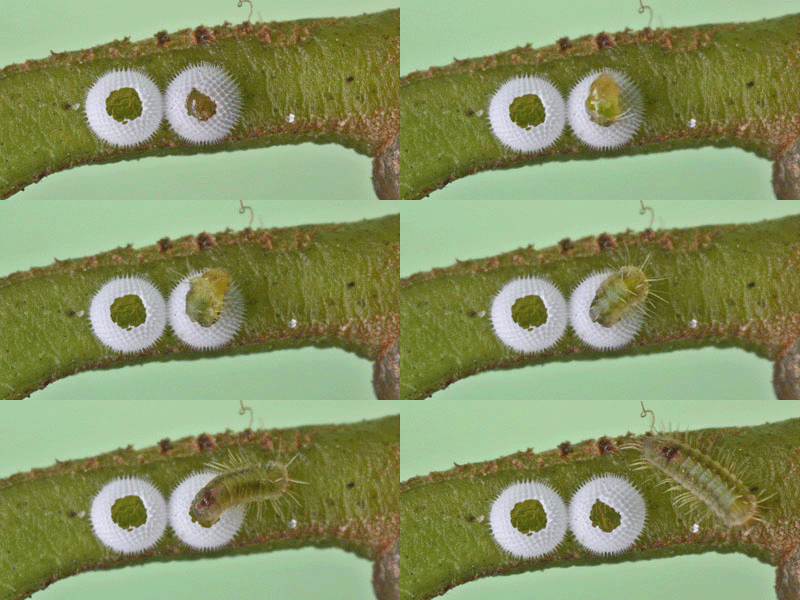
It takes about 3.5-4 days for the egg to hatch. The young caterpillar consumes part of the egg shell to emerge. With a length of about 1.9-2.0mm, it has a pale greenish and cylindrical body with long setae dorso-laterally and sub-spiracularly. The body color changes to a brighter shade of yellow with a green undertone as it feeds and grows. Conical tubercles, one pair to each body segment, become prominently featured laterally. Each tubercle is furnished with a tuff of setae.


A 1st instar caterpillar showing us the result of its grazing work, length: 2.9mm

The first instar lasts for 3.5-4 days and the body length reaches about 3mm. Prior to the moult to 2nd instar, the body shortens and takes on a pumped up appearance. This shortening routine also occurs prior to each of the subsequent moults.


A late first instar caterpillar, in dormant mode prior to its moult, length: 2.9mm.


A newly moulted 2nd instar caterpillar with the excuvia (shed larval skin) lying nearby.

The body color of the 2nd instar caterpillar is yellow with a greenish undertone. Small reddish patches are seen on the some of the lateral conical tubercles. Overall, the hairy appearance is little changed from the 1st instar. This instar lasts for 3-3.5 days and the caterpillar grows to a length of about 5-5.5mm before the moult to the 3rd instar.


Two views of a second instar caterpillar, early in this stage, length: 2.8mm.


Two views of a 2nd instar caterpillar, length: 4mm.


Two views of a late 2nd instar caterpillar, in dormant mode prior to its moult, length: 4.8mm.

The 3rd instar caterpillar is yellowish green with a much greater emphasis in green. Reddish patches are more prominently featured on the conical tubercles. After 3-3.5 days in this stage with the body length reaching a maximum lenght of about 7.5mm, the caterpillar moults to the penultimate instar.


Two views of a 3rd instar caterpillar, early in this stage, length: 4.5mm.


Two views of a 3rd instar caterpillar, length: 7.5mm


Two views of a 3rd instar caterpillar, in dormant mode prior to its moult, length: 7mm

The 4th instar caterpillar has a reddish patch surrounding each spiracle which is whitish in coloration. The distal end of each conical tubercle is also colored in red. Whitish dashes also appear dorsally and dorso-laterally. resembles the 3rd instar caterpillar but with a much denser set of sub-spiracular setae. The body is mainly green in ground color. Overall, the caterpillar has a more striking appearance than in the previous instar. This instar lasts for 4-4.5 days and the body grows up to a length of about 14mm.


Two views of a a 4th instar caterpillar, early in this stage, length: 9,5mm.


Two views of a 4th instar caterpillar, length: 10.5mm


Two views of a 4th instar caterpillar, late in this stage, length: 12.5mm

The 5th instar caterpillar closely resembles the 4th instar caterpillar except for the appearance of a black spot on the dorsum of each segment from the metathorax to the 7th abdominal segment. All the body setae are dark in coloration except for those occurring sub-spiracularly which are in a contrasting whitish coloration. The body ground color could vary from pale green to pale brown in different individuals.


Two views of a 5th instar caterpillar, length: 19mm


Two views of a 5th instar caterpillar, length: 23mm


The head capsule of a 5th instar caterpillar.

The 5th instar lasts for 5-5.5 days and the body grows up to a length of about 29mm. On the last day of this instar, the caterpillar ceases food intake and its body shrinks in length and decolorises. It then finds a spot on the leaf surface where it spins a silk pad and a silk girdle to secure itself for the upcoming pupation event.


Two views of the pre-pupa of the Harlequin.

After 1-1.5 day of the pre-pupal phase, pupation takes place. The green pupa has a elongated diamond-shaped outline, being broader at mid-body and pointed at the front and rear ends. The body has pale pinkish patches dorso-laterally and laterally, with a number of dark spots, symmetrically spaced on each body segment. Laterally, there are some hairs running along the fringe of the body. Each pupa is 20-22mm in length.


Two views of a pupa of the Harlequin.

6-6.5 days later, the pupa becomes darkened in color signaling the imminent emergence of the adult. The next day the adult butterfly emerges from the mature pupa.


Two views of a mature pupa of a male Harlequin, minutes prior to the eclosion event.


A newly eclosed male Harlequin.

References:

  • [C&P4] The Butterflies of The Malay Peninsula, A.S. Corbet and H.M. Pendlebury, 4th Edition, Malayan Nature Society.
  • Butterflies of Thailand, Pisuth Ek-Amnuay, 1st Edition, 2006
Text by Horace Tan, Photos by Chng C K, Loke P F, Sunny Chir and Horace Tan

29 January 2011

Butterfly of the Month - January 2011

Butterfly of the Month - January 2011
The Harlequin (Taxila haquinus haquinus)


Time passes quickly again, and the first month of 2011 is almost over. The temperate countries around the world experienced one of their worst winters in recent years, and the local climate in Singapore swings from hot, humid days to thunderstorms and miserable rainy days. Australia also experienced one of the worst floods that many people can recall. A sign of things to come with climate change and global warming? Warning signals to take note of...


The Singapore economy bounced back from the global financial crisis, and recorded an amazing 14.7% GDP growth for 2010. With the prices of housing reaching unprecedented heights and the economy heating up, the unsustainable growth is probably headed for some contraction this year. But any growth is better than none, and the economies in Asia are definitely in a better shape than those in the west.


The month of January is known for its association with the gemstone garnet. The name garnet probably came from the Middle English word gernet meaning 'dark red'. The gemstone, usually associated with its deep red colour (but the gem also comes in other colours), is the birthstone for the month of January.


"By her who in January was born
No gem save garnets shall be worn
They will ensure her constancy
True friendship and fidelity."
- Gregorian Birthstone poems


And so this month, we feature a reddish brown butterfly, the Harlequin. Belonging to the family Riodinidae, the Harlequin was first re-discovered on the military training island of Pulau Tekong in the late 1990's, but another colony of them was found in the north-western part of Singapore in a patch of forested area.


The butterfly is usually shade-loving, hopping from leaf to leaf under the heavy canopy of large trees, twisting and turning as it flits from leaf to leaf. It appears to feed on some unknown substances on moss-covered leaves. Both sexes often stop with half-open wings on the upper surfaces of leaves, and at times remain still for long periods of time unless disturbed.


The male Harlequin is brownish black above with an obscure pale reddish brown subapical patch on the forewing. A unique feature of this family of butterflies is that the males have four fully-developed legs for walking, whilst the females have all three pairs of legs fully functional.


The female is generally similarly marked like the female of the Lesser Harlequin but the whitish subapical patch on the forewing is not crossed by dark dusted veins. The upperside is patterned and coloured as on the underside, unlike the male. In both sexes, the underside is reddish brown, with outwardly pale greyish-blue edged black spots.


The upperside of the female Harlequin (top shot) and hte male Harlequin (bottom shot)

The unfortunate thing about the location for this moderately rare species, is that the site where they are usually found in numbers, is slated for the redevelopment of a CleanTech Park. Ironical, that the site stands as an example of a "green and sustainable" development masterplan, but may effectively wipe out this species from Singapore, if this is the last known colony of the Harlequin on the main island.


However, as pragmatic Singaporeans always take such interventions into Mother Nature's creations in their stride, there is little that can be done to stop the engines of progress, but to make all attempts to translocate the Harlequin to other hopefully similar habitats where it can thrive.


Several translocation attempts have proven futile or with very dubious success and this is probably the Harlequin's last stand as the site where they are always found, is right in the path of a road widening project to serve the CleanTech Park. A final attempt at translocation will probably be attempted before the site becomes a pristine tarmac-ed lane for the future road.


Will this be one of the last few times that this pretty "Metalmark" be seen in Singapore? Will all these photographs by ButterflyCircle members be all that remain for future generations of nature enthusiasts and butterfly lovers to see? We certainly hope not.


Text by Khew SK ; Photos by Sunny Chir, Chng CK, Federick Ho, Khew SK, Koh CH, Loke PF, Anthony Wong & Benjamin Yam

Further Reading :

22 January 2011

Life History of the Centaur Oakblue

Life History of the Centaur Oakblue (Arhopala centaurus nakula)


Butterfly Biodata:

Genus: Arhopala Biosduval, 1832
Species: centaurus Fabricius, 1775
Subspecies: nakula C & R Felder, 1860
Wingspan of Adult Butterfly: 48mm
Caterpillar Host Plants:
Terminalia catappa (Combretaceae, Common name: Sea Almond), Syzygium grande (Myrtaceae); Syzygium aqueum (Myrtaceae); Macrosolen cochinchinensis (Loranthaceae), Hopea odorata (Dipterocarpaceae).


A Centaur Oakblue on a leaf perch


Another Centaur Oakblue on a leaf perch

Physical Description of Adult Butterfly:
This species is one of the largest within the Arhopala genus. Both sexes have more pointed forewing apex than usual. Hindwing cell is short, being less than half the wing length. A stout white-tipped tail is present at the end of vein 2 on the hindwing. Above, the male is purplish blue with a very narrow, thread-like dark border on the forewing while the female is paler purplish blue with broader black borders. Underneath, both sexes are brown with markings in darker brown and outlined with lines in paler brown. A purplish sheen can be observed on fresh specimens. A feature which immediately distinguishes this species from other Arhopala spp. locally is the presence of green silvery lines outlining spots in the forewing cell (refer to the area highlighted by a flashing red border in the picture below). The post-discal band on the forewing is continuous and a spot is present in space 10.


Another Centaur Oakblue to take off from a cement surface of a park bench.


A Centaur Oakblue perching on a branch.

Field Observations of Butterfly Behaviour:
This species is not uncommon in Singapore. Adults have been sighted in multiple habitats both in and out of the nature reserves, at places such as neighborhood gardens, hill parks, mangrove areas and off-shore islands. Usually they are sighted perching on leaves in the vicinity of their host plants, but the adults have also been observed to visit flowers (see the blog article at this link for related information on this behavior).


A Centaur Oakblue taking nectar from a palm inflorescence.


A close-up view of the eye of a Centaur Oakblue.

Early Stages:
The Centaur Oakblue is polyphagous as its early stages feed on a number of host plants from different families, including one parasitic plant,
Macrosolen cochinchinensis. The caterpillars feed on the young to middle-aged leaves of the hosts, and typically build shallow shelters on the leaf. Between feeds, and when threatened, the caterpillars retreat to these shelters. The caterpillars also have a symbiotic relationship with ants, in particular the 'Weaver Ant' or Kerengga (Oecophylla smaragdina).

Host plant: Sea Almond. Leaves and fruits are featured here.

Host plant : Macroseolen cochinchinensis

The eggs are laid singly and sometimes in small groups on young shoots of the host plant. Each egg is about 1.0-1.1mm in diameter, white in color with a greenish tinge when freshly laid. It is circular with a depressed micropylar at the pole, a finely reticulated pattern of intersecting ridges on the surface, and pointed spines at intersections of these ridges.

Two views of an egg of the Centaur Oakblue
It takes 2.5-3 days for the egg to hatch. The newly hatched has a length of about 1.8-1.9mm and has a yellowish green coloration. It has a rather flattened woodlouse appearance with a large semicircular pro-thorax and a pale orangy head. This appearance remains in later instars.
The body also carries long dorso-lateral and lateral setae (hair). A dark reddish marking can be seen on the dorsum of the 7th abdominal segment. As it grows, the body color becomes more yellowish and a dorsal band reddish in color appears on the last few abdominal segments.
A time-lapse sequence of the hatching event of a Centaur Oakblue caterpillar.

1st instar caterpillar, newly hatched, length: 1.9mm

1st instar caterpillars, length: 2.3m (top), 3mm (bottom).

After 1.5-2 days of growth in the first instar, and reaching a length of about 3mm, the caterpillar moults to the next instar. The 2nd instar caterpillar has long fine lateral setae and numerous very short and fine hairs all over the body surface. It is mostly yellowish green except for the reddish band on the dorsum on the last half of the abdominal segments. Even at this early stage, the dorsal nectary organ and tentacular organs are discernible on the 7th and 8th abdominal segments respectively.

2nd instar caterpillar, length: 3.3mm (top), 4.5mm (bottom).
Top: 2nd instar caterpillar, late in this stage, prior to its moult.
Bottom: 3rd instar caterpillar, newly moulted, length: 5mm


The 2nd instar caterpillar reaches a length of about 5.5mm, and after about 2 days in this stage, it moults again. The 3rd instar caterpillar is prominently marked with a rather broad dorsal band, reddish brown at the posterior segments but becoming more greenish and diffused as it extends and tapering toward the prothorax. From the 2nd thoracic segment to the 6th abdominal segment, the dorsal band is highlighted by a series of convex and dark line segments. The 3rd instar takes about 2-2.5 days to complete with the body length reaching about 9.5mm.

Two views of a 3rd instar caterpillar, length: 7.5mm
Top: a late 3rd instar caterpillar moments before its moult, length:9mm
Bottom: the same caterpillar soon after its moult to the 4 instar, length: 10mm.


The 4th instar ushers in further "enhancements" to the dorsal band. Now the band is made more prominent by narrow white areas appearing on the inner side of the dark outlines. From the 1st to the 6th abdominal segment, these convex dark lines also have a large lateral brown patch on each side. The patches become larger as the caterpillars grows in this instar. The dorsal band on the 6th abdominal segment is much narrower, allowing for a greater extent of body base colour between the band and the dark outlines. The dorsal nectary organ on the 7th abdominal segment is clearly marked and is flanked by narrow protruding brown markings. On the prothorax, a U-shaped brown marking nearly encircles the tapering end of the dorsal band. The spiracles are dark brown in color, standing out against the yellowish green base color of the body. Towards the end of this instar, the spiracles become encircled in orangy brown rings.The 4th instar takes about 2.5-3 days to complete with the body length reaching 20mm.

Two views of a 4th instar caterpillar, length: 13.5mm
Two views of a 4th instar caterpillar, length: 16.5mm


Two 4th instar caterpillars being attended by weaver ants in the field.

The 5th instar caterpillar has similar but more striking markings. Visible changes are 1) dark patches appear within the dark outlines of the dorsal band, thus leading to the appearance of an inner dorsal band; 2) each tentacular organ is highlighted in a black ring which is also connected to the main dorsal band; 3) lateral dark patches reaches all the way to the spiracles and nearly fill up the space between spiracles.
Two views of a 5th instar caterpillar, early in this stage, length:: 20.5mm


Close-up view of the body markings near the spiracles.


Close-up views of the posterior end of a 5th instar caterpillar, showing the location of the dorsal nectary organ (DNO) and tentacular organs (TO).After 5-6 days of feeding and reaching a length of about 31-32mm, the caterpillar slows down and actually stops food intake for about 1 day. During this time, its body length gradually shortened. Soon it becomes an immobile pre-pupa in its shallow leaf shelter.


Weaver ants attending to a 5th instar caterpillar.


Two views of 5th instar caterpillar, late in this stage, length: 30mm. Note the large droplet of nectary fluid exuded by the dorsal nectary organ.

The pre-pupa caterpillar prepares for pupation by spinning a silk girdle and a silk pad to which it attaches itself via cremastral hooks. After 1 day as a pre-pupa, pupation takes place. The predominantly brown pupa, with a length of 19-20mm, has a shape typical of any Lycaenid species, but with a somewhat produced anal segment.

Two views of a pre-pupa of the Centaur Oakblue lying (immobile) within its pupation shelter.


Two views of a pupa of the Centaur Oakblue.Even at the pupal stage, at least for the initial few days of this stage, a little slit on the dorsum of the 7th abdominal segment has been found to exude fluid droplets. This is likely the remnant or continuation of the dorsal nectary organ of the larval stage. It is no surprise that ants have been seen actively attending to the pupa during field observations. Thus the symbiotic relationship between the two species continues into the larval stage of the Centaur Oakblue.


A pupa of the Centaur Oakblue being attended by weaver ants.
Close-up views of the posterior end of a pupa, showing the remnant of the dorsal nectary organ still exuding fluid.

Nine to ten days later, the pupa turns rather dark, first in the wing pad and thorax, then progressively in the abdomen. The extent of the blue patches in the wing pads gives an early indication of the gender of the soon-to-emerge adult. The next day, the pupal stage comes to an end with the emergence of the adult butterfly.


Two views of a mature pupa of the Centaur Oakblue.


A newly eclosed Centaur Oakblue.

References:

  • The Butterflies of The Malay Peninsula, A.S. Corbet and H.M. Pendlebury, 4th Edition, The Malayan Nature Society.
  • Butterflies of Thailand, Pisuth Ek-Amnuay, 1st Edition, 2006

Text by Horace Tan, Photos by Anthony Wong, Federick Ho, Ben Jin Tan, Khew SK and Horace Tan