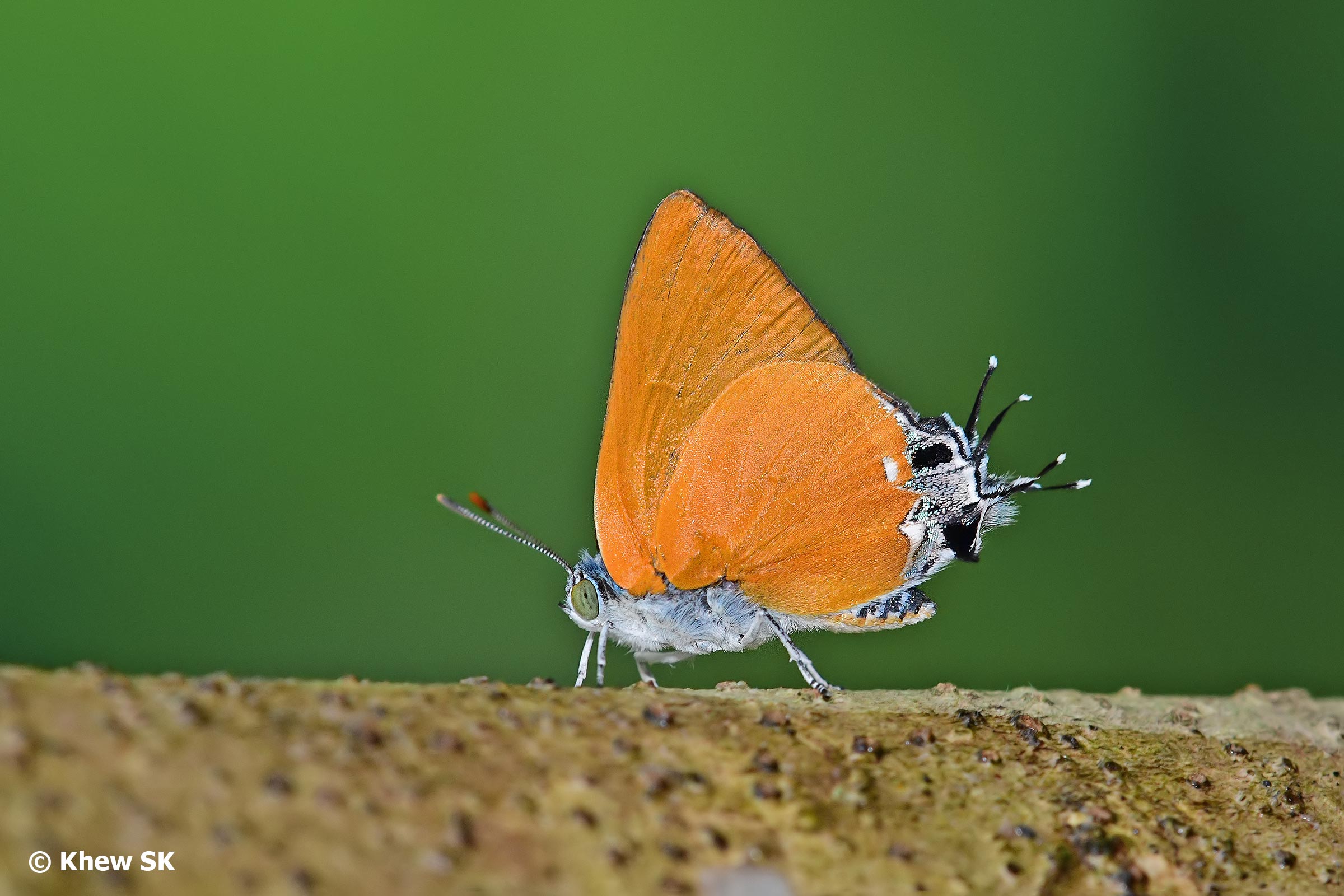
Butterfly Biodata:
Genus: Tajuria Moore, 1881
Species: deudorix Hewitson, 1869
Subspecies: ingeni Corbet, 1948
Wingspan of Adult Butterfly: 28-34mm
Caterpillar Local Host Plants: Dendropthoe pentandra (Loranthaceae, common name: Malayan Mistletoe), Scurrula ferruginea (Loranthaceae, common name: Rusty-leafed Mistletoe).


Physical Description of Adult Butterfly:
On the upperside, the male is shining blue with black distal borders on both forewing and hindwing; the female is pale purplish blue with black borders. On the forewing, the black border in the female is narrower, reaching near cell apex. The forewing dorsal area is whitened. On the underside, both sexes are dark yellowish brown with a postdiscal series of dark brown striae on both wings. The post-discal line is closer to the termen than to the cell end. In the hindwing, black tornal spots are present in spaces 1a and 2. Adjacent to these spots, prominent orange patches extend towards the postdiscal line, and upwards into spaces 3 and 4. Each hindwing has a pair of white-tipped black tails at end of veins 1b and 2.
 Upperside view of a male Flash Royal.
 Underside view of a male Flash Royal.
 Upperside view of a female Flash Royal.
 Underside view of a female Flash Royal.
 A rear-end view of a Flash Royal, showing the orange-crowned block spot in the tornal lobes.
Field Observations:
The Flash Royal was recorded as extant in Singapore by early researchers and its life history was documented during WWII in Singapore by F.C, van Ingen while he was a prisoner of war. Due to its close resemblance to the much commoner Felder's Royal (Tajuria mantra), its sightings in the past few decades in Singapore had largely been overlooked or wrongly identified. A recent review of local photographic records of Felder's Royal by Dr Seow Tek Lin revealed that several of them are actually Flash Royal, thus allowing us to confirm the existence status of this species. It is noteworthy that sightings of the Flash Royal in the past three decades have all been confined to the Southern Ridges.
 An archived picture of the Flash Royal taken in 2006 but misidentified as Felder's Royal then.
On the upperside, there are two main differences between the Flash Royal and the Felder's Royal. 1. The male Felder's Royal is greenish blue and the female is greyish blue, whereas both sexes of the Flash Royal are purer blue; 2. The dorsal area of the forewing is whitened in the Flash Royal, but not whitened in the Felder's Royal. On the underside, the differences are more subtle and mainly occur in the hindwing. 1. the parts of the postdiscal line in spaces 2 and 3 are straighter in the Flash Royal, but more curved in lower portion in the Felder's Royal; 2. the part of the postdiscal line in space 1b resembling a chevron is more rounded in the Flash Royal, but more pointed in the Felder's Royal. 3. The marginal patch in space 1b is bluish green dotted with black in the Felder's Royal, but whitish dotted with black in the Flash Royal.
 Comparison of hindwing underside features between females of Tajuria deudorix and Tajuria mantra.
 Comparison of hindwing underside features between males of Tajuria deudorix and Tajuria mantra.
Early Stages:
In Singapore, thus far two larval host plants have been confirmed, namely, the Malayan Mistletoe (Dendropthoe pentandra) and the Rusty-leafed Mistletoe (Scurrula ferruginea). On the larval host plant, the early stages of the Flash Royal feed on the leaves and flower buds. In all but the final instar, the caterpillar has the habit of grazing on the leaf surface, creating long grooves in the process.
 Local host plant #1: Dendropthoe pentandra (Malayan
Mistletoe).
Local host plant #1: Dendropthoe pentandra (Malayan
Mistletoe).
 Local host plant #2: Scurrula ferruginea (Rusty-leafed Mistletoe)
Eggs are laid singly on the stem or leaf of the host plant. Each egg is about 1mm in diameter and about 0.5mm in height. It is white with a slight greenish tinge when freshly laid. The bun-shaped egg has a depressed micropylar at the pole and a surface reticulated with polygonal depressions.
 A Flash Royal laying an egg on a stem of the Malayan Mistletoe.
 Two views of an egg of the Flash Royal.
 A sequence of views from left to right, showing the egg shell being eaten away to allow for the emergence of the caterpillar. The rightmost view shows the empty egg shell.
It takes about 4.5-5 days for the egg to hatch. The young caterpillar consumes just enough of the egg shell to emerge. The remnant of the egg shell is left alone after the caterpillar emerges from it. The newly hatched is pale pinkish brown with reddish lateral bands and posterior patches, and has a length of about 1.6mm. Long setae (hairs) run along the length of the body dorsally as well as sub-spiracularly. Raised dorsal tubercles are transparent. The body also features a diamond-shaped pale brown prothoracic shield and a pale brown anal plate. As it grows in this instar, the body ground colour turns yellowish brown, and a dorsal reddish band gains prominence gradually. The 1st instar lasts about 5 days with the body length increased to about 3.6mm.
 A newly hatched caterpillar next to its empty egg shell.
 Two views of a newly hatched caterpillar, length: 1.6mm.
 Two views of a L1 caterpillar, length: 3.1mm.
 A 1st instar caterpillar with its grazing trail on the leaf surface.
 A late 1st instar caterpillar of the Flash Royal, dormant prior to the moult to the next instar.
In the 2nd instar caterpillar, long dorsal setae seen in the 1st instar are now absent. The body is pale yellowish brown and adorned with a prominent dorsal red band stretching from the mesothorax to the 7th abdominal segment. The reddish band forks into two from the mesothorax to the prothorax. At the posterior end, the reddish band broadens from the 7th abdominal segment into a reddish patch covering the carapace feature over the fused 8th-10th segments. The prothoracic shield is brown in colour and the dorsal nectary organ on the 7th abdominal segment is now distinguishable. Small and irregular-shaped reddish patches are scattered throughout the body surface. As it feeds and grows in this instar, the body takes on a greenish undertone. The 2nd instar lasts for about 5 days, with the body length reaching up to 6mm.
 A newly moulted 2nd instar caterpillar of the Flash Royal, eating its
old skin (exuvia).
A newly moulted 2nd instar caterpillar of the Flash Royal, eating its
old skin (exuvia).
 Two views of a 2nd instar caterpillar of the Flash Royal, early in this instar, length: 2.5mm.
 A 2nd instar caterpillar of the Flash Royal feeding on flower buds of the Malayan Mistletoe.
 Two views of 2nd instar caterpillar of the Flash Royal, late in this instar, length:4.6mm.
 Two views of a 2nd instar caterpillar, dormant prior to its moult.
Initially, the 3rd instar caterpillar resemble the 2nd instar mostly, but with a greenish body and narrower reddish dorsal band, and up to only six sub-spiracular reddish patches. Some individual will still have some degree of forking of the reddish band on the mesothorax, but the forked arms will gradually disappear as it grows in this instar. On the other hand, a reddish band branches around the prothoracic shield and stretch to the anterior end of the prothorax. The dorsal nectary organ on the 7th abdominal segment and the tentacular organs on the 8th abdominal segment are now easily discernible. The body reaches up to 12-13mm in the 3rd instar. After about 5 days in the 3rd instar, the moult to the 4th instar takes place.
 Two views of a newly moulted 3rd instar caterpillar feeding on its exuvia.
 Two views of a 3rd instar caterpillar feeding on flower buds of the Malayan Mistletoe.
 A 3rd instar caterpillar feeding on a leaf of the Rusty-leafed Mistletoe.
 A late 3rd instar caterpillar, dormant prior to the next moult, length: 12.5mm.
The 4th instar caterpillar resembles the 3rd instar caterpillar closely but with much narrower and discontinuous reddish dorsal band. In general there are still six reddish sub-spiracular patches, but some of these could be missing in some individuals. In this instar, the caterpillar switches to the habit of eating along the leaf edge and rarely grazes on the leaf surface. The 4th (and final) instar lasts about 6-7 days with the body length reaching up to 20-22mm.
 Two views of a newly moulted 4th instar caterpillar, eating its exuvia.
 Two views of a 4th instar caterpillar of the Flash Royal feeding along the leaf edge of the Malayan Mistletoe.
 Two views of a 4th instar caterpillar on a leaf of the Malayan Mistletoe, length: 19mm.
As the 4th instar comes to an end, the anterior segments to the 4th abdominal segment, and the posterior segments starting the 7th abdominal segments gradually turn pale yellowish brown while the portion in between remains greenish. Soon after, the caterpillar ceases its feeding activity and its body gradually shrinks in length. The pre-pupatory caterpillar wanders around for a suitable pupation site. Typically it settles for a spot on the leaf surface of the host plant. At the chosen pupation site, it stays dormant for about 0.5 day or so before spinning a silk pad to which it attaches itself via claspers at the posterior end.
 Two views of a late 4th instar caterpillar of the Flash Royal, with an ant in attendance at its dorsal nectary organ.
 Two views of a late 4th instar caterpillar on Rusty-leafed Mistletoe, still feeding.
 Two views of another late 4th instar caterpillar of the Flash Royal. Feeding has ceased.
 Two views of a pre-pupa of the Flash Royal on the upperside of a leaf of the host plant.
About one day after the pre-pupatory caterpillar secures itself to the pupation site, pupation takes place. The pupa is held firmly via a broad cremastral attachment to the silk pad. It is 13.8 to 14mm in length, with the typical shape for a lycaenid pupa. It is mostly greenish in the thorax, wing pads and the lower part of the abdomen, reddish brown in the mesothorax and metathorax, and the dorsum of the abdomen in the middle and the posterior segment. Two short and yellowish cephalic horns are also present.
Video: A Flash Royal caterpillar turns into a pupa.
 Two views of a pupa of the Flash Royal, length: 13.8mm.
 Fully developed pupa. Top: male; bottom: female. Here the difference in the bluish patch in the wing pad is evident.
Eight days later, the pupa becomes darkened in color signaling the imminent emergence of the adult. The next day the adult butterfly emerges from the mature pupa (pupal period:9 days).
On the upperside, the male is shining blue with black distal borders on both forewing and hindwing; the female is pale purplish blue with black borders. On the forewing, the black border in the female is narrower, reaching near cell apex. The forewing dorsal area is whitened. On the underside, both sexes are dark yellowish brown with a postdiscal series of dark brown striae on both wings. The post-discal line is closer to the termen than to the cell end. In the hindwing, black tornal spots are present in spaces 1a and 2. Adjacent to these spots, prominent orange patches extend towards the postdiscal line, and upwards into spaces 3 and 4. Each hindwing has a pair of white-tipped black tails at end of veins 1b and 2.


Field Observations:
The Flash Royal was recorded as extant in Singapore by early researchers and its life history was documented during WWII in Singapore by F.C, van Ingen while he was a prisoner of war. Due to its close resemblance to the much commoner Felder's Royal (Tajuria mantra), its sightings in the past few decades in Singapore had largely been overlooked or wrongly identified. A recent review of local photographic records of Felder's Royal by Dr Seow Tek Lin revealed that several of them are actually Flash Royal, thus allowing us to confirm the existence status of this species. It is noteworthy that sightings of the Flash Royal in the past three decades have all been confined to the Southern Ridges.

On the upperside, there are two main differences between the Flash Royal and the Felder's Royal. 1. The male Felder's Royal is greenish blue and the female is greyish blue, whereas both sexes of the Flash Royal are purer blue; 2. The dorsal area of the forewing is whitened in the Flash Royal, but not whitened in the Felder's Royal. On the underside, the differences are more subtle and mainly occur in the hindwing. 1. the parts of the postdiscal line in spaces 2 and 3 are straighter in the Flash Royal, but more curved in lower portion in the Felder's Royal; 2. the part of the postdiscal line in space 1b resembling a chevron is more rounded in the Flash Royal, but more pointed in the Felder's Royal. 3. The marginal patch in space 1b is bluish green dotted with black in the Felder's Royal, but whitish dotted with black in the Flash Royal.


Early Stages:
In Singapore, thus far two larval host plants have been confirmed, namely, the Malayan Mistletoe (Dendropthoe pentandra) and the Rusty-leafed Mistletoe (Scurrula ferruginea). On the larval host plant, the early stages of the Flash Royal feed on the leaves and flower buds. In all but the final instar, the caterpillar has the habit of grazing on the leaf surface, creating long grooves in the process.


Eggs are laid singly on the stem or leaf of the host plant. Each egg is about 1mm in diameter and about 0.5mm in height. It is white with a slight greenish tinge when freshly laid. The bun-shaped egg has a depressed micropylar at the pole and a surface reticulated with polygonal depressions.


It takes about 4.5-5 days for the egg to hatch. The young caterpillar consumes just enough of the egg shell to emerge. The remnant of the egg shell is left alone after the caterpillar emerges from it. The newly hatched is pale pinkish brown with reddish lateral bands and posterior patches, and has a length of about 1.6mm. Long setae (hairs) run along the length of the body dorsally as well as sub-spiracularly. Raised dorsal tubercles are transparent. The body also features a diamond-shaped pale brown prothoracic shield and a pale brown anal plate. As it grows in this instar, the body ground colour turns yellowish brown, and a dorsal reddish band gains prominence gradually. The 1st instar lasts about 5 days with the body length increased to about 3.6mm.


In the 2nd instar caterpillar, long dorsal setae seen in the 1st instar are now absent. The body is pale yellowish brown and adorned with a prominent dorsal red band stretching from the mesothorax to the 7th abdominal segment. The reddish band forks into two from the mesothorax to the prothorax. At the posterior end, the reddish band broadens from the 7th abdominal segment into a reddish patch covering the carapace feature over the fused 8th-10th segments. The prothoracic shield is brown in colour and the dorsal nectary organ on the 7th abdominal segment is now distinguishable. Small and irregular-shaped reddish patches are scattered throughout the body surface. As it feeds and grows in this instar, the body takes on a greenish undertone. The 2nd instar lasts for about 5 days, with the body length reaching up to 6mm.


Initially, the 3rd instar caterpillar resemble the 2nd instar mostly, but with a greenish body and narrower reddish dorsal band, and up to only six sub-spiracular reddish patches. Some individual will still have some degree of forking of the reddish band on the mesothorax, but the forked arms will gradually disappear as it grows in this instar. On the other hand, a reddish band branches around the prothoracic shield and stretch to the anterior end of the prothorax. The dorsal nectary organ on the 7th abdominal segment and the tentacular organs on the 8th abdominal segment are now easily discernible. The body reaches up to 12-13mm in the 3rd instar. After about 5 days in the 3rd instar, the moult to the 4th instar takes place.


The 4th instar caterpillar resembles the 3rd instar caterpillar closely but with much narrower and discontinuous reddish dorsal band. In general there are still six reddish sub-spiracular patches, but some of these could be missing in some individuals. In this instar, the caterpillar switches to the habit of eating along the leaf edge and rarely grazes on the leaf surface. The 4th (and final) instar lasts about 6-7 days with the body length reaching up to 20-22mm.


As the 4th instar comes to an end, the anterior segments to the 4th abdominal segment, and the posterior segments starting the 7th abdominal segments gradually turn pale yellowish brown while the portion in between remains greenish. Soon after, the caterpillar ceases its feeding activity and its body gradually shrinks in length. The pre-pupatory caterpillar wanders around for a suitable pupation site. Typically it settles for a spot on the leaf surface of the host plant. At the chosen pupation site, it stays dormant for about 0.5 day or so before spinning a silk pad to which it attaches itself via claspers at the posterior end.


About one day after the pre-pupatory caterpillar secures itself to the pupation site, pupation takes place. The pupa is held firmly via a broad cremastral attachment to the silk pad. It is 13.8 to 14mm in length, with the typical shape for a lycaenid pupa. It is mostly greenish in the thorax, wing pads and the lower part of the abdomen, reddish brown in the mesothorax and metathorax, and the dorsum of the abdomen in the middle and the posterior segment. Two short and yellowish cephalic horns are also present.
Video: A Flash Royal caterpillar turns into a pupa.


Eight days later, the pupa becomes darkened in color signaling the imminent emergence of the adult. The next day the adult butterfly emerges from the mature pupa (pupal period:9 days).
Video: A female Flash Royal emerges from its pupal case.

References:
- [C&P5] The Butterflies of The Malay Peninsula, A.S. Corbet and H.M. Pendlebury, G. and N. van der Poorten (Eds.), 5th Edition, Malayan Nature Society, 2020.
- Butterflies of Thailand, Pisuth Ek-Amnuay, 2nd Edition, 2012.
- A Field Guide to the Butterflies of Singapore, Khew S.K., Ink On Paper Communications, 2nd Edition, 2015.
- Tajuria deudorix ingeni. Extant in Singapore?, Seow T.L., ButterflyCircle Forum thread, 29-Jun-2014.