18 March 2022

Life History of the Common Faun

Life History of the Common Faun ( Faunis canens arcesilas)


Butterfly Biodata:
Genus: Faunis Hübner, 1819
Species: canens Hübner, 1826
Subspecies: arcesilas Stichel, 1933
Wingspan of Adult Butterfly: 55-65mm
Caterpillar Local Host Plants: Caryota mitis (Palmae, common name: Fish Tail Palm), Plectocomia elongata (Palmae, common name: Giant Rattan Palm), Molineria latifolia (Hypoxidaceae, common name: Weevil Lily), Cyrtostachys lakka (Palmae, common name: Lipstick Palm).


Physical Description of Adult Butterfly:
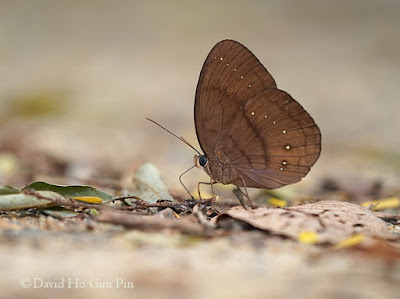
On the upperside, the wings are orange-brown and unmarked. On the underside, the wings are deep brown. On both fore- and hindwings, there are basal, discal and submarginal series of dark brown lines transvering the wings, as well as a series of post-discal whitish spots.

Close-up view of the deep-bluish eyes of the Common Faun.
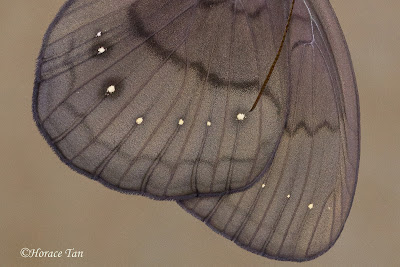
Close-up view of the wings of the Common Faun.


Field Observations of Butterfly Behaviour:
The Common Faun is relatively common in Singapore and is usually found flying close to ground in the shady understorey of forested areas within the nature reserves. Typically, it is found in the company of other species of Nymphalidae (such as the Saturn, Archduke and the Dark-Blue Jungle Glory) feeding on fallen fruits on the forest floor. With its deep brown coloration, the Common Faun is well-camouflaged among the leaf litter on the forest floor.



Early Stages:
Caterpillars of the Common Faun are polyphagous, and they utilize a number of plants as larval food plants. Most of these plants are in the Palmae family. One of the most commonly used plant is Caryota mities (Fish-Tailed Palm).

Local host plant #1: Caryota mitis (Fish Tail Palm).

Local host plant #2: Plectocomia elongata (Giant Rattan Palm).

A mating pair of the Common Faun.

A mother Common Faun ovispositing on the leaf underside of the Fish-Tailed Palm.

A mother Common Faun ovispositing on the leaf underside of an unidentified plant.

Eggs of the Common Faun are laid in a small group of 5 to 10 eggs, typically on the underside of a leaf of the host plant. The pale whitish egg is spherical in shape and appear to have a smooth surface. A close-up view of the egg shows that the surface is covered with numerous, small and faint polygonal markings. Each egg has a height or diameter of about 1.5 mm.

Top view of a group of seven eggs of the Common Faun.

Lateral view of the same group of seven eggs of the Common Faun.

Left: lateral view; Right: top view of an egg of the Common Faun. Diameter: 1.5mm.

Developing eggs of the Common Faun, day 5 after oviposition.

Two views of a mature egg of the Common Faun.

The egg takes about 8 days to hatch. The young caterpillar emerges by eating a sufficiently large part of the egg shell. The newly hatched is about 4mm in length and it has a cylindrical and whitish to pale brown body covered with rows of long black setae (hair) dorsally and dorso-laterally, and white setae laterally. The head capsule is dark brown. After emergence, the newly hatched proceeds to devour the rest of the egg shell.

Two views of a newly hatched Common Faun caterpillar soon after its emergence.

A group of three newly hatched Common Faun caterpillars, with two more yet to hatch.

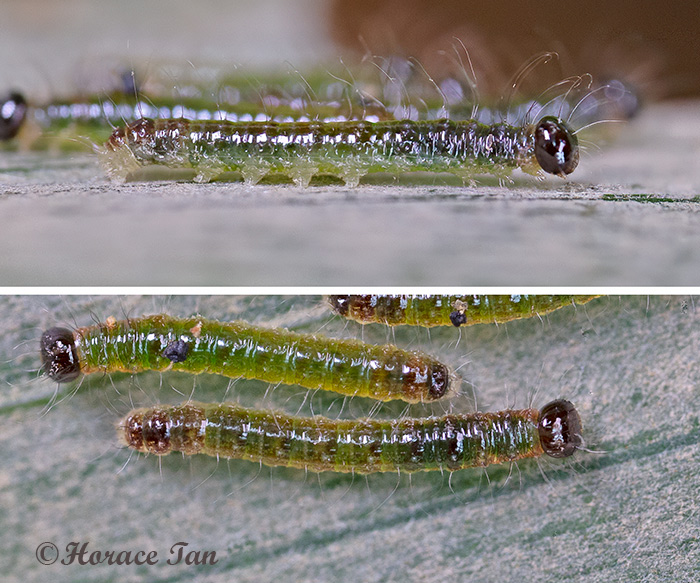
The 1st instar caterpillars feed together on the leaf lamina at the leaf edge. As the caterpillar feeds and grows, the body takes on a green undertone. In the last two days of the 1st intar, the first few and the last few body segments take on a brown coloration. After reaching about 8-9mm in about 6 days, the caterpillar moults to the 2nd instar.

Two views of a 1st instar caterpillar, length: 6.2mm.

A group of 1st instar Common Faun caterpillars.

Two views of 1st instar caterpillar, late in this stage, length: 8.8mm.

The body of the 2nd instar caterpillar is black on the 3 last segments and initially brownish but turning greyish on the remaining segments. Each of these segments is adorned with a black spot on the dorsum. Long setae cover all body segments. These setae is a mixture of shorter black setae and much longer white setae. There is also a pair of short, white and pointed anal processes. The head capsule is orange-colored in most specimens but can be black-colored in odd specimens. The head capsule bears two cephalic horns, the tip of which has a few short spines emanating from it. This instar lasts about 4 days with the body length reaching about 14.5mm.

Two views of a 2nd instar caterpillar of the Common Faun, early in this stage, length: 8mm.

Front view of the "face" of a 2nd instar caterpillar which has "black" face as opposed to the more common orangy brown face.

Two views of a 2nd instar caterpillar of the Common Faun, length: 11mm.

A group of 2nd instar Common Faun caterpillears resting together at the feeding site.

The 3rd instar caterpillar resembles the 2nd instar caterpillar but without the black spots on the dorsum. The whitish long setae on all body segments are longer proportionately compared to those in the second instar. Narrow white bands running lengthwise on the dorsumm are now discernible. There is also a series of wavy white bands occurring spiracularly. The first two and last two body segments are much darker than the other body segments. This instar takes about 4 days to complete with body length reaching about 20mm.

Two views of 3rd instar caterpillars of the Common Faun, length: 20mm.

A group of 3rd instar Common Faun caterpillears resting together at the feeding site.

Frontal view of the heads of several 3rd instar Common Faun caterpillars.

Close-up frontal view of the head of a 3rd instar Common Faun caterpillar.

The 4th instar caterpillar closely resembles the 3rd instar caterpillar, but with much denser coat of whitish setae all over the body. Most specimens have their head capsule taken on dark brown to black patches. The 4th instar lasts about 5-6 days with the body length reaching about 29mm.

Two views of a 4th instar caterpillar, length: 25mm.

Frontal view of the heads of three 4th instar Common Faun caterpillars.

A group of nice 4th instar Common Faun caterpillars resting on a palm leaf.

A group of 4th instar Common Faun caterpillar found in the field on a leaf of an unknown dicot plant.

Compared to the 4th instar caterpillar, the 5th (and final) instar caterpillar has additional orangy brown setae which are shorter than the long white setae. These brown setae are much denser in the anterior body segments. The head now features distinctive black markings with large lateral patches above an inverted V-shaped transverse band.

Two view of a 5th instar Common Faun caterpillar, length: 41mm.

A group of nine 5th instar Common Faun caterpillars on a palm leaf.

Front view of a group of 5th instar Common Faun caterpillars, showing their ``faces''.

Close-up frontal and side views of the head of a 5th instar Common Faun caterpillar.

The 5th instar lasts for 8 to 10 days, and the body length reaches up to 44-45mm. On the last day, the body becomes shortened and the caterpillar ceases feeding and wanders around. Eventually it stops at a spot on the underside of a leaf or a stem and spins a silk pad from which it hangs vertically to take on the pre-pupatory pose.

A pre-pupa of the Common Faun.


The pupation event of a Common Faun caterpillar.

Pupation takes place about one day later. The pupa suspends itself from the silk pad with no supporting silk girdle. The pupal body is yellowish green in colour with no marking. The dorsum of the thoracic segments are raised slightly at the mesothorax. At the anterior end, there are two short cephalic horns with yellowish pointed tips. Length of the pupa: 24.5-26mm.

Three views of a pupa of the Common Faun, brown form.

A group of four Common Faun pupae on the underside of a palm leaf.

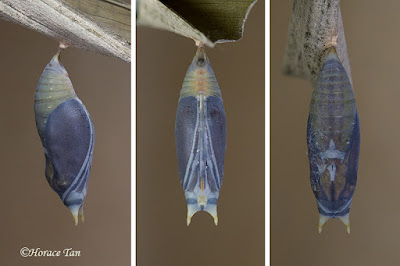
After about 8-9 days of development, the pupa darkens in colour with the wing pads turning brownish. The next morning, the mature pupa becomes mostly deep dark brown and the adult Common Faun emerges soon after.
Three views of a mature pupa of the Common Faun.


The eclosion event of a Common Faun butterfly.

A newly eclosed Common Faun resting on its pupal case.

References:
  • [C&P5] The Butterflies of The Malay Peninsula, A.S. Corbet and H.M. Pendlebury;  G. and N.  van der Poorten (Eds.),  5th Edition, Malayan Nature Society (2020).
  • Butterflies of Thailand, Pisuth Ek-Amnuay, 2nd Edition, 2012.
Text by Horace Tan, Photos by David Ho Gim Pin, Lim Cheng Ai, Koh Cher Hern, Bobby Mun, Tan Ben Jin, Frederick Ho, Khew S K and Horace Tan, Videos by Horace Tan.

27 February 2022

Butterfly of the Month - February 2022

Butterfly of the Month - February 2022
The Pygmy Grass Blue (Zizula hylax pygmaea)

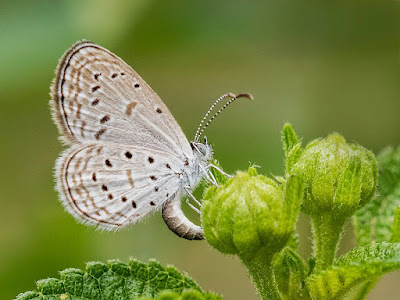
A Pygmy Grass Blue ovipositing in the flower bud of its preferred caterpillar host plant - Lantana camara

The month of February has been pretty eventful on many fronts - both celebratory for some and distressing for others. For the Chinese community all over the world, we heralded the new Year of the Tiger on Lunar New Year's day on 1 Feb. Amidst the continuing spread of Covid19 and the Omicron variant, celebrations were somewhat muted, but still, it's the Lunar New Year and the resilient human race will continue its fight against the virus.


This mutation of the Covid19 virus appears to be even more contagious, but the good news is that statistics show that it is also less severe than the previous variants. Fatalities are much lower, as is the need for hospitalisations, but nonetheless still a risk to the community. Some of the infected are even asymptomatic and a large majority of the infected showing milder symptoms than the preceding Delta variant.

Pygmy Grass Blue ovipositing on its preferred caterpillar host plant - Lantana camara

As the world looks ahead with more optimism and learning to live with the virus, travel restrictions between countries are starting to open up, albeit with some cautious safety measures put in place to minimise the risks. Some nations are already beginning to relax their control measures and policies and gearing themselves up for a new normal, and opening up economies to sustain livelihoods.


And then on 24 Feb, the optimism was shattered by Russia's military invasion of Ukraine. Long brewing, the Russian attack shocked the world, as in this age and time, not many would believe that nations can go to war, resulting in military as well as civilian casualties. As the global news is dominated by news about the Russian invasion, it does become obvious that the superpowers tend to avoid further conflict by standing on the sidelines and biding their time, whilst the oppressed continues to face the uncertainty of losing their country to the invaders.

A mating pair of Pygmy Grass Blues

We go back to our peaceful butterfly world by introducing the smallest butterfly (by wingspan) in the region. Our Butterfly for February 2022 is the Pygmy Grass Blue (Zizula hylax pygmaea). A common (and sometimes abundant) urban butterfly, the Pygmy Grass Blue often flutters around restlessly on warm sunny days amongst shrubbery and open grassy areas. Often, many individuals can be seen together.


The Pygmy Grass Blue is also referred to as the Tiny Grass Blue in various references and the common names are used interchangeably. The butterfly is small, with a rather variable average wingspan ranging from 14-22 mm. It flies together with other species of Polyommatinae, like its closest relative the Lesser Grass Blue (Zizina otis lampa). The species has an erratic flight, and coupled with is diminutive size, can sometimes be hard to identify with confidence if it does not stop to rest or feed.

Upperside views of the Pygmy Grass Blue - Top : Male, Bottom : Female

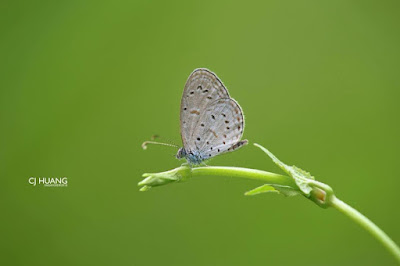
The male Pygmy Grass Blue is dull blue above, with broad dark borders on both wings, whilst the female is predominantly brown and unmarked. The underside is greyish-white with the usual black spots and light greyish-brown streaks and submarginal markings. There is a distinctive V-shaped sub-apical spot on the underside of the forewing that distinguishes it from the other Grass Blues.

An aberrant Pygmy Grass Blue with the forewing subapical spot rounded instead of V-shaped

The post-discal black spots on the underside of the hindwing are aligned, unlike the Lesser Grass Blue. The antennae are banded black-and-white whilst its eyes are transparent. The palpi are hairy and gives it a distinct unshaven look. It uses all six legs to support itself when perched.


The Pygmy Grass Blue is regularly seen fluttering amongst common garden plants. A favourite is the Prickly Lantana (Lantana camara), where this diminutive butterfly is observed ovipositing on the young buds of the flower. Other caterpillar host plants that have been recorded are Mimosa pudica, Ruellia repens and Desmodium triflorum.

A Pygmy Grass Blue puddling at a sandy streambank

Occasionally, the butterfly, particularly males, can be observed puddling at damp footpaths and sandy stream banks.  At certain hours of the day, both the males and females can be spotted opening their wings to sunbathe, showing the uppersides of their wings. Due to their abundance in certain localities, mating pairs of the Pygmy Grass Blue are regularly seen and photographed.

Text by Khew SK : Photos by David Chan, Gavin Chan, Bob Cheong, Huang CJ, Khew SK, Loh MY, Bobby Mun, Michael Soh, Mark Wong and Benjamin Yam

30 January 2022

Butterfly of the Month - January 2022

Butterfly of the Month - January 2022
The Little Maplet (Chersonesia peraka peraka)

A Little Maplet peers from its typical upside down perch beneath a leaf

Another year has passed and we are well into the year 2022. This is the final weekend before the Lunar New Year starts on 1 Feb 2022. As the year of the Ox ends, the new year will welcome the next animal in the Chinese horoscope, the Black Water Tiger. Will it be a year when the world recovers successfully from the Covid pandemic that started two years ago? Only time will tell...

A typical pose of the Little Maplet on the underside of a leaf with its antennae held close together

This month, we'll just jump straight to our Butterfly of the Month for January 2022 - the Little Maplet (Chersonesia peraka peraka). Also called the Rounded Maplet in other countries, this species is the only representative of the subfamily Cyrestinae that can still be found in Singapore. Another related species, the Wavy Maplet (Chersonesia rahria rahria) is potentially extirpated from Singapore and has not been recorded on the island for at least the past five decades.

A Wavy Maplet, now considered extinct in Singapore pudding on damp moss.  Note the single post-discal band on the forewing above

The Little Maplet is a forest-dependent butterfly, often found in localised areas in the nature reserves of Singapore. They are rather feeble in flight, but very skittish and takes off to the treetops when alarmed. They have a habit of settling on the undersides of leaves with their wings spread open. The species has a wingspan of about 30-34mm and is the smallest species of the genus Chersonesia.

A Little Maplet feeding at a blooming Syzygium tree
At times, the Little Maplet can also be observed puddling at damp footpaths, foraging amongst leaf litter.
Various shots of a Little Maplet feeding on Syzygium and Mikania micrantha flowers

At times, they are also observed to puddle along damp footpaths and foraging amongst leaf litter. They are also spotted with many other species of butterflies, when the Syzygium trees flower in the nature reserves. Considered a moderately rare species, the Little Maplet is not often encountered but may be seasonal and several individuals may be spotted during certain months of the year.


The Little Maplet is orange brown above with reddish brown bands across both wings. The undersides are a pale orange-yellow and similarly marked as the uppersides. The species has the upperside forewing post-discal band double and the two bands internal to it are wide. This is the main distinguishing ID key to separating it from the other species in the genus.

A Little Maplet perched on the flower of a Syzygium tree after feeding

The eyes of the butterfly are yellow-green and species of the genus have rather prominent pointed palpi. When at rest, the antennae of the Little Maplet are occasionally observed to be held close together rather than splayed. The antennae are black-and-white banded and orange tipped.


The caterpillars of the Little Maplet feed on Ficus punctata (Climbing Fig) and its life history has been successfully recorded in Singapore. Although the caterpillar host plant can be commonly found and widely distributed in Singapore - even in urban parks and gardens, the Little Maplet prefers the shaded forest understorey and remains in the safety of the nature reserves in Singapore.

A newly-eclosed Little Maplet hanging on to its pupal case


IUCN Conservation Status in Singapre : Vulnerable
Threat : Loss of habitats and caterpillar host plants 
Conservation measures : Ensuring that the caterpillar host plants in its preferred habitats within localised areas in Singapore's nature reserves continue to be present.

Text by Khew SK : Photos by Chng CK, Khew SK, Koh CH, Jonathan Soong, Horace Tan, Catalina Tong, Anthony Wong and Mark Wong