11 October 2020

1000 - A Milestone


1000 Posts - A Milestone
Thirteen Years of Blogging

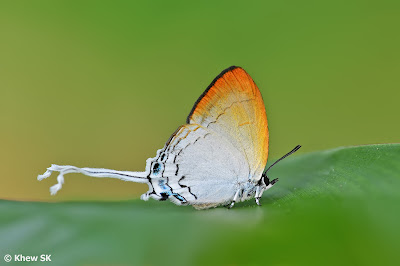
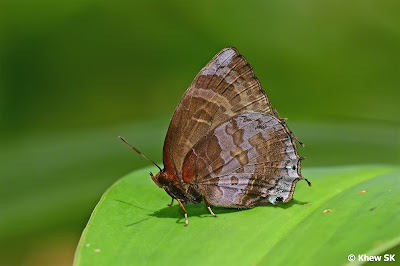
A male Cornelian (Deudorix epijarbas cinnabarus) sunbathes on a blade of grass

Over 13 years ago, I benefitted much from the knowledge shared by fellow nature enthusiasts in Singapore. Back then, when social media, influencers and blogging were less pervasive than it is today, I enjoyed the stories and information shared by a few active nature bloggers and friends in the Singapore nature community. Amongst these bloggers were Ria Tan, Dr Wee Yeow Chin, November Tan and Marcus Ng. I often followed their blog articles which were always inspiring and promoted nature appreciation across a myriad of topics from the terrestrial to the marine world.
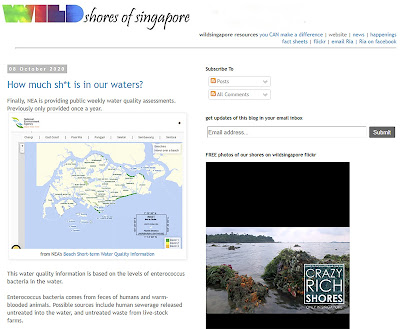
Wild Shores of Singapore Blog by Ria Tan - one of Singapore's most prolific Nature Bloggers

Ria, who started her Wild Singapore Blog and portals to feature the marine, intertidal and to a lesser extent, terrestrial news by various local enthusiasts, became a hub for nature news in Singapore. Her own personal blog, Wild Shores of Singapore, continues to this day. The main portal, Wild Happenings In Singapore, which functions like a calendar of local nature happenings, has now been shut down.


Another friend, November Tan, also persuaded me to share information about butterflies when I was invited to her now-retired series of workshops to educate like-minded and interested parties about various aspects of nature in Singapore. She used to blog via her Leaf Monkey Workshop portal, through which she energetically promoted nature through fun and humorous workshops.
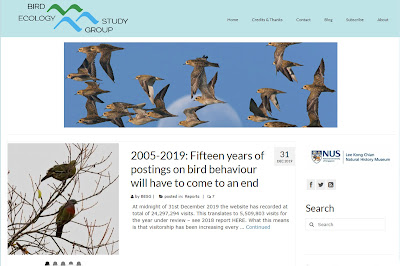
The now-retired Bird Ecology Study Group by Dr Wee Yeow Chin - nearly 25 million visits to the blog and a popular resource in the international birding scene

Dr Wee, who is a prominent author and botanist by training, took up the mantle of bird watching and started his own observations on his blog, which evolved in his Bird Ecology Study Group. Dr Wee's blog was a huge influencer in bringing the bird watching community from just recording sightings of birds, locations and numbers to observing their behaviour in the field in specific habitats and place more emphasis on the ecological study of birds in the region. Unfortunately, due to health and other commitments, Dr Wee ended his internationally popular blog at the end of 2019.
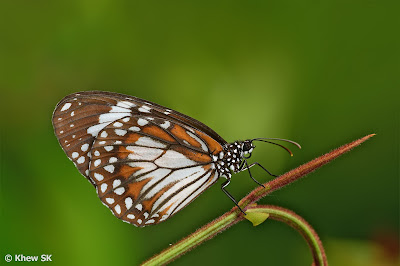
A newly-recorded species in 2020 - The Swamp Tiger was spotted on Butterfly Hill at Pulau Ubin

Then there was "Budak" Marcus Ng with his Annotated Budak blog (last post in 2015), fellow ButterflyCircle member Federick Ho with his "Beauty of Flora and Fauna in Nature" blog (which has intermittent posts and is still active), Debby Ng's Hantu Bloggers (active blog today) and many others.

A male Banded Royal perches on the red flowers of Ixora sp

Prior to joining the blogging community, I had a website created back in 2004 just to post information about butterflies. Back then, another internet veteran, Chin Fah Shin, was an inspiration with his website about Malaysian butterflies which he started way back in 1998! I also observed that there were not many websites dedicated to information about butterflies back then, and I thought that it would be useful to jump on to the blogging bandwagon and see where it takes me.
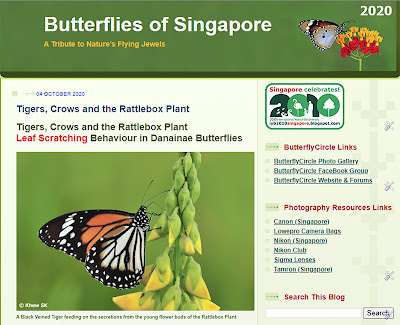
Butterflies of Singapore Blog 2007-2020 and the 999th article on the blog

I researched on various blogging platforms back then, looking at software like Blogger (now owned by Google), WordPress, and other easy-to-set-up-and-use software. The most popular back then was Blogger, so I tried it and found it much easier than managing a website that I did in the past, where I had to learn a bit of HTML coding and organising the information. So I dabbled around with it and posted my first blogpost on 16 Aug 2007. A comment on that post by Dr Wee still resonated with me. He wisely said "knowledge not shared is knowledge lost."

And that's how it all started. Thirteen years in the making. Although not as prolific in posting almost daily, as Dr Wee did in his heydays on BESG, I organised my thoughts across various topics relating to butterflies - ranging from photography, life histories, habitats, plants, community engagement, education, publications, taxonomy and morphology, locations, travelogues, and many other categories.
   

Looking around the blogging scene back then in 2007, many others started their own blogs, but few had the stamina to last more than a few months. Most fizzled out after the initial novelty of having a blog to their own name wore off. Others just ran out of steam. At the end of the day, it's still a personal commitment to share information and knowledge.  Other than a handful of blogs which attracted business opportunities, there is no commercial gain nor benefit from such a past time.
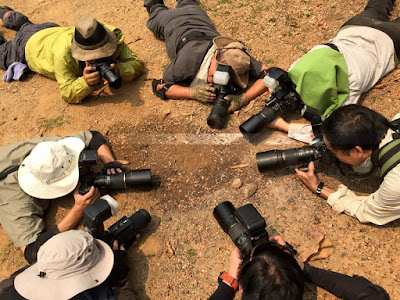
Members of ButterflyCircle on an overseas outing

I was fortunate that ButterflyCircle was formed three years earlier in 2004, and there were many friends and enthusiasts who were out regularly to record butterflies in the field - both locally and overseas. This provided a good source of information and material for blogposts, and ideas for articles that were spun off a few pictures or observations. This continued through the years, and I am thankful to all these friends and fellow-photographers who helped make this blog more "colourful" and to showcase their good work.
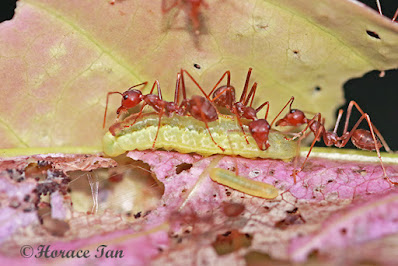
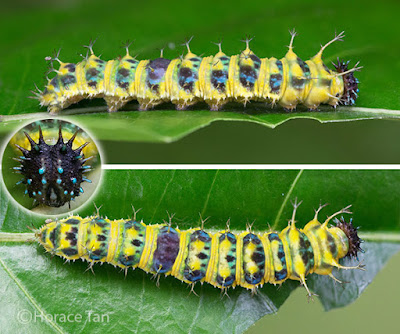
Examples of Horace's masterpieces on Life Histories of Singapore's Butterflies

Then there were those who also contributed articles that added to the diversity of knowledge on this blog. I have to specially mention Horace Tan, who is the life-histories expert behind all the excellently documented articles here. To date, there is a total of 197 life history (and more to come!) documentation of Singapore's butterflies on this blog, and this valuable repository of information far exceeds what anyone else has done for Singapore's butterfly early stages' research. Horace then followed up with his caterpillar host plants series of articles, penning a further 14 articles.
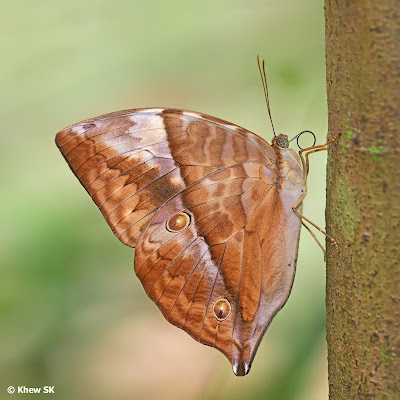

And so this blog has passed its 1000th post milestone. And that's done with at least one blogpost per week, for the past 13 years! With the advent of more convenient platforms on social media like FaceBook groups, Instagram and so on, it is much easier to share information across the world today. Posts are usually more concise, and a large majority of posts tend to be short 1-minute reads. Anything longer is likely to be skipped.


Is a blog still relevant to the way people consume news and knowledge today? Are there other more efficient and productive ways of reaching out? Many questions posed food for thought to me. But like Dr Wee, Ria and the other friends who have stood the test of time and endured for many years with their informative nature articles, perhaps it is time to take a rest and let the younger generation take on the next lap.
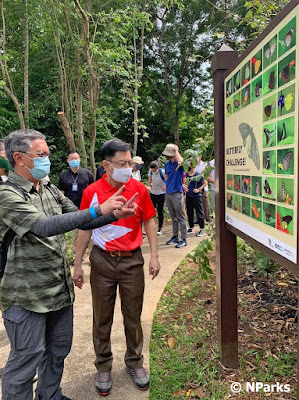
Briefing Deputy Prime Minister Heng at Butterfly Hill on Ubin Day 2020

This blog will continue for the remaining months of 2020, in the same way that it has churned out a-week-a-post for the past 13 years. The new year 2021 will see a reduction in the number of articles per month and may be more ad hoc and intermittent in terms of information sharing. I would like to express my deepest appreciation to those who have contributed to this blog in one way or another, and all our readers out there who have enjoyed and appreciated the research and work put into each of these articles since 2007.

Text by Khew SK : Photos by Khew SK, NParks and Horace Tan

04 October 2020

Tigers, Crows and the Rattlebox Plant

Tigers, Crows and the Rattlebox Plant
Leaf Scratching Behaviour in Danainae Butterflies

A Black Veined Tiger feeding on the secretions from the young flower buds of the Rattlebox Plant

The Danainae butterflies, often referred to as the "Tigers and Crows" are known to be attracted to some plants to sequester chemical substances to aid in biosynthesis of a pheremone component. These pheromones in the males are used for attracting females in courtship, and the eventual process of mating and procreation.

A Dark Glassy Tiger feeding on the secretions from the yellow flower of the Rattlebox Plant

Plants in the families Boraginaceae, Asteraceae and Fabaceae are usually targeted by adult Danainae butterflies for a particular chemical substance called pyrrolizidine alkaloid (or PA). These "Tigers and Crows" have previously been recognised by the early authors to be attracted to the dried leaves of Heliotropium indicum (Boraginaceae) which is often used to attract these butterflies for collection purposes.

A male Common Tiger feeding on the secretions from a young flower bud of the Rattlebox Plant

In the "Butterflies of the Malay Peninsula" 4th Edition, the authors noted that "In courtship, the correct sequence of dispersal of the male pheremones by the abdominal hair pencils must be followed before successful mating can take place... additional pryrrolizidine alkaloids have to be imbibed by the adult males, both from nectar and from withered or damaged plants. Droplets of fluid are regurgitated onto the plant and then reimbibed."

A Spotted Black Crow feeding on the sap after scratching the surface of a pea pod of the Rattlebox Plant

The authors of "Butterflies of Hong Kong" also observed this behaviour of the Danainae using their midtarsi claws to scratch the "soft surfaces of the leaves, stems, calyx cups, pod stalks, and damaged areas and the exuding sap is greedily imbibed, the proboscis moving about in an agitated manner." It was also observed that in Hong Kong, although there are 8 species of Crotalaria, the Danainae fed in this manner on only C. retusa."

A Common Tiger (Danaus genutia genutia) displaying plant-scratching behaviour on the flower bud of the Rattlebox Plant (Crotalaria retusa). Click to play video.

The same plant-scratching behaviour has also been observed many times in Singapore and Malaysia. The presence of the Rattlebox Plant (Crotalaria retusa) (Fabaceae) in a garden or park, has often attracted a variety of different Tigers and Crows to display this behaviour. At times, up to a dozen or more individuals of different species of Danainae have been observed congregated at a single plant, feeding on various parts of the Rattlebox Plant from the buds to the seed pods.


Over years of observations of this plant-scratching behaviour by Danainae species, we have recorded at least nine different species of the Tigers and Crows feeding at Crotalaria retusa. Whilst some Danainae species do not stay as long as others, there is obviously a need for these species to feed on the chemicals that are present on various parts of this plant - from the flowers to leaves and seed pods.

A female Striped Blue Crow joins in the search for the alkaloids from the Rattlebox Plant

Interestingly, a female Striped Blue Crow (Euploea mulciber mulciber) was also observed to feed on the sap from the stem of a seed pod of the plant. Was she looking for PAs as well? Or was it some other chemical substance in the fluid of the plant that she is searching for? Or do females also need to sequester PAs for other biological functions that have yet to be ascertained?

A "crowd" of Dark Glassy Tigers on the young flower buds of a Rattlebox Plant
A Dark Glassy Tiger feeding on the sap from ripened pea pods of the Rattlebox Plant
A Dark Glassy Tiger feeding on the sap of the seed pod of the Rattlebox Plant. Note the scratch marks on the seed pod caused by the sharp tarsal claws of the butterfly
A Dark Glassy Tiger feeding on the sap of a damaged young pea pod of the Rattlebox Plant

Amongst the Danainae, the most often-encountered species that displays the "plant-scratch and feeding" behaviour is the Dark Glassy Tiger (Parantica agleoides agleoides). They seem to be very quickly attracted to the Rattlebox Plant whenever this plant is available at our parks and gardens, and in some instances, many individuals are observed, congregated on the plant and feeding greedily.

A Common Tiger exhibiting the leaf-scratching behaviour on the Rattlebox Plant. Click to play video

The Common Tiger (Danaus genutia genutia) is almost equally often encountered feeding (compared to the Dark Glassy Tiger) on the damaged parts of the Rattlebox Plant, particularly after some vigorous scratching by the butterflies. There have been observations of the Common Tiger feeding on various parts of the Rattlebox Plant, both with and without the scratching behaviour.  In some cases, the butterfly merely fed on the moisture from the leaves or flower buds of the plant.

How many Common Tigers can you count on this Rattlebox Plant?

In one observation at Coney Island Park at a damaged Rattlebox Plant, there were at least 11 Common Tigers feeding and fluttering restlessly around the plant, vying for and nudging each other in competing for the best spot to imbibe the PA.

A Black Veined Tiger feeding on the damaged young shoots of the Rattlebox Plant. Click to play video

The similar-looking Black Veined Tiger (Danaus melanippus hegesippus) is another Danainae that is regularly seen around the Rattlebox Plants. The species was recorded on this video showing an individual feeding on the damaged young shoots of the plant. In other observations, the Black Veined Tigers have been seen to be feeding on the undamaged young flower buds of the Rattlebox Plant.

A gathering of Tigers and Crows at the Rattlebox Plant at Pulau Ubin's Butterfly Hill

The closely-related and equally common Plain Tiger has been observed at the plant, although not as often nor in as large numbers as the Common Tiger. Other less common Danainaes like the Spotted Black Crow (Euploea crameri bremeri), the Dwarf Crow (Euploea tulliolus ledereri), the King Crow (Euploea phaenareta castelnaui) and the Striped Black Crow (Euploea eyndhovii gardeneri) are occasionally spotted feeding on various parts of the Rattlebox Plant.


The Rattlebox Plant is a useful addition in urban parks and gardens, and certainly in dedicated butterfly gardens. Despite being sometimes considered a "weed", its attractive green foliage and bright yellow flowers makes it a pretty plant for a landscaped garden. It is considered one of those "butterfly magnets", especially for the leaf-scratching Danainae butterflies. The plant is also a caterpillar host plant for the Pea Blue (Lampides boeticus).

Text by Khew SK : Photos by Khew SK, Michael Soh, Tea Yi Kai and Yeo Chew Kheang.


27 September 2020

The Disappearing Acts

The Disappearing Acts
Now You See Me, Now You Don't

A Plain Lacewing (Cethosia methypsea methypsea), one of the new discoveries recorded in the 1990's appeared and disappeared for many years before reappearing again, and has not been seen since 2016

Over the years, the number of species spotted and recorded in Singapore has continued to increase. Of these, some have become resident species after they have managed to sustain a viable population in Singapore. With adequate availability of host plants, these species have continued to breed and colonise their preferred habitats and some of these species, though considered non-native or exotic, have become a familiar sight in our local butterfly scene.

A Yellow Flat (Mooreana trichoneura trichoneura) that was first discovered at the NTU area in 2012 but individuals have continued to be spotted over the years

Some of these exotics that have been able to find a home in Singapore are species like the Tawny Coster (Acraea terpsicore), Leopard Lacewing (Cethosia cyane), Common Jay (Graphium doson evemonides), Pale Grass Blue (Zizeeria maha serica), Two Spotted Line Blue (Nacaduba biocellata), Orange Tailed Awl (Bibasis sena uniformis) and Yellow Flat (Mooreana trichoneura trichoneura), just to name a few of the over 35 new discoveries to Singapore. Of these, some have become common in the environment and are often encountered in urban parks and gardens, whilst others continue to be very rare.

The Orange Tailed Awl (Bibasis sena uniformis) a new discovery, continues to be spotted from time to time and its caterpillars were once "common" at the Singapore Botanic Gardens

However, there are some species that appear over a period of time, when several pristine individuals were seen for several weeks. Then for some mysterious reason, they disappeared altogether and not seen for many years. I am not referring to those species that are singly or randomly spotted, suggesting that they may be migrants, strays or vagrants from neighbouring countries. Or they could simply be very rare native individuals that are somehow surviving in Singapore's dense forested areas.

The Tawny Coster (Acraea terpsicore) and Leopard Lacewing (Cethosia cyane) are exotic visitors that are found relatively commonly in Singapore today

In this blogpost, we investigate three different butterflies - all non-native species, that have, for a short period, been spotted in very localised areas - even in numbers, but then after a few weeks or months, went completely missing and have not been seen for some time. What happened to these species? Perhaps their host plants were insufficient to sustain a population? Were they subject to genetic in-breeding that wiped out the population? Or was there some other reason to explain their disappearance? Will they re-appear again some time in the future?

1. The Malayan Jester (Symbrenthia hippoclus selangorana)

A pristine Malayan Jester (Symbrenthia hippoclus selangorana) sunbathes on a leaf at Dairy Farm Nature Park

The Malayan Jester was first recorded as a new discovery to Singapore in early 2012. Back then, an individual was first spotted in the western part of Singapore at the grounds of Nanyang Technological University. A subsequent individual was spotted a few days thereafter, and then there was no further sign of this species


Then, six years later, observations of this species were made over the period 2018-2019 at the Dairy Farm Nature Park. From the flurry of posts on social media, the Malayan Jester suddenly became "common" for a few months from around Oct 2018 to Jul 2019. It was seen quite regularly in the area and sometimes several individuals were spotted together. From the observations, quite a few of the butterflies photographed were pristine, suggesting that they had just eclosed recently, and could not have been migratory individuals (usually with worn out or tattered wings).


Then all of a sudden, the species disappeared altogether. Visits to the Dairy Farm area no longer yielded any sightings of this species. The Malayan Jester left town. As suddenly as it had appeared and became common, the species went missing again. Did something happen to the colony flying at Dairy Farm? Will it be back again anytime soon?

2. The Common Yeoman (Cirrochroa tyche rotundata)

A pristine male Common Yeoman sunbathes on a leaf at the Singapore Botanic Gardens

Some time in Jun 2015, a couple of sightings of the non-native Common Yeoman appeared. A species that is not rare in Malaysia, the Common Yeoman has not been recorded from Singapore before until those encounters in 2015. The bright orange coloured butterfly flies erratically and resembles the common Leopard found in our urban areas. This sighting was, interestingly, at the urban Singapore Botanic Gardens, and not in the forested areas where the species is more often found in Malaysia.

A tattered female Common Yeoman ovipositing on its caterpillar host plant at SBG

A few subsequent visits to the SBG showed that there was a small colony of this species breeding at a very localised area where its caterpillar host plant grows. All of a sudden, the species became "common" only in that area, and again, several individuals - both males and females, were found there. We even managed to document the full life history of the Common Yeoman from that encounter.

A female (top) and male (bottom) Common Yeoman spotted at the Singapore Botanic Gardens for a short period in 2015 and subsequently in 2018.  It has not been seen since. Is it still around?

It continued to be seen at SBG for about 3 months until Sep 2015, then vanished. Subsequent visits to that location were not fruitful, even though the host plants were still there and nothing has changed in the habitat. It was only about 3 years later, in Apr 2018 that another sighting was recorded at SBG again. But this time around, it did not stay long and it disappeared after that. It is not known for sure if this species continues to survive in Singapore. How do we help to conserve this species sustainably? What are the secrets that the butterfly need to tell us to help it continue to exist in Singapore?

3. The Plain Lacewing (Cethosia methypsea methypsea)

Butterfly watchers had to wait for 14 years for the return of the Plain Lacewing and in recent years, it has been missing again.

The Plain Lacewing was first recorded as a new taxon for Singapore some time back in early 1991. It was first observed at Upper Seletar Reservoir Park. Back then, I recalled that, whilst it was not common, it made regular appearances, feeding at the flowering plants in the reservoir park. The related and similar-looking Malay Lacewing was much more common. 


Over the next 10 years from 1991, there were few sightings of the Plain Lacewing in Singapore, where it continued to be a rarity in the forested nature reserves. Then, all of a sudden the Plain Lacewing disappeared altogether, and there were no further sightings of the species for many years. The Malay Lacewing was the only Lacewing (Cethosia) species extant in Singapore until the discovery of another species, the Leopard Lacewing in 2005. In the meantime, the Plain Lacewing continued to elude butterfly watchers in Singapore.


Then suddenly, in 2014, sightings of the Plain Lacewing were reported by members of the butterfly watching community! After a long absence of 14 years, it was back! Several individuals were spotted over a few weeks, and seen mainly at the Upper Seletar Reservoir Park's forested areas. During that time, we also had the fortune of being able to document the species' life history, before it disappeared. Our records showed another sighting in mid 2016, two years later, and then the sightings stopped altogether. Why did it reappear again after 14 years, only to disappear again? Where did it "hide" all this time? Will butterfly watchers have to wait another 14 years again before spotting a Plain Lacewing again in Singapore?

Text by Khew SK : Photos by Khew SK, Koh CH, Loke PF, Jonathan Soong and Horace Tan
20 September 2020

Butterfly of the Month - September 2020

Butterfly of the Month - September 2020
The Malay Staff Sergeant (Athyma reta moorei)

A typical male Malay Staff Sergeant with the twice-constricted forewing cell streak

The month of September 2020 is well into its second half, and this year, the first half of the month coincided with the Chinese Hungry Ghost Festival. In Chinese folk legend, the seventh lunar month is the Ghost Month. It is said that every year on the first day of the seventh lunar month, the Gates of Hell will be wide open and the ghosts will come out until the gates are closed on the 30th day of the month, which fell on the 16 Sep this year. So we are now into the 8th month of the Lunar Calendar, and looking forward to delicious moon cakes.


The COVID-19 situation in Singapore appears to be improving, with low double digit infection cases in the recent few days, and few or no cases at all in the community. This is a good sign that the pandemic is well under control, and Singaporeans from all walks of life look forward to further relaxation of the controls that were put in place to manage the spread of the virus. But all these controls have been at the expense of the economy - and a valid trade-off.  Even so, Singapore's estimated Gross Domestic Product (GDP) for the full year is expected to land somewhere between -6% to -7% - its worst economic contraction since its independence in 1965!


As the economy takes a severe beating, the spectre of increased unemployment, job losses and salary cuts loom over the horizon. There is little cheer in the atmosphere, as our island state braces itself for the stormy seas ahead. Even as the government rolls out various measures to ease the pain of businesses and individuals, such schemes are not sustainable in the long term, and various sectors are compelled to craft new strategies to adapt to the new norm and reinvent their businesses to stay afloat.


The race is on, for a vaccine to eliminate the never-ending outbreaks and recurrence of the virus. Optimistically such a vaccine is hoped to wipe out the COVID19's effect across the globe. The current estimate of infections globally has already passed 30.8M with over 958,000 fatalities due to the virus.  The numbers continue to climb every day, with the US, India and Brazil taking the top three spots for total infections. And the world continues to search for a solution to end one of the most deadly pandemics in modern history.


Our Butterfly of the Month for September 2020 is a species that has recently made the news in taxonomic circles. The female of the Malay Staff Sergeant (Athyma reta moorei) had eluded many taxonomists and butterfly experts all this time. The discovery that the species is actually sexually-dimorphic was only made this year, after years of careful research and life history documentation. It is now confirmed that there is unlikely to be a black-and-white female of the Malay Staff Sergeant, and that the female is orange and black all along.

A puddling male Malay Staff Sergeant

The Malay Staff Sergeant is considered a rare species in Singapore, and is a forest-dependent butterfly. It is usually spotted singly feeding on flowers or puddling on damp sandy footpaths or streambanks.  The ripened fruits of the Singapore Rhododendron is also a favourite with this species. Interestingly, in Singapore, the females are more often encountered than the males. 


The diagnostic feature of the Malay Staff Sergeant is the twice-constricted white cell streak on the upperside of the forewing.  This streak is also well separated from the triangular spot beyond. The white bands in the males show a slight bluish tint at certain angles, but not as prominently as those in the related male Colour Sergeant.


The female is now known to be orange and black, and the differences between the female Malay Staff Sergeant and the lookalike female Colour Sergeant form-neftina are depicted in the annotated photo shown here. The female Malay Staff Sergeant is regularly observed singly, usually feeding at flowering plants or on the ripened fruits of the Singapore Rhododendron (Melastoma malabathricum)

Newly eclosed male (left) and female (right) Malay Staff Sergeant

The caterpillar host plant where it has been successfully bred on in Singapore, is Glochidion zeylanicum. The complete life history is recorded here.

Text by Khew SK : Photos by Huang CJ, Khew SK and Horace Tan