Featuring : Telok Blangah Hill Park

The Terrace Garden which leads up to the highest point of Telok Blangah Hill Park
In our earlier blogpost on the Southern Ridges Parks, we explored the 47 Ha Kent Ridge Park. Starting from west and moving towards east, the Southern Ridges comprises Kent Ridge Park, Hort Park, Telok Blangah Hill Park and Mount Faber Park. All the four parks are interconnected via walkways and overhead bridges. This weekend, we take a look at the next elevated park, Telok Blangah Hill Park.

An overview of Telok Blangah Hill Park which is connected to Hort Park at the western end at Alexandra Road, and to Mount Faber at the eastern end at Henderson Road

A view along the elevated Forest Walk, which connects Alexandra Arch to Telok Blangah Hill Park.
Telok Blangah Hill Park is bounded by Alexandra Road on its western boundary, and Henderson Road on its eastern boundary. This elongated park is about 34 Hectares in area, and covered with lush greenery over most of its area. It is connected to the Hort Park via the Alexandra Arch overhead bridge at its western boundary. A visitor entering from this end of the Park will trek the Forest Walk – a 1.3-kilometre-long elevated metal walkway that links Hort Park to Telok Blangah Hill Park.

Below the elevated Forest Walk is the Earth Trail.

A certain locations, the Earth Trail is connected to the elevated Forest Walk via staircases

Both the Earth Trail and Forest Walk end at the little metal shelter which then leads you onto Telok Blangah Green road
An alternative route along the same direction is the Earth Trail that brings you closer to the forest understorey. The Earth Trail is below the elevated Forest Walk and connects to the elevated walk at certain places via staircases. Both trails will lead a visitor to Telok Blangah Green. At the start of the Forest Walk is a shelter at which you can take a quick rest before proceeding to the other parts of this hill park.

A the top of Telok Blangah Hill Park, where a visitor gets a 360deg view of the surroundings


A view across the horizon of the Singapore skyline

A view downwards from the top at the Terrace Garden

Be prepared for lots of staircases and steps at Telok Blangah Hill Park!

The entrance to the Terrace Garden
Telok Blangah Green winds around the hillock which overlooks the Terrace Garden. The Terrace Garden consists of a series of semi-circular terraces situated at the top of the park. The top of this hillock is the highest point of the park and from here, you will be able to enjoy a breath-taking 360-degree view of Singapore.

Alkaff Mansion with its commanding view of the surroundings

Alkaff Mansion and more steps!

The forecourt at Alkaff Mansion
Walking along Telok Blangah Green will take you past the historic Alkaff Mansion, an elegant colonial bungalow built by a family of Arab Traders, which used to host grand parties for the social elite and who's who in 19th century Singapore. Situated on top of a knoll with a commanding view of the lush greenery around, Alkaff Mansion is now an F&B outlet today.

Some of the red-brick paths winding through the forested areas in the park

Brick path in the forested area. There are stone tables/seats where one can take a good rest or even have a picnic under the shaded understorey.
As you continue to walk towards the east, you will pass a public rest room on the left, and the Therapeutic Garden on the right. The lush greenery all around the garden creates a restorative environment to engage the senses and to uplift both mental and emotional well-being while serving as complementary habitat for native biodiversity. Walk towards the Therapeutic Garden and take a short detour downhill towards the Stream Garden which brings you to the foot of the hill and the main road Telok Blangah Heights.

A pavilion to take shelter from the hot sun or pouring rain

And more steps!
Back up at the Therapeutic Garden, and on the left of Telok Blangah Green is a hilly patch of lush forested area with a network of quiet paths complete with stone tables and seats and a shelter from the elements. There are the occasional butterfly surprises around this area, and one should look carefully at the shrubbery that may attract some rarities.

Paved road leading towards the Henderson Waves

If you stay on the main trails, there are ample signages

One of the older trails that lead you to the hillock that connects to Mount Faber Park.
On the right side is Car Park 1, and another network of paths winding around the greenery, leading to another knoll which is connected to the Henderson Bridge. There is a shelter and seats at this hilltop area where one can take a short rest and a cold drink from the vending machine before crossing the distinctive Henderson Waves overhead bridge to Mount Faber Park. This forested hillock was also the location where the body of Huang Na was found after her tragic murder back in 2004.

Butterflies of Telok Blangah Hill Park
As far as butterflies are concerned, the Southern Ridges is a location where occasional rare species may appear. This is related to one of the habits of "hill topping" by butterflies - whereby many species, particularly the males, indulge in the activity of choosing their favourite perches and patrol the area for eligible females. The list of butterflies featured here is not exhaustive.


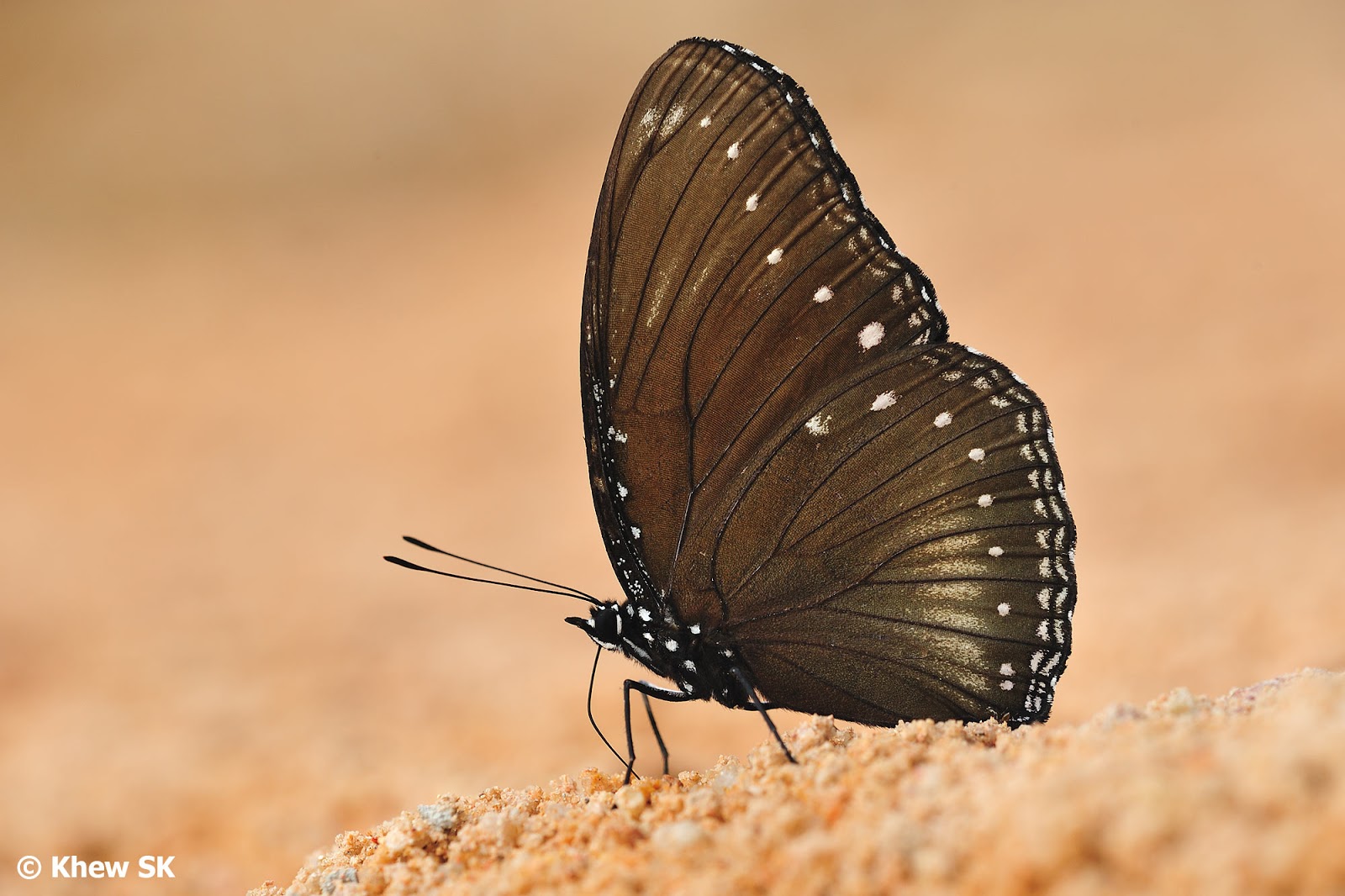
Two examples of butterflies that are normally found in the forested nature reserves, but can be spotted at Telok Blangah Hill Park.
Over the years, some of the species that have been observed at Telok Blangah Hill Park include some of the rarest Lycaenidae species that have been observed in Singapore. As some of the vegetation have evolved over the years, certain species that have been spotted between 2000 and 2010 are no longer seen today. Interestingly, some forest-dependent species like the Branded Imperial and Malayan Lascar were "regulars" at TBHP in the past.

The Colour Sergeant was once found quite commonly at the grounds of Alkaff Mansion. It is no longer seen there today.
At the grounds of the Alkaff Mansion, there once were a few host plants of the Colour Sergeant growing at the periphery of the forecourt. I recall that we often found the caterpillars of the Colour Sergeant on this host. Today, these plants have not survived and the species is rarely seen at this location.


Three Spot Grass Yellows eclosing on their host plant, Albizia
The common urban species are found at TBHP, and interestingly, three species of the Eurema or Grass Yellows, have been observed around the park. There was a time when the Albizia trees (Paraserianthes moluccana) had large congregations of the Three Spot Grass Yellow (Eurema blanda snelleni) breeding on them. The Common Grass Yellow (E. hecabe contubernalis) and the Chocolate Grass Yellow (E. sari sodalis) are also spotted here.


Look out for the distinctive dragon-headed Plain Nawab caterpillars on the Red Saga shrubs
If you look amongst the low shrubs of the Red Saga, there are often caterpillars of the Plain Nawab (Polyura hebe plautus) feeding on the leaflets of this common tree. The adults are often frolicking at tree top level, flying rapidly from one perch to another, and returning repeatedly to their favourite perches.

The Malayan Plum Judy was first recorded from the Southern Ridges


Examples of the Miletinae found at Telok Blangah Hill Park
This park was one of the first places where the Malayan Plum Judy (Abisara saturata kausambioides) was spotted. It can still be observed hopping from leaf to leaf in recent years. At least four species of the Miletinae are regularly observed at TBHP, the most often seen is the Biggs Brownwing (Miletus biggsii biggsii) flying restlessly amongst the shrubbery. The Apefly, Blue Brownwing and Pale Mottle have also been spotted here.

The rare Silver Royal was feeding at the flower of Syzygium sp. at Telok Blangah Hill Park when it was sighted in 2005


The very rare White Fourline Blue was observed at Telok Blangah Hill Park for a period of about a month in 2009. It can no longer be found there and has not been seen since.
Amongst the Lycaenidae recorded here is the very rare Silver Royal, which was photographed whilst feeding on the flowers of a Syzygium tree where it was first recorded as a re-discovery in 2005. Another very rare Lycaenidae, the White Fourline Blue (Nacaduba angusta kerriana) was first observed at TBHP. Subsequent to that sighting in 2009, where it was documented as a re-discovery, a female was observed ovipositing and its life history successfully recorded on the host plant Entada spiralis. However, it has not been seen since that short period in 2009.


Various other Line Blues from the genus Nacaduba are often sighted at Telok Blangah Hill Park
The other confusing lookalike Sixline and Fourline Blues can also be found here, usually frolicking on bright sunny days. They fly rapidly, and then select a perch onto which to land and they have a unique habit of flattening themselves to the angle of the sun to maximise their exposure to the warm sunshine.


A variety of skippers observed at Telok Blangah Hill Park
Amongst the Hesperiidae found at TBHP are the various Palm Darts, Common Redeye, Chequered Lancer, Plain Banded Awl and the Orange Awlet (where its caterpillar host plant, Arthrophyllum diversifolium, is commonly found at TBHP). The variety of caterpillar host plants that can be found at TBHP supports these species. Some examples are Spatholobus ferrugineus, Caryota mitis, Cocos nucifera and various grasses and bamboos.

A Copper Flash feeding at the flowers of the Mile-A-Minute at Telok Blangah Hill Park
All in all, the butterfly diversity at TBHP is above average. However, the park cannot be considered as an ideal butterfly-shooting location for beginners due to its topography and vegetation - some areas of which are not easily accessible. As nectaring plants are not as widespread, it is challenging to photograph butterflies that are actively flying about. Nevertheless, it is a good place to do butterfly-watching, due to its variety of habitats and environments.

A map of Telok Blangah Hill Park
How to Get There :
By bus :
(57, 145, 175, 176, 195, 195a, 272, 273) stop at Bus stop 14241, along Henderson Road and walk up along Telok Blangah Green.
(120, 124) stop at Bus stop 14331, along Telok Blangah Heights.
By car :
Drive along Henderson Green and turn into Telok Blangah Green. There are three carparks 1, 2 and 3, but on weekends, it may be challenging to find carpark lots during the peak hours. Parking is free.
Note that, due to the terrain, accessibility is challenging and there is no wheelchair access to many of the attractions mentioned above.
Text and Photos by Khew SK
References : NParks Website : Telok Blangah Hill Park

An overview of Telok Blangah Hill Park which is connected to Hort Park at the western end at Alexandra Road, and to Mount Faber at the eastern end at Henderson Road

A view along the elevated Forest Walk, which connects Alexandra Arch to Telok Blangah Hill Park.
Telok Blangah Hill Park is bounded by Alexandra Road on its western boundary, and Henderson Road on its eastern boundary. This elongated park is about 34 Hectares in area, and covered with lush greenery over most of its area. It is connected to the Hort Park via the Alexandra Arch overhead bridge at its western boundary. A visitor entering from this end of the Park will trek the Forest Walk – a 1.3-kilometre-long elevated metal walkway that links Hort Park to Telok Blangah Hill Park.

Below the elevated Forest Walk is the Earth Trail.

A certain locations, the Earth Trail is connected to the elevated Forest Walk via staircases

Both the Earth Trail and Forest Walk end at the little metal shelter which then leads you onto Telok Blangah Green road
An alternative route along the same direction is the Earth Trail that brings you closer to the forest understorey. The Earth Trail is below the elevated Forest Walk and connects to the elevated walk at certain places via staircases. Both trails will lead a visitor to Telok Blangah Green. At the start of the Forest Walk is a shelter at which you can take a quick rest before proceeding to the other parts of this hill park.

A the top of Telok Blangah Hill Park, where a visitor gets a 360deg view of the surroundings


A view across the horizon of the Singapore skyline

A view downwards from the top at the Terrace Garden

Be prepared for lots of staircases and steps at Telok Blangah Hill Park!

The entrance to the Terrace Garden
Telok Blangah Green winds around the hillock which overlooks the Terrace Garden. The Terrace Garden consists of a series of semi-circular terraces situated at the top of the park. The top of this hillock is the highest point of the park and from here, you will be able to enjoy a breath-taking 360-degree view of Singapore.

Alkaff Mansion with its commanding view of the surroundings

Alkaff Mansion and more steps!

The forecourt at Alkaff Mansion
Walking along Telok Blangah Green will take you past the historic Alkaff Mansion, an elegant colonial bungalow built by a family of Arab Traders, which used to host grand parties for the social elite and who's who in 19th century Singapore. Situated on top of a knoll with a commanding view of the lush greenery around, Alkaff Mansion is now an F&B outlet today.

Some of the red-brick paths winding through the forested areas in the park

Brick path in the forested area. There are stone tables/seats where one can take a good rest or even have a picnic under the shaded understorey.
As you continue to walk towards the east, you will pass a public rest room on the left, and the Therapeutic Garden on the right. The lush greenery all around the garden creates a restorative environment to engage the senses and to uplift both mental and emotional well-being while serving as complementary habitat for native biodiversity. Walk towards the Therapeutic Garden and take a short detour downhill towards the Stream Garden which brings you to the foot of the hill and the main road Telok Blangah Heights.

A pavilion to take shelter from the hot sun or pouring rain

And more steps!
Back up at the Therapeutic Garden, and on the left of Telok Blangah Green is a hilly patch of lush forested area with a network of quiet paths complete with stone tables and seats and a shelter from the elements. There are the occasional butterfly surprises around this area, and one should look carefully at the shrubbery that may attract some rarities.

Paved road leading towards the Henderson Waves

If you stay on the main trails, there are ample signages

One of the older trails that lead you to the hillock that connects to Mount Faber Park.
On the right side is Car Park 1, and another network of paths winding around the greenery, leading to another knoll which is connected to the Henderson Bridge. There is a shelter and seats at this hilltop area where one can take a short rest and a cold drink from the vending machine before crossing the distinctive Henderson Waves overhead bridge to Mount Faber Park. This forested hillock was also the location where the body of Huang Na was found after her tragic murder back in 2004.

Butterflies of Telok Blangah Hill Park
As far as butterflies are concerned, the Southern Ridges is a location where occasional rare species may appear. This is related to one of the habits of "hill topping" by butterflies - whereby many species, particularly the males, indulge in the activity of choosing their favourite perches and patrol the area for eligible females. The list of butterflies featured here is not exhaustive.


Two examples of butterflies that are normally found in the forested nature reserves, but can be spotted at Telok Blangah Hill Park.
Over the years, some of the species that have been observed at Telok Blangah Hill Park include some of the rarest Lycaenidae species that have been observed in Singapore. As some of the vegetation have evolved over the years, certain species that have been spotted between 2000 and 2010 are no longer seen today. Interestingly, some forest-dependent species like the Branded Imperial and Malayan Lascar were "regulars" at TBHP in the past.

The Colour Sergeant was once found quite commonly at the grounds of Alkaff Mansion. It is no longer seen there today.
At the grounds of the Alkaff Mansion, there once were a few host plants of the Colour Sergeant growing at the periphery of the forecourt. I recall that we often found the caterpillars of the Colour Sergeant on this host. Today, these plants have not survived and the species is rarely seen at this location.


Three Spot Grass Yellows eclosing on their host plant, Albizia
The common urban species are found at TBHP, and interestingly, three species of the Eurema or Grass Yellows, have been observed around the park. There was a time when the Albizia trees (Paraserianthes moluccana) had large congregations of the Three Spot Grass Yellow (Eurema blanda snelleni) breeding on them. The Common Grass Yellow (E. hecabe contubernalis) and the Chocolate Grass Yellow (E. sari sodalis) are also spotted here.


Look out for the distinctive dragon-headed Plain Nawab caterpillars on the Red Saga shrubs
If you look amongst the low shrubs of the Red Saga, there are often caterpillars of the Plain Nawab (Polyura hebe plautus) feeding on the leaflets of this common tree. The adults are often frolicking at tree top level, flying rapidly from one perch to another, and returning repeatedly to their favourite perches.

The Malayan Plum Judy was first recorded from the Southern Ridges


Examples of the Miletinae found at Telok Blangah Hill Park
This park was one of the first places where the Malayan Plum Judy (Abisara saturata kausambioides) was spotted. It can still be observed hopping from leaf to leaf in recent years. At least four species of the Miletinae are regularly observed at TBHP, the most often seen is the Biggs Brownwing (Miletus biggsii biggsii) flying restlessly amongst the shrubbery. The Apefly, Blue Brownwing and Pale Mottle have also been spotted here.

The rare Silver Royal was feeding at the flower of Syzygium sp. at Telok Blangah Hill Park when it was sighted in 2005


The very rare White Fourline Blue was observed at Telok Blangah Hill Park for a period of about a month in 2009. It can no longer be found there and has not been seen since.
Amongst the Lycaenidae recorded here is the very rare Silver Royal, which was photographed whilst feeding on the flowers of a Syzygium tree where it was first recorded as a re-discovery in 2005. Another very rare Lycaenidae, the White Fourline Blue (Nacaduba angusta kerriana) was first observed at TBHP. Subsequent to that sighting in 2009, where it was documented as a re-discovery, a female was observed ovipositing and its life history successfully recorded on the host plant Entada spiralis. However, it has not been seen since that short period in 2009.


Various other Line Blues from the genus Nacaduba are often sighted at Telok Blangah Hill Park
The other confusing lookalike Sixline and Fourline Blues can also be found here, usually frolicking on bright sunny days. They fly rapidly, and then select a perch onto which to land and they have a unique habit of flattening themselves to the angle of the sun to maximise their exposure to the warm sunshine.


A variety of skippers observed at Telok Blangah Hill Park
Amongst the Hesperiidae found at TBHP are the various Palm Darts, Common Redeye, Chequered Lancer, Plain Banded Awl and the Orange Awlet (where its caterpillar host plant, Arthrophyllum diversifolium, is commonly found at TBHP). The variety of caterpillar host plants that can be found at TBHP supports these species. Some examples are Spatholobus ferrugineus, Caryota mitis, Cocos nucifera and various grasses and bamboos.

A Copper Flash feeding at the flowers of the Mile-A-Minute at Telok Blangah Hill Park
All in all, the butterfly diversity at TBHP is above average. However, the park cannot be considered as an ideal butterfly-shooting location for beginners due to its topography and vegetation - some areas of which are not easily accessible. As nectaring plants are not as widespread, it is challenging to photograph butterflies that are actively flying about. Nevertheless, it is a good place to do butterfly-watching, due to its variety of habitats and environments.

A map of Telok Blangah Hill Park
How to Get There :
By bus :
(57, 145, 175, 176, 195, 195a, 272, 273) stop at Bus stop 14241, along Henderson Road and walk up along Telok Blangah Green.
(120, 124) stop at Bus stop 14331, along Telok Blangah Heights.
By car :
Drive along Henderson Green and turn into Telok Blangah Green. There are three carparks 1, 2 and 3, but on weekends, it may be challenging to find carpark lots during the peak hours. Parking is free.
Note that, due to the terrain, accessibility is challenging and there is no wheelchair access to many of the attractions mentioned above.
Text and Photos by Khew SK
References : NParks Website : Telok Blangah Hill Park