01 August 2020

Plushblues of Singapore

The Plushblues of Singapore
Featuring the Flos species in Singapore


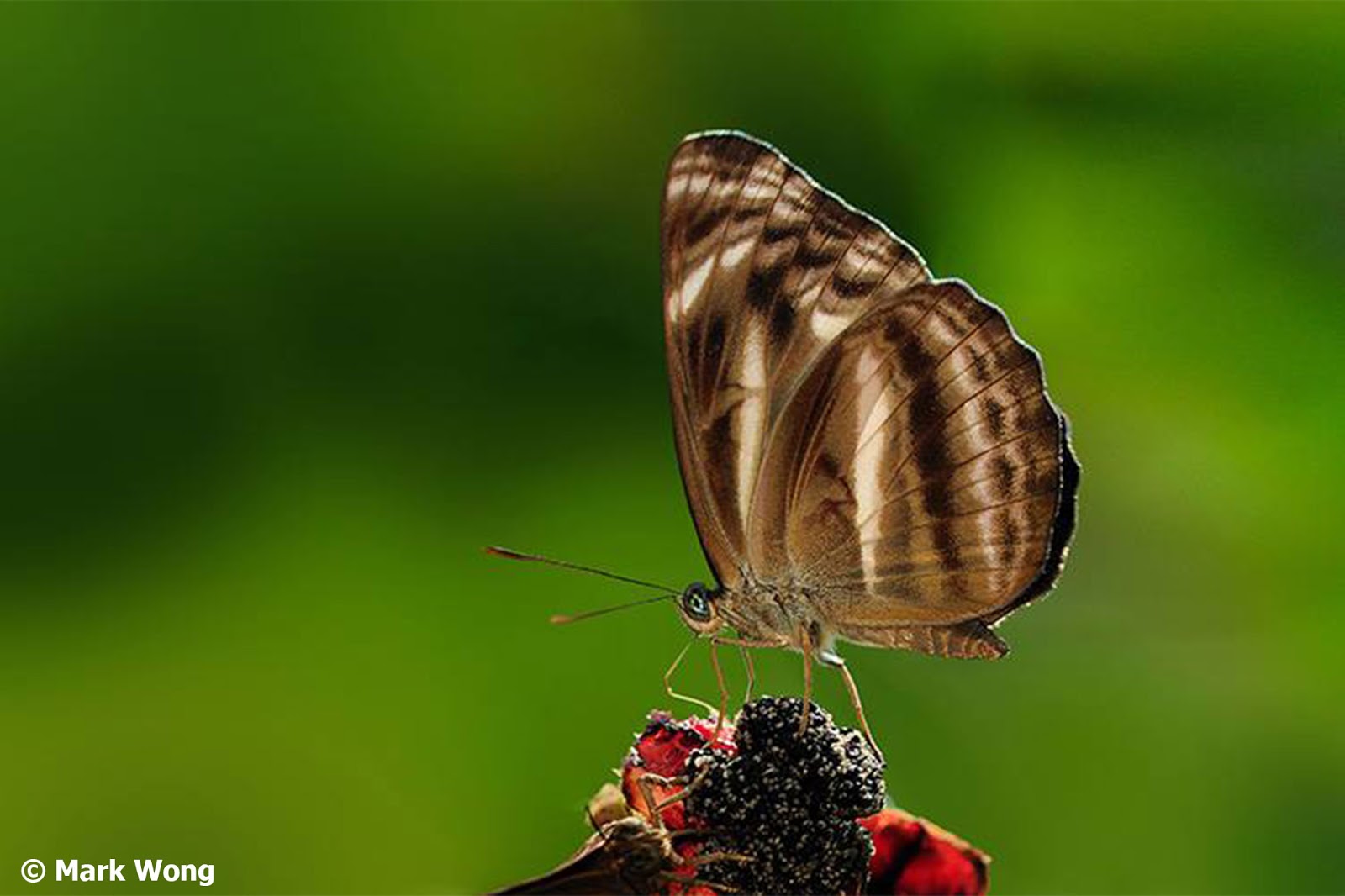
A Darky Plushblue perches on some flower buds in the shaded forest understorey

The genus Flos, collectively called the Plushblues, showcases some of the most attractive Lycaenidae species with iridescent ultramarine blue uppersides. Unfortunately, all the species rarely sunbathe with their wings fully opened, and one often only gets a glimpse of its attractive blue uppersides. Globally, there are 15 species of Flos recorded, although some researchers have re-classified at least one species of Arhopala under Flos after studies of its early stages and morphology.


A Plain Plushblue feeds on the sweet secretions on the stem of a Rattlebox weed

A Bifid Plushblue perches on a leaf

There are four Flos species extant in Singapore, and only one can be regularly found in urban parks and gardens. The other three are rare, often encountered singly, and forest-dependent species. They usually prefer the shaded understorey of the forested nature reserves of Singapore. The genus is related to the Arhopala and sometimes found in the same heavily-shaded localities.


A Shining Plushblue perches at the edge of a leaf

The Plushblues are generally skittish and easily spooked. They fly quite rapidly and settle on the top surfaces of leaves to perch with their wings folded upright. The underside of the Plushblues is dark purple brown with cryptic bands and spots on both wings. In some of the species, there is a patch of deep red or crimson at the wing bases.

1. The Plain Plushblue (Flos apidanus saturatus)


The Plain Plushblue is the only Flos species that can be found in urban parks and gardens more often than in the forested areas. It is skittish and flies rapidly amongst the shrubbery. It can sometimes be observed feeding on the sap of stems and branches. It stops to rest on tops of leaves with its wings folded upright.


A male Plain Plushblue shows its ultramarine blue uppersides

A Plain Plushblue feeding on the ripened fruits of the Singapore Rhododendron

The male Plain Plushblue is a deep ultramarine on its uppersides, with a thin forewing border. The female is a shining blue with broad black borders on both wings. The underside is a pale purple brown with dark markings across both wings. In pristine individuals, there is often a deep red patch at the base of both wings. The hindwing bears a stubby white-tipped tail at vein 2 and is toothed at veins 1b and 3. There are pale green iridescent scales at the tornal eyespots on the underside of the hindwing.

2. The Bifid Plushblue (Flos diardi capeta)


A Bifid Plushblue feeding on the ripened fruits of the Singapore Rhododendron

The Bifid Plushblue is mainly found in the forested nature reserves of Singapore, and is not seen in urban gardens. Other than the Plain Plushblue, all the other three species are considered rare and usually occur singly in heavily shaded habitats. It is a strong flyer and alert to movements. It is one of the Plushblues of which the female is more regularly observed to sunbathe with wings opened.


A female Bifid Plushblue opens her wings to sunbathe

A Bifid Plushblue shares the sugars from the ripened fruits of the Singapore Rhododendron with an ant

The male Bifid Plushblue is a dark purple-blue above with thin black borders. The female is a paler purple-blue with broad black borders on both the fore- and hindwings. The underside is cryptic in appearance, with dark brown and pale markings. There is a characteristic "V" shaped costal spot that is not connected to the other brown markings on the hindwing that separates this species from the other Plushblues. There is a white-tipped tail at vein 2 of the hindwing and is toothed at veins 1b and 3. The pale green iridescent scales at the tornal area is more extensive that the other species in the genus.

3. The Shining Plushblue (Flos fulgida singhapura)


A Shining Plushblue perches on a leaf in the shaded understorey in the nature reserves

This 3rd Plushblue has the distinction of bearing the word "Singapore" in Malay in its subspecies name. It is a rare forest-dependent species and prefers the heavily-shaded forest understorey in the nature reserves of Singapore. Also another skittish and rapid-flying species, it tends to prefer to fly closer to the ground and stop on the tops of leaves until disturbed.


A newly-eclosed male Shining Plushblue

A newly-eclosed male Shining Plushblue opens his wings to sunbathe

The Shining Plushblue can easily be distinguished from its other cousins in that it has a shorter stumpy tail at vein 2 of the hindwing, and is correspondingly toothed at veins 1b and 3. It is darker in appearance on the underside, and has a dark brown band stretching from costa to base. The males are deep ultramarine blue on the upperside, whilst females are shining blue with broad black borders.

4. The Darky Plushblue (Flos anniella anniella)


A Darky Plushblue perches at the edge of a leaf

The last Plushblue is considered the rarest of the four, and also prefers heavily-shaded forested habitats in the nature reserves of Singapore. It is the least encountered of the four Plushblues and has the same skittish disposition and rapid flight of its other relatives in the genus. It has been bred on various species of Lithocarpus which is a preferred genus on which the other Flos species (except Flos apidanus) feeds.


The Darky Plushblue is tailless, unlike the other 3 species, but the hindwing is toothed at veins 2 and 3. The upperside of the male is a lustrous violet blue with a thin black border. Females are lighter purple with broad black borders on both wings. The underside is mostly dark purple brown with white edging on the darker brown bands. The apical area is distinctly whitened, whilst the iridescent scaling at the tornal area of the hindwing is the least distinct amongst the four species.

Text by Khew SK : Photos by Huang CJ, Khew SK, Loh MY and Horace Tan

26 July 2020

Butterfly Photography at Our Local Parks - Kent Ridge Park

Butterfly Photography at Our Local Parks
Featuring : Kent Ridge Park


The Canopy Walk at Kent Ridge Park, surrounded by lush greenery at tree canopy level

On our rambles around Singapore's parks and gardens in search of butterflies, we explore the series of parks that make up the Southern Ridges. Starting from west and moving towards east, the Southern Ridges comprises Kent Ridge Park, Hort Park, Telok Blangah Hill Park and Mount Faber Park. All the four parks are connected via walkways and overhead bridges. In this blogpost, we visit the western-most entrance of the Southern Ridges, Kent Ridge Park.


A map of the Southern Ridges parks, comprising Kent Ridge Park, Hort Park, Telok Blangah Hill Park and Mount Faber Park.

A larger map of the 47 Ha Kent Ridge Park, stretching from Science Park to Pasir Panjang Road to the southwest boundary of the park

Kent Ridge Park is a wartime historical park, where one of the last battles for Singapore was fought during the Japanese Occupation. A war memorial plaque stands in Kent Ridge Park, erected to honour Lt Adnan Saidi, a lieutenant of the Malay Regiment's 1st Battalion, who died fighting the Japanese in one of the fiercest battles in Singapore in World War II. He led his men in the Battle of Opium Hill (Bukit Chandu), off Pasir Panjang, frustrating the Japanese efforts to take the ridge. He motivated his troops to try and fend off the Japanese, even though they were grossly outnumbered and undersupplied.


The main access road, Vigilante Drive, that leads up to Kent Ridge Park

The main carpark at Kent Ridge Park. Public amenities like rest rooms and drinking fountains are also located at this main area

A large shelter at Kent Ridge Park

Lush vegetation and towering trees are typical at Kent Ridge Park

Access to Kent Ridge Park on the eastern boundary, is via the winding South Buona Vista Road, turning left onto Vigilante Drive, up a steep incline to the ridge. There is a fairly large main carpark of about 40 lots and a smaller one near the entrance along Vigilante Drive. Parking is free. Covering a total area of 47 Ha, Kent Ridge Park features lush natural vegetation, tall mature trees and is rich in biodiversity.


Butterfly Row - a delightful row of butterfly-attracting nectaring plants to watch butterflies!

There are many trails starting from this point, leading in all directions around the ridge and enough biodiversity to satisfy the nature buff and those out for some fresh air and exercise. Just beyond the main carpark and a short walk along the ridge, is a row of butterfly-attracting nectaring plants like Shanghai Beauty (Jatropha integerrima), Snakeweed (Stachytarpheta indica), Red Tree Bush (Leea rubra) and many others.


Pansies and Skippers can be found feeding on the flowers

This "Butterfly Row" is a good place to visit to find butterflies fluttering around and feeding on the nectar from these flowering plants. In the morning hours, one can expect to find several species of skippers flitting from flower to flower, the sun-loving pansies, Chocolate Albatross, Lemon Emigrant and a variety of hill-topping Lycaenidae, if one is lucky.


A Bush Hopper that can be found amongst the grasses at the verge of the pond

A view of the pond at the eastern boundary of Kent Ridge Park

On the eastern side of Kent Ridge Park is a large pond abutting the boundary of Science Park. Starting from the low-point at this pond, there are many meandering footpaths that weave through the vegetation and rising in elevation towards the highest lookout points in the park. There are many dragonflies and damselflies around the pond, and amongst the grasses, species like the Bush Hopper and other skippers flit around.


Wide paths and lush greenery on both sides to cheer the nature lover and fitness enthusiast.  Compare the scale of the joggers with the heights of the trees flanking the path

Expect some steep climbs and lots of staircases! 

But don't worry if you run out of breath!  There are sturdy shelters and stone seats for you to take a break.

Expect lots of staircases and steep climbs as the paths lead from the pond upwards towards the ridge. The paths are either of tarmac or concrete, and are flanked by lush greenery and a variety of plants. Look out for the bird and insect life - there is always something to interest you.


The Scarce Silverstreak is sometimes seen ovipositing at the roadside hedge


The Transparent Sixline Blue can be encountered in the late afternoon, basking in the sun

The Ambon Onyx is occasionally encountered at Kent Ridge Park.  This individual was shot at the vegetation along the ridge

Back up at the main carpark, is a long hedge of Ficus microcarpa. This is the caterpillar host plant of the Scarce Silverstreak (Iraota rochana boswelliana), and if you are at the right place at the right time, you will be able to see the females of this species coming down to lay their eggs on this plant. Do keep a lookout for other Lycaenidae like the Transparent Sixline Blue (Nacaduba kurava nemana) and the occasional Ambon Onyx (Horaga syrinx maenala) amongst the vegetation in this area.


Views of the Pasir Panjang Container Port through the tall vegetation at Kent Ridge Park

Do take in the views of the southern waterfront from the Lookout Points along the ridge. At this point in time, the Pasir Panjang Container Port is still in operation the the views may be marred by these unsightly industrial equipment. In the near future, there are plans to transform this industrial area into the Greater Southern Waterfront with housing, parks, entertainment and commercial areas!


Forest bathing anyone?

Continue your walk westwards towards the Canopy Walk. Along the way, marvel at the towering Tembusu and Casuarina trees flanking the path. It is a tranquil walk and one can truly experience the therapeutic effects of "forest bathing" along this route. Do look out for the Miletinae amongst the shrubbery. Species like the Apefly (Spalgis epius epius) and Pale Mottle (Logania marmorata damis) are sometimes encountered here.


A mating pair of Pale Mottle

At the western end of Kent Ridge Park is the 280m long Canopy Walk - an elevated walkway that was designed to avoid felling any of the mature trees in the area, weaving amongst the tree canopies. The Canopy Walk ends at the wartime museum, Reflections At Bukit Chandu. This area before reaching the Canopy Walk is lined with tall Tembusu trees, offering shade from the hot sun and shelter for birds, butterflies, and a myriad of Mother Nature's creations.


The elevated Canopy Walk, which is one of the key attractions of Kent Ridge Park


The shelter at the mid-point of the Canopy Walk

A view from the Canopy Walk towards the Pasir Panjang Nursery and the city skyline beyond

Looking down at the tree canopies below

Along the Canopy Walk, the visitor can take in breath-taking views of NParks' Pasir Panjang Nursery and the city skyline beyond. From this elevated vantage point, one can look down at the tree canopies below, and also be at eye-level with the treetops of some of the tallest trees in the area. There is also a small shelter mid-way along this elevated walkway to take cover from the hot afternoon sun to enjoy the scenic view.


Some butterfly species that can be found at Kent Ridge Park - Malayan Plum Judy, Dark Brand Bush Brown and Plain Nawab.  

Down below the Canopy Walk, there is also a shaded forested path, where sometimes the Malayan Plum Judy (Abisara saturata kausambioides) can be spotted amongst the low shrubbery. This Riodinidae species usually displays its twist-and-turn behaviour and stops on the uppersurfaces of the vegetation with half-opened wings. Other species like the Dark Brand Bush Brown (Mycalesis mineus macromalayana) and the Plain Nawab (Polyura hebe plautus) may also be spotted here (the last named so, because its caterpillar host plant, the Red Saga, is common at Kent Ridge Park)

How to Get There :

By bus: 92, 92A along Science Park Drive
Alight opposite the Rutherford (Bus Stop ID : 18289) and access Kent Ridge Park via the pond area

Or 200
Alight outside National Leadership Institute, (Bus stop ID: 15099) walk northwards along South Buona Vista Road until Vigilante Drive)

By Car : From South Buona Vista Road. Turn into Vigilante Drive and up the slope to Kent Ridge Park. Parking is free.

Text by Khew SK : Photos by Khew SK, Lim CA and Loh MY

19 July 2020

Butterfly of the Month - July 2020

Butterfly of the Month - July 2020
The Chocolate Sailor (Neptis harita harita)


A Chocolate Sailor sunbathes with open wings on top of a leaf

We move apprehensively into the second half of the year 2020, a year that will most likely go into history as a significant year where an "invisible" enemy brought the world to its knees. COVID-19, a coronavirus that purportedly originated from the Chinese city of Wuhan, spread across the globe with such an exponential speed that had many governments scrambling to contain the pandemic, resulting in the current global infection rate of over 14 million people with more than 600,000 deaths and counting!


Coupled with nation-wide lockdowns and travel bans, the world reeled in the face of severe economic crisis as businesses fold, employees are retrenched and governments dig deep into their reserves or incur significant debts to save businesses and jobs. The race to find a vaccine continues, as nations that are relaxing their lockdowns are beginning to experience 2nd and even 3rd waves of infections amongst their populations.


The underside of the Chocolate Sailor is somewhat similar to the upperside, but much paler in colour

Back in Singapore, as we were just getting the hang of the phased opening of the lockdowns, the government decided to call the General Elections. With various measures that continued to be in place to prevent another surge in infections, GE2020 was unprecedented in that all campaigning was done digitally via mainstream and social media. For the first time since independence (and even before) there were no mass rallies and crowds listening to the candidates campaign.


Various upperside and underside poses of the Chocolate Sailor

The result of the elections, as far as who would continue to govern Singapore, was not unexpected. The PAP secured 83 out of a total of 93 parliamentary seats. What was perhaps surprising, was the increased vote share of the opposition parties to almost 40% of popular vote, and the loss of two Group Representation Constituencies (GRCs) to the Workers' Party. This would mean that for the first time since 1965, there will be 10 elected Members of Parliament representing the opposition.


A Chocolate Sailor sunbathes on the tip of a Singapore Rhododendron leaf

Our Butterfly of the Month for July 2020 is the Chocolate Sailor (Neptis harita harita) (or called Dingiest Sailer in other regional references). When it was first discovered in the Mandai precinct in the early 1990's it was a new record for Singapore, as it was not in the checklists of the early authors. It is one of three Neptis or "Sailors" species that are now extant in Singapore, but is the only all-brown species, compared to the other two black-and-white Sailors found in Singapore.


A Chocolate Sailor pudding at a muddy footpath

A Chocolate Sailor feeding on the ripe fruit of the Singapore Rhododendron (Melastoma malabathricum)

The Chocolate Sailor is a forest-dependent species and can usually be spotted within and along the fringes of Singapore's nature reserves. The species flies in the usual sailing fashion like its related cousins in the Neptis genus. It is usually observed singly, feeding on flowering plants, ripened fruits of the Singapore Rhododendron or just gliding amongst the forest vegetation. It is also known to puddle along damp forest paths and on decomposing animal matter.


A Chocolate Sailor perches on a leaf with its wings folded upright

Whilst feeding on the ripened fruit of the Singapore Rhodendron, the Chocolate Sailor opens its wings

The Chocolate Sailor is dark brown on the upperside, and striped in the usual Neptis pattern. There is a distinctive crescent-shaped post-discal spot in space 2 of the forewing. The underside is a lighter shade of brown with markings similar to the upperside. In a sidelight, there is a slight hint of a violet shading on the lighter bands.


The caterpillar host plant that this "non-native" butterfly has been bred on successfully in Singapore is Poikilospermum suaveolens (Urticaceae). The plant is relatively rare and largely found in forested areas within the nature reserves. The complete life history of the Chocolate Sailor is recorded here.

Text by Khew SK : Photos by David Ho, Khew SK, Horace Tan, Mark Wong and Benjamin Yam