21 December 2019

Occasional Visitors

Occasional Visitors
Strays and Vagrants to Singapore


A Vagrant puddling with open wings

During the Northeast monsoon season in the region, the prevailing winds herald the wet season in Southeast Asia. The predominantly north-easterly winds blow from the South China sea towards Singapore bringing heavy rains and the occasional flash floods. The eastern coasts of West Malaysia and South Thailand are usually inundated with heavy rains during this period too.


The yellow arrows show the prevailing NE monsoon winds blowing from Malaysia towards Singapore

With the winds blowing from southern Johor towards Singapore, there have been observations in the past years that certain butterfly species that are not resident in Singapore suddenly appear during these months. Also, it is possible that some species are blown southwards in Singapore and somehow stay a little longer (if they are able to breed with available host plants).


This weekend's blogpost investigates some of these "strays or vagrants" that are typically not seen in Singapore. However, seasonally, they may appear for a short period of time, and then disappear as suddenly and may not be seen for several years thereafter. The list is not exhaustive and is just a sample of the "exotic" species that stray into Singapore from time to time.

1) The Wanderer (Pareronia valeria lutescens)


The Wanderer belongs to the Pieridae family, of which several species are known to participate in migratory behaviour. This species, in particular, the male, is a strong flyer and can likely bridge the sea gap between Johor and Singapore. With a little aid from the winds blowing in the right direction, it can likely reach the northern coasts of Singapore. The Wanderer has been spotted on the northern offshore island of Pulau Ubin. After several unconfirmed sightings, a lone female was successfully photographed in Feb 2011.


The males continued to be spotted from time to time, but taking a photo of the skittish and fast-flying male is easier said than done. The male Wanderer is pale blue above, with prominent black veins on both wings. In the female, the wings bases are yellowish with broadly black-dusted veins. When in flight, the upperside of the female closely resembles the Yellow Glassy Tiger. The underside is paler and the colours muted, almost resembling a weathered individual of a Yellow Glassy Tiger. The flight of the female closely mimics that of the distasteful Danaid, as compared to the speedy flight of the male Wanderer.

2) The Yellow Glassy Tiger (Parantica aspasia aspasia)
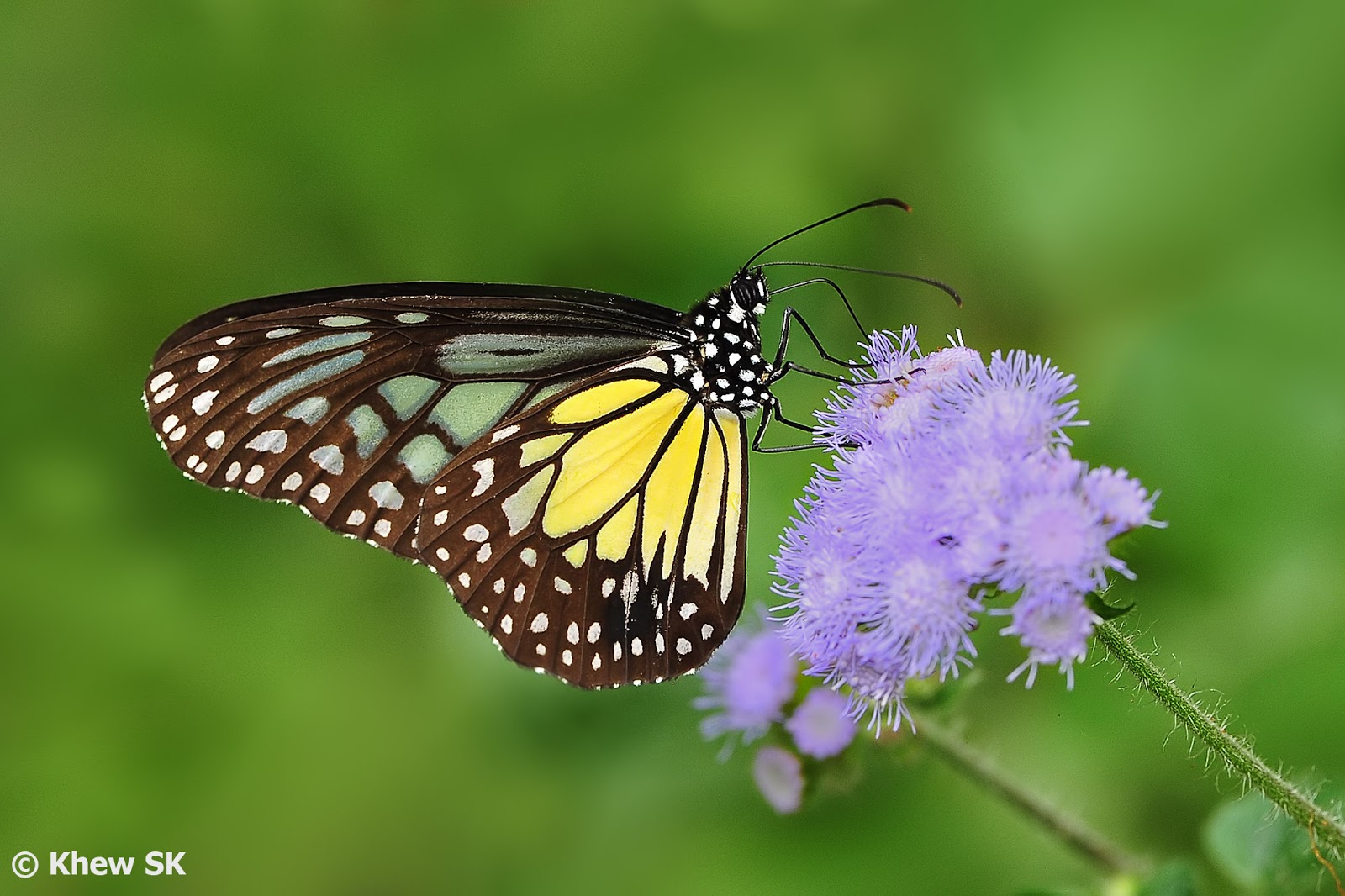


This slow-flying Danainae has been spotted many times all across Singapore - from Pulau Ubin in the north, to Gardens by the Bay in the south. It was also observed in the urban parks along the Southern Ridges. The species was once extant in Singapore, but is no longer considered a resident species of Singapore. It makes an appearance once in a while and is by no means as commonly seen as in Malaysia.


The Yellow Glassy Tiger, as earlier mentioned in this blogpost, is the model for the mimetic female Wanderer. Its wings are predominantly bluish-grey with narrow black longitudinal streaks. Each wing has a bright yellow basal patch of which the hindwing has a more extensive yellow area. Whilst it exhibits Batesian mimicry with the female Wanderer, it is also a classic example of Mullerian mimicry where the day-flying moth, Cyclosia pieridoides also mimics the Yellow Glassy Tiger for mutual protection via aposematic colouration.

3) The Orange Gull (Cephora iudith malaya)


Another Pieridae species, the Orange Gull was a very recent re-discovery on Pulau Ubin in Dec 2018. Reinforcing the theory that some of these Malaysian species appear in Singapore during the NE Monsoon months, the Orange Gull is one example. Again, with Pulau Ubin as the nearest pitstop to mainland Malaysia, it is likely that this is a wind-assisted stray that appeared in Singapore. Listed as extant in Singapore by the early authors, this species has not been reliably recorded for many decades until one year ago.


An Orange Gull spotted recently on Pulau Ubin in Singapore

The underside of the hindwing of the Orange Gull is yellow with the tornal area dark orange and brown marginal borders. On the upperside the wings are predominantly white with black veins but the tornal half of the hindwing is a bright yellow. The species is often observed puddling at sand banks with other butterflies. Like many of its related species in the family Pieridae, it is a strong flyer.

4) The Vagrant (Vagrans sinha sinha)


The Vagrant was another re-discovery when it was spotted by chance at Gardens by the Bay in June 2013. Though documented as a Singapore-extant species by the early authors, the Vagrant has not been seen on the island for several decades. It was then photographed again one year later, in June 2014 at the Seletar Golf Course Butterfly garden, and then again last year in Sep 2018 at a reservoir park. Whether there is a viable colony surviving on the island or not, remains to be seen.


The Vagrant is coloured a rich fulvous orange on the uppersides, with dark brown borders, spots and patches on both wings. The underside is paler, with light greenish scaling at the tornal area of the hindwing. It is skittish and swift in flight and can sometimes be found puddling. It has a characteristic half-open wing pose when foraging on the ground.

5) The Danaid Eggfly (Hypolimnas missippus missippus)


The Danaid Eggfly is one of three species of the genus Hypolimnas that are found in Singapore. One of the other species, Hypolimnas bolina, has two different subspecies flying here in Singapore. The Danaid Eggfly was recorded as extant in Singapore. However it is again, very rare and only a handful of sightings of the species have been made in Singapore. The majority of observations have been at the urban hill parks at the Southern Ridges.


The male of the Danaid Eggfly closely resembles the Great Eggfly and Jacintha Eggfly, whilst the female (which has not been photographed in Singapore yet), is a good mimic of the Plain Tiger (Danaus chrysippus chrysippus). On the underside the white hindwing patch is much larger than the related species, and there is a distinct costal marking on the hindwing that is a diagnostic characteristic of this species.


And there we have, 5 examples of strays or vagrants to the Singapore butterfly scene. It is likely that more will be seen in the coming years, as butterflies do not respect geographical or political borders and fly freely between adjacent countries.

Text by Khew SK : Photos by Khew SK, Koh CH, Loke PF, Bobby Mun, Nelson Ong and Michael Soh

14 December 2019

Butterfly of the Month - December 2019

Butterfly of the Month - December 2019
The Yellow Archduke (Lexias canescens pardalina)


A Yellow Archduke foraging amongst the leaf litter along a shaded forest path

And we reach December 2019, the final month of the 10-year period starting from 2010, we stand on the threshold of 2020 and an exciting new decade ahead. The world is changing at an even faster rate, with unprecedented technological disruptions, new experiences and a new way of life that we would never have dreamed of in the 20th century.


In the developed and emerging economies of the world, it would be hard to imagine life without the ubiquitous smartphone that has penetrated every aspect of our daily lives. It is this "computer in our hands" that has accelerated so many changes in our our lives, from ordering food to daily mobility and consuming information and news. Today, it is almost unthinkable that there are still people around who does not carry a smartphone - so dependent are we on it.


A Yellow Archduke sunbathing on a patch of leaves

And then comes AI or Artificial Intelligence, which is developing so rapidly that it is beginning to make Skynet (of the Terminator movies) somewhat a reality rather than fiction. Today, we hear possibilities of unmanned vehicles, unmanned stores, unmanned banks and unmanned schools? One begins to wonder what the world will be like in 2100?


The subject of environmental issues and climate change will be more and more actively debated. Countries that have the means, are already looking at how they can protect themselves from the adverse effects of climate change, whilst there are some that ignore the signs or are just too helpless to do anything effective. But this is a global issue and not a geographical nor political one. After all, don't we all breathe in the same air everywhere we go and it's not air that belongs to only one country?


Some newsworthy items in Singapore include the decision to put the mass transit Cross Island Line right below the nature reserve. Whilst it sparked off a huge debate when it was first announced, the nature community engaged the authorities to try to find a middle ground. Although the outcome will not satisfy everyone, the optimists will conclude that at least the authorities have compromised and found mitigation measures to reduce the environmental impact of the construction of this mega transportation project across a "nature reserve".


When PMDs (electric personal mobility devices) came into the environment and shared transportation networks with pedestrians, there are bound to be unfortunate interactions that neither side will find acceptable. However, it had to take several fatal accidents and lives lost, before the authorities took decisive action to ban them from shared pedestrian footpaths. And then the extent of the use of these devices in the food delivery business became obvious, as livelihood issues were raised. The problems of a developed and techology-dependent world!


Our final butterfly of the month for this decade is a medium-sized forest-dependent species called the Yellow Archduke (Lexias canescens pardalina). One of three Singapore-extant species from the genus Lexias, the Yellow Archduke is rather local in distribution and the rarest of the species found in Singapore.


A Yellow Archduke perched on a leaf 

The Yellow Archduke is an interesting species in that both the males and females are similar in appearance, but both look like the females of its related species, the Archduke and Dark Archduke. This often creates a confusion in the identification of the species, especially when all three can be found in the same habitats - in the shaded forest understorey of the nature reserves in Singapore.


A mating pair of Yellow Archdukes

The species is usually encountered foraging on forest litter and overripe fruits on the forest floor. At its preferred habitats, sometimes several individuals may be found together, and engaging in "dogfights" just a few feet above the forest floor. They are skittish and alert to movement, making them rather hard to approach for a photo. At times, when they are feeding greedily, they may be sufficiently distracted to allow an observer to approach them without scaring them off.


The Yellow Archduke is generally smaller in size, but is similarly marked as the females of the Archduke and Dark Archduke. Males and females are similar in appearance, except that the males are usually smaller in size. The species is dark brown above, with yellow spots on both the fore and hindwings.


A Yellow Archduke showing its undersides whilst foraging amongst leaf litter

The underside is a deep ochreous brown with yellow spots. Only the basal area of the hindwing is pale greyish blue, unlike the females of the Archduke and Dark Archduke, where almost the underside of the entire hindwing is pale greyish blue.


A weathered Yellow Archduke puddling along a muddy footpath

A Yellow Archduke feeding on ripened berries on the forest floor

Besides the underside of the hindwing, one of the most obvious diagnostic feature of the Yellow Archduke, is the 3rd spot from the base in space 1b of the forewing. This spot is coalesced into a single spot, whereas it is split into two spots in the female of the Archduke and Dark Archduke.

Text by Khew SK : Photos by David Chan, Huang CJ, Khew SK, Koh CH, Nelson Ong, Simon Sng and Jonathan Soong

08 December 2019

Butterfly Eyespots

Butterfly Eyespots
Ocelli on A Butterfly's Wings


An eyespot on a butterfly's wing, complete with "pupil and iris", and a reflective highlight - all created by the evolutionary adaptation of the scales on the wings

The intricate patterns, markings and colours of a butterfly's wings have long intrigued researchers, many of whom have postulated theories and possible reasons for these markings. Whether these are striations, bands, structural colours, iridescent markings or eyespots, their functional origins or objectives have often been a source of debate amongst scientists.


A female Blue Pansy (Junonia orithya wallacei) complete with colourful "eyes" on the fore and hindwings

The amazing array of designs and spectrum of colours on a butterfly's wings have been admired by nature enthusiasts and butterfly watchers. From black-and-white patterns to multi-coloured designs, each species of butterfly is unique in its own right. Combined with the morphological attributes of wingshape, size and so on, these features are often used for the basic identification of the different species of butterflies.


Underside ocelli of the Blue Morpho (Morphos peleides) 

Other than just for pure aesthetic reasons to look 'pretty', observers and scientists have been searching for answers as to why the patterns and colours on butterflies' wings are presented in such a way and if there are evolutionary functions of these patterns and markings, whether viewed individually or as a group, to resemble or mimic other organisms.


The large eyespots on the Giant Owl (Caligo memnon) are designed to confuse predators that they are dealing with an animal that is much larger

One of the often-studied features of a butterfly's wing patterns is the presence of ocelli (singular : ocellus) or referred to as "eyespots" on the wings. Eyespots may be a form of mimicry in which a spot on the wings of a butterfly may resemble an eye of a much larger animal to deceive potential predator or prey species. Eyespots may also play a role in intraspecies communication or even in courtship.


The modified ocelli at the tornal area of the hindwing of the Long Banded Silverline, complete with false antennae moving in the wind, are designed to fool predators into attacking a less critical part of the wings

In some cases, like in Lycaenidae species, the eye spots are a form of self-mimicry, to draw a predator's attention away from the most vulnerable body parts. Coupled with striations which draw attention to the eyespots and the butterfly's wing movements, this form of decoy mimicry has been well studied.


Large tornal "eyes" on a Great Helen's hindwings with its spatulate tails - designed to confuse predators?

Let us take a look at some examples of ocelli-adorned species across the different families of butterflies in Singapore. The Papilionidae do not generally employ ocelli patterns on the majority of the species in the family. A few species like the Helens and Great Mormons feature large tornal ocelli that suggest that these eyespots may be some form of decoy that could either scare predators into thinking that they are dealing with a large animal with red eyes, or perhaps direct a predator to a less fatal spot to attack.


An eyespot on the underside of a Lime Butterfly.  A mere decorative feature, or an eyespot designed to confuse predators?

The Pieridae species of "Whites and Sulphurs" have wings that feature streaks, spots and stripes, but have no particular strong association with the use of ocelli for any form of mimicry or protection. Many of the species of this family display aposematic colouration or simply use their flight speed to avoid predators.


Amongst the subfamilies of the family Nymphalidae, the use of ocelli-like patterns on the wings appear to be mainly limited to the subfamilies Satyrinae and some genera of Nymphalinae. The other subfamilies are generally patterned with stripes and other forms of designs, and usually coloured beautifully.


Eyespots on the wings of the Bush Browns (Mycalesis spp) complete with "irises and pupils"

The Satyrinae in particular, have several genera that have wings adorned with ocelli, e.g. Orsotriaena, Mycalesis, Ypthima, and many others. With the majority of the species in the subfamily that are not known to be distasteful to predators, it is likely that the use of ocelli on their wings give some measure of mimetic decoy as protection from predators.


Ocelli on the hindwing of Ypthima species

The Mycalesis or Bush Browns, and the Ypthima or Rings, have many ocelli on their fore-and hindwings as well as on the uppersides and undersides of their wings. Whether these eyespots are meant to intimidate, confuse or misdirect predators would be an interesting subject for researchers to further investigate.


"I'm looking at you!" - Eyespots on the hindwing of a Palm King (Amathusia phidippus)

Amongst the larger species of butterflies, formerly placed in the Morphinae subfamily, are also examples that feature large animal-like eyespots, particularly on the undersides of the wings. These species tend to lurk in the shaded understorey of forested areas and camouflage themselves well. These eyespots may fool predators into thinking that they are dealing with a larger animal.


© Vallin A1, Jakobsson S, Lind J, Wiklund C : From the research article : Prey survival by predator intimidation: an experimental study of peacock butterfly defence against blue tits.Biological Sciences, 01 Jun 2005, 272(1569):1203-1207

The studies of ocelli and their effect on predation have been largely done by western researchers and the experiments conducted by the Swedish researchers, particularly on the European Peacock butterfly (Inachis io) have produced evidence that these eyespots do deter predators like birds from attacking the butterflies. Essentially, the researchers painted over the ocelli for some of the butterflies and studied them together with the normal individuals and how predators react to them.


Colourful eyespots on the wings of Junonia spp.

Our local species in the Junonia genus, collectively called the Pansys, offer an almost similar range of ocelli-adorned species as the European Peacock. The Blue, Peacock, Chocolate and Grey Pansy species all have an interesting array of ocelli on their wings that probably function in the same way as their European cousins where the "eyes" are used to intimidate or deter predators.


Adapted ocelli on the tornal edge of the hindwings of Lycaenidae

The Lycaenidae have evolved their utilisation of ocelli into what is referred to as auto-mimicry to fool predators into attacking a less important part of their wings. The eyespots are adapted to look like the head of an organism, usually complete with "antennae" and the movement of the butterfly's hindwings, to direct a predator to attack a less critical part of the butterfly.


It is always interesting to observe how these Lycaenidae utilise colours, patterns and eyespots as a group of features to form a decoy to escape predatory attacks. Some of these eyespots come complete with silvery "eyebrows", orange and black eyespots and iridescent scales to emphasise an eyespot to attract a predator to "look at the wrong end" of the butterfly if it intends to attack.

Text and Photos by Khew SK

References :