24 December 2017

2017 - Looking Back

ButterflyCircle 2017 - Looking Back...
The Year in Review : Part 1


We take a look back over the past 12 months in 2017 and reflect on the activities that the group has contributed to the knowledge and sharing of information about butterflies in Singapore and our neighbours in Southeast Asia. It has been quite eventful, although here in Singapore, the actual butterfly population seemed to have dropped a bit in some months. There was no haze to blame this year, so perhaps there could be other reasons to explain for the drop in the sightings of some species that were more regular in past years.


This year, we continued to share useful articles on this blog to benefit different groups of people with different interests about butterflies. Into its 10th year, since 2007, this blog continues to churn out at least an article every weekend to cover various aspects about butterflies - from ecology and biology of butterflies, to community activities and education, to photography and outings to butterfly-rich neighbouring countries. We end 2017 with a grand total of 855 articles over the past decade of blogging.


In the regular feature articles in the blog like the Butterfly of the Month articles, we continue to share information and colourful photographs of individual species every month. This year, we have completed a total of 122 species featured over the past 10 years since the Dec 2007 "centrefold". It has been an incredible journey of monthly articles about the local butterflies featured, plus a few personal anecdotes about the world we live in.


Our life history expert, Horace Tan, has worked tirelessly over the years, churning out articles with amazing details to document the early stages of Singapore's butterflies. Given that he has already covered a staggering 194 individual life histories on this blog, this forms nearly 60% of the extant species in Singapore! There are probably a few more that Horace has yet to complete, but probably with diminishing returns as we reach a level where only the rare or very rare species are left to be documented.

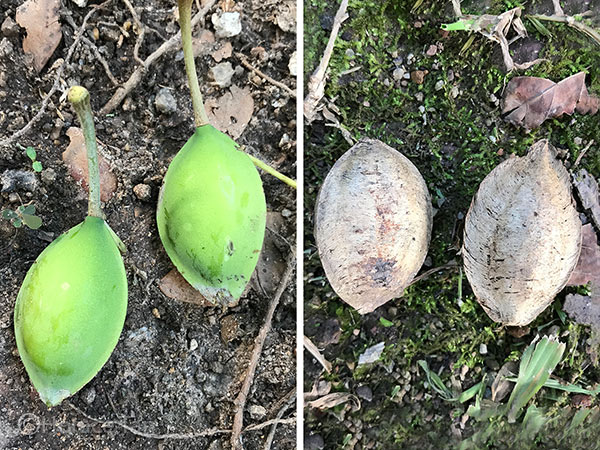


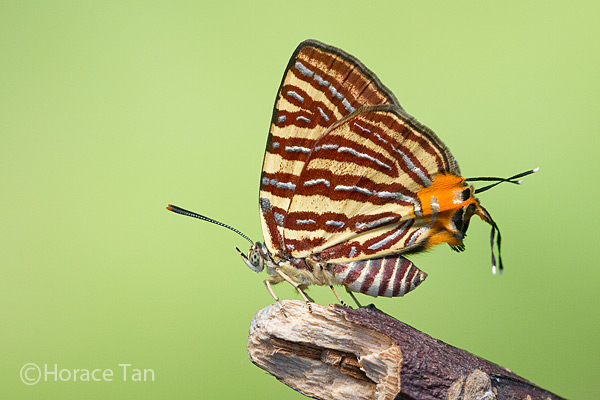

Our local host plant Sea Almond (Terminalia catappa) and three of the butterfly species that this plant supports in their early stages

This year, Horace added two more species to his meticulous documentation of Singapore's butterfly species with the inclusion of an update to the early stages of the Purple Duke (Eulaceura osteria kumana) and the Ganda Dart (Potanthus ganda). Horace also shared one article on the Larval Host Plants of Butterflies, featuring the Sea Almond (Terminalia catappa). At least 3 butterfly species have been successfully bred on this host plant in Singapore.


Six additional butterflies' favourite nectaring plants were featured in 2017

Our Butterflies' Favourite Nectaring Plants series added six flowering plants that our local butterflies are attracted to. This topped up our list to fourteen such nectaring plants that every butterfly garden should be cultivated with. Not all the plants are your typical landscaping material, and some of them are often considered as 'weeds' to gardeners. However, it is important to have the diversity of nectaring sources to attract a wider variety of butterflies.


On the social media front, the original FaceBook site set up for sharing butterflies of Singapore took a different direction and changed its focus more and more towards the international scene. This has pros and cons, but I feel that the original mission of setting up a sharing group that features Singapore's butterfly biodiversity first, has been diluted beyond recognition.


Hence a back-to-basics Butterflies of Singapore FB group was re-created in June this year. Whilst the community is a much smaller group now, there is better local relevance and focus on Singapore's butterflies and activities. The previous group concentrates on a global thrust which does not do much to promote butterfly conservation, community engagement outings and educational activities that are specific to our local scene. I will devote my time and effort to the local group and wish the more international-outlook group all the best in pursuing their own objectives, whatever those may be.


The ever-active and enthusiastic Mr Foo contributing his time and energy to encourage butterfly enthusiasts to participate in community butterfly gardens and sharing of knowledge

ButterflyCircle's collaboration with Foo JL's Nature @ Seletar Butterfly Group has also reaped dividends for butterfly conservation and education efforts that are more tailored towards, and of particular benefit to Singapore. It is important to leave behind a legacy that cultivates the next generation of butterfly enthusiasts for Singapore to ensure a sustainable conservation community that continues to be active locally so that nature continues to have a place in our lives, despite the pressure of intensive developments on our small 715 sq km island.


The original ButterflyCircle forum that was set up in 2004 is left to take on a more scientific and taxonomic purpose. It remains a very useful resource on butterflies, particularly when we still have the invaluable expertise of Dr Seow TL in the identification of the cryptic lookalikes amongst our butterflies. Although the forums have not been as active as before, the information that is relevant still comes in very useful from time to time.


In the next part of this article, we will share more of the educational and community engagement efforts that ButterflyCircle has participated in over the past year. As we head our to our respective Christmas Eve celebrations and parties with our friends and loved ones this evening, I would like to take this opportunity to wish all our friends and readers a blessed and MERRY CHRISTMAS!!!

Text by Khew SK : Photos by Khew SK, Loh MY, Loke PF and Horace Tan

16 December 2017

Butterfly of the Month - December 2017

Butterfly of the Month - December 2017
The Common Snow Flat (Tagiades japetus atticus)


Ten years ago, in December 2007, we started the Butterfly of the Month series with our first feature butterfly, the beautiful Malay Lacewing (Cethosia hypsea hysina). This month, December 2017 we mark a milestone for this series, after featuring a total of 122 species of butterflies found in Singapore. (inclusive of this month's feature species). So we celebrate a decade of Singapore's butterflies and look forward to featuring more of our flying jewels.


December is always a month for festivities and the year-end holidays. Shopping malls, offices and even the public roads along the main shopping belts in Singapore are decorated with pretty lights and cheery Christmas decorations. The cooler winter breezes and daily rains also make the ambient temperatures feel a lot like Christmas, even though Singapore is unlikely to see any real snow for a long time to come!


Even as we enjoy the holiday season, indulge in good food and great company of friends and family, many countries continue to be on high alert for acts of terrorism during the year-end festivities. And just when you least expect it, incidents such as the recent New York Times Square bomb attack brings back the reality that there extremists out there and no amount of vigilance and surveillance by the authorities can eliminate them completely. Over the years, travellers have come to terms with terror attacks as an inevitable part of life, including travelling overseas.


In global news, North Korea continues to take centre stage, as it successfully launch an intercontinental ballistic missile that it claims can potentially reach any city in the US. The Trump Administration, on the other hand made news (and a lot of unhappy people) when it announced that it will henceforth recognise Jerusalem as Israel's capital.


On the environmental front, Singapore saw its first electric car-sharing company starting operations this month with 80 "blue cars" and about 30 charging stations. Similar to the bike-sharing scheme which can be popularly seen all over Singapore today, this electric car-sharing scheme will be the pioneer of car mobility in our sharing economy. The scheme is operated by BlueSG, a subsidiary of the French Bollore group, which launched the world’s largest and most successful car sharing, Autolib’ in Paris. The plan is to reach a total of 1,000 BlueSG electric vehicles in Singapore, which may appeal to those who do not think it is feasible to pay an arm and a leg for Certificates of Entitlement (COEs) and the attendant high costs of car ownership in Singapore.


A Common Snow Flat feeding on the flower of Syzygium tree

Our feature butterfly for December 2017 is a rather drab Hesperiidae, predominantly brown on its upperside and bluish-white scaling on the undersurfaces of its hindwing. The Common Snow Flat (Tagiades japetus atticus) is moderately common in Singapore where it is usually found along the edges of Singapore's forested nature reserves, hill parks and wastelands.


This species belongs to the subfamily Pyrginae often referred to as Flats and Spread-Winged Skippers, indicating the open-winged posed of the butterflies when at rest or when feeding. The majority are fast-flyers, zipping rapidly around, and then stopping to rest with their wings opened flat on the undersides of leaves. The Snow Flats, of which there are four species from the genus Tagiades in Singapore, have whitened hindwings, which when in flight, makes the butterfly appear much smaller than it actually is.


The underside of the hindwing of the Common Snow Flat is suffused with bluish white scaling

The Common Snow Flat is pale brown on the upperside of its wings, with dark brown patches and spots on both wings. There are small sub-apical and post-discal hyaline spots on the forewings which are larger in the female than in the male. The underside of the hindwing is suffused with bluish-white scaling and appears almost whitish when in flight.  The head, thorax and abdomen of the species is strongly whitened on the underside.


A Common Snow Flat rests with its wings opened flat on the underside of a leaf

The species' habit of stopping under leaves to rest makes it challenging to photograph. However, there are times of the day with it sunbathes on the upper surfaces of leaves with its usually open-winged post. Occasionally, when there are Syzygium trees flowering, there may be several individuals of the Common Snow Flat visiting the flowers to feed. In the early morning hours, they may be seen feeding on the flowers of plants like the Chinese Violet (Asystasia gangetica).


The Common Snow Flat is occasionally observed to feed on bird droppings on leaves or on the ground. It is rarely observed puddling at damp streambanks although other species in the subfamily have been seen to puddle more often than this species.


The local caterpillar host plant of the Common Snow Flat is of the Dioscorea spp. - a climbing vine that is more often found in the forested areas than in urban parks and gardens. The host plant is also shared by at least two other species of the genus.

Text by Khew SK : Photos by Chng CK, Goh LC, Federick Ho, Huang CJ, Khew SK, Loke PF, Nelson Ong, Jonathan Soong, Horace Tan and Benjamin Yam.

09 December 2017

Book Review - Two Indonesian Butterfly Books

Book Review - Two Indonesian Butterfly Books
Featuring : "Precious and Protected Indonesian Butterflies" and "Butterflies of Bogor Botanic Garden"


A female Common Green Birdwing (Ornithoptera priamus poseidon)

In a previous weekend's blog article, we took a look at the literature available (or lack thereof) on Bornean butterflies. This weekend, we shift our attention to the 14th largest country in the world, in terms of land mass. Amongst the ASEAN nations, Indonesia is the largest country amongst the 10 southeast asian countries. Indonesia is the 4th most populous country in the world, after China, India and the US.


The largest archipelago in the world, Indonesia has about 1,919,000 sq km of land mass

Given the land mass of 1.9 million sq km (or about 3.5 times the size of Thailand), and the very diverse ecosystems and habitats of its 17,000 islands, any effort to document the butterflies of the entire country would be almost a superhuman feat! Hence it is not surprising that no researcher has ever attempted a comprehensive book covering all of Indonesia yet! It is with this background that Pisuth Ek-Amnuay's Butterflies of Thailand (two editions) should be lauded for the author's effort to document Thailand's butterfly fauna, as writing a book that covers over 1,000 species would certainly not have been easy.


A male Common Green Birdwing (Ornithoptera priamus poseidon) clings on to its leaf perch

Indonesia has an estimated number of 2,500 species of butterflies, or about double the number of butterfly species found in Thailand or Malaysia! It is home to many endemic species, some of which are so unique and beautiful, they should rightfully be also given protection status under the CITES list. Many of the larger species of swallowtails and birdwings found in Indonesia are amongst the largest butterfly species found in the world.


This article takes a look at two (out of four) books authored by Dr Djunijanti Peggie, which introduces a selective sample of butterflies found in Indonesia. The first book is entitled "Precious and Protected Indonesian Butterflies". This book basically features some CITES-protected species, particularly the Ornithoptera, Trogonoptera and Troides butterflies found in Indonesia. Several of these species are endemic to the country.


The format of the book, in B4 dimension, is clean and easy to read. Written in English and Bahasa Indonesia, the book is targeted at both the local Indonesian enthusiasts as well as international readers. Due to the small number of species featured, a nice visual quick index to the species helps to orientate the reader to the butterflies featured in the book.


The CITES list of the butterflies featured in Dr Peggie's book

The introductory section of the book efficiently summarises the Indonesian bio-geography and where the featured butterflies can be found. This section covers a short introduction to butterflies, nomenclature, handling collected specimens, butterfly morphology and terminology and some distinguishing features of each species. A list of of the species protected under CITES Appendix II is also included.


A page from the book featuring the very beautiful Violet Lacewing (Cethosia myrina sarnada) which is endemic in Sulawesi

The remaining pages of the book shows a double-spread of each species with useful data on the common and scientific names, wing dimensions, distinguishing features, distribution and protection status. Only photos of collected and set specimens accompany the write ups. But these are very useful to allow the reader to view the upper and underside of each species, and male/female photos also highlight the sexual dimorphism amongst these species.


The tailed male of Paradise Birdwing (Ornithoptera paradisea) is one of the beautiful birdwing butterflies in Indonesia


Specific distinguishing features of each species highlighted in the text are also annotated on the photos to visually show these features. Annotations by numbers is also helpful to guide the reader to understand the corresponding descriptions in the text box. A centimeter ruler is added under each butterfly specimen to help give an approximate scale to the photo and an indication of its wingspan.


Wallace's Golden Birdwing (Ornithoptera croesus), a spectacular species that was first described by Alfred Russel Wallace in 1859 and had a prominent mention in his book, the Malay Archipelago. This species is endemic to northern Maluku.

This 72-page book provides a good introduction to some of Indonesia's most spectacular butterflies. The book is simple and well-organised, with the key information and photographs effectively laid out to present the maximum information without any distracting clutter. The synopsis on the back cover of the book is written by Prof Dick Vane-Wright of the UK.


The second book, co-authored by Dr Peggie with Mr Mohammad Amir, is a small pocket-guide entitled "Practical Guide to the Butterflies of Bogor Botanic Garden". This guide book features a total of about 96 species of butterflies found at the Bogor Botanic Garden, which covers about 87 Hectares in Bogor City in western Java. This botanic garden is apparently initiated by Sir Thomas Stamford Raffles some time in the early 19th Century.


A diagrammatic location map of Bogor Botanic Garden shows the various sub-gardens where the species featured in the book were observed.

The pocket guide is also bi-lingual in English and Bahasa Indonesia. A few quick introduction-to-butterflies pages precede the main species pages. There is also a short section about Bogor Botanic Garden with a diagrammatic map of the gardens and some specific areas within the premises where the butterflies were observed.


A location map of Bogor Botanic Gardens.  The garden is about an hour's drive from Jakarta, the capital city of Indonesia

The species pages are organised by taxonomic families of butterflies, with the exception of Riodinidae, which is not found in Bogor Botanic Garden. Details of host plants, distribution, and some description of the butterfly are included for each species. There is a small pictorial diagram of Bogor Botanic Garden on each page to depict the locations where the species was observed within the garden.


Each species photo is of a set specimen with the upper/underside cut into half and digitally "sewn together" to depict the butterfly in one photo. This is useful to save space and keep the book concise and affordable. Description of the butterfly behaviour and other notes of interest are included. Photos of the species in the field, where available, are added to the bottom part of the page to complement the species described.


Some of the specimen photos shown are not in the best of condition, but they were probably of specimens that were actually captured and set on location from the Bogor Botanic Gardens. It should be noted that no English common names are indicated in this particular pocket guide, and only the scientific names of the species are used.


On the left page, the awesome caliper-tailed Polyura dehanii was also observed before at the Bogor Botanic Garden! 

At Rp45,000 or just under S$5, this pocket guide is a good companion for any butterfly-watching enthusiast visiting Bogor Botanic Garden. And who knows, you may be lucky enough to spot the awesome caliper-tailed Polyura dehanii at the gardens!

Text and Photos by Khew SK.

Photos from the books "Precious and Protected Indonesian Butterflies" and "Practical Guide to the Butterflies of Bogor Botanic Garden" are copyrighted property of their respective authors and publishers, and samples of the pages from the books are featured here under the principles of fair use.