06 November 2016

Larval Host Plant for Butterflies: Common Chinese Mistletoe

Butterflies' Larval Host Plants #12
The Common Chinese Mistletoe (Macrosolen cochinchinensis )


This 12th instalment of our Butterflies' Larval Host Plants series features Macrosolen cochinchinensis (Common Chinese Mistletoe), a member of Loranthaceae which is a family of flowering plants containing 75 genera and about 1,000 species, many of which are hemiparasites (parasitic plants which derive water/nutrients from the hosts and are photosynthetic themselves). As is the case of  the Malayan Mistletoe, the Common Chinese Mistletoe is a stem hemiparasite, attaching itself to the stem/branch of their hosts.

Common Chinese Mistletoe residing on a Lagerstroemia turbinata (Malayan Crape Myrtle) plant in the Japanese Garden.

In terms of commonness among the 10 extant parasitic plant species in Singapore, the Common Chinese Mistletoe is only second to the Malayan Mistletoe. Trees and shrubs (of many species across multiple families) growing in urban areas, residential estates, parks and gardens, wastelands, wetland and nature reserves have been observed to carry it, sometimes appearing together with the Malayan Mistletoe on the same hosts.

Left: The Common Chinese Mistletoe on a Ficus plant along the Jurong Park Connector. Right: A closer view.

Plant Biodata :
Family: Loranthaceae
Genus: Macrosolen
Species: cochinchinensis
Synonyms: M. fordii, Loranthus cochinchinensis, L. ampullaceus, L. fordii, Elytranthe ampullacea, E. cochinchinensis, E. fordii.
Country/Region of Origin :  Southern China, Nepal, India and South East Asia.
English Common Name: Common Chinese Mistletoe
Other Local Names:  鞘花
Larval Host for Butterfly Species: Arhopala centaurus nakula (Centaur Oakblue), Tajuria cippus maxentius (Peacock Royal), Tajuria mantra mantra (Felder's Royal), Euthalia adonia pinwilli (Green Baron), Jacoona anasuja anasuja (Great Imperial), Manto hypoleuca terana (Green Imperial), Semanga superba deliciosa.

Common Chinese Mistletoe found on a Polyathia longifolia (False Ashoka) plant in the Chinese Garden.

The Common Chinese Mistletoe is an epiphytic shrub between 0.5m to 1.3m in height. Branches/stems are greyish, usually with lenticels scattered on the surface. The leathery leaves are broadly elliptic or ovate to lanceolate, and sizes (5-10cm in length, 2.5-6cm in width). Leaves are initially pale reddish brown, but turning yellowish green and finally dark green when fully mature.

Tiny young shoots of the Common Chinese Mistletoe with a young caterpillar of the Green Imperial well concealed among the leaves.

Another young shoot, with longer stem, bearing an egg of the Peacock Royal.

Maturing leaves of the Common Chinese Mistletoe, yet to lose their pale brown coloration.

A branch showing mature and maturing leaves. Note the leaf arrangement.

A branch of the Common Chinese Mistletoe bearing mature leaves, one of which is adorned with an egg of the Green Baron.

Similar to the Malayan Mistletoe, fruits of the Common Chinese Mistletoe are typically dispersed by birds. The sticky coat of the seed allows it to easily adhere to the stem/branch surface of the host plant it lands on (after being carried there by birds or another forces of nature). The germinating seed will grow a green bending stalk with a disc-like tip, which eventually makes contact with the host's surface and develop into the first haustorium. The haustorium is a specialized root which penetrate into the host's tissues and connect to the xylem/phloem of the host, allowing it to draw water and non-organic nutrients from the host. The first leaves of the young plant come in an elongated form, in contrast to the more ovate form in grown plants.

The exposed seed of the Common Chinese Mistletoe sticking to the surface of a host's branch.

A young seedling of the Common Chinese Mistletoe on a branch of a Kopsia fruticosa, note the elongated leaves.

A young seedling of the Common Chinese Mistletoe with both elongated and lanceolate leaves.

As it grows, the Common Chinese Mistletoe develops side roots running alongside the branch of the host, with haustoria occur at intervals to penetrate into the host plant for more anchorage and nutrient-intake points.

Side roots and secondary hautoria of a Common Chinese Mistletoe.

Flowers of the Common Chinese Mistletoe are bisexual and occur in racemes, each of which bearing 4 to 8 flowers. Each flower is green with yellow-tipped petals. The basal part of the corolla is slightly inflated.

Young flower buds of the Common Chinese Mistletoe.

A closer view of flowers of the Common Chinese Mistletoe.

Fruits are small and sub-globose, about 5mm in diameter, initially orange, turning green as it develops, and finally dark reddish brown when fully ripened.

A branch of the Common Chinese Mistletoe bearing developing fruits.

Close-up view of two fruits of the Common Chinese Mistletoe.

In Singapore, the Common Chinese Mistletoe serves as the larval host plant for seven butterfly species in two families: Centaur Oakblue, Peacock Royal, Felder's Royal, Great Imperial, Green Imperial, Semanga superba deliciosa and Green Baron. The first six are lycaenid and the last is a limenitid.

A Centaur Oakblue.

A Peacock Royal.

A Felder's Royal.

A Green Imperial.

A Great Imperial.

A Semanga superba deliciosa.

A female Green Baron.

A male Green Baron.

Eggs of the six lycaenid species are typically laid singly on young shoots or underside of young leaves. One exception is Semanga superba deliciosa which have been observed to lay eggs in small clusters of 2-3. In contrast, the eggs of the Green Baron are laid singly on the upperside of a mature leaf.
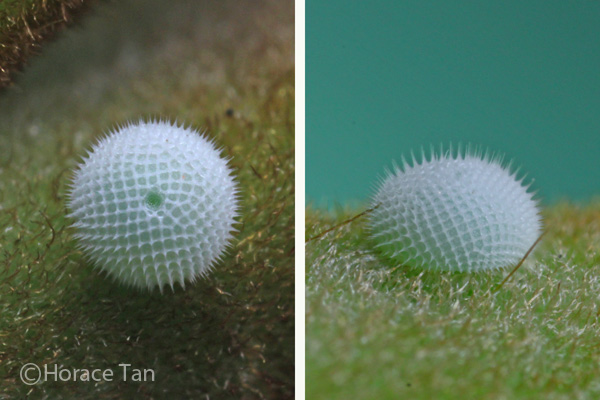
Two views of an egg of the Centaur Oakblue.

Two views of an egg of the Peacock Royal.

Two views of an egg of the Felder's Royal.

Two views of an egg of the Green Imperial.

Two views of an egg of the Great Imperial.

Two views of an egg of the Semanga superba deliciosa.

Two views of an egg of the Green Baron.

Caterpillars of all six lycaenid species feed on young leaves and young shoots of the Common Chinese Mistletoe, with those of the Semanga superba deliciosa have the added habit of feeding on flowers and flower buds. These lycaenid caterpillars are usually sighted with ants in attendance. Caterpillars of the Green Baron, in contrast, feed on mature leaves of the Common Chinese Mistletoe and have the habit of resting on the upperside of a leaf.

Two views of a 5th instar caterpillar of the Centaur Oakblue.

Two views of a 4th instar caterpillar of the Peacock Royal.

Two views of a 4th instar caterpillar of the Felder's Royal.

Two views of a 4th instar caterpillar of the Green Imperial.

Two views of a 4th instar caterpillar of the Great Imperial.

Two views of a 5th instar caterpillar of the Semanga superba deliciosa.

A final instar caterpillar of the Green Baron resting on a leaf of the Common Chinese Mistletoe.

A pupa of the Green Baron found on the underside of a Ficus leaf in the vicinity of its mistletoe host.

References:
Text and Photos by Horace Tan.

30 October 2016

Grass Blues of Singapore

The Grass Blues of Singapore


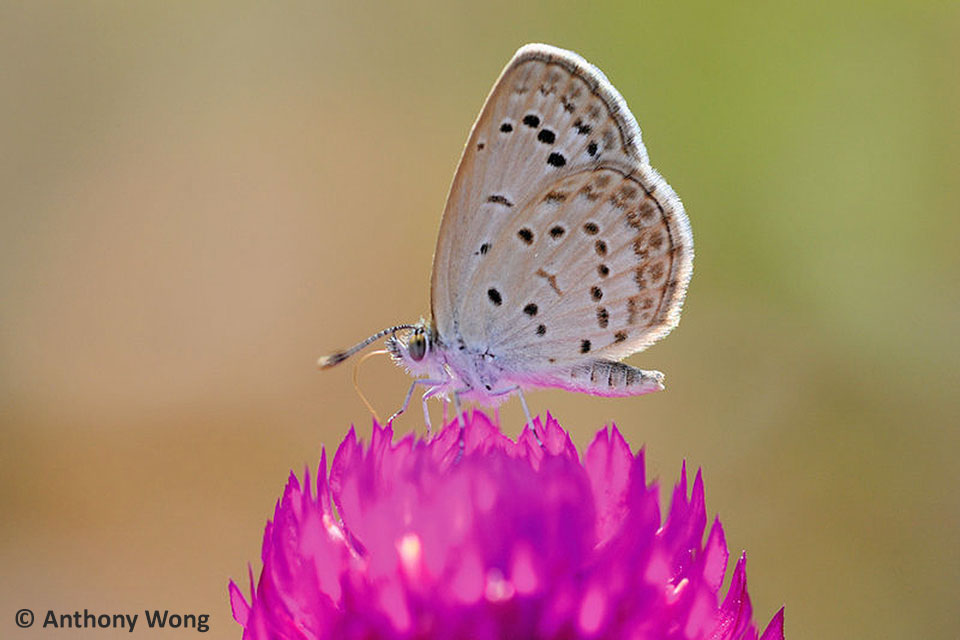
Pale Grass Blue (Zizeeria maha serica)

This article features three small butterflies from the subfamily Polyommatinae. Collectively called "Grass Blues", these species are small, feeble but erratic flyers with forewing lengths ranging between 8mm to 16mm. All three are usually observed in urban parks and gardens, and may be considered common, perhaps with the exception of the Pale Grass Blue, which is less often observed than the other two species.


Lesser Grass Blue (Zizina otis lampa)

The Grass Blues that are currently extant in Singapore actually belong to three different genera - Zizina, Zizula and Zizeeria. From historical records, a fourth species was known to exist in Singapore - The Dark Grass Blue (Zizeeria karsandra). However, this species has not been observed in Singapore for over 20 years and is likely to be extinct, although its presence should continue to be looked out for.


Pygmy Grass Blue (Zizula hylax pygmaea)

In recent years, the three "Grass Blues" that have been observed in Singapore are :
  • The Lesser Grass Blue (Zizina otis lampa)
  • The Pygmy Grass Blue (Zizula hylax pygmaea)
  • The Pale Grass Blue (Zizeeria maha serica)


A visual ID key to separate the three Grass Blues in Singapore

Of the three species, the Lesser Grass Blue (Zizina otis lampa) may be considered the commonest. Often found in urban gardens at open fields and grassy areas, the Lesser Grass Blue flies erratically usually no more than a few centimetres above the ground. Occasionally, they can be abundant, fluttering and chasing each other amongst the grasses and wildflowers in open wastelands and roadside verges.


Upperside of a male Lesser Grass Blue

With an average wingspan of no more than 18-20mm, the Lesser Grass Blue is a dull purplish blue with broad diffuse black borders in the male. The female is predominantly brown and unmarked above. The underside is a pale ochreous grey with small dark spots on both wings.


The distinguishing feature of this species that separates it from its lookalike cousins is the spot in space 6 of the hindwing. This spot is moved out of line with the adjacent spots. The submarginal markings on both wings are typically diffuse and indistinct. On the underside of the forewing, the spot in space 11 is absent.


The second species of Grass Blue found in Singapore is the Pygmy Grass Blue (Zizula hylax pygmaea). Also known as the Tiny Grass Blue in other countries, this species is considered the smallest butterfly in Malaysia and Singapore. With a wingspan of only about 14-16mm, this small butterfly is often missed by observers.


Like its related cousins, the Pygmy Grass Blue flies amongst shrubbery in urban gardens and is sometimes abundant. A favourite is the Prickly Lantana (Lantana camara), where this diminutive butterfly is observed ovipositing on the young buds of the flower. Other caterpillar host plants that have been recorded are Mimosa pudica, Ruellia repens and Desmodium triflorum.


A Pygmy Grass Blue ovipositing on the flower bud of Lantana camara

The male is a dull blue above and unmarked. The female is dark brown. The underside is greyish white with the usual black spots on both wings, and a paler series of submarginal markings. The subapical spot on the underside of the forewing is typically "V" shaped, whilst the post-discal spots on the underside of the hindwing are aligned.


The third and final species of Singapore's Grass Blues is the Pale Grass Blue (Zizeeria maha serica). This species is a new record for Singapore when it was first found in 2001. It was never listed in the early authors' checklists and may likely to have been accidentally introduced to Singapore. Photos of specimens sent to the late Col JN Eliot confirmed that this was subspecies serica. Col Eliot opined that this species is similar to the type species that originates from Hong Kong.


Amongst the three Grass Blues found in Singapore, the Pale Grass Blue is the least common. It is found in the same localities as the other two, and often flies in the company of other Polyommatinae in urban parks and gardens. It is also the largest of the three species, with an average wingspan of between 20-22mm. The caterpillar of this species has been successfully bred on the Yellow Sorrel (Oxalis corniculata)


Upperside of a male Pale Grass Blue. Note hindwing marginal black spots


The Pale Grass Blue is light blue above, with broad diffuse dark borders. The female is a dark greyish blue. The submarginal markings are distinct and dark. On the underside of the forewing, the post discal spots are large, round and distinct. The post-discal spots on the underside of the hindwing are aligned. There is also no spot in space 11 on the underside of the forewing.


A newly-eclosed Pale Grass Blue with its pupal case on the left

It is interesting that the Pale Grass Blue (Zizeeria maha serica) has replaced the other species in the genus, the Dark Grass Blue (Zizeeria karsandra) in Singapore. Although the Dark Grass Blue has been recorded in Singapore before, no reliable sightings nor specimens have been found in recent years. This species may have been overlooked by observers and darker individuals of the Grass Blues should be scrutinised closely to establish if it is indeed still extant in Singapore.

Text by Khew SK : Photos by Bob Cheong, Federick Ho, Khew SK, Loke PF, Bobby Mun, Jonathan Soong, Horace Tan, Tan BJ and Anthony Wong

23 October 2016

Revision to the Common Names of Butterflies 5

A Revision to the Common Names of Butterflies
Part 5 : An Analysis of Name Changes


In this fifth part of the series where we discuss the Common Names of Butterflies in the region, we continue our discussion to one species from the Riodinidae family and the species of the Lycaenidae family. In Part 2, Part 3 and Part 4, we framed the background of the naming convention of the English Common Names of butterflies, and also some of the changes in the book by Dr Laurence Kirton.


We also indicated the references of available published work, from which we researched into the Common English names of butterflies. However, in recent years, the usage and acceptance of these common names appear to be largely driven by regular usage by hobbyists and butterfly enthusiasts - particularly on social media and cyberspace. Once a name is coined, and used by the larger community on the internet, there is a high chance that the name becomes adopted quickly, especially if the names are repeated by frequent usage on blogs, photo repositories, social media and websites.


Unlike the taxonomic names, which fall in the domain of researchers and experts who pen scientific papers, common names are often coined by amateurs and hobbyists. Today, even some of the scientific names are being debated as new information becomes available, but often, there is no central body to moderate such changes and some new recommendations can take some time to gain acceptance - even amongst the experts. Butterflies' common names' acceptance is more of a result of frequent and regular usage and availability of books and references on the internet, rather than by any scientific means.


Continuing from where we left off in Part 4 of our discussions on common names, we consider the single species of contention in the Riodinidae family - Abisara savitri savitri. This species has been renamed to Malayan Tailed Judy. As rationalised in our earlier discussions on the common names that have been amended from "Malay" to "Malayan", we see no necessity for this change.


The name Malay Tailed Judy had been used since Evans' time (1927) and continued to be used by various authors of several butterfly books without exception. The sole book that shows the name as "Malayan Tailed Judy" is the one by Dr Kirton, and for all intents and purposes, completely outnumbered by all available literature on butterflies in the region.

Recommendation : Abisara savitri savitri should retain its common name Malay Tailed Judy.

We now move on to the Blues and Hairstreaks in the family Lycaenidae. This family is by far the largest family of butterflies in the Malaysian, Singaporean and Thai region. Many of the species are very similar looking, making it even more challenging to associate logical and justifiable common names for the butterflies.


The first species of that has multiple common names across the region, is Curetis saronis sumatrana. In Evans (1927), the species Curetis saronis is given the name Burmese Sunbeam. Dr Kirton adopted this historical reference name for this species. In Thailand, the subspecies Curetis saronis indosinica is known as Indo-Chine Sunbeam. In Singapore, subspecies sumatrana has been given the name Sumatran Sunbeam.


No other Malaysian reference has given a common name for the species Curetis saronis sumatrana other than Dr Kirton's book. The name Sumatran Sunbeam has appeared in at least four references in Singapore - Butterflies of Singapore 2010, Butterflies of Singapore 2nd Edition 2015, Caterpillars of Singapore's Butterflies 2012 and Singapore Biodiversity : An Encyclopedia of the Natural Environment and Sustainable Development 2011. Whilst there is probably no compelling reason to adopt any of the common names over the others, it is probably from common usage that the name Sumatran Sunbeam has gained a wider acceptance in the local scene.

Recommendation : Curetis saronis sumatrana should retain its common name Sumatran Sunbeam.

The next subfamily under Polyommatinae, or the Blues, comprise a large group of mainly small and delicate butterflies of which many have blue uppersides. The first species that had its name changed in Dr Kirton's book, is Neopithecops zalmora zalmora to Inornate Blue. The original name found in most literature across the region, and all the way back to Evans' "The Identification of Indian Butterflies" (1927), is The Quaker.


It is not clearly understood why Dr Kirton amended the name of this species, but it is probably classified under "Where the original name is socially unacceptable / derogatory". A search on the Internet indeed turned out some information that pointed to Quaker as being derogatory in some societies. However, the tenuous link to anything socially unacceptable or derogatory is probably in some obscure circles that is totally irrelevant today.


Even in commercial products, where I previously used the example in Darkie toothpaste being changed to Darlie toothpaste to avoid the minefield of associations to a derogatory or racist word, there are no such changes. Today, we still eat Quaker Oats. The company has a website, and products on the market still carry the word Quaker. I am not aware of any society or group that violently objects to the word "Quaker" in the modern world. Hence I do not believe that there is any issue with the continued use of the name Quaker for the species Neopithecops zalmora zalmora.

Recommendation : Neopithecops zalmora zalmora should retain its common name The Quaker.

The next species of discussion is Megisba malaya sikkima. In Evans' book, the name The Malayan was coined for this species. Thus far, all the publications that I have come across, have retained that common name for this species. The only book that has altered its name to "Malayan Pied Blue" is Butterflies of Peninsular Malaysia, Singapore and Thailand.


Whilst Dr Kirton may have a good reason for changing the name of this species by adding "Pied Blue" to the common name, it is unlikely that the rest of the amateurs and enthusiasts in the butterfly world would agree with him. Hence the name "Malayan", through legacy usage and frequent reference in cyberspace, would continue to be the primary name for this species from India to Southeast Asia and Hong Kong.


Recommendation : Megisba malaya sikkima should retain its common name The Malayan.

Text by Khew SK : Photos by May Chan, Sunny Chir, Khew SK, Simon Sng, Jonathan Soong, Horace Tan and Benjamin Yam.

Earlier articles in this series :
Revision to the Common Names of Butterflies Part 1
Revision to the Common Names of Butterflies Part 2
Revision to the Common Names of Butterflies Part 3
Revision to the Common Names of Butterflies Part 4