23 January 2014

Butterflies Galore! : Lime Butterfly

Butterflies Galore!
The Lime Butterfly (Papilio demoleus malayanus)


The Lime Butterfly is a common urban species that is widely distributed across Singapore. It is mainly found in urban parks and gardens, although there are regular sightings of the species in the forested nature reserves. During the Lunar New Year period, where there is an abundance of Citrus plants, the caterpillars are more often seen on abandoned plants.

It is a fast-flyer and skittish, although when it stops to rest, either with wings opened to sunbathe, or just perched, like in this photo taken by young ButterflyCircle member Jonathan Soong, it will be easier to approach to take a shot of it. Males are also known to puddle at sandy streambanks and footpaths which have been contaminated with animal excretions.

22 January 2014

Butterflies Galore! : Striped Blue Crow

Butterflies Galore!
The Striped Blue Crow (Euploea mulciber mulciber)


This Crow is the most commonly encountered species of the genus Euploea in Singapore, and probably the most attractive. The iridescent blue of the male's upperside forewings usually attracts the attention of observers. The female has less blue, but the striped hindwings is probably what gave this species its common English name. Males of this species are also known to puddle at sandy streambanks and forest paths.

The underside of the male is predominantly a chocolate brown with a variable series of white spots - some slightly bluish as well. This male Striped Blue Crow was shot by young ButterflyCircle member Jonathan Soong.

21 January 2014

Butterflies Galore! : Two Spotted Line Blue

Butterflies Galore!
The Two Spotted Line Blue (Nacaduba biocellata)


This very small Lycaenid was photographed some time back in 2004 but was kept in the "UFO folder" until more reliable sightings and a voucher specimen was obtained for validation. Finally recorded on the Singapore Butterfly Checklist in 2008, this species makes a regular appearance yearly, and then totally disappears for most of the year. When it does re-appear, there will be a breakout, with the species becoming locally abundant, particularly in the vicinity of areas where its host plant exists. The life history of this species has been recorded here.

This time in 2014, ten years after a single individual was photographed, it makes its reappearance again. ButterflyCircle member Sunny Chir shot this pristine individual last weekend. For those who have yet to get a photo of this species, now's the time to go hunting for it!

18 January 2014

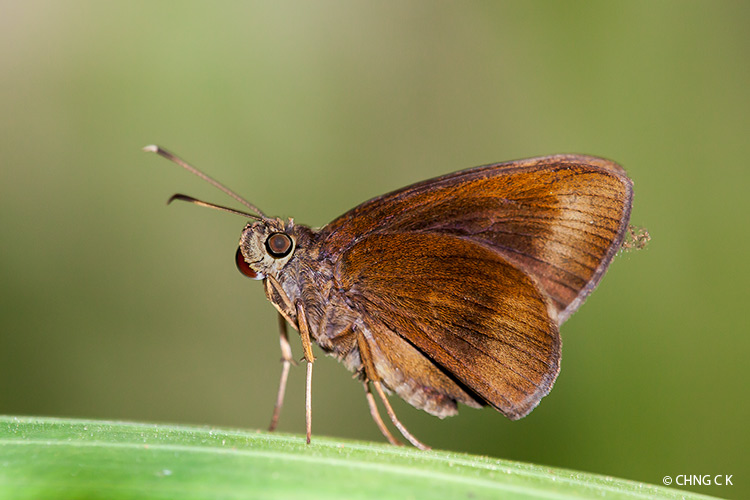
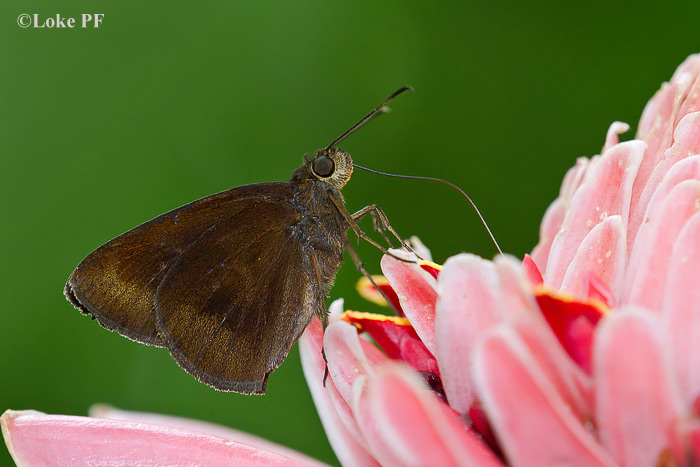
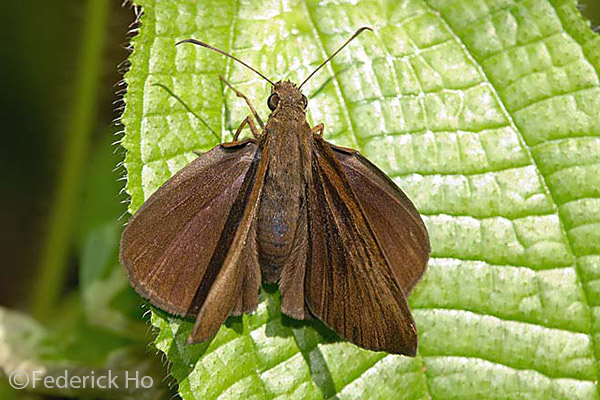
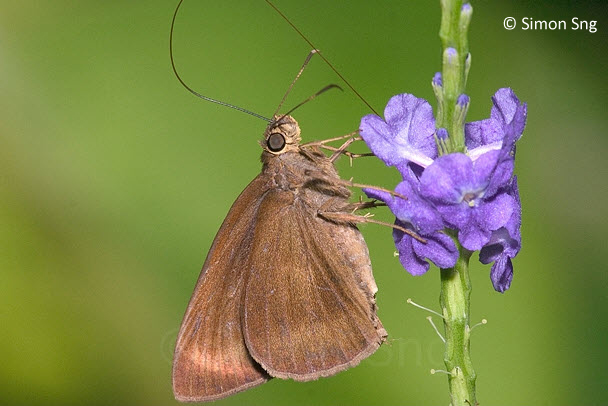
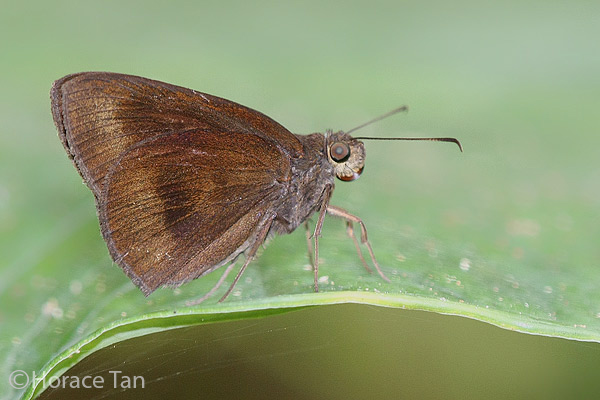
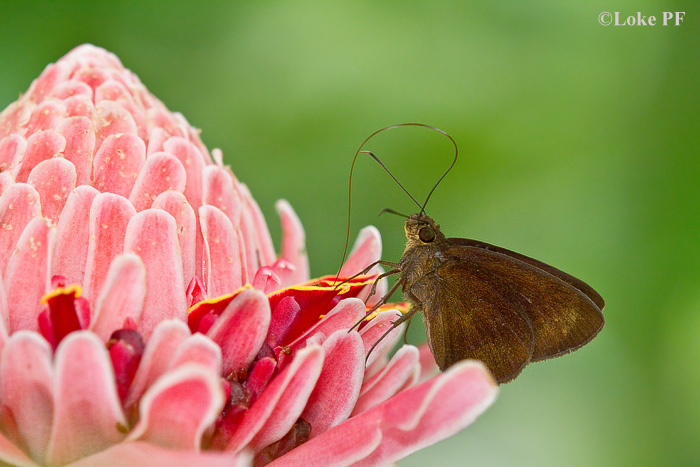
Life History of the Chocolate Demon

Life History of the Chocolate Demon (Ancistroides nigrita maura)


Butterfly Biodata:
Genus: Ancistroides Butler, 1874
Species: nigrita Latreille, 1824
Sub-species: maura Snellen, 1880
Wingspan of Adult Butterfly: 42-50mm
Caterpillar Local Host Plants: Etlingera elatior (Zingiberaceae, common name: Torch Ginger), Hedychium coronarium  (Zingiberaceae, common name: White Ginger Lily, Butterfly Ginger), Zingiber officinale (Zingiberaceae, common name: Ginger), Alpinia aquatica (Zingiberaceae).


Physical Description of Adult Butterfly:
Chocolate Demon is a relatively large skipper. On the upperside, the wings are dark brown and unmarked. On the underside, the wings are brown with marginal areas of both wings paler than the ground colour. The proboscis is particularly long compared to other skipper species.


Field Observations of Butterfly Behaviour:
Chocolate Demon is moderately common in Singapore. The adults are typically found in parks, park connectors and gardens where one of its host plants in the Zingiberaceae is cultivated. The adults fly in an erratic and hopping manner amongst low shrubbery. They visit flowers for nectar, and puddle on birding droppings and other animal excretions.


16 January 2014

Butterflies Galore! : Rustic

Butterflies Galore!
The Rustic (Cupha erymanthis lotis)


The Rustic is a skittish and active butterfly. Very often, when it is encountered - usually in the forested areas of the nature reserves, it is actively flying around and is difficult to shoot. Even when it is feeding at flowers, it tends to continuously flap its wings and twist and turn, making it a species that is challenging to get a good shot of.

There are times when it is observed to puddle at sandy streambanks or forest paths. There are also occasions where it comes down to puddle on a sweaty backpack or towel (it is partial to human sweat!), giving a photographer a much better chance to get a good shot of it. This individual, shot by ButterflyCircle member Loke PF, was puddling on some forest litter.

13 January 2014

Butterflies Galore! : Cornelian

Butterflies Galore!
The Cornelian (Deudorix epijarbas cinnabarus)


This robust-bodied Lycaenid is one of two species from the genus Deudorix that can be found in Singapore. It is observed at urban parks, as well as in the forested nature reserves, usually feeding at flowers. In this shot taken last weekend, ButterflyCircle member Nelson Ong encountered the Cornelian feeding at the flowers of the Mile-A-Minute (Mikania micrantha) weed.

The upperside of the males of this species features crimson wings with broad black borders, whilst the females are a drab copper brown. Caterpillars of the Cornelian have been recorded to feed on pulpy fruits like the Lychee and Pomegranate. More details about this butterfly can be found in an earlier article on this blog here.

11 January 2014

Butterfly of the Month - January 2014

Butterfly of the Month - January 2014
The Common Mormon (Papilio polytes romulus)


A new year, and new challenges and opportunities await us, whether at work, at home or our everyday lives. 2014 is here - galloping at full speed, as the Lunar New Year will herald the Year of the Horse on 31 Jan this year. If you've made your New Year resolutions, I'm sure you'll try to keep them (like you did last year, didn't you?!)


It was a very eventful 2013, some good, some bad.  But life goes on, and we now face the new year with anticipation and optimism, putting the unpleasant events and failures behind us; not forgotten, but learning from the experiences as we move on.


For Singapore, it has been a time of strange flashbacks in the past few years - floods, strikes, riots, and just this month, even a kidnapping, complete with ransom payment! It is almost a re-run of some of the events that were quite prevalent in the 50's and 60's. Over the years as Singapore grew from third world to first, some of these civil unrest events and criminal activities faded for over four decades before re-surfacing like some terrifying kaijus, just biding their time to re-appear and cause havoc to our peaceful little island.


Are all these flashback events just coincidental, or are they ominous signs of worse things to come? Has the world, and Singapore 'progressed' to such a level where the stress and tensions of crowded city living have begun to manifest itself in these normally unusual events in this time and era? Only time will tell.


For our first month of 2014, we feature a common urban species, the Common Mormon (Papilio polytes romulus) a medium sized "Swallowtail" that is more often seen in urban parks and gardens than in the forested nature reserves. Very recognisable with its black wings, a yellowish-white band on the hindwing, consisting of a series of ovoid-shaped spots, and a spatulate tail on the hindwing.


The Common Mormon is a sexually dimorphic species, where the male and female have different appearances. There are two forms of females in Singapore - the form-cyrus which is almost indistinguishable from the male, other than a red lunule in space 1a of the hindwing above, and the form-polytes which has red submarginal spots on the hindwing.


It was believed that the female form-polytes mimics the distasteful Common Rose (Pachliopta aristolochiae asteris) for protection against predators. However, recent debate has questioned this theory, as field experiments have shown that there is a spectrum of unpalatability that suggests a variable range of distastefulness that affects the frequency of predation. Hence the theory of Batesian mimicry in the female form-polytes Common Mormon and the Common Rose is not so clear cut.


The Common Mormon is not a particularly fast flyer, but is often alert and can be skittish when approached. It is often seen in urban parks and gardens where its host plants, mainly plants from the Rutaceae family, can be found. Amongst these host plants are the Citrus species like Pomelo (Citrus maxima) and the Common Lime plant (Citrus aurantifolia). In gardens where the Indian Curry Leaf plant (Murraya koenigii) is cultivated, the butterfly will very often be seen fluttering around.


When the Common Mormon alights to feed at flowers, it continues to flap its forewings rapidly whilst its hindwings are kept relatively still. This is one of the characteristics of the Papilionidae species in terms of flight behaviour. All the six legs of the Papilionidae butterflies are fully developed in both sexes.


The Common Mormon is a frequent visitor to gardens where the Prickly Lantana and the purple Snakeweed are cultivated. It also likes the small white flowers of the Common Asystasia (Asystasia gangetica). Males of the Common Mormon are also often observed puddling at damp streambanks and muddy footpaths.


Text by Khew SK : Photos by James Chia, Sunny Chir, Federick Ho, Huang CJ, Khew SK, Loke PF, Jonathan Soong & Anthony Wong