10 March 2012

The Predator Strikes Back!

The Predator Strikes Back!
(And the Rebels that Got Away)


A female Autumn Leaf showing evidence of a predatory strike

Contrary to what the title of this week's blog article may suggest, no, you won't get to hear stories about things that happened a long, long time ago in a galaxy far, far away. Or see pictures of Yoda or Darth Vader. This is still a butterfly blog, and we are still talking about butterflies. :)


A Commander with its right hindwing damaged : Predatory strike or wear and tear?

If you're also wondering what happened to spectacular photos of pristine and beautiful butterflies that this blog has become known for, this week's article is about strikes - predatory strikes and 'scars' of attacks on butterflies. In nature, butterflies are subject to dangers of all shapes and sizes in the form of predators whose sole objective is to eat the poor butterflies. In my earlier articles about predators (see : Death in the Wind), we featured a whole range of predators that feed on butterflies.


In this article, we show the embattled ones that "got away" with souvenirs of chipped, torn and badly damaged wings that these butterflies suffer from predatory strikes. In earlier articles discussing survival strategies, we had also shown how butterflies have tried to even the odds by employing the use of various 'tricks' to fool predators into either not noticing them altogether, or biting off a part of the wings that are less critical. (See Survival Strategies Part 1 and Part 2)


This invariably allows the victim of a predatory attack to escape alive, albeit without a portion of its wings intact. The surviving butterfly will be "crippled" but buys a few more hours or perhaps days of continued survival to either mate or lay eggs, and allowing it to fulfil its ecological function of procreation of the species.

A Great Mormon with a significant part of its left hindwing torn off by probably a predatory strike

Field observations by ButterflyCircle members have contributed valuable information and photographic records of predatory attacks on butterflies. Whilst there are no conclusive evidence of the type of predator that attacked these butterflies, the damage on the wings could give some forensic clues to the types of strikes that the butterflies had encountered.


The same individual of the male Great Mormon using its forewings to continue to fly and feed

For those butterflies with a symmetrical tear on both wings, a likely predator would be birds, that had tried to take a bite at the victims, but obviously missed delivering a fatal strike. The escaped butterfly continues to go about its daily business, but without a part of its wings. It is quite amazing to consider how much wing material is removed, before the butterfly it totally crippled and unable to fly.


In spite of its aposematic colours, this female Malay Lacewing is not spared a predatory strike

Despite the damage, many of these predator-struck butterflies appear to be still able to fly relatively 'normally'. However in some cases, the ability to shift into high gear and take off at their usual speeds is drastically reduced, suggesting that a 2nd attack by a predator would most likely be fatal. Furthermore, the erratic flight of the damaged butterfly would also call attention to itself and the weakened flight would almost certainly attract nearby predators to attack a "sitting duck".


A "one-armed" Commander with its left forewing substantially bitten off

In cases where the wing damage is asymmetrical, e.g. only one side of the wings are torn, it could suggest that the butterfly was sunbathing with its wings opened flat, and the predator managed to take a chunk off one wing as it struck but missed. However, it will be almost impossible to conclude if the predator was a bird, a lizard, a shrew or any other attacker with mouth parts large enough to take a piece off the butterfly's wing.


The typical behaviour of the butterfly species is also quite consistent with the types of damage on the wings. For example, a ground lurker like the Ypthima species are more likely to be attacked by a reptile whilst it is sunbathing on a low bush. Some field examples tend to show asymmetrical bite marks on one side of the wings only.


A Dark Blue Jungle Glory with a symmetrical bite mark on its hindwings

For a Dark Blue Jungle Glory, that spends most of its day foraging amongst litter on the forest floor, its most likely attacker would be a snake, lizard or a small mammal?


The fast flying Blue Jay that shows hindwings that bear evidence of a predator strike

Even the "turbo-charged" butterfly species, that are usually skittish and fly at tremendous speeds, are not spared predatory attacks. Despite their propensity for high-speed flights and alertness, no butterfly can continue to do so all the time. When they come down from lofty perches to rest or feed, that is when a lurking predator has an opportune time to launch a strike at the butterfly.


Where are my light sabres? A "swordless" Five Bar Swordtail - a probable victim of a predator strike

Examples shown here, are two fast flying Paplionidae species, where under normal circumstances are very alert and skittish, and rarely give any chances for predators to chase and attack them when in full flight. However, it is likely that their torn hindwings are examples of predatory strikes that occur when they were at rest or puddling.


The near-symmetrical bite marks on these two different Flash species suggest a predator attacking the "wrong" side of the butterfly allowing it to escape alive

The Lycaenidae, which employ decoy tactics whereby a predator is fooled into attacking a less vital part of its wings, often show evidence that this survival strategy does work quite successfuly in the field.

Two Lycaenids with their tornal areas bitten off

We have come across quite a number of individuals that display scars of such attacks, where the hindwings are torn in a symmetrical manner, suggesting that the predator had been fooled into attacking the "wrong" side of the butterfly where its false eyes and antennae are located.


Can this poor Peacock Pansy actually still fly?

Yet other species, which feature eyespots and rings on their hindwings, appear to also show signs of attacks on the parts of their wings where the false eyes are located. Again, in the shown example of the Chocolate Pansy below, a large part of the hindwings has been bitten off, yet it continued to fly and glide quite normally... until the next (and probably fatal) strike occurs.


The near symmetrical tear on both the hindwings suggest a predatory strike when the butterfly was resting with its wings folded upright

And so we see a part of the daily survival of a butterfly, whose life is always fraught with dangers of being a lucky predator's lunch (or not), and how it manages to escape with its life to "fight" for another day. Whilst the exact nature and the actual predator cannot be easily concluded from these pictures, they show some evidence where the clues help to piece together some possible theories as to what attacked these butterflies.
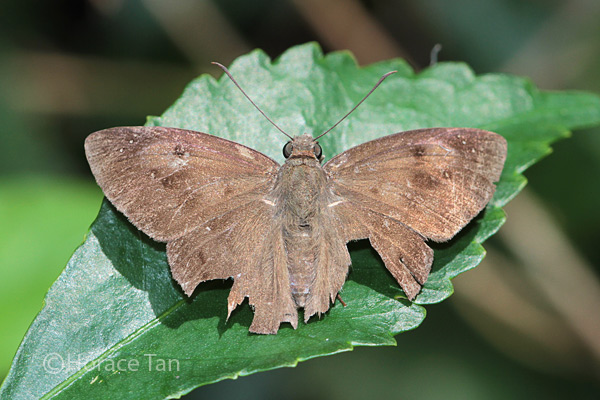
Even this fast-flying Common Snow Flat shows damaged hindwings. Evidence of predatory strike? Or just damage caused by old age?


Text by Khew SK ; Photos by Chng CK, Federick Ho, Khew SK, Loke PF, Horace Tan & Yano

Special Acknowledments to Teo TP for sharing research papers on predator strikes & behaviour ; William Folsom for starting a discussion on this topic on ButterflyCircle's forums

03 March 2012

Life History of the Dark Tit

Life History of the Dark Tit (Hypolycaena thecloides thecloides)


Butterfly Biodata:
Genus: Hypolycaena C & R Felder,1862
Species: thecloides
C & R Felder,1860
Sub-species: thecloides
C & R Felder,1860
Wingspan of Adult Butterfly:26-30mm
CaterpillarLocal Host Plant:
Flagellaria indica (Flagellariaceae).


A sunbathing  Dark Tit  displaying its upperside.

Physical Description of Adult Butterfly:
Above, both sexes are dark brown except for an orange tornal area stretching to space 3 on the hindwing. Prominent black spots are embedded in the orange tornal area in spaces 1b and 2 and within the whitish area in space 1a. Underneath, both sexes are whitish grey with  acell-end bar and a narrow orange post-discal line on both fore- andhindwings.  The forewing apical area, costal margin and termen are shaded in orange.The hindwing has an orange tornal area up to space 3 and a prominent black spot embedded in space 2. Another equally large black spot is featured on the whitish tornal lobe. A prominent orange bar could be found at the base of space 7 in the hindwing. There are two white-tippedtails at ends of veins 1b and 2, with the longer one at vein 1b. Theupperside of the abdomen is colored as per wing upperside, but theunderside is mostly white. The legs are also whiteand black-banded.


Field Observations of Butterfly Behaviour:
This species is moderately rare in Singapore. It can be found in the Central Catchment Reserve, certain wastelands as well as  landward edges of mangrove areas in both the main Singapore island and offshore islands like Pulau Ubin and Pulau Semakau. At times, the adults have been found to  occur in numbers locally at one location. The fast flying adults typically perch with its wings closed upright between flights. In sunny weather, however, they have the tendency to sun-bathe with wings fully open.


Early Stages: 
The Dark Tit is likely to be monophagous as only one host plant has been recorded both locally and across the region. Its host plant, Flagellaria indica, is  a monocotyledon. This is  remarkable  as the majority of  Lycaenidae species feed on dicotyledons.  Also noteworthy is that the same host plant is recorded in Igarashi and Fukuda's voluminous work: Life History of Asian Butterflies, vol. 2, but with the plant wrongly identified as a gramineae species. The caterpillars of the Dark Tit feed on the leaf blades and young/immature stems of the host plant, and  are attended by several ant species.

Host plant: Flagellaria indica.

Three eggs of the Dark Tit found on the host plant in a wetland reserve.

The eggs are laid singly on leaf underside or on the stem of the host plant. Each egg is about 0.7-0.75mm in diameter, white in color with a greenish undertone when freshly laid. It is dome-shaped with a depressed micropylar at the pole.  Large triangular  indentations with rather broad ridges are featured on the egg surface.

Two views of an egg of the Dark Tit.

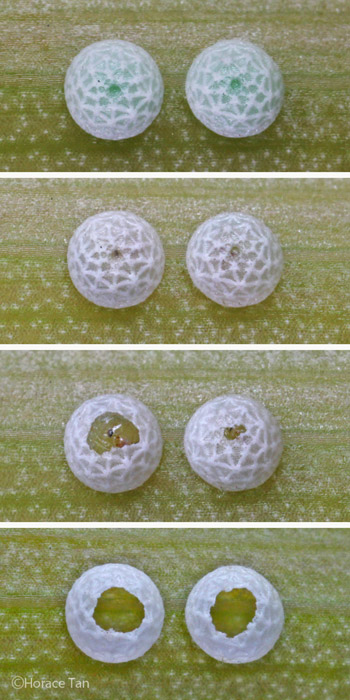
A sequence of 4 snapshots  of egg development.
 
It takes about 3 days for the egg to hatch. The pale yellowish brown newly hatched has a length of about 1-1.1mm. Its head and the rather large pro-thoracic shield are in the same coloration as the body ground colour. The body also features rather long, pale yellowish brown  dorso-lateral and lateral setae (hair).  The newly hatched shows no interest in devouring the remnant of the egg shell after its emergence, and moves straight away to nibble on the leaf lamina in its vicinity. The caterpillar typically leaves a feeding trail  marked with foliage/tissue damage and frass pellets.

Two views of a newly hatched caterpillar of the Dark Tit.

An early 1st instar caterpillar  feeding  on the stem of its host plant (near center of pic).

As it grows, the body color becomes more yellowish.  After about 3-4 days of growth in the first instar, and reaching a length of about 2.4mm,the caterpillar moults to the next instar. Unlike its  cousin, the Common Tit (Hypolycaena erylus teatus), the Dark Tit caterpillars consume the exuvia after each moult.

Two views of a 1st instar caterpillar, late in this stage, length: 2.3mm.

Two views of a 1st instar caterpillar, dormant before its moult.

The 2nd instar caterpillar has numerous pale brown setae over its body, with those occurring dorso-laterally and laterally somewhat longer than the rest. Depending on whether it is feeding on the yellowish brown stem or the green leaf blades, the caterpillar appears to occur in two colour forms: yellowish brown throughout or yellow with a strong green undertone.  Even at this early stage, the dorsal nectary organ is discernible on the dorsum of the 7th abdominal segment. The 2nd instar caterpillar reaches a length of about 4.5-4.8mm, and after about 3 days in this stage, it moults again.

Two views of a 2nd instar caterpillar, early in this stage, length: 2.2mm..

Two views of a 2nd instar caterpillar, late in this stage, length: 4.2mm.

Two views of a 2nd instar caterpillar, dormant before its moult, length: 4.1mm.

The 3rd instar caterpillar resembles the 2nd instar caterpillar closely. One discernible difference is that the numerous setae covering the body are now proportionately shorter and uniform in length. The dorsal nectary organ is also rather large and  prominently featured. However the pair of tentacular organs found on the 8th abdominal segment in most of the other Lycaenidae species are not observed in the Dark Tit, in this and later instars. The 3rd instar takes about 2-3 days to complete with the body length reaching about 6.5mm.

Two views of a 3rd instar caterpillar feeding on the stem tissue, length: 5.5mm

Two views of a 3rd instar caterpillar, late in this stage, length: 6.2mm.

The 4th instar resembles the late 3rd instar caterpillar closely with no obvious changes.  The 4th instar takes about 3 days to complete with the body length reaching about 11mm.

Two views of a 4th instar caterpillar, early in this stage, length: 6.5mm.

Two views of a 4th instar caterpillar, late in this stage, length: 10mm.

A Dark Tit caterpillar feeding on the stem of the host plant.
Note the attending ant and the pile of frass pellets.

The 5th instar caterpillar is again little changed in body features from the earlier two instars. In comparison, its body colour is mainly green. Its dorsal nectary organ seems to be rather  active with droplets of nectary fluid being exuded from time to time.

A newly moulted 5th instar caterpillar of the Dark Tit.

Two views of a 5th instar caterpillar, length: 13.5mm.

Two views of a 5th instar caterpillar, late in this stage, length: 17mm.

A 5th instar caterpillar devouring stem issue in a wetland reserve. Note the attending ant and the fluid droplet on the dorsal nectary organ.

After about 3 days of feeding and reaching a length of about 17mm, the caterpillar stops foodintake, and its body gradually shortened and decolorised to a uniform lime green.  The caterpillar would wander around in seek of a pupation site which is typically a spot on the leaf surface. At this site, the pre-pupatory caterpillar prepares for pupation by spinning a silk girdle and a silk padto which it attaches itself via its anal claspers.  After 1 day as apre-pupa, pupation takes place. The pupa has a typical but stout Lycaenid shape. It is predominantly pale greenand unmarked. Pupal length: 8.5-10mm. 


Two views of an immobile pre-pupa of the Dark Tit.

Two views of a pupa of the Dark Tit.

Seven days later, the pupa turns rather dark, first in the wing pad and thorax,then progressively in the abdomen. The next day, the pupal stage comes to an end with the emergence of the adult butterfly.

Two views of a mature pupa of the Dark Tit.

A newly eclosed  Dark Tit waiting for its wings to expand fully near its pupal case.


References:


  • [C&P4] The Butterflies of The Malay Peninsula, A.S. Corbet and H.M. Pendlebury, 4th Edition, The Malayan Nature Society.
  • Life Histories of Asian Butterflies, Volume 2, S. Igarashi & H. Fukuda, Tokai University Press, 2000.
  • Butterflies of Thailand, Pisuth Ek-Amnuay, 1st Edition, 2006.

Text by Horace Tan, Photos by Wong C M, Loke PY, Chng CK, Nelson Ong  and Horace Tan