06 August 2011

An Audience with the King

An Audience with the King -
Close Encounters with the Rajah Brooke's Birdwing

Two male Rajah Brooke's Birdwings puddling at Kuala Woh Recreational Forest Park


Some time in early June this year, four ButterflyCircle members made the journey up north to Ipoh for a butterfly shooting trip.  We figured out that it would be interesting to try the journey by coach up to Ipoh, and then let Loke borrow his dad's car to explore a few areas around the Ipoh vicinity.

Puddling Kings in the foreground!


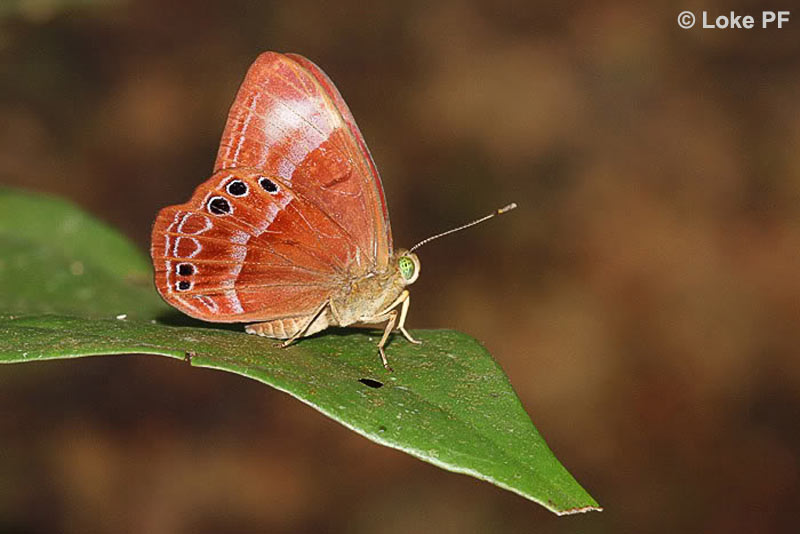
Besides making a trip on the first day, to Gua Tempurung in Gopeng, where the BC quartet managed to shoot quite a number of different species, including some rare Hesperiidae and Lycaenidae, our mission was accomplished when most of us managed to shoot the Dragontails and the Banded Peacock - two species frequently seen in that area.


But the subject of this blog article is our second day's trip to the Kuala Woh Recreational Forest Park.  Having been there many decades back as a school kid with my mentor, I had fond memories of Kuala Woh, where I had collected many species that I had not encountered before.  But amongst my most memorable encounters was with the black and emerald Rajah Brooke's Birdwing (Trogonoptera brookiana albescens). 

An overview signage showing all the features and attractions at the Kuala Woh Park


Situated about 13 km from Tapah Town, the Kuala Woh Recreational Forest today has many user-friendly facilities for picnickers and nature lovers.  As it was a long weekend in Malaysia, with a public holiday, many locals were out in numbers, swimming in the river, enjoying a day out their their family members and having a fun day out at the recreational forest. 

A special sign paying tribute to the King Among Butterflies!


When the four of us arrived at Kuala Woh, the car park was already quite packed, and there were many families out to enjoy themselves on this warm humid day.  After a quick recce, we headed for the banks of the river.  We were pleased to see a number of the Rajah Brooke's Birdwings puddling at the sandy banks just beside the river. 

A congregation of male Rajah Brooke's Birdwings at their puddling ground


The butterflies were mesmerising with their black and green wings, fluttering elegantly in their regal splendour and gliding around looking for the choiciest spots to puddle.  Those that were already on the sand were happily puddling away, often so engrossed in their activity of drinking the salts from the most sand, that one could even hold them between one's fingers! 


Our group unpacked our equipment and started to select the best specimens to photograph.  It was challenging when there were so many of these magnificent birdwings fluttering around.  Interestingly, the green scales on the Rajah Brooke's Birdwings' wings took on slightly different hues of greens and blues (and even appeared yellow) when viewed at different angles, or whether the flash from the camera is on or off.


When we were proning along the sandy bank getting eye-level shots of the butterflies, we realised that the sand was hot to the touch!  We then discovered that the area where the butterflies liked to puddle was actually part of a hot spring, where the water contained high mineral content that the butterflies were looking for.

The environment where the Rajah Brooke's Birdwings were puddling at the river bank


The congregation of Rajah Brooke's Birdwings (all males) continued to puddle, oblivious to the increasing crowd of people swimming in the river, and walking around them.  Each time they were disturbed, they took off, flew around and then quickly returned and settled down to drink from the damp sandy banks, with their long black probosces extended.


After having our fill of many shots of the Rajah Brooke's Birdwings, we took the opportunity to explore around the Kuala Woh Recreational Park. By then it was getting a bit cloudy. But along the forest trails we still managed to observe quite a few species of butterflies, including a male Rajah Brooke's Birdwing that was resting in the shade, no doubt after having his fill of nutrients from the puddling.


Our objective of seeking an audience with the "King of Butterflies" the Malaysian Rajah Brooke's Birding, was granted!  The four of us left, happy and satisfied at having encountered so many of these beautiful and magnificent butterflies that made the trip to Kuala Woh well worth it. 

All ready to board the coach and back to Singapore!


The following day, we took the coach and headed back to Singapore, each of us wondering when we would return to see the "King" again in the future.


Text by Khew SK : Photos by Chng CK, Khew SK, Koh CH and Loke PF

Special thanks for Loke PF for organising this trip and showing our group around his hometown of Ipon, Malaysia

30 July 2011

Life History of Arhopala amphimuta amphimuta

Life History of Arhopala amphimuta amphimuta


Butterfly Biodata:
Genus: Arhopala Biosduval, 1832
Species: amphimuta C & R Felder, 1860
Subspecies: amphimuta C & R Felder, 1860
Wingspan of Adult Butterfly: 38mm
Caterpillar Host Plants:
Macarange bancana (Euphorbiaceae, common name: Common Mahang).


Physical Description of Adult Butterfly:
Above, the male is violet with narrow but regular dark borders; the female is pale purple with broader dark borders than the male. Underneath, for both sexes, the post-discal band on the forewing is slightly dislocated at vein 4, and the post-discal spots in spaces 5, 6 ,7 on the hindwing overlapping and their centres aligned. The spot in space 3 on the forewing is usually an oblique oval. There are tornal green scales in the tailless hindwings which are slightly toothed at the end of vein 2.


Field Observations of Butterfly Behaviour:
This species is relatively common in Singapore. Sightings of the adults largely occur in the Central Catchment Area and Bukit Timah Nature Reserve where its host plant, Macaraga bancana is present in relative abundance. Typically the adults perch with its wings closed, but in sunny weather, they have the inclination to open their wings fully to sunbathe.


Early Stages:
The host plant Macaranga bancana has often been mistaken as M. triloba (click here for a related article). It is a small tree with hollow twigs inhabited by ants of the Cremastogaster genus
and featuring large broad reddish brown stipules at leaf nodes. Leaves are 3-lobed with leaf base broadly rounded. The immature stages of Arhopala amphimuta feed on the young leaves of M. bancana and has a symbiotic relationship with the inhabitant ants. When not feeding, the caterpillars in all instars have the habit of resting on the leaf underside, typically next to the adjoining main ribs at the leaf base.


Host plant: Macaranga bancana. A far view of its foliage.


Host plant: Macaranga bancana. Close-up view of its stem, showing broad and reddish brown stipules and the inhabitant ants.


A mother Arhopala amphimuta laying egg, during and immediate after the oviposition.

The egg is laid singly on the surface of a young leaf of the host plant. Each egg is about 1-1.1mm in diameter, white in color, depressed dome-shaped and feature many small broad-based spikes.


Two views of an egg of Arhopala amphimuta.


A mature egg with part of the chorion eaten away.

It takes 3-3.5 days for the egg to hatch. The newly hatched has a length of about 1.5mm and has a whitish coloration. It has a rather flattened woodlouse appearance with a large semicircular first thoracic segment. The large prothoracic shield is coloured as per the body base color. This onisform appearance remains as the caterpillar grows through the instars but becoming less flattened in later instars. The body also carries long lateral hairs and short dorsal hairs. As it grows, the body color becomes yellowish green.


Two views of a 1st instar caterpillar, newly hatched, length: 1.5mm


1st instar caterpillar, length: 2mm.


Two 1st instar caterpillars, one in early stage (left) and one in late stage (right) of this instar.

After 3-4 days of growth, and reaching a length of about 3mm, the caterpillar moults to the next instar. The 2nd instar caterpillar is yellowish green to green in body colour and has moderatlely long lateral hairs. The dorsum is somewhat more raised in this instar than the earlier instar. The dorsal nectary organ (DNO) and the tentacular organs (TOs) are present now, but they are still too small to be easily distinguisable.
The 2nd instar caterpillar reaches a length of about 5mm, and after about 3-4 days in this stage, it moults again.


The same caterpillar. Top: in late 1st instar stage; Bottom: newly moulted to the 2nd instar.


2nd instar caterpillar, length: 4mm.

The 3rd instar caterpillar resembles the 2nd instar caterpillar closely. The body colour is yellowish green initially and for some specimens this remains so for the entire instar but others take on a pale reddish brown coloration on the lateral area of the body surface. The row of whitish spiracles now stand out against the darker body base colour. The 3rd instar takes about 3-4 days to complete with the body length reaching about 8-9mm.


Two 3rd instar caterpillars. Top: newly moulted, 5mm. Bottom: 6.5mm.


Two 3rd instar caterpillars resting against the main ribs at the leaf base.

The 4th instar caterpillar has similar appearance as in the 3rd instar. The intensity and extent of the reddish coloration on the body surface vary from specimen to specimen as depicted in the following series of three pictures. Now the DNO and TOs are all easily discernible. The 4th instar takes about 3-4 days to complete with the body length reaching up to 12-13mm.


Two views of a 4th instar caterpillar, length: 9mm.


Two views of another 4th instar caterpillar, with lesser intensity of reddish brown coloration, length: 9mm.


Two views of another 4th instar caterpillar, with greater intensity of reddish brown coloration, length: 11.5mm

The 5th instar caterpillar has similar body markings and variation of body colour as in the early two instars. With the increased body mass, the caterpillar has a less flattened body shape. In the field, these final instar caterpillars can be found resting against the reddish brown stipules on the stem.


Two views of a 5th instar caterpillar, late in this stage, length: 18mm.


The nectary organs of a 5th instar caterpillar. Dorsal nectary organ (DNO) on the 7th abdominal segment and the tentacular organs (TOs) on the 8th abdominal segment.


Two views of a 5th instar caterpillar being attended by ants which are particularly interested in the dorsal nectary organ (left side of the picture).

After about 7 days of feeding and reaching up to a length of 20mm, the caterpillar slows down and stops food intake for about 1 day. During this time, its body length gradually shortened. In the field, the caterpillar has been observed to choose the spot next to stipules as its pupation site. In a home breeding environment, the caterpillar chooses the gaps or space between leaf blades when leaf litter is offered.


A late 5th instar caterpillar resting against the reddish brown stipule in the field.


A pre-pupa of Arhopala amphimuta.

The pre-pupa caterpillar prepares for pupation by spinning a silk girdle and a silk pad to which it attaches itself via cremastral hooks. After 1 day as a pre-pupa, pupation takes place. The pupa, with a length of 13-14mm, has a shape typical of a Lycaenid species, and has a somewhat produced anal segment. It is mostly yellowish brown in coloration with dark brown patches in the wing cases and in mid body segments.


Two views of a pupa, length: 13mm

Eight days later, the pupa becomes darken especially in the thorax and wing cases, signalling that the pupal stage is coming to an end. The next day, the adult butterfly emerges.


Two views of a mature pupa.


A newly eclosed Arhopala amphimuta. Note the aberrated spots on the hindwings.


A 5th instar caterpillar being attended by ants in the field.

References:

  • [C&P4] The Butterflies of The Malay Peninsula, A.S. Corbet and H.M. Pendlebury, 4th Edition, The Malayan Nature Society.
  • Butterflies of Thailand, Pisuth Ek-Amnuay, 1st Edition, 2006
Further Readings:
  • Immature stages and biology of Bornean Arhopala butterflies feeding on myrmecophytic Macaranga, T. Okubo, M. Yago and T. Itioka, Trans. Lepid. Soc. Japan, 60(1), pp.37-51, 2009
Text by Horace Tan, Photos by Henry Koh, Mark Wong, Anthony Wong, Federick Ho, Sunny Chir and Horace Tan

27 July 2011

Butterfly Portraits - Magpie Crow

Butterfly Portraits
Magpie Crow (Euploea radamanthus radamanthus)


I still have vivid memories of how I chased and stalked this Magpie Crow (Euploea radamanthus radamanthus) on 22 June 2009 in Endau Rompin National Park, Johor. This male Magpie Crow was flitting and puddling on the riverbank. There weren’t any other species for me to shoot on that very quiet morning, so photographing this “Crow” became my focus.

I knelt down to attempt a puddling shot whenever it settled down on the sandy ground. Being  alert and skittish, it took off each time I inched forward. This happened a few times but allowed me to notice its taking-off flight was rather slow and lethargic. The idea of capturing an in-flight shot flashed through my mind, So , for the next few minutes, I didn’t have to “go down” to shoot it, what a relief !

Technically speaking, this was just an ordinary shot - the sharpness and composition are far from good. However, I treasure this shot very much because It was a precious reward for my determined and relentless effort that allowed me to nail this in-flight shot showing the uppersides of the Magpie Crow - a timely capture of an instantaneous moment. To me, nature photography is about how an interesting or a rare moment of any natural phenomenon being captured permanently that would make a person remember and marvel at it for a long time – just like this shot does for me.

Today, trekking cum butterfly photography is my weekend routine. I had many wonderful and fond memories of shootings and outings with friends from ButterflyCircle. Thank you very much and hope we would continue enjoy walking this butterfly photography journey together to scale new heights in the quest of understanding butterfly species and helping them to thrive in nature.

ButterflyCircle Photographer : Federick Ho in his early 50's who works in the education sector


23 July 2011

Butterfly of the Month - July 2011

Butterfly of the Month - July 2011
The Spotted Judy (Abisara geza niya)


And so, we gallop past the half-way mark of 2011, and way into the month of July.  In some areas, the global turmoil seemed to have abated and things are returning to normalcy.  However, in this age and time, we have been trained to expect the unexpected.  Singapore's economic recovery stabilised, as our little city state prepares to face new challenges with an uncomfortable trepidation.


The political atmosphere appears to have taken an approach where the citizenry has become more vocal and no punches are pulled when engaging the authorities.  Yet the government is now more willing to listen and to debate policies and new directions.  In some quarters, the old timers opine that the government has gone soft.  But change is here to stay, and we will have to see how the new style of public engagement can continue to see Singapore prosper and grow in the years to come.


On a more day-to-day view of things, the Certificate of Entitlement has breached the S$70,000 mark and rising.  For the less familiar amongst our readers, the COE is a piece of paper that gives a car owner the licence to buy and own a car - for the next ten years at least.  Whenever I explain this quota system of managing the republic's car population on the roads to my foreign friends, I usually get looks of amazement and disbelief.  When the realities of the monetary amounts sink in, my friends will often think that Singaporeans are mad, spending that kind of money (which is now of a higher value than the car itself) on a piece of paper!  Nowhere else in the world has such a system!  Uniquely Singapore, we call it...


The birthstone for July is the Ruby, a pink to blood-red gemstone.  The ruby is considered one of the four precious stones, the others being the sapphire, emerald and diamond.  The red colour of this stone is caused by the element chromium.  I will always remember the rubies that I've seen in Myanmar during my earlier trips there, and the most sought-after and valuable ones came from the province of Mogok, famed for their 'pigeon's blood' stones.   


The glowing ruby shall adorn,
Those who in July are born;
Then they'll be exempt and free
From love's doubts and anxiety.
- Gregorian Birthstone Poems


A mating pair of the Spotted Judy


For July's Butterfly of the Month, we feature the Spotted Judy (Abisara geza niya).  The Judys belong to a family of butterflies in the Riodinidae family, usually referred to as Metalmarks.  Of the three extant species of the genus Abisara here in Singapore, two, the Spotted and Malayan Plum Judys are coloured a deep red. 


The Judys are relatively small-sized butterflies usually with a wingspan of no more than 45mm.  They have a unique habit of hopping actively from leaf to leaf with half-opened wings.  Most of the species in the genus favour the shady forest understorey, and are mainly active in the early and late afternoon hours of the day.


The Spotted Judy is recognised by the pale sub-apical patch of the forewing and the black submarginal spots on the hindwing.  One of the characteristics of this species is that the underside of the hindwing's post-discal band is dislocated at vein 4.  This dislocation is variable, and is usually more pronounced in the female than in the male.  The prominently angled hindwing is more rounded in the male, but is more angular in the female.  


Three views of the upperside of the Spotted Judy with varying sidelight angles that reveal the vivid blue colour


The species feature attractive emerald-coloured eyes, and is unique in that the females have six fully-developed legs, whilst the males have only four fully-developed legs.  The males' remaining pair of legs (the forelegs) appear more like hair tufts and are useless for walking.The upperside of the wings of the males, when viewed at certain angles and in a sidelight, feature a strong purple-blue sheen.


The Spotted Judy cannot be said to be very common, but at certain favoured localities, several individuals can often be observed dog-fighting in the late afternoon hours of the day.  They will return again and again to the same favourite perches and then take off to 'attack' another individual that strays into its territory.  


Text by Khew SK : Photos by Chng CK, James Chia, Sunny Chir, James Foong, Khew SK, Loke PF, Benedict Tay and Benjamin Yam


20 July 2011

Butterfly Portraits - The Plane

Butterfly Portraits
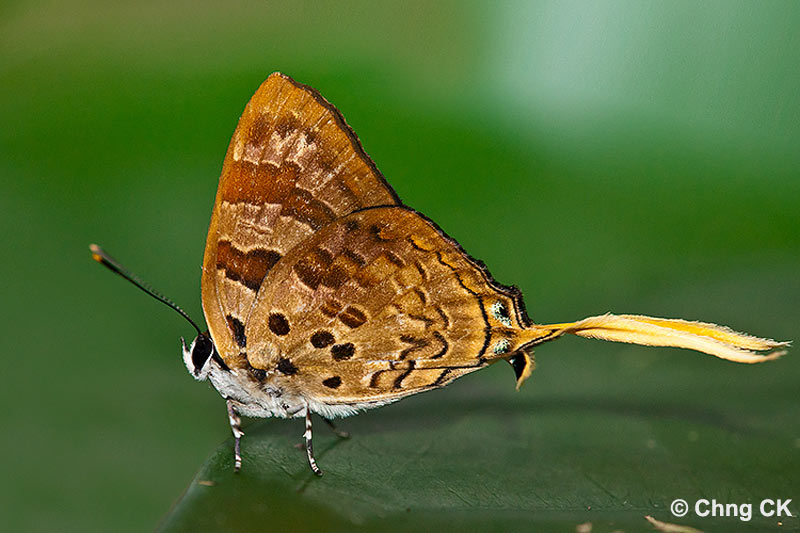
The Plane (Bindahara phocides phocides)


Canon 5D MkII with Speedlight 580EXII, Tamron 180 F3.5, Manual Mode, 1/125s, f/5.0, ISO2000, fill-flash, Handheld.

It was a cloudy Sunday morning when Anthony, Mark and I arrived at our favourite hunting ground within the Central Catchment Area. Today, I had only one objective on my mind - to shoot The Plane. I settled immediately around the area the Plane had been spotted in recent weeks. After a while, I received several SMSes from Mark, reporting that he had seen some rare species along another nearby trail. I was quite tempted to join him but told Anthony to proceed first. This turned out to be the right decision.

Left alone, I went slightly off-trail into an area that was heavily shaded by the thick forest canopy. Scanning around like a predator hunting for its prey, it was when I looked through the gaps of some leaves that I saw a brown butterfly perched at eye level about 2 feet away. I took a second look to check out its wing pattern and the long tail. To my delight, The Plane had landed right in front of me !

The first thing that went through my mind was to take a record shot. A few branches and leaves in front were blocking the lens, so I used the lens hood to carefully find an opening for an unblocked view. With the record shots safely in the bag, I decided to take my chances by moving the obstructing branches and leaves away carefully, knowing from experience that the they might be “connected” to the leaf on which the Plane was resting. Carefully, I managed to move the obstructions away without frightening the butterfly off. This allowed me to go a step forward for a near full frame shot.

My initial shots looked fine, except that the background was messy and dark. I switched to manual mode, pumped up the ISO and opened up the aperture. I lowered myself a little to be more parallel to the wings this time, steadied my feet again while tightening my grip firmly on the 5D MkII before squeezing off another 4 more shots.

Although this shot wasn’t up to the usual ButterflyCircle photography standards, it was an unforgettable one for me. After all, I have finally shot my avatar.

ButterflyCircle Photographer : Chng CK in his 40's who works in the aviation industry.