
Butterfly Biodata:
Genus: Doleschallia C. & R. Felder, 1860
Species: bisaltide Cramer, 1777
Subspecies: ?bisaltide var. Eliot, 2006
Wingspan of Adult Butterfly: 85mm
Caterpillar Local Host Plants: Asystasia gangetica (Acanthaceae), Pseuderanthemum laxiflorum (Acanthaceae), Pseuderanthemum carruthersii var. reticulatum (Acanthaceae).

An Autumn Leaf puddling on a wet surface.

Another puddling Autumn Leaf giving us a view of its upperside.
Physical Description of Adult Butterfly:
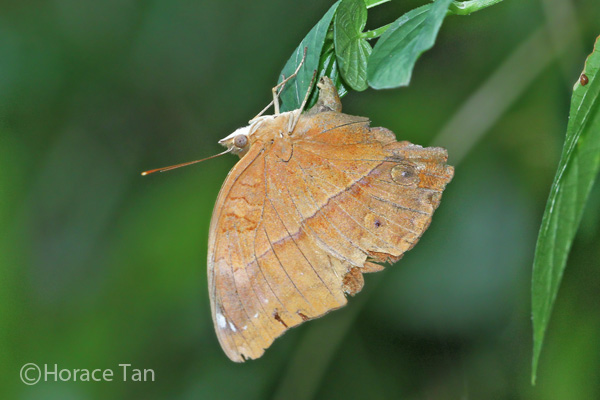
Above, the wings are orange brown but with the forewings broadly darkened at the apex. There are four to five white spots in the black apex of the forewing. An irregular cell-end black streak reaches the black distal margin. Underneath, the wings are greyish brown and marked with various irregular shaped streaks/patches in different colors. The hindwing tornus is protruded into a short tail, and this aids in giving an resting adult butterfly (with wings closed) a leaf-like resemblance.

An Autumn Leaf puddling on damp ground in a wasteland.

A sun-bathing Autumn Leaf perching on a leaf.
Field Observations of Butterfly Behaviour:
This subspecies of D. bisaltide has a dominant presence in Singapore compared to D. bisaltide. pratipa (which is localized to just one small habitat in the north). It has a wide-spread occurrence across multiple habitats, both in and out of the nature reserves, such as urban areas, nature parks and wastelands, swampy forests. This is likely due to the fact the one of its three known local host plants, Asystasia gangetica, is a common weed, and that the other two (Pseuderanthemum spp.) are cultivated and used as ornamental plants. The fast flying adults can be seen taking nectar at flowering shrubs/trees and puddling on damp grounds. According to J.N. Eliot [C&P4 Rev], the origin of this new taxon is unknown but could have reached Singapore and Malaysia by "island-hopping" from Java. Before the researchers could agree on an appropriate subspecies name, it is tentatively referred to as "?bisaltide var.".

An Autumn Leaf perching on the underside of a leaf.

An Autumn Leaf paying a visit to Lantana flowers in a northern park connector.
Early Stages:
The caterpillars of the Autumn Leaf feed mainly on leaves of its host plants. Due to the ubiquitous occurrence of the weed, Asystasia gangetica, it is the host plant of choice commonly utilized by immature stages of Autumn Leaf in Singapore. Indeed, the same weed also serves as larval food source for another two Nymphalid butterflies, the Jacintha Eggfly and Blue Pansy.
Genus: Doleschallia C. & R. Felder, 1860
Species: bisaltide Cramer, 1777
Subspecies: ?bisaltide var. Eliot, 2006
Wingspan of Adult Butterfly: 85mm
Caterpillar Local Host Plants: Asystasia gangetica (Acanthaceae), Pseuderanthemum laxiflorum (Acanthaceae), Pseuderanthemum carruthersii var. reticulatum (Acanthaceae).

An Autumn Leaf puddling on a wet surface.

Another puddling Autumn Leaf giving us a view of its upperside.
Physical Description of Adult Butterfly:
Above, the wings are orange brown but with the forewings broadly darkened at the apex. There are four to five white spots in the black apex of the forewing. An irregular cell-end black streak reaches the black distal margin. Underneath, the wings are greyish brown and marked with various irregular shaped streaks/patches in different colors. The hindwing tornus is protruded into a short tail, and this aids in giving an resting adult butterfly (with wings closed) a leaf-like resemblance.

An Autumn Leaf puddling on damp ground in a wasteland.

A sun-bathing Autumn Leaf perching on a leaf.
Field Observations of Butterfly Behaviour:
This subspecies of D. bisaltide has a dominant presence in Singapore compared to D. bisaltide. pratipa (which is localized to just one small habitat in the north). It has a wide-spread occurrence across multiple habitats, both in and out of the nature reserves, such as urban areas, nature parks and wastelands, swampy forests. This is likely due to the fact the one of its three known local host plants, Asystasia gangetica, is a common weed, and that the other two (Pseuderanthemum spp.) are cultivated and used as ornamental plants. The fast flying adults can be seen taking nectar at flowering shrubs/trees and puddling on damp grounds. According to J.N. Eliot [C&P4 Rev], the origin of this new taxon is unknown but could have reached Singapore and Malaysia by "island-hopping" from Java. Before the researchers could agree on an appropriate subspecies name, it is tentatively referred to as "?bisaltide var.".

An Autumn Leaf perching on the underside of a leaf.

An Autumn Leaf paying a visit to Lantana flowers in a northern park connector.
Early Stages:
The caterpillars of the Autumn Leaf feed mainly on leaves of its host plants. Due to the ubiquitous occurrence of the weed, Asystasia gangetica, it is the host plant of choice commonly utilized by immature stages of Autumn Leaf in Singapore. Indeed, the same weed also serves as larval food source for another two Nymphalid butterflies, the Jacintha Eggfly and Blue Pansy.

Local host plant #1: Asystasia gangetica.

Local host plant #2: Pseuderanthemum laxiflorum.

Local host plant #3: Pseuderanthemum carruthersii var. reticulatum.
A tattered mother Autumn Leaf ovispositing on the leaf underside of Asystasia gangetica.
The eggs of the Autumn Leaf are typically laid in a small group of two to three on the underside of a leaf of the host plant. The creamy white egg is somewhat globular (with a polar axis longer than the equatorial diameter). It has a blunt top with the micropylar sitting in the middle. The surface is marked with very shallow and inconspicuous pits which are roughly hexagonal to rectangular in shape. Each egg has a diameter of about 1mm.

Two views of an egg of the Autumn Leaf, diameter: 1mm.

Two views of a mature egg of the Autumn Leaf. Note the large dark brown head capsule and body setae now clearly visible through the egg shell.

Two views of a mature egg of the Autumn Leaf. Note the large dark brown head capsule and body setae now clearly visible through the egg shell.
The egg takes about 3 days to hatch. The young caterpillar emerges by eating away part of the egg shell. The rest of the egg shell becomes the first meal for the newly hatched which is 2.5mm in length. It has a cylindrical and pale yellowish body covered with many small tubercles and moderately long black setae (hair). The head capsule is black in colour.

A newly hatched Autumn Leaf caterpillar soon after its emergence.

Two views of a newly hatched 1st instar caterpillar.
The 1st instar caterpillar feeds on the leaf lamina leaves The leaf diet causes the caterpillar to become yellowish green in body colour. The body turns orangy brown towards the end of this instar. After reaching about 6mm in 3-3.5 days, the caterpillar moults to the 2nd instar.

Two views of 1st instar caterpillar, length: 4.8mm.

Two views of 1st instar caterpillar, late in this stage, dormant prior to its moult, length: 6.2mm.
The body of the 2nd instar caterpillar is yellowish brown in base color with a strong green undertone. Moderately long dark brown processes, each of endowed is with several short setae, run along the length of the body. On each side of the body, there are three series of such processes: One series occurs dorso-laterally, another lateraly and the last sub-spiracularly. The base of the sub-spiracular processes on abdominal segments 1-8 are yellowish to orangy. The head capsule is black with two cephalic horns. Short white dashes mark the dorsum of almost all body segments. This instar lasts about 2.5-3 days with the body length reaching about 11.5mm.

Two views of a 2nd instar caterpillar, early in this stage, length: 8mm

Two views of a late 2nd instar caterpillar, dormant prior to its moult, length: 10.5mm
The 3rd instar caterpillar resembles the 2nd instar caterpillar closely. As growth proceeds in this instar, markings of short white dashes appear dorso-laterally. This instar takes about 2-3 days to complete with body length reaching about 23mm.

Two views of a 3rd instar caterpillar, late in this stage, length: 22.5mm.

Three caterpillars of Autumn Leaf found on Asystasia gangetica in a hill park.
The 4th instar caterpillar closely resembles the 3rd instar caterpillar, but with markings of short white dashes appearing between the base of sub-spiracular processes. The 4th instar lasts 2-3 days with the body length reaching about 35-37mm.

Two views of a 4th instar caterpillar, later in this stage, length: 30mm.

Two views of a late 4th instar caterpillar, dormant before its moult, length: 34mm.
The 5th (and final) instar caterpillar is similar to the 4th instar caterpillar but with all white dashes much bolder and more prominent. An additional band of white dashes appear laterally in this instar. The black head capsule also takes on a bluish to greenish sheen.

A 5th instar caterpillar, newly moulted. Note the exuvia behind the caterpillar.

Two views of a 5th instar caterpillar, length: 55mm.

Two views of a 5th instar caterpillar, length: 60mm.

5th instar caterpillars found on Pseuderanthemum laxiflorum in the Southern Ridges..
The 5th instar lasts for 5-6 days, and the body length reaches up to 70mm. On the last 0.5 day, the body becomes shortened and the caterpillar ceases feeding and wanders around. Eventually it stops at a spot on the underside of a leaf or a stem, not necessarily that of the host plant, and spins a silk pad from which it hangs vertically to take on the pre-pupatory pose.

A pre-pupa found on the leaf underside of Asystasia gangetica in a wasteland.

A close-up view of a pre-pupa of the Autumn Leaf.
The pupation event of a Autumn Leaf caterpillar.
Pupation takes place about 0.5 day later. The pupa suspends itself from the silk pad with no supporting silk girdle. It is entirely pale brown with dark brown shadings, more so in the wing pads. Dorsally and dorso-laterally there are a number of regularly-spaced black spots. Black fine lines, on on each side, occur dorso-laterally, The dorsum of the thoracic segments and the ventrum of the posterior abdominal segments are also marked with a dark line. There are two short but pointed cephalic horns. Length of pupae: 29-31mm.

Three views of a pupa of the Autumn Leaf.

A pupa found on the leaf underside of Asystasia gangetica in a neglected corner of a condominium.

Three views of a mature pupa of the Autumn Leaf.
After about 7 days of development, the pupal skin of the mature pupa turns translucent and the whole pupa becomes mostly black at this stage. Now it is possible to see the white spots and orange patches on the forewing upperside. The eclosion event takes place the next day.
The eclosion event of an Autumn Leaf.


Two newly eclosed Autumn Leaf butterflies clinging on to their empty pupal cases.

A newly eclosed Autumn Leaf on a leaf perch.
References:
- [C&P4] The Butterflies of The Malay Peninsula, A.S. Corbet and H.M. Pendlebury, 4th Edition, Malayan Nature Society.
- [C&P4 Rev] Updating The Butterflies of The Malay Peninsula, J.N. Eliot, Malayan Nature Journal, 59(1), p.1-49, 2006.
- Butterflies of Thailand, Pisuth Ek-Amnuay, 1st Edition, 2006
Text by Horace Tan, Photos by Mark Wong, Loke P F, Anthony Wong, Sunny Chir, Khew S K and Horace Tan


