01 January 2011

Re-Discovery of the Detached Dart

Re-Discovery of the Detached Dart (Potanthus trachala tytleri)
Species #296 of the Singapore Butterflies Checklist


Happy New Year to all ButterflyCircle members and blog readers. It is the 1st of January of the year 2011, and we start off the year with some good news with the addition of one more species to the Singapore Checklist. The checklist is now at 296 species and counting, and we hope that the year 2011 will bring more good cheer.


A clump of the host plant of at least 4 different species of skippers - all on the same plant!

A shot of the inflorescence of the host plant and a close up of the florets

On a late Sunday afternoon, whilst out on a short butterfly photography outing at a urban park when I came across a number of leaf shelters on a clump of long grass (possibly Panicum maximum - to be confirmed). Knowing that there would likely be caterpillars of the Hesperiidae, I checked the leaf shelters and discovered at least 5-6 caterpillars of various instars on the grass blades.


A female Formosan Swift (Borbo cinnara) ovipositing on the host plant that three other species of caterpillars were found, including that of the Detached Dart

Interestingly, the caterpillars appeared different and were likely to be of different species. As this was an opportune moment to record the life histories of some of these skipper species, I passed the caterpillars to Horace Tan, our avid cat farmer, in whose good hands I would be certain would see the caterpillars bred successfully and documented in Horace's usual meticulous recording.


Amongst the species that were successfully bred were the Palm Dart (Telicota augias augias), Full Stop Swift (Caltoris cormasa) and a Potanthus sp. which we could not identify with certainty. Horace later obtained a few more eggs to complete the life history of this Potanthus from the same clump of host plant.


However, the early stages of the caterpillar seemed to coincide with the pictures documented in the Butterflies of Hong Kong (Bascombe, Johnston & Bascombe) for the species Lesser Band Dart (Potanthus trachala). The distinctive head capsule and anal plate of the 5th instar caterpillar matches the same species on Plate 105 of the book, showing in full colour the early stages of this species.


Upon eclosion, the male and female specimens were examined and matched against the various references and ID keys. After consulting two experts - one from Hong Kong and one from Malaysia, it was confirmed that the species thus bred from the eggs and caterpillar found at this urban park was indeed Potanthus trachala tytleri.

It is curious though, that the same species is given different common English names in different regions. In the Hong Kong references, this species is called the Lesser Band Dart. In Indian website references, this species is called Detached Dart. In our main Thai reference, Butterflies of Thailand, also calls it the Detached Dart. However, another Thai website calls it the Broad Bident Dart.


For consistency of the common names given to the species in the South East Asian region covering Thailand, Malaysian and Singapore, we will give preference to the name Detached Dart, taking reference from the name given in the Butterflies of Thailand book by Pisuth Ek-Amnuay.


The Detached Dart is larger than the typical Potanthus species and usually larger than the more commonly encountered Lesser Dart (Potanthus omaha omaha). It has a wingspan of about 28-30mm, compared the the Lesser Dart's 20-24mm. and the Large Dart's (Potanthus serina) 30-35mm.


The species can usually be separated from the other species in the genus in that the spots in spaces 4 and 5 of the forewing above are detached and out of line from the spots below. The post-discal spots in spaces 2 and 3 are outwardly concave and deeply excavated. On the upperside of the hindwing, there is usually a conspicuous spot in space 7 and none in space 6. The underside is dark brown with yellow dusting.


In the field, it is not easy to spot the differences amongst the lookalike Potanthus species, and it was only with this chance discovery of the early stages of this species that we now re-instate the Detached Dart to the Singapore Checklist. Given this find, there is always the possibility that more of the Potanthus species occur in Singapore as well. It will only be matter of time and luck that will yield more of these lookalike species to be added to the checklist in due course. Special thanks to Horace Tan for re-discovering this species through his recording of the early stages of the Detached Dart.

Text by Khew SK ; Photos by Horace Tan & Khew SK

References :
  • [C&P4] The Butterflies of The Malay Peninsula, A.S. Corbet and H.M. Pendlebury, 4th Edition, The Malayan Nature Society.
  • Butterflies of Thailand, Pisuth Ek-Amnuay, 1st Edition, 2006
  • The Butterflies of Hong Kong, M. Bascombe, G. Johnston, F. Bascombe, Princeton University Press 1999

Acknowledgments :

  • National Biodiversity Centre, National Parks Board, Singapore for issuing official research permits to selected members of ButterflyCircle to collect and document early stages of butterflies on State Land under NParks' jurisdiction

25 December 2010

Life History of the King Crow

Life History of the King Crow (Euploea phaenareta castelnaui)


Butterfly Biodata:
Genus: Euploea Fabricius, 1807
Species: phaenareta Schaller, 1785
Subspecies: castelnaui C & R Felder, 1865
Wingspan of Adult Butterfly: 105mm
Caterpillar Local Host Plant: Cerbera odollam (Apocynaceae, Common name: Sea Apple, Yellow-Eyed Pong Pong).


A King Crow showing us its upperside while resting on a leaf of the Wild Cinnamon on an urban hill park.


Another King Crow on a leaf perch, showing us its wing underside.

Physical Description of Adult Butterfly:
Euploea phaenareta is the largest species of its genus. As is typical of this genus, the termens are slightly crenulate. Above, the wings are dark brown. On the forewing, there is a series of discal spots, post-discal spots and submarginal spots, all whitish with a slight violet tinge. The discal and post-discal spots are larger in size towards the apex. There is also a small white spot in the forewing cell. On the hindwing, there is a whitish patch at the apex. Underneath, the wings are marked similarly as per the upperside though with variation in size of the white spots. The male has a large and raised scent patch in the hindwing cell.


A King Crow on a leaf perch.


Another King Crow found in an urban park.

Field Observations of Butterfly Behaviour:
The King Crow is considered rare in Malaysia (C&P4) but in Singapore, it is not uncommon especially at sites where its host plant, the Pong Pong Tree, is found growing naturally (such as in mangrove areas and parts of the nature reserves) or cultivated in abundance. In the recent past, the host plant was commonly planted as a roadside tree and as a result, King Crow was brought into urban areas and parks. However this practice has changed over time, and nowadays, the cultivation of the plant is confined to various urban parks. This change has an effect of restricting the appearance of King Crow to such sites. Sightings of the slow flying adults includes individuals or small groups visiting flowering trees and puddling on wet ground.


A King Crow balancing itself on a tiny perch.

Early Stages:
In the region, the host plants recorded for this species are the Yellow-Eyed Pong Pong (Cerbera odollam) and the Red-Eyed Pong Pong (Cerbera manghas). In Singapore, only the former has been recorded as the host plant, due largely to the very rare occurrence of the latter. The caterpillars of King Crow feed on leaves of the Pong Pong Tree.


Host plant: Cerbera odollam (Yellowed-Eyed Pong Pong).


A mother King Crow laying egg on a leaf of the Pong Pong tree

The eggs of the King Crow are laid singly on the underside of a leaf (typically young leaf) of the host plant. The creamy yellow eggs are tall (about 1.6mm in height) and somewhat cylindrical (diameter: 1.2mm) with a rounded top. The egg surface is ribbed.


Two views of an egg of the King Crow.


Two views of a mature egg of the King Crow.

The egg takes about 3.5 days to hatch. The young caterpillar emerges by eating away part of the egg shell. The rest of the egg shell becomes the first meal for the newly hatched, which has a length of about 3mm. Its cylindrical body is pale yellowish. The large head capsule is black in color. A pair of very short and inconspicuous protuberances can be found on the dorsum of each of the following three segments: 2nd and 3rd thoracic segments, and the 8th abdominal segment.


Two views of a newly hatched caterpillar eating the last of the egg shell, length: 3mm.

Once the newly hatched moves on to feed on the leaf lamina, its body starts to take on a green undertone. The growth is rather rapid with the body length doubled to 6mm in about 1.5-2 days. Towards the final half day of the 1st instar, the body takes on yellowish brown ring markings on all segments with the exception of the prothoracic segment. Laterally, the body also assumes a yellowish tinge above and below the spiracles.


Two views of a 1st instar caterpillar, several hours old, length: 3.6mm


Two views of a 1st instar caterpillar, late in this stage, length: 6mm.

The body of the 2nd instar caterpillar has a white ground color. There are black rings on each of the body segments except for the very 1st segment. The most obvious change is the lengthening of the 6 tiny protuberances seen in the 1st instar to short processes, each of which is almost entirely black. There are two small black spots on the dorsum of the prothorax, and one large black patch (anal plate) on the posterior end of the body. The body is also colored yellowish to orangy in the super- and sub-spiracular areas. This instar lasts only 1.5-2 days with the body length reaching 12.5mm before the moult to the 3rd instar.


Two views of a newly moulted 2nd instar caterpillar, length: 3.2mm


Two views of a 2nd instar caterpillar, late in this stage, length: 11mm

The 3rd instar caterpillar is similar in appearance to the 2nd instar caterpillar with the only obvious change being the proportionally longer processes. The 6 processes are still mostly black in color with a touch of grey towards the base. When at rest, the 6 thoracic processes are typically kept at a forward pointing horizontal position. This instar takes about 1.5-2.5 days to complete with body length reaching up to 20mm.


Two views of a newly moulted 3rd instar caterpillar, length: 12mm.


Two views of a 3rd instar caterpillar, late in this stage, length: 20mm.

The 4th instar caterpillar has proportionally longer processes. The lower half and the tip of each process are colored in white. On the body segments, the dark rings from the previous instar are replaced with grey-colored rings outlined in dashes of black. The black head capsule now has two frontal, prominent but disjoint white stripes and two shorter lateral white stripes. This instar lasts 2 to 2.5 days with the body length reaching about 30mm. In the half day leading to the moult, the body of the 4th instar caterpillar discolorizes dramatically to almost a complete snow-white.


Two views of a 4th instar caterpillar, length: 26mm


Two views of a 4th instar caterpillar, late in this stage, length: 30mm.

The 5th instar caterpillar initially resembles a decolorized version of the 4th instar caterpillar. The frontal and lateral white stripes on the black head capsules are now more prominent and joined together. But within hours, the white base colour is replaced by a dark shade of purplish brown. The proportionately longer processes are still white tipped but the basal portion are now colored purplish brown. The spiracles have also become more prominently marked in black spots.


A newly moulted 5th instar caterpillar, with its exuvia lying near by.


A final instar King Crow caterpillar flashing its adenosma.

The King Crow caterpillar, just like the Blue Spotted Crow (E. midamus singapura), has an adenosma (located just ahead of the 1st pair of thoracic legs). The green-colored adenosma is everted when the caterpillar feels threatened.


Two views of a 5th instar caterpillar, length: 46mm.


Two views of a 5th instar caterpillar, late in this stage, length: 43mm.

The 5th instar lasts for 3.5-4 days, and the body length reaches up to 53mm. On the last day, the caterpillar ceases feeding, and its body becomes shortened and decolorised somewhat with the sub- and super-spiracular area turned yellowish. The basal portion of the six processes turn bright reddish. For pupation site, the caterpillar typically chooses a spot on the mid-rib of a leaf underside. At this site, the caterpillar spins a silk pad from which it then hangs vertically to take on the pre-pupatory pose. At this point the body color decolorises further to a greyish white color.


A pre-pupatory larva of the King Crow.


The pupation event of a King Crow caterpillar.

Pupation takes place 0.5 days after the caterpillar assumes the hanging posture. The pupa of the King Crow suspends itself from the silk pad with no supporting silk girdle. Initially, the pupa is in a light shade of yellowish brown, but the surface gradually takes on a silvery metalic glitter about a day later. The pupa is rather rotund, and has a few black spots and dark brown patches on the dorsum. Length of pupae: 26mm.


Three views of a shining pupa of the King Crow, day 2 after pupation.


Three views of a mature pupa of the King Crow, minutes prior to eclosion.

After about 8 days of development, the pupal turns black as the development within the pupal case comes to an end. The white spots on the forewing upperside also become discernible. The following day, the adult butterfly emerges from the pupal case. It then perches nearby to expand and dry its wings before taking its first flight.


A newly eclosed King Crow drying its wings on its pupal case.


References:
  • [C&P4] The Butterflies of The Malay Peninsula, A.S. Corbet and H.M. Pendlebury, 4th Edition, The Malayan Nature Society.
  • Butterflies of Thailand, Pisuth Ek-Amnuay, 1st Edition, 2006
Text by Horace Tan, Photos by James Chia, Ben Jin Tan, Sunny Chir, Khew SK and Horace Tan

18 December 2010

Butterfly of the Month - December 2010

Butterfly of the Month - December 2010
Painted Jezebel (Delias hyparete metarete)


Almost in the blink of an eye, the year 2010 is nearly over. It has been an eventful year for ButterflyCircle, as our online group grows from strength to strength with more new members joining and the standard of butterfly photography reaching new heights. The year saw some new additions to the Singapore checklist, as well as many valuable discoveries on the early stages of various species recorded meticulously by our ever-diligent cat farmer, Horace Tan.


The crowning achievement of the year was the launch of the Field Guide to the Butterflies of Singapore, which saw the combined photographic efforts of nearly 40 members of ButterflyCircle come to fruition in a single book.


As we are only a week before Christmas 2010, we in ButterflyCircle would like to take this opportunity to thank our members and readers for being with us all these years. In these turbulent times of global financial crises and terrorists in all shapes and sizes, it is a time to reflect and be thankful for what we've got and to be with our loved ones.


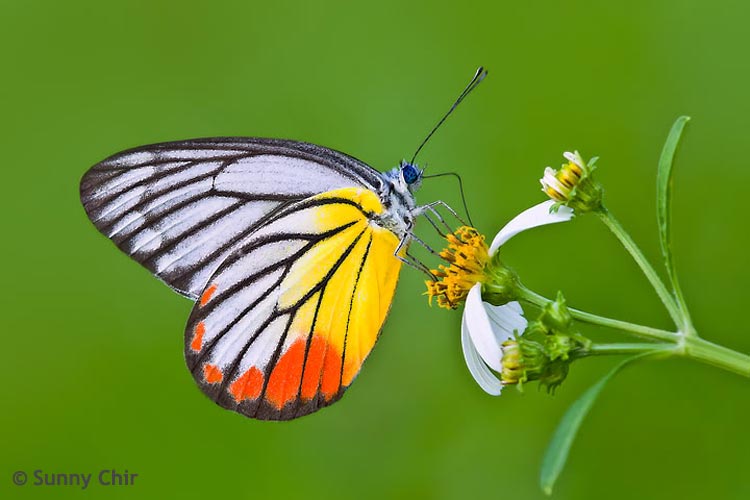
Our butterfly of the month for December 2010 is the intrepid Painted Jezebel. A common urban butterfly, the species appears all over the island, often seen flying restlessly at treetop levels, coming down only to feed on flowering plants or to rest after a long day of flying.


The species displays aposematic colouration i.e. warning colouration that advertises the butterfly's distastefulness to would-be predators. The species belongs to the genus Delias of the Pieridae family, which features some of the most colourful and attractive butterflies in the world. For more information on the genus Delias, do visit the website of one of ButterflyCircle's members, Leslie Day, at the Delias of the World.


It is interesting that the English common name of the butterfly takes reference from biblical origins. Historically, Queen Jezebel was the wife of King Ahab of Israel in the mid-ninth century BCE. A Phoenician by birth, Queen Jezebel claimed her place on the throne of Israel and solidified a prosperous trade alliance between Israel and Tyre.


Queen Jezebel's story was tragic, however, as it ended with her murder where she was thrown out of her palace window and her corpse eaten by dogs.


In modern times, the name Jezebel has rather uncomplimentary connotations. It has come to be associated with women who are sexually agressive, promiscuous, wicked, manipulative and controlling. Such phrases as "painted Jezebel" refer to the scene in 2 Kings 9, in which the vain, elderly queen paints her eyes and does her hair just before being thrown to her death. In some contemporary views, her dressing in finery and putting on makeup before her execution led to the association of the use of cosmetics with "painted women" or prostitutes.


With that little bit of history, we now come back to focus on our little butterfly, which probably does not know (nor care!) much about its rather dubious pedigree. The Painted Jezebel flutters nonchalantly amongst the treetops, never making any attempts to conceal itself as its predominantly white wings can be seen clearly from afar.


The Painted Jezebel occurs commonly throughout Singapore and is seen in urban areas as well as within forested reserves. It usually flies at treetop level, frolicking amongst the canopies of tall trees. Its restless flight is interrupted only when it descends to feed at flowering shrubs or to rest in the shaded understorey of the forests towards the later part of the day.


The wings of the Painted Jezebel are white above, with the veins prominently black-dusted in the outer areas. The female is more heavily dusted with black, more so on the upperside than the underside, than the male - appearing almost dark grey when in flight. The basal half of the underside of the hindwing is bright yellow with a bright red marginal border and crossed with the contrasting black veins, giving it an attractive and colourful appearance.

Two male Painted Jezebels competing for a single female

One can often observe the courtship dance between males and females of the species. Often, more than one male (I have see up to four!) can be seen in pursuit of a female Painted Jezebel.

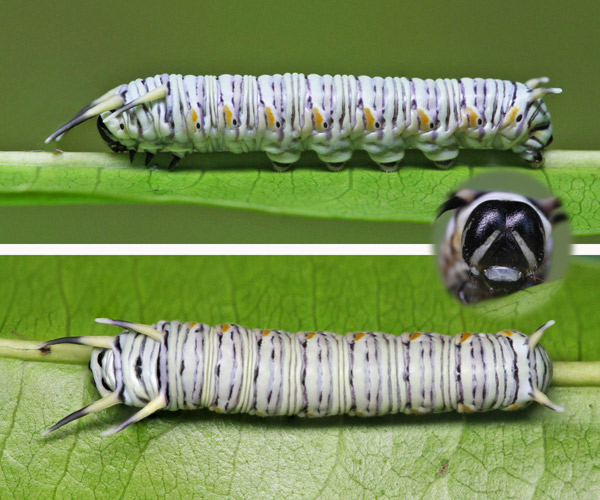
Painted Jezebel caterpillar trio... singing Silent Night this Christmas?

The caterpillars of the Painted Jezebel feed on the plant Dendrophthoe pentandra, a parasite that grows on the branches of other trees and plants. The caterpillars are equally colourful and prominent, and feed gregariously amongst the leaves of its host plant. As the seeds of this plant are usually spread by birds, the plant itself can often be seen growing amongst the treetops 3-4 storeys above ground amongst the lofty canopies of large trees.


It has been a good year for butterflies, and we look forward to 2011 with great anticipation for more discoveries and new knowledge to share with the nature community in Singapore and the rest of the world.


As the countdown to Christmas 2010 and the new year 2011 approaches, on behalf of ButterflyCircle, we would like to wish everyone.....


* * * A Happy and Peaceful Christmas !!! * * *

Text by Khew SK : Photos by James Chia, Sunny Chir, Federick Ho, Khew SK, Henry Koh, Bobby Mun, Benedict Tay, Tan Ben Jin, Tan Tze Siong & Anthony Wong