21 October 2009

Parasitic Mites on Butterflies

Parasitic Mites on adult butterflies
What are they?
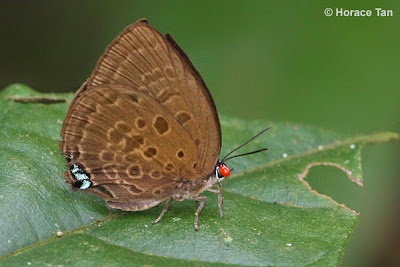


An Arhopala sp with a rather large mite attached to its eye

Occasionally, when out in the field photographing butterflies, members of ButterflyCircle encounter strange red globular attachments to adult butterflies - usually at the head or eye of the butterfly. Curious as to what these little critters are, I searched the internet and found that butterflies do fall victim to certain parasitic mites.
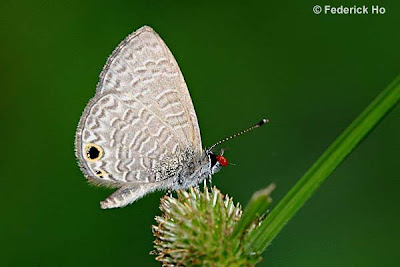

A Tailless Line Blue (Prosotas dubiosa lumpura) with a red mite attached to its head
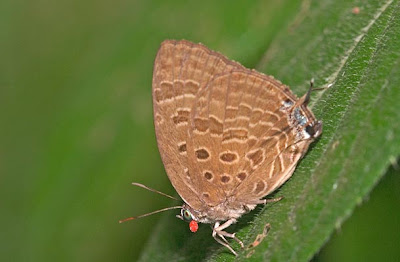
Another Arhopala sp with a red mite attached to its head

Interestingly, the majority of these encounters affect the smaller butterflies in the Lycaeninae family, even though there are examples from the Riodinidae and Hesperiidae families. So far, we have not encountered these mites on the larger species of butterflies yet. Although theoretically, there should be no reason why these mites could not attach themselves to larger butterflies as well. But by far, there have been more observations of these mites on Arhopala spp than any other butterfly genus.
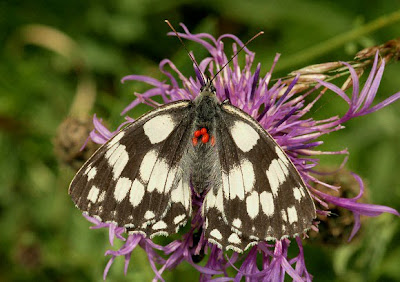

Parasitic mites on the thorax of a Marbled White in the UK © Adrian Hoskins

In his excellent and informative website Learn about Butterflies, ButterflyCircle member Adrian Hoskins wrote about these mites on the British butterfly the Marbled White (Melanargia galathea), and in the example shown, a number of these mites were attached to the thorax of the butterfly rather than the eye or head, as is the more common occurrence in Singapore. Adrian noted that these mites were of the species Trombidium breei and that "studies have shown that these mites are harmless to the butterfly, having no detectable effect on the flight performance, orientation ability or lifespan".
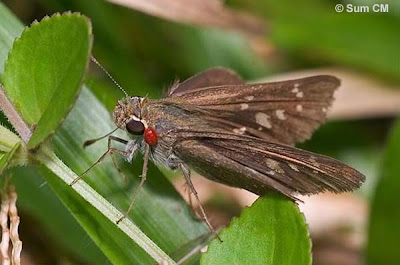

A parasitic mite on a Hesperiidae. Even fast-flying skippers cannot shake off its little red passenger.

It is interesting to learn that despite being parasitic in nature, these mites have little effect on the lifespan of the butterfly. However, it is not known if the mites found on butterflies here in Singapore are of the same species of mites. Perhaps if a reader of this blog who is an authority on mites may want to contribute his or her knowledge about what these little stowaways are and if they cause any harm to the host butterfly.


Close-up shot of a mite attached to the eye of an Arhopala sp

Indeed, where a butterfly is encountered with one of these mites attached to its eye or head, the flight of the butterfly did not seem abnormal, nor did the butterfly display any discomfort or make any attempt to remove the mite with its legs. These butterflies observed seemed to be able to carry out their normal activity like feeding and flying around without much hindrance.
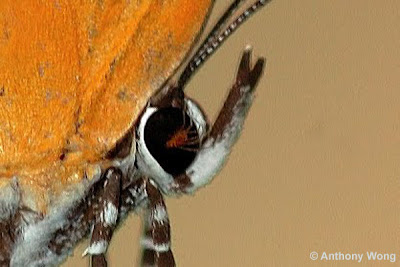

A mite on the eye of a Branded Imperial (Eooxylides tharis distanti)

In two of the cases shown here, the mites are rather 'skinny' where the legs can be seen. It is not known if the mites actually grow fatter as it feeds off the butterfly or if these are of a different species of mites.


Parasitic mite on the eye of Abisara geza niya. Inset : Close up of the mite. Is this a different species from the fatter mites?

It is likely that these mites lurk on flowers and vegetation where these butterflies frequent, and are able to quickly attach themselves to the butterflies when they stop to rest or feed at flowers. However, why they appear to generally attach themselves to the head/eye region of the butterflies observed in Singapore remains a mystery.


The fact that most of the encounters over the years by ButterflyCircle members show this phenomenon of a single mite attached to a butterfly's head or eye appears to reflect the consistency in which this happens in the field here in Singapore.


Similar-looking mites also parasitise other invertebrates like the Harvestman as is shown at this link.

So when you're out there in the field, observing and photographing butterflies, keep a look out for these little red dots on the butterflies, and record your observations and findings. If you have any clue as to what these species of mites are or how they affect the butterflies that they parasatise upon, do share your views with us.


Text by Khew SK : Photos by Adrian Hoskins, Anthony Wong, Federick Ho, Jason Ng, Horace Tan, Simon Sng, Sum CM & Tan CP.

15 October 2009

Life History of the Fivebar Swordtail

Life History of the Fivebar Swordtail (Pathysa antiphates itamputi)
A newer version of the life history of the Fivebar Swordtail can be found by clicking this link.


Butterfly Biodata
Genus : Pathysa Rearkirt, 1865
Species : antiphates Cramer, 1775
SubSpecies : itamputi Butler, 1885
Wingspan of Adult Butterfly : 80-90mm
Caterpillar Host Plant : To be identified


Physical Description of Adult Butterfly :
The Swordtails are remarkable for the very long, slender and tapering tail on the hindwing, resembling a long sword. They are forest butterflies and are very swift on the wing, with an erratic flight. They are often mistaken for a white Pierid butterfly, as the tails are usually not seen during flight. The ground color of the upperside is white with five short black costal bars crossing the cell. It has a long black tail edged with orange and a white tip.


The markings of the underside forewing is similar to the upperside with green infilling the black bars at the postdiscal area. The basal area on the underside of the hindwing is green, with orange-yellow submarginal patches. It has 3 black basal bands series of black submarginal and marginal markings. The butterfly has 3 pairs of fully-developed legs and opaque jet-black eyes. The proboscis is also totally black.


Field Observations of Butterfly Behaviour :
The Five Bar Swordtail is a medium size butterfly belonging to the Papilionidae family. It can be found in forested areas, riverbanks or the edges of the forest. It is a strong flyer with a rapid erratic flight. Often, it is seen flying high at tree top level.

It flies from flower to flower in search of nectar. Like the other typical Papilionidae s[ecies it has a characteristic flight when feeding at flowers, in that, whilst the forewings are flapping rapidly, the hindwings are held almost stationary as if to balance the butterfly perched on a flower as it sucks nectar from the flower with its long proboscis. Male Five Bar Swordtails are often observed puddling at muddy seepages and along river banks tainted with decomposing organic waste.


Early Stages :


The hitherto unidentified host plant, probably of the Annonaceae family

The female lays an ovum singly on a young bud or on the undersurface of the young leaf of the host plant. The egg is smooth, round and creamy white in colour with a diameter of slightly over 1mm.


After about 3-4 days, the caterpillar hatches from the egg, and immediately starts to consume the eggshell completely. The caterpillar then starts to eat the young leaf that the egg was laid upon. The 1st instar caterpillar is about 3mm long, and has a spiky appearance. The body also features rows of short dorsal-lateral tubercles with long setae. The colour of its body is white with transverse darker stripes. As it feeds, the caterpillar usually stays on the middle of the upper surface of the leaf like the Tailed Jay.


In the 2nd instar caterpillar, the thoracic segments are much enlarged from the 2nd to 3rd segment. The thoracic segments and the anal segments are yellowish orange. The body has a series of transverse light and dark grey stripes on a creamy white ground colour. The spiky appearance of the 1st instar is now replaced by a smooth body with thoracic and anal spines. It grows to about 7-8mm before moulting.


At the 3rd instar the ground colour of the caterpillar is more lemon yellow with the dark transverse stripes more prominent, giving a 'tiger-like' appearance. The thoracic spines are now black, whilst the anal spines are white in colour. At the end of this instar, the caterpillar grows to about 13mm.


After moulting, the 4th instar caterpillar appears a deep orange-yellow with the transverse stripes less distinct than the earlier instar. The thoracic spines are still black, whilst the anal spines are longer and creamy white in colour. The caterpillar reaches a length of 25mm before moulting.


In the 5th and final instar, the ground colour of the caterpillar turns reddish brown with the striations rather indistinct. There are dark green circles at the base of the 3rd thoracic spines. The caterpillar eats voraciously for about 6 days to reach a final length of about 45mm.


At the 5th instar the caterpillar changes to reddish brown in colour

The pre-pupation stage lasts over a day, where the caterpillar spins a silken pad on which to anchor itself - usually on the undersurface of a leaf of the host plant or on the stem. The pupa is light green with a short projection at the front on its head. A silken girdle helps the pupa stay in an upward position.


After about 12 days, the adult butterfly ecloses and emerges in the early morning hours, ready to continue its next phase of life as a spectacular butterfly.


The Five Bar Swordtail's life history has eluded the Singaporean ButterflyCircle members thus far, and we thank our Malaysian member, LC Goh for sharing his record of this life history with us. It is hoped that we will eventually be able to identify the host plant for this species.

Text by LC Goh & Khew SK ; Photos of early stages by LC Goh ; Other Photos by LC Goh, Wong CM & Khew SK

References :
  • The Butterflies of The Malay Peninsula, A.S. Corbet and H.M. Pendlebury, 4th Edition, The Malayan Nature Society.
  • The Life Histories of Asian Butterflies Vol 2, Igarashi Suguru & Fukuda Haruo

11 October 2009

Life History of Semanga superba deliciosa

Life History of Semanga superba deliciosa


Butterfly Biodata:
Genus: Semanga Distant, 1884
Species: superba H. Druce, 1873

Sub-species: deliciosa Seitz, 1926
Wingspan of Adult Butterfly: 28mm
Caterpillar Local Host Plants:
Mallotus paniculatus (Euphorbiaceae), Melastoma malabathricum (Melastomataceae), Saraca cauliflora (Leguminosae), Macrosolen cochinchinensis (Loranthaceae), Kopsia fruticosa (Apocynaceae), Bridelia tomentosa (Euphorbiaceae), Trema tomentosa (Ulmaceae).


A female Semanga superba resting on a leaf.


The upperside of a female Semanga superba.

Physical Description of Adult Butterfly:
Above, the male is lustrous purple with a black border on the forewing and an orange-red distal border on the hindwing. The female is bluish purple with a wider forewing border. Underneath both sexes are buff-brown with narrow reddish brown post-discal line on the forewing. The hindwing has basal area unmarked, but the tornal half broad and reddish-orange with black spots and metallic blue/green zig-zagged lines. The male possesses two pairs of moderately long filamentous tails at the end of veins 2 and 3, whilst the female features one additional short pair at the end of vein 4.


A female Semanga superba feeding on a leaf in the nature reserve.


A male Semanga superba resting on a perch.

Field Observations of Butterfly Behaviour:
This attractive and small species is infrequently encountered in the nature reserves in Singapore, despite the wide distribution of its many host plants throughout the country. In most encounters, adults are sighted flying rapidly in the vicinity of flowering shrubs and trees. Rare photograph opportunities only arise when they stop to sun-bathe or to take nectar from flowers.

Early Stages:
The immature stages of Semanga superba are polyphagous and so far 7 plants have been recorded as local hosts, with species ID for all but one established. Depending on the host, caterpillars of all instars feed on either young leaves or flower buds.


Host plant: Mallotus paniculatus (also host plant for the Malayan).


Host plant: Kopsia fruticosa. Leaves and flowers.

All field sightings of caterpillars in any instar typically come bundled with a number of ants in attendance. Such strong association with ant species has earlier been observed and documented in a 1995 journal paper by Prof. Fiedler and his colleague. Earlier partial breeding attempts (by Prof. Fiedler, and by Butterflycircle members) were successfuly completed with ants in attendance. Recently, Ben Jin Tan, an active Butterflycircle member, managed to accomplish the task of breeding two specimens from the egg stage to adulthood in total absence of ants, a task previously thought to be impossible. The following account of the complete life history of Semanga superba is based mostly on the growth record maintained and provided by Ben Jin.


A caterpillar of Semanga superba in 5th or 6th instar being attended by ants.

Eggs are laid on the leaf underside or on a perduncle/pedicel of an infloresence The white egg , about 0.9mm in diameter, is shaped like a slightly flattened chinese bun with its surface covered with numerous short spikes and a depressed micropylar sitting atop.


An egg laid on Kopsia fruticosa. Diameter: 0.9mm.
The right panel shows the empty egg shell after hatching.


A cluster of three eggs laid against the midrib on a leaf underside of the Singapore Rhododendron.

Each egg takes about 4 days to hatch. The young caterpillar emerges after nibbling away sufficiently large upper portion of the egg shell. Measured at a length of about 1.2-1.3mm, its pale yellow body is cylindrical in shape, sporting moderately long fine setae running lengthwise, a black head capsule, a large dark prothoracic shield and a light brown to greyish anal plate.


Two views of a newly hatched caterpillar of Semanga superba.


An early instar caterpillar being attended by two ants.

As the caterpillar grows, its body broadens sideway, and red to reddish patches appear on the prothorax, mesothorax and posterior abdominal segments. The growth is slow and after about 4-6 days, it only reaches about 3mm in length when it stops for the moult to the 2nd instar.


Two views of a 1st instar caterpillar, late in this stage.

Covered with numerous short setae, the body of the 2nd instar caterpillar is pale yellow in base color. The prothoracic shield is dark and well developed. The body is onisciform in shape and flattened dorso-ventrally. The three thoracic segments and the first 6 abdominal segments bear a pair of lateral cone-shaped projections furnished with a tuft of long and erect setae. The anal end also features cone-shaped projections with long and erect setae. There are also postmedian series of red markings on the first 6 abdominal segments. The growth in this stage brings the caterpillar to a length of about 4mm, and after about 3 days in this stage, it moults again.


A freshly moulted 2nd instar caterpillar.


Two views of a 2nd instar caterpillar, lengths: 3.8mm.

In the 3rd instar, both the prothoracic shield and the anal plate are black and well developed. The lateral projections all around the body have become rather pronounced. There is also a pair of lateral projections on the 8th abdominal segment which is long and elevated with sclerotized black sheaths housing the eversible and whitish tentacular organs. The dorsal nectary organ on the dorsum of the 7th abdominal segment is clearly discernible. This instar takes 3-4 days to complete with the body length reaching about 7mm before the next moult.


3rd instar caterpillar, early in this stage.


Two views of a 3rd instar caterpillar, length: 5mm.

The 4th instar caterpillar bears few changes from the 3rd instar. One visual difference is the increase in color intensity of the red to reddish brown patches at both ends to dark brown or dark reddish brown. The body base color has also changed to pale green. The postmedian markings on 1st-6th abdominal segments are more prominent with white wavy pink/red/dark-brown strips interminging with white. The dorsal nectary organ is now sitting within a pale reddish-brown patch. The tentacular organs are easily observed as their eversions occur frequently. This instar lasts about 5 days with length reaching 10-11mm.


4th instar caterpillar, early in this stage.


4th instar caterpillars, late in this stage, length: 10mm.


A Semanga superba caterpillar of either 3rd or 4th instar being attended by ants.

The 5th instar caterpillar has broader and more contrasting postmedian series of markings, and the patch containing the dorsal nectary organ is now larger and more prominent. A pair of dark dorsal projections on the mesothorax has also become more elevated. This instar lasts about 6 days with length reaching 13-13.5mm.


A 5th instar caterpillar moving past flower buds of Macrosolen cochinchinensis.


Two views of a 5th instar caterpillar, late in this stage.

The 6th (and final) instar caterpillar has much darker postmedian series of markings. Dark patches of varying sizes appear lateraly with those on the 1st abdominal segment being the largest and most discernible. A mid-sized white to beige dorsal patch also appears on the mesothorax. This instar lasts about 11-12 days with the length reaching about 20mm.


A 5th instar caterpillar feeding on flower buds of Macrosolen cochinchinensis


6th instar caterpillars on Trema tomentosa.


A picture illustrating the differences in the posterior ends of 2nd instar (left) and
6th instar (right). Note the everted tentacular organs.

Towards the end of the 6th instar, the caterpillar ceases eating and chooses a spot on the leaf surface for its pupation site. A pupation shelter is made with multiple silk threads joining opposing leaf surfaces. Within the shelter, the pre-pupatory caterpillar readies itself for pupation by spinning a silk girdle and a silk pad. In the wild, some caterpillars have been found to pupate within ant pavillions.


A pre-pupatory larva of Semanga superba.

Pupation takes place after one day of the pre-pupal stage. The pupa has the typical lycaenid shape, silvery white in base colour with many black patches in greenish tinge on the pupal surface. The pupa has a length of about 10-11mm.


A pupa of Semanga superba within a shallow pupation shelter.

Nine days later, the pupa becomes darkened in color signaling the imminent emergence of the adult. The next day the adult butterfly emerges from the mature pupa.


The eclosion sequence of a Semanga superba adult.

References:
  • The Butterflies of The Malay Peninsula, A.S. Corbet and H.M. Pendlebury, 4th Edition, The Malayan Nature Society.
  • The mature larva and pupa of Semanga superba, Konrad Fiedler and Peter Seufert, Nachr. entomol. Ver. Apollo, N.F. 16 (1): 1-12, 1995.
Text by Horace Tan, Photos by Benedict Tay, Mark Wong, Sunny Chir, Ben Jin Tan and Horace Tan