Showing posts sorted by date for query Prosotas nora superdates. Sort by relevance Show all posts

30 July 2025

Butterfly of the Month - July 2025

Butterfly of the Month - July 2025
The White Fourline Blue (Nacaduba angusta kerriana)

A White Fourline Blue perched on a leaf in the forest understorey

We are into the 2nd half of the year 2025, and the summer is in full swing in the northern hemisphere. The weather has been mercilessly hot but yet there have been countries that have been inundated with heavy rains and even suffered fatalities. Over in Singapore, it has been a very hot July with few days of rains in between and we are getting temperature highs in the mid-30's for the month.

A newly eclosed White Fourline Blue perched on its pupal case

It was alarming that even over in our generally peaceful ASEAN region, disputed territorial claims have led to a war level conflict between Thailand and Cambodia. The military on both sides exchanged fire at the border between the two neighbours and escalated to heavy artillery, rocket fire and air strikes on 24 July. There were fatalities, unfortunately affecting civilians where up to 43 people were killed in the crossfire. Ceasefire talks are in progress, although tensions remain high.


It was a generally uneventful month in Singapore, perhaps except for a sinkhole incident that swallowed a car. Fortunately, the lady driver managed to get out of her car and was rescued by some migrant workers from a construction site adjacent to the sinkhole before a burst water mains flooded the hole. The authorities are still investigating the cause of the soil failure and the road remains closed to traffic whilst repairs are in progress.

A mating pair of White Fourline Blue

Over in the US, the topic of tariffs, threats and negotiations are still ongoing with many countries as the deadline of 1 Aug looms. Many trade representatives are pushing negotiations hard to ensure that the proposed tariffs are not imposed on their countries' goods to the US. Despite the volatility and uncertainty, world financial markets appear to be still on a bull run as if these tariffs have been already factored into their projections.


Back to our Butterfly of the Month for July 2025 - a diminutive but extremely rare Lycaenidae called the White Fourline Blue (Nacaduba angusta kerriana). It was re-discovered in late 2008 at Telok Blangah Hills Park when the late ButterflyCircle member Sunny Chir stumbled on a mating pair along the trails and suspected that it was a species that he had not encountered before. Subsequent trips to the location continued and for a few days, the species was flying in the same area.


The White Fourline Blue was on the early authors' checklists but has eluded butterfly watchers until that year. However, besides that very short period, it has been absent again and never reliably seen since. Classified as 'data deficient' in the Singapore Red Data Book 3rd Edition, its mysterious appearance, and disappearance is still unexplainable. Perhaps it is still flying around somewhere in Singapore just waiting to be encountered again someday soon.

Upperside of male White Fourline Blue (top) and female White Fourline Blue (bottom)

The male White FourLine Blue is purplish blue above with a thin black border, which is about 1mm broad towards the apex. The hindwing is unmarked but with a thin submarginal black border. The hindwing cilia is white. The female has broad black border on the forewing and has a light blue ground colour with diffuse greyish markings on both wings.


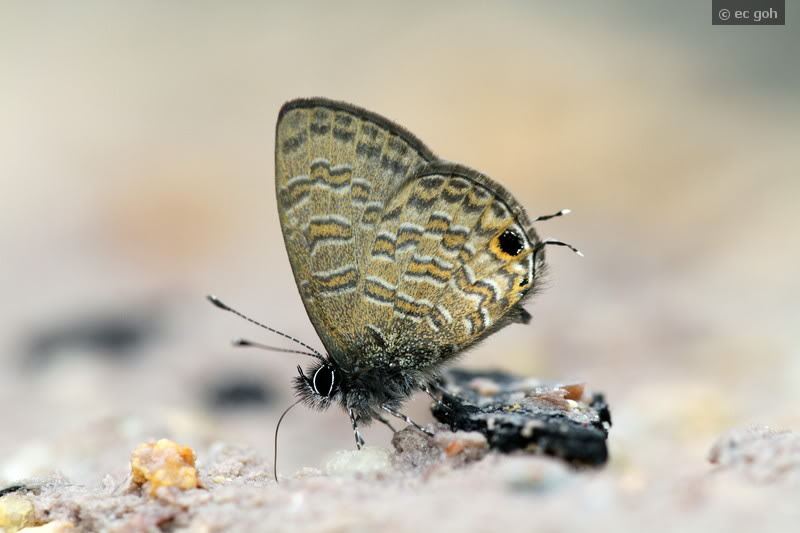
Beneath, both sexes have greyish ground colour with very broad and diffuse whitish-grey stripes. On each hindwing, there is an orange-crowned tornal spot lightly speckled with bluish-green metallic scaling. i Next to the tornal spot, a pair of filamentous white-tipped tails occur at end of vein 2. Marginal and submarginal spots are black and stand out against the whitish background. The prominent rounded black sub-marginal spot in space 6 of the hindwing serves as an important identification key for this species.

A White Fourline Blue puddling on damp muddy footpath

The White Fourline Blue has an erratic but rather weak flight, and prefers to stay under shade, fluttering amongst thick vegetation along the forest edge. Males tend to stay higher up in the forest canopy, and descend lower to find a mate, or to feed. Males are also observed puddling on damp forest paths in Malaysia. 

A female White Fourline Blue ovipositing on its caterpillar host plant, Entada spiralis

The complete
life history has been successfully recorded in Singapore on its caterpillar host plant, Entada spiralis, which it shares with a number of other more common species like the Large Four-Line Blue (Nacaduba pactolus odon), Common Line Blue (Prosotas nora superdates) and the Common Grass Yellow (Eurema hecabe contubernalis).

Text by Khew SK : Photos by Sunny Chir, Khew SK, Low JK and Horace Tan.


15 November 2020

Butterfly of the Month - November 2020

Butterfly of the Month - November 2020
The Common Line Blue (Prosotas nora superdates)

A Common Line Blue feeding at the flower of the Spanish Needle (Bidens alba)

It is the 11th month of a tumultuous 2020 and many of us would just wish that we could wake up in 2021 and all the nightmares of this year will be over! But if only the pandemic that has spread across the whole world will be so easy to get rid of. News of a viable and safe vaccine are already making their rounds and we can only wait with baited breath that there is light at the end of this dark tunnel that we have been crawling through for most of this year.


Over on the other side of the globe, the US Presidential Election is over. Or is it? Although the official results show that the US now has a new 46th President, there are still some quarters that harbour a different view that the incumbent still has a whisker of a chance to wrest the Presidency back. Whilst the rest of the world get down to the business of making our nations safe again, and to kick start the ailing economies, it should be a matter of time before we see a new President in the White House.


Back home on our Little Red Dot, the Covid-19 situation appears to be under control, with daily single digit or no new community infections for the past couple of weeks. Whilst there are still the irritating imported cases almost every day, the anticipation of a "new normal" or a semblance of getting our lives back, grows by the day. There is talk of a "Phase 3" on the cards, but it comes with a warning of a second wave, if we let our guard down. But looking around us in Singapore, it would appear that we are beginning to see a bit of pre-Covid normalcy, albeit with face masks as a default as we go about doing our daily business.


Our feature butterfly of the month of November 2020 is the small and inconspicuous Common Line Blue (Prosotas nora superdates). With a wingspan of only about 20-25mm, the Common Line Blue is a small species that is not easy to spot. It can hardly be considered "common", although it is quite widespread in distribution across habitats like urban parks and gardens. It can also be found in the forested nature reserves. Due to its diminutive size and erratic flight, it is not easy to identify the species when it is on the wing.

A mating pair of Common Line Blue : Left - Male, Right - Female

The male Common Line Blue is bluish-purple on its uppersides, with a very thin and almost imperceptible border. The upperside of the female is dark brown and mostly unmarked. The underside is ochreous in the male, and sometimes appears almost like a small orange butterfly, whilst the female is greyish buff with ochreous speckles.


There is a prominent tornal orange-crowned black eyespot edged with pale green iridescent scales on the underside of the hindwing. There is a long white tipped filamentous tail at vein 2 of the hindwing. The large eyes of the Prosotas species are jet black, whilst the thorax, palpi and the dorsal margin of the hindwing are covered with hairs, giving the butterfly a particularly shaggy and unshaven look.

The Common Line Blues are most often seen puddling at damp footpaths and sandy streambanks

The Common Line Blue has a weak but erratic flight, and often seen flying restlessly at low levels amongst shrubbery. At times, the butterflies are seen feeding at flowering plants, but males are most often spotted puddling at damp footpaths and sandy streambanks that are contaminated with animal excretions and other organic matter. Females are much rarer.


When stopped at rest, the species usually perches on the tops of leaves and twigs with their wings folded upright. At times during hot sunny days, male Common Line Blues are occasionally observed to sunbath with their wings almost fully open, to reveal their purplish-blue uppersides.


The Common Line Blue's life history has been recorded on two host plants in Singapore - Entada spiralis and the non-native Australian Wattle (Acacia auriculiformis).

Text by Khew SK : Photos by Janice Ang, David Chan, Chng CK, Goh EC, Khew SK, Koh CH and Horace Tan

04 July 2020

Singapore's Line Blues - Part 1

Singapore's Line Blues - Part 1
Featuring the Line Blue Butterflies of Singapore


A male Common Line Blue puddling at a sandy streambank

The "Line Blue" butterflies are a group of rather small species that belong to the subfamily Polyommatinae of the family Lycaenidae. The Polyommatinae are often referred to as the "Blues". A large number of the species in this subfamily are small and delicate butterflies with many of them sporting thin filamentous white-tipped tails on their hindwings. Many species, particularly the males, have blue uppersides, hence the English common name for the group.


A Pointed Line Blue perched on top of a leaf

This blogpost introduces the seven extant species found in Singapore that carry the English common name "Line Blue" in their names. All these species feature a series of striations across the undersides of both the fore- and hindwings. They have the typical "eyespot" at the tornal area of the hindwing and, in some of the species, coupled with the thin tails, form a decoy to fool predators into attacking a less critical part of their wings.


A Tailless Line Blue feeding on the flower of the Stringbush

In this article, we introduce three of the seven species that are found in Singapore. Ironically, of these "Line Blues" found in Singapore, four are new discoveries. Based on reference literature, these four were not recorded in Singapore by the early authors. We will feature these four "exotics" in Part 2 of the article next weekend. We will now highlight the three native, and relatively common species in Singapore.

1. The Pointed Line Blue (Ionolyce helicon merguia)


A puddling Pointed Line Blue

The Pointed Line Blue is the sole representative of the genus Ionolyce in the region. It is relatively common and widespread in distribution across the island. It can be found in urban parks and gardens, and sometimes in the forested nature reserves as well. Males are regularly found puddling at damp streambanks and muddy footpaths, and are partial to human perspiration as well.


It is a fast flyer, and flies erratically, and is often skittish, until it comes down to puddle on the forest floor. Once it is a feeding mood, it can also be coaxed to feed on a sweaty finger. The forewings of the males are more pronounced and pointed than other lookalike species in the subfamily.


A male Pointed Line Blue opens its wings to sunbathe

The male Pointed Line Blue is a deep purple-blue on top, with a very thin black margin and unmarked. The female is predominantly brown on her uppersides with the discal areas and wing bases overlaid with bluish-purple. The undersides are dull greyish-brown with narrow whitish wavy lines across both wings. There is an orange-crowned eye spot at the tornal area of the hindwing and a black filamentous tail which is tipped with white at vein 2 of the hindwing.

2. The Common Line Blue (Prosotas nora superdates)


A Common Line Blue feeding on the Spanish Needle flower

The Common Line Blue is a small butterfly that has a wingspan of around 25-28mm and considered moderately common. It can be found in urban parks and gardens but can also be found in the forested nature reserves. Males of the Common Line Blue are attracted to damp footpaths and streambanks where they come down to puddle for salts.


A male Common Line Blue puddling with its wings opened

The male Common Line Blue is bluish-purple on the upper surfaces with a thin black border, whilst the upperside of the female is dark brown and unmarked.  The underside of the male appears orangey whilst the base colour of the female is greyish buff.


A mating pair of Common Line Blue.  Left : Male Right : Female

The underside features white-edged dark lines across both wings with the interstitial spaces orange in the males, and grey with orange speckles in the female. There is a large orange crowned black eyespot at the tornal area of the hindwing below, with iridescent greenish scales. At vein 2 of the hindwing is a filamentous white-tipped tail.

3. The Tailless Line Blue (Prosotas dubiosa lumpura)


A Tailless Line Blue puddling

The Tailless Line Blue is a closely related species from the same genus as the Common Line Blue. But as its name suggests, there is no tail on the hindwing of this species. It is common, and sometimes seasonally abundant where two dozen individuals or even more, can be observed, frolicking amongst the shrubbery.


A male Tailless Line Blue opens its wings to sunbathe

The male Tailless Line Blue is bluish-purple on top with an almost imperceptible border. The female is brown on the uppersides with a blue discal patch. The underside is greyish, with the usual white-edged dark lines across both wings. There is a large tornal spot on the underside of the hindwing with some iridescent pale green scales.


A mating pair of Tailless Line Blues

Males are sometimes found puddling at damp footpaths, drains and wet areas. Females are more often found at flowering plants like the Stringbush. The species is widely distributed and is common throughout Singapore in urban parks and gardens.

Text and Photos by Khew SK

16 January 2016

Butterfly Photography at Our Local Parks - Seletar Country Club

Butterfly Photography at Our Local Parks
Featuring : Seletar Country Club Butterfly Garden


Welcome to the Seletar Country Club Butterfly Garden

Golf courses are large tracts of greenery that are, ironically, not very "green". A typical golf course occupies tens of hectares of land that is usually cleared of vegetation for the course to serve its purpose. Referred to as "green deserts" by Dr Richard Corlett (formerly from the NUS), the greenery on golf courses may mislead one to think that the greens are rich with biodiversity. This is usually furthest from the truth, as the amount of environmentally-unfriendly fertilisers and pesticides used to keep golf greens pristine and manicured can adversely affect biodiversity.


However, one man set out to at least make an effort to mitigate the "golf course effect" at his club. Mr Foo Jit Leang, owner of a private software company, wanted to show that golf courses need not necessarily be devoid of wildlife. During a visit by Prof Peter Ng of the Lee Kong Chian Natural History Museum, and the Seletar Country Club Chairman, Mr Khoo Teng Chye, they challenged Mr Foo to try to create pockets of planted areas that can attract biodiversity to the club premises.


Armed with only his love for nature, and the information that he could get from available books and the internet, and amongst the nature community in Singapore, Mr Foo set out to plant butterfly-attracting host and nectaring plants at a small patch of land next to the clubhouse in 2012. Today, the Seletar Country Club Butterfly Garden, as it is known, occupies an area of about 500-600 sqm and is usually teeming with butterflies on a good sunny day.


Mr Foo and the visitors who spent time at the Butterfly Garden have, to date, spotted a total of 102 butterfly species at the three-year old project. On a good day, an observer can usually expect to see about 20-25 different species of butterflies, from the large Papilionidaes to the small and skittish Hesperiidaes. Combining host plants with nectaring plants around the garden, the SCC Butterfly Garden is now a magnet for butterflies, as well as other insects, birds and even small reptiles.


Different views of the SCC Butterfly Garden - from open areas to intimate corners for butterflies

This morning, I visited Mr Foo and the SCC Butterfly Garden. It was a bright sunny day when I arrived and the butterflies were already up and about, and feeding on the flowers of the String Bush and Shepherd's Needles bushes. A few Plain Tigers and Dark Glassy Tigers were chasing each other amongst the shrubbery.


I spotted a Leopard (Phalanta phalantha phalantha) ovipositing on its caterpillar host plant, the Batoko Plum. A Lime Butterfly (Papilio demoleus malayanus) zipped past me, stopping for a fleeting moment to feed on the flower of the Pink Snakeweed.


Mr Foo and our young ButterflyCircle member Jonathan Soong joined me, and we walked around the garden as Mr Foo shared his stories of the challenges of setting up the butterfly garden, and maintaining the momentum of his initiative. He had to "educate" the club's gardeners not to spray pesticides and not to pull out plants that they considered "weeds". Many butterfly host plants are what landscape designers see as invasive and ugly weeds. However, without these host plants, one cannot expect to see a wider variety of butterfly species. Mr Foo proudly shared that he has bred a total of 42 different species of butterflies found at the garden.


The "closed-loop" water-based habitat for butterflies, dragonflies and other critters

Besides the lush greenery that the Butterfly Garden showcases today, Mr Foo also brought us to the "closed-loop" stream nearby. This stream creates a water-based habitat with appropriate plants to attract dragonflies and butterflies. The body of water is constantly moving, using the topography of the land and a simple pump to move the water around. We noticed a number of the diminutive Pygmy Grass Blues fluttering happily around the bushes near the stream.


Walking back to the main Butterfly Garden, I spotted a hungry Painted Jezebel (Delias hyparete metarete) feeding on the flowers of the String Bush. It kept me busy chasing it for about half an hour, teasing me as it came close, and then quickly flitted away as I approached it. After a tiring game of cat-and-mouse with it, I finally managed to take a decent shot of it on the String Bush flowers.


The scorching overhead noon sun was taking a toll on us, and we quickly retreated to the clubhouse for a yummy lunch, courtesy of Mr Foo. Looking back at the Butterfly Garden, I would consider it a successful rehabilitation of a piece of land adjacent to a somewhat sterile golf course. The butterfly diversity is considered very good, and it took a simple initiative to populate an otherwise featureless piece of land with butterfly-attracting plants to rejuvenate the biodiversity.


Mr Foo sharing his stories about the Butterfly Garden

Mr Foo has gone on to spread his enthusiasm to schools, childcare centres, community gardens, and to anyone who is interested to set up a butterfly garden. He has unselfishly shared plant cuttings, seeds and always willing to impart his experience and knowledge to give a helping hand to our butterflies to survive and thrive in urban areas in Singapore.


"Green Desert" alert!! - a view across the Butterfly Garden to the golf course beyond

Mr Foo has also shown golf course owners that they can do something for nature, and to use part of the large tracts of land that these golf courses sit on, to support our local biodiversity, instead of maintaining their unsavoury reputation for being "green deserts" in Singapore. Interestingly, for a small island of only about 714 sqkm, Singapore has 21 golf courses! Imagine if small Butterfly Gardens sprout up in all these golf courses. We will need more people like Mr Foo to achieve this dream!


And so we have another local "garden" at the Seletar Country Club that is a haven for butterflies. Photographers and nature lovers can visit this SCC Butterfly Garden to have their fill of nature's flying jewels, and you might meet Mr Foo walking around and infect you with his passion for nature and butterflies!

How to get to Seletar Country Club Butterfly Garden


Driving/Taxi : From the Central Expressway heading north, use the exit 16 to Seletar West Link and turn into Seletar Club Road.  There is ample free parking at the premises.

By MRT/Bus : Drop at Khatib MRT, and cross the road.  Take Bus 85 to just before the TPE, alight and switch to Bus 103 and alight just before West Camp Road and walk to Seletar CC. Alternatively, take Bus 39 and alight at the stop before Seletar Camp G and switch to Bus 103 and alight just before West Camp Road and walk to Seletar CC.

Text by Khew SK : Photos by Janice Ang, Bob Cheong, Foo JL, Khew SK, Koh CH and Jonathan Soong

Checklist of Butterflies Spotted at Seletar CC Butterfly Garden as at Jan 2016 (by Mr Foo JL)


  1. Common Birdwing - Troides helena cerberus  
  2. Common Rose - Pachliopta aristolochiae asteris 
  3. Common Mime - Papilio clytia clytia
  4. Lime Butterfly - Papilio demoleus malayanus
  5. Common Mormon - Papilio polytes romulus
  6. Common Bluebottle - Graphium sarpedon luctatius
  7. Tailed Jay - Graphium agamemnon agamemnon
  8. Painted Jezebel - Delias hyparete metarete
  9. Striped Albatross - Appias libythea olferna
  10. Mottled Emigrant - Catopsilia pyranthe pyranthe
  11. Lemon Emigrant - Catopsilia pomona pomona
  12. Orange Emigrant - Catopsilia scylla cornelia
  13. Common Grass Yellow - Eurema hecabe contubernalis
  14. Three Spot Grass Yellow - Eurema blanda snelleni
  15. Plain Tiger - Danaus chrysippus chrysippus
  16. Common Tiger - Danaus genutia genutia
  17. Blue Glassy Tiger - Ideopsis vulgaris macrina
  18. Common Evening Brown - Melanitis leda leda
  19. Common Palmfly - Elymnias hypermnestra agina
  20. Malayan Eggfly - Hypolimnas anomala anomala
  21. Great Eggfly - Hypolimnas bolina bolina
  22. Jacintha Eggfly - Hypolimnas bolina jacintha
  23. Autumn Leaf - Doleschallia bisaltide bisaltide
  24. Chocolate Pansy - Junonia hedonia ida
  25. Grey Pansy - Junonia atlites atlites
  26. Peacock Pansy - Junonia almana javana
  27. Blue Pansy - Junonia orithya wallacei
  28. Tawny Coster - Acraea terpsicore
  29. Leopard Lacewing - Cethosia cyane
  30. Green Baron - Euthalia adonia pinwilli
  31. Plain Nawab - Polyura hebe plautus
  32. The Apefly - Spalgis epius epius
  33. Lesser Grass Blue - Zizina otis lampa
  34. Pygmy Grass Blue - Zizula hylax pygmaea
  35. Cycad Blue - Chilades pandava pandava
  36. Gram Blue - Euchrysops cnejus cnejus
  37. Ciliate Blue - Anthene emolus goberus
  38. Pointed Ciliate Blue - Anthene lycaenina miya
  39. Centaur Oak Blue - Arhopala centaurus nakula
  40. Peacock Royal - Tajuria cippus maxentius
  41. Common Tit - Hypolycaena erylus teatus
  42. Chestnut Bob - Iambrix salsala salsala
  43. Palm Bob - Suastus gremius gremius
  44. Yellow Palm Dart - Cephrenes trichopepla
  45. Common Palm Dart - Telicota colon stinga
  46. Small Branded Swift - Pelopidas mathias mathias
  47. Lesser Dart - Potanthus omaha omaha
  48. Large Dart - Potanthus serina
  49. Plain Palm Dart - Cephrenes acalle niasicus
  50. Conjoined Swift - Pelopidas conjunctus conjunctus
  51. Dingy Bush Brown - Mycalesis perseus cepheus
  52. Dark Brand Bush Brown - Mycalesis mineus macromalayana
  53. Common Four Ring - Ypthima huebneri
  54. Palm King - Amathusia phidippus phidippus
  55. Short Banded Sailor - Phaedyma columella singa
  56. Malayan Lascar - Lasippa tiga siaka
  57. Dark Glassy Tiger - Parantica agleoides agleoides
  58. Pea Blue - Lampides boeticus
  59. Copper Flash - Rapala pheretima sequeira
  60. Black Veined Tiger - Danaus melanippus hegesippus
  61. Chocolate Albatross - Appias lyncida vasava
  62. Detached Dart - Potanthus trachala tytleri
  63. Cornelian - Deudorix epijarbas cinnabarus
  64. Slate Flash - Rapala manea chozeba
  65. Transparent Sixline Blue - Nacaduba kurava nemana
  66. Dark Malayan Sixline Blue - Nacaduba calauria malayica
  67. Blue Nawab - Polyura schreiber tisamenus
  68. Dark Caerulean - Jamides bochus nabonassar
  69. Common Line Blue - Prosotas nora superdates
  70. Formosan Swift - Borbo cinnara
  71. Colonel - Pandita sinope sinope
  72. Common Sailor - Neptis hylas papaja
  73. Leopard - Phalanta phalantha phalantha
  74. Common Banded Awl - Hasora chromus chromus
  75. Striped Blue Crow - Euploea mulciber mulciber
  76. Common Dartlet - Oriens gola pseudolus
  77. Chocolate Demon - Ancistroides nigrita maura
  78. Tailless Line Blue - Prosotas dubiosa lumpura
  79. Contiguous Swift - Polytremis lubricans lubricans
  80. Vagrant - Vagrans sinha sinha
  81. Bush Hopper - Ampittia dioscorides camertes
  82. Striped Black Crow - Euploea eyndhovii gardineri
  83. Plain PlushBlue - Flos apidanus saturatus
  84. Brown Awl - Badamia exclamationis
  85. Great Swift - Pelopidas assamensis
  86. Cabbage White - Pieris canidia canidia
  87. Besta Palm Dart - Telicota besta bina
  88. Grass Demon - Udaspes folus
  89. Common Red Flash - Rapala iarbus iarbus
  90. King Crow - Euploea phaenareta castelnaui
  91. Banana Skipper - Erionota thrax thrax
  92. Common Awl - Hasora badra badra
  93. Baron - Euthalia aconthea gurda
  94. White Tipped Skipper - Erionota hiraca apicalis
  95. Pale Grass Blue - Zizeeria maha serica
  96. Pale Palm Dart - Telicota augias augias
  97. Bamboo Paintbrush Swift - Baoris farri farri
  98. Vinous Oakblue - Arhopala athada athada
  99. Full Stop Swift - Caltoris cormasa
  100. Linna Palm Dart - Telicota linna
  101. Silver Forget-Me-Not - Catochrysops panormus exiguus
  102. Rustic - Cupha erymanthis lotis