Showing posts sorted by date for query Prosotas dubiosa lumpura. Sort by relevance Show all posts

27 November 2022

Butterfly of the Month - November 2022

Butterfly of the Month - November 2022
The Tailless Line Blue (Prosotas dubiosa lumpura)

A mating pair of Tailless Line Blues perched on the top of a leaf

The atmosphere of Christmas is in the air, as we stand on the threshold of December. Shopping malls and offices in Singapore are beginning to be decorated with festive paraphernalia and Christmas songs are being played over the audio systems. The cooler (and wetter) weather at this time of the year also reminds us that the monsoon rains are upon us, and the final month of 2022 is nigh.

A Tailless Line Blue feeding on the flower of the Stringbush (Cordia cylindristachya)
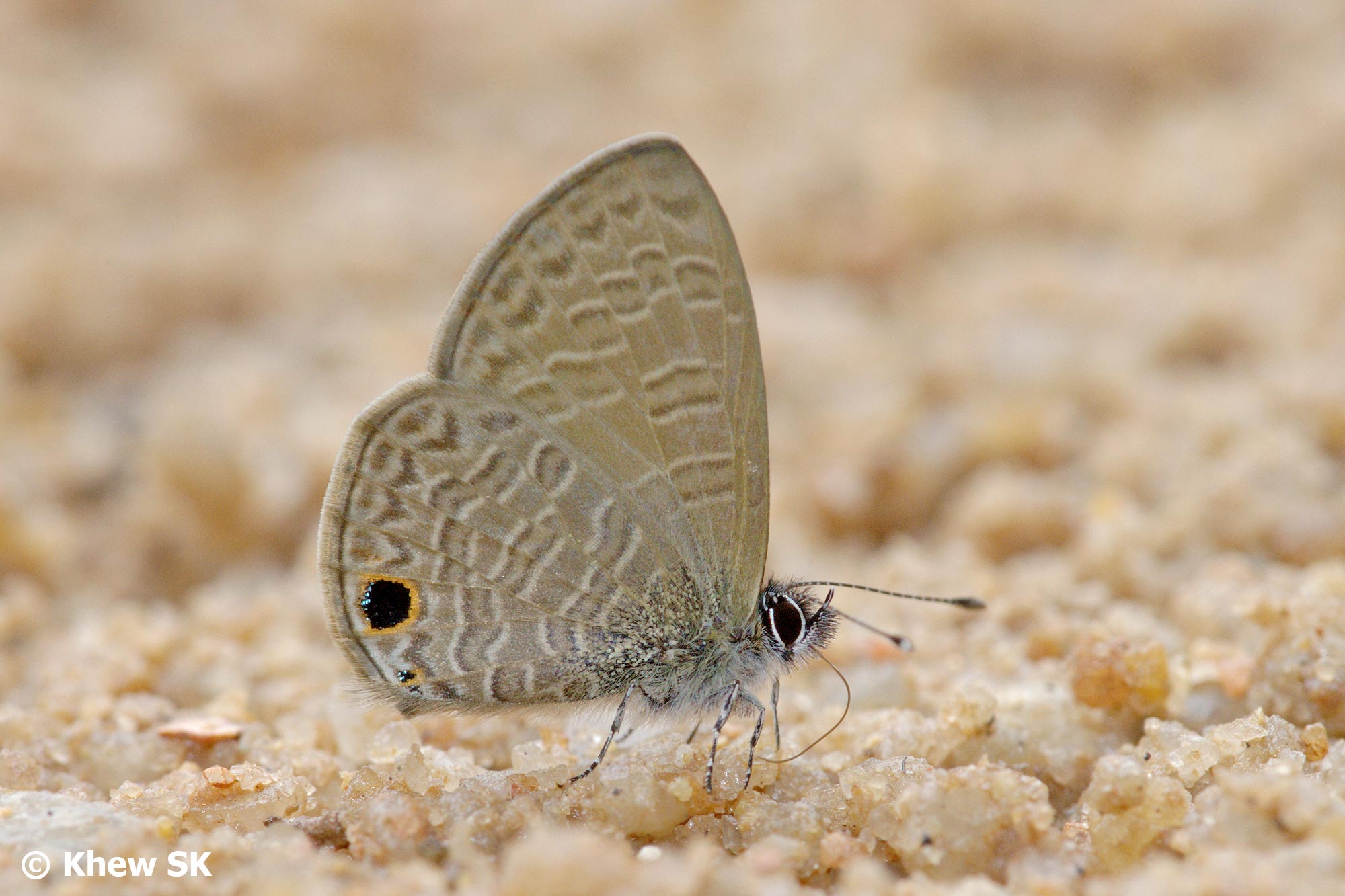
A Tailless Line Blue puddling at a damp footpath

There was much excitement with the election fever gripping our northern neighbour as Malaysians waited with bated breath, anticipating who would be proclaimed Malaysia's 10th Prime Minister. As expected, the results of the elections were not conclusive, and it was left to the Yang DiPertuan Agong to decide who would lead Malaysian politics into the coming years. As it came to be, the 75-year old Anwar Ibrahim become Malaysia's next PM.

A Tailless Line Blue feeding on the remains of a dragonfly nymph
A Tailless Line Blue puddling at a red brick path

With his colourful history, particularly having served a prison sentence before, PM Anwar is a shining example of "never give up" spirit. Not many would have given him a chance of ever being Malaysia's PM after so many attempts to return to power, and the intriguing twists and turns in his political fortunes - one that would make a very interesting plot for a drama!

A pair of Tailless Line Blues puddling together
A Tailless Line Blue feeding on the flower of the Spanish Needle (Bidens alba) in Hong Kong

Over in Qatar, soccer fans were treated to their first FIFA World Cup ever to be held in the Arab world. Held once every four years, the 2022 edition of the FIFA World Cup supposedly costs over US$220B to host - a sum that would even be significant to the wealthy emirate with the 4th highest GDP per capita in the world. This edition of the World Cup is being held in the "winter" months as the unbearable heat and humidity in the region would have posed challenges to playing soccer in the summer months.


Back home in Singapore, the rising interest rates, rents and general cost of living and the impending adjustment of the Goods and Services Tax by 1% in 2023 and another 1% in the following year was cause for concern for the residents. For example, rentals of residential units rose by an eye-watering 46% from 2019, and is set to continue on its trajectory upwards. This would certainly put a severe strain on the working population, particularly the foreign workforce in Singapore. Already, there is talk of an imminent recession in the months ahead, adding to the woes of Singaporeans.


Back to our butterfly world, we introduce our 181st Butterfly of the Month since the start of this series.  For the month of November 2022, we feature the diminutive Tailless Line Blue (Prosotas dubiosa lumpura). This tiny species, with a wingspan of just over 20mm, is widely distributed across Singapore, and is sometimes abundant where several dozens may be flying around and dogfighting amongst the shrubbery.

A Tailless Line Blue taking in perspiration from a human
It can be found in Singapore's urban parks and gardens as well as in the nature reserves. It has a weak but erratic flight but is skittish and waiting for an individual to stop and perch for a good photograph is often challenging. Amongst its caterpillar host plants are Bridelia tomentosa and the non-native Acacia auriculiformis.

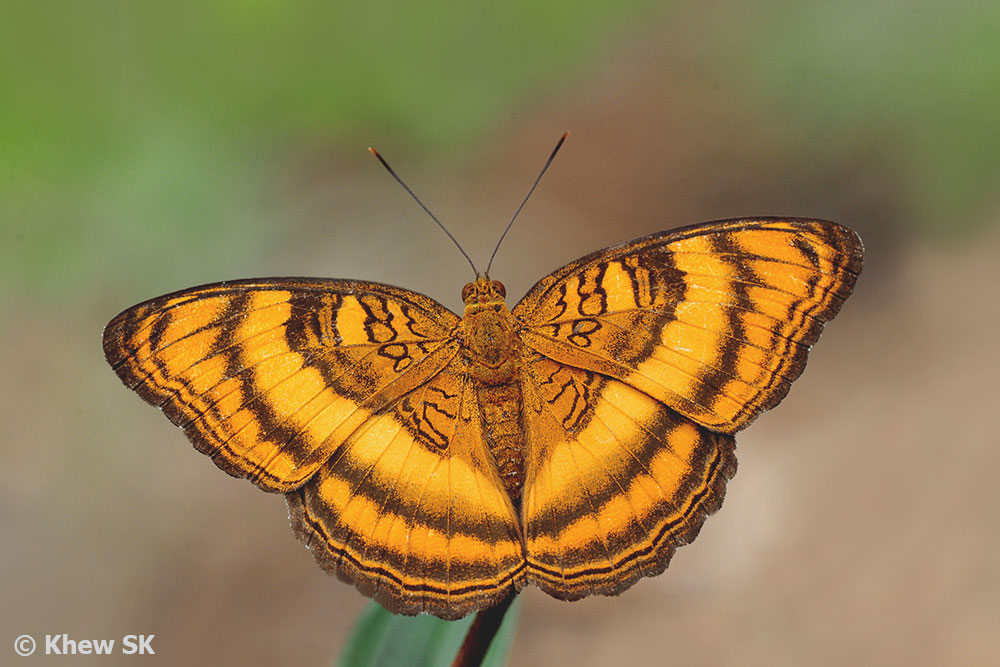
A glimpse of the upperside of a male Tailless Line Blue
A female Tailless Line Blue sunbathes on the top of a palm leaf

The Tailless Line Blue is bluish purple on top with an almost imperceptible border in the male. The female is brown on top with blue discal patch and wing bases. The underside is greyish with the usual striations of the genus. At the tornal area is a large black spot that is crowned with orange. There are also some light greenish blue iridescent scales on the tornal spot.

Puddling Tailless Line Blues on various food sources

The eyes are jet black and large, and the antennae black-and-white banded. As its common name suggests, it is tailless, unlike many of the other tailed species in the genus. It can be encountered feeding at small flowers and can easily be approached when puddling on damp sandy streambanks and decomposing organic material.

Text by Khew SK : Photos by Janice Ang, David Chan, May Chan, David Ho, Khew SK, Koh CH, Ann Kong, Loh MY, Michael Soh and Zick Soh.

27 June 2021

Butterfly of the Month - June 2021

Butterfly of the Month - June 2021
The Dingy Line Blue (Petrelaea dana dana)

A Dingy Line blue puddling at a sandy streambank in the nature reserves in Singapore

The final weekend of June is here, and it also marks the end of the first half of 2021. The past six months have been a blur that zoomed past us, leaving us wondering what we have managed to achieve. We all know that time flies; but COVID19 seems to make it fly faster! The world has had to deal with the pandemic from early 2020, and to some, it seemed to have robbed us of 1.5 years of our lives, making us reflect on how we spent that time.


Very few are going to talk about productivity over the past 18 months, nor are we going to be measured against how productively we worked. The pandemic decided that for us. Working from home, online meetings, home-based learning and so on - did we manage to do as much in that time as compared to the pre-COVID year before? I believe that for the majority of us, we don't even want to think about it - there were too many compromises made, and safety is our priority. We were mainly struggling to ensure that we would not be infected, and that we could continue to keep our jobs.

A Dingy Line Blue puddling on a clay brick staircase in an urban hill park

In the past month, Singapore experienced a "2nd wave" of sorts. There were no official references to a 2nd wave, but restriction measures were tightened in the face of a potential mass outbreak caused by the Delta variant of the virus, which proved to be more aggressive and infectious and caused more severe symptoms for those who are not vaccinated. So, for a short period, we reverted to dining only at home, ordering food "to go" via online delivery, and it was back to WFH once again.


This time around, there was perceptibly much less panic - no mad rush for groceries, grumbling about having to contend with online meetings, or working from home. Have we been de-sensitised? The government is preparing the general citizenry for the time when COVID19 becomes "endemic". In this instance, the definition refers to a disease that is prevalent in a particular locality, region, or population (and in the case of COVID, it refers to a global endemism).

The Dingy Line Blue is more often encountered puddling at various damp spots and is a widely distributed species in Singapore

Vaccination programmes are being rolled out in many countries, with the objective of achieving "herd immunity" within the country. This, together with the fact that the effect of the virus on vaccinated individuals is much less severe, may be the solution to achieve a new normalcy that we may one day wake up to. In other words, we have to learn to live with COVID19, much like we have lived with the common cold, influenza and a host of other diseases that we have already taken for granted in our daily lives.


Speaking of normal, let's get back to our world of butterflies and our Butterfly of the Month for June 2021. We feature a diminutive and unremarkable Lycaenidae species, the Dingy Line Blue (Petrelaea dana dana). A species that was recorded as a new discovery when it was first observed in Singapore on Pulau Ubin in 2004, the Dingy Line Blue is now widely distributed across the island.


It has been observed in urban areas as well as the forested nature reserves. Due to its small size and erratic flight, the Dingy Line Blue may have been overlooked more often than not. If it does not stop to puddle or rest, it is almost impossible to identify this species when it is in flight. Most of the time, when encountered, the butterfly is puddling at damp footpaths, where it can be photographed and the identity validated.

The ground colour of the underside of the wings of this species is variable, ranging from a cool grey to a warm beige 

The upperside of the male Dingy Line Blue is violet-blue with a narrow black border, whilst the female is brown with a whitish patch on the forewing with metallic blue scaling on the wing bases. The underside ground colour is greyish brown but often variable and appearing a warmer beige-brown in some individuals.

A shot of the Dingy Line Blue perched on a blade of grass

The usual striations on the underside of the wings are white, with the inner borders of the striations darker. There are two small black spots at the tornal area of the hindwings. It should be noted that these spots are never orange-crowned and this distinguishes the Dingy Line Blue from a similar sized lookalike, the Tailless Line Blue (Prosotas dubiosa lumpura), which has orange-crowned tornal spots.


The Dingy Line Blue is a small butterfly with a wingspan of 25-28mm. The eyes of this species are opaque black. The legs are banded black and white. The species has been bred on Terminalia catappa in Singapore.

Text by Khew SK : Photos by James Chia, Hii Hui Seng, Federick Ho, Khew SK, Koh CH, Loh MY, Loke PF, Simon Sng and Michael Soh

04 July 2020

Singapore's Line Blues - Part 1

Singapore's Line Blues - Part 1
Featuring the Line Blue Butterflies of Singapore


A male Common Line Blue puddling at a sandy streambank

The "Line Blue" butterflies are a group of rather small species that belong to the subfamily Polyommatinae of the family Lycaenidae. The Polyommatinae are often referred to as the "Blues". A large number of the species in this subfamily are small and delicate butterflies with many of them sporting thin filamentous white-tipped tails on their hindwings. Many species, particularly the males, have blue uppersides, hence the English common name for the group.


A Pointed Line Blue perched on top of a leaf

This blogpost introduces the seven extant species found in Singapore that carry the English common name "Line Blue" in their names. All these species feature a series of striations across the undersides of both the fore- and hindwings. They have the typical "eyespot" at the tornal area of the hindwing and, in some of the species, coupled with the thin tails, form a decoy to fool predators into attacking a less critical part of their wings.


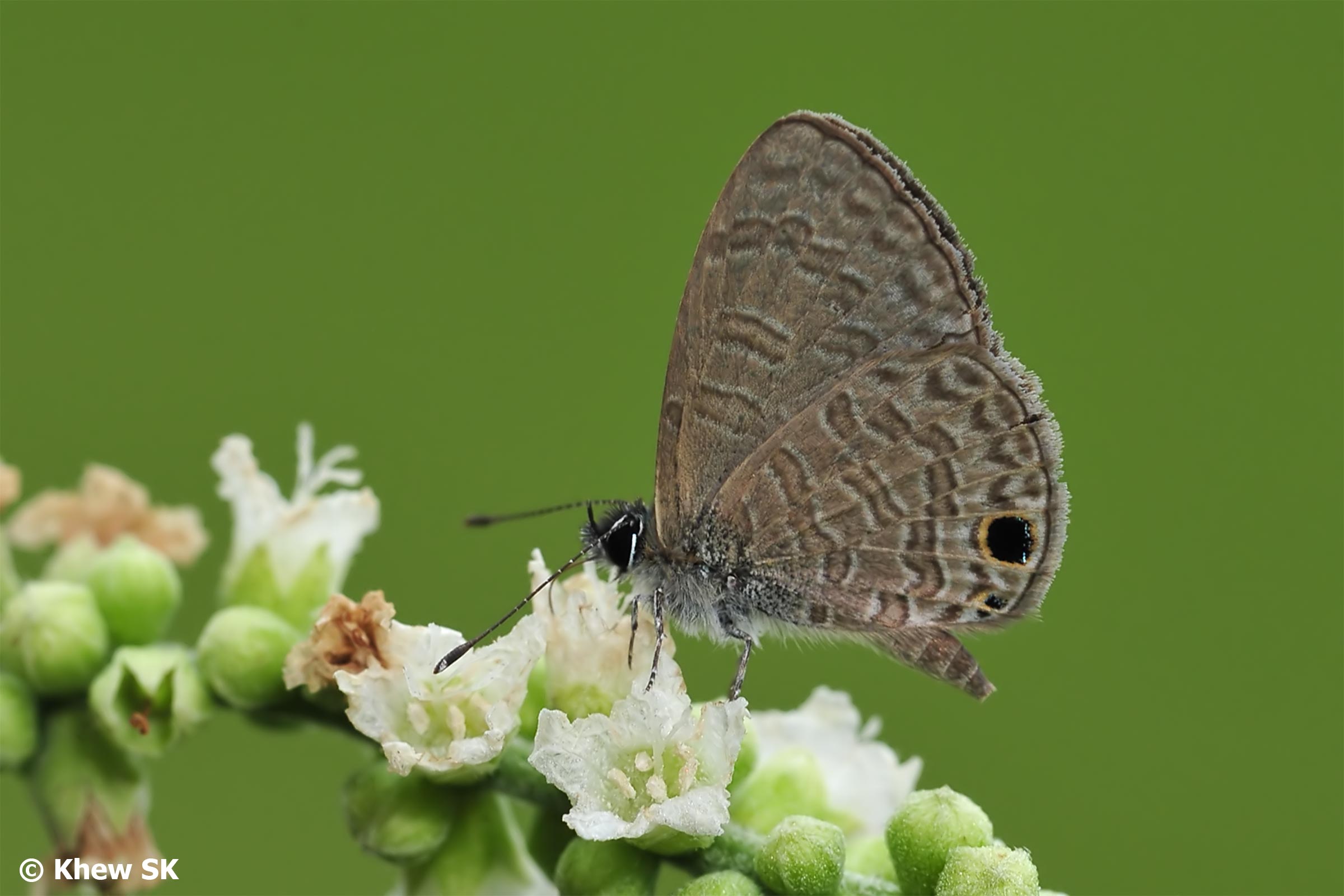
A Tailless Line Blue feeding on the flower of the Stringbush

In this article, we introduce three of the seven species that are found in Singapore. Ironically, of these "Line Blues" found in Singapore, four are new discoveries. Based on reference literature, these four were not recorded in Singapore by the early authors. We will feature these four "exotics" in Part 2 of the article next weekend. We will now highlight the three native, and relatively common species in Singapore.

1. The Pointed Line Blue (Ionolyce helicon merguia)


A puddling Pointed Line Blue

The Pointed Line Blue is the sole representative of the genus Ionolyce in the region. It is relatively common and widespread in distribution across the island. It can be found in urban parks and gardens, and sometimes in the forested nature reserves as well. Males are regularly found puddling at damp streambanks and muddy footpaths, and are partial to human perspiration as well.


It is a fast flyer, and flies erratically, and is often skittish, until it comes down to puddle on the forest floor. Once it is a feeding mood, it can also be coaxed to feed on a sweaty finger. The forewings of the males are more pronounced and pointed than other lookalike species in the subfamily.


A male Pointed Line Blue opens its wings to sunbathe

The male Pointed Line Blue is a deep purple-blue on top, with a very thin black margin and unmarked. The female is predominantly brown on her uppersides with the discal areas and wing bases overlaid with bluish-purple. The undersides are dull greyish-brown with narrow whitish wavy lines across both wings. There is an orange-crowned eye spot at the tornal area of the hindwing and a black filamentous tail which is tipped with white at vein 2 of the hindwing.

2. The Common Line Blue (Prosotas nora superdates)


A Common Line Blue feeding on the Spanish Needle flower

The Common Line Blue is a small butterfly that has a wingspan of around 25-28mm and considered moderately common. It can be found in urban parks and gardens but can also be found in the forested nature reserves. Males of the Common Line Blue are attracted to damp footpaths and streambanks where they come down to puddle for salts.


A male Common Line Blue puddling with its wings opened

The male Common Line Blue is bluish-purple on the upper surfaces with a thin black border, whilst the upperside of the female is dark brown and unmarked.  The underside of the male appears orangey whilst the base colour of the female is greyish buff.


A mating pair of Common Line Blue.  Left : Male Right : Female

The underside features white-edged dark lines across both wings with the interstitial spaces orange in the males, and grey with orange speckles in the female. There is a large orange crowned black eyespot at the tornal area of the hindwing below, with iridescent greenish scales. At vein 2 of the hindwing is a filamentous white-tipped tail.

3. The Tailless Line Blue (Prosotas dubiosa lumpura)


A Tailless Line Blue puddling

The Tailless Line Blue is a closely related species from the same genus as the Common Line Blue. But as its name suggests, there is no tail on the hindwing of this species. It is common, and sometimes seasonally abundant where two dozen individuals or even more, can be observed, frolicking amongst the shrubbery.


A male Tailless Line Blue opens its wings to sunbathe

The male Tailless Line Blue is bluish-purple on top with an almost imperceptible border. The female is brown on the uppersides with a blue discal patch. The underside is greyish, with the usual white-edged dark lines across both wings. There is a large tornal spot on the underside of the hindwing with some iridescent pale green scales.

A mating pair of Tailless Line Blues

Males are sometimes found puddling at damp footpaths, drains and wet areas. Females are more often found at flowering plants like the Stringbush. The species is widely distributed and is common throughout Singapore in urban parks and gardens.

Text and Photos by Khew SK

01 December 2018

Butterfly Photography at Our Local Parks - Kranji Marshes

Butterfly Photography at Our Local Parks
Featuring : Kranji Marshes


The Colonel (Pandita sinope sinope) feeding at the flowers of the Red Tree Shrub (Leea rubra) at Kranji Marshes

In this weekend's blogpost, we take a visit to a wetlands park situated in the northwest part of Singapore. Kranji Marshes, located along the northwestern shore of Kranji Reservoir, is one of the largest freshwater marshes in Singapore. Set in a rustic and rural environment around the Kranji area in Singapore, the 56.8-hectare freshwater marshland that is home to a wide range of biodiversity.


A map of Kranji Marshes - click to enlarge

Kranji Marshes is divided into two portions - a publicly accessible sector that covers about 8Ha, and a Core Conservation Area that comprises a freshwater marshland habitat that is ecologically sensitive and is closed to the public, except for activities approved by NParks. Specially guided walks are conducted regularly by NParks and volunteers.


Visitor Centre at Kranji Gate viewed from the carpark


The entrance to Kranji Marshes is via Neo Tiew Road into Neo Tiew Lane 2. You will pass the homestay farm known as D'Kranji Farm Resort before reaching the carpark in front of the visitor centre at Kranji Gate. There are basic visitor amenities here like restrooms, classroom facilities, and creature comforts like a drinking fountain and cold drinks dispensing machine.


Landscaping at Kranji Gate area.  Look out for the Red Tree Shrub and Singapore Rhododendron where some butterflies come to feed

The landscaping here is in keeping with marshland plants, and vegetation that can tolerate waterlogged conditions. When I visited the Kranji Marshes recently, there were a couple of fruiting Melastoma malabathricum (Straits or Singapore Rhododendron) bushes. The "signature" butterfly of Kranji Marshes (more about this butterfly in awhile) is often found in the vicinity, and one greeted me as soon as I walked past the Rhododendron bushes. Another Common Sailor (Neptis hylas papaja) was feeding on the ripened fruits.


A Common Tit feeding on the flower of the Red Tree Shrub at Kranji Marshes

Although the plants around the Kranji Gate area are not particularly the butterfly-attracting type, look out for the Red Tree Shrub (Leea rubra) shrubs with their attractive crimson red inflorescence. On a good day, you may be able to spot several species of butterflies feeding at these flowers.


Along the walk at Neo Tiew Woods, spot the butterflies on both sides of the road

As you leave the Kranji Gate area, walk along the paved road along a narrow strip of land that is referred to as Neo Tiew Woods. The newly-planted trees that line this road do not offer much shade yet, and the walk along this stretch of road can be unpleasantly hot under the scorching mid-day sun. However, keep your eyes peeled on the roadside shrubbery and grasses where butterflies may be frolicking around.


Checking out the Bandicoot Berry shrubs at Neo Tiew Woods can sometimes yield a few surprises

There are several Bandicoot Berry (Leea indica) and Red Tree Shrub trees along this track that are attractive to butterflies. Other butterfly-attracting species like the Syzygium lineatum and Syzygium zeylanicum line the roadside and when these shrubs in flower, they would be quite busy with butterflies feeding on the flowers.


Two views of the Woodpecker Shelter

Proceeding further on, you will reach the Woodpecker Shelter before arriving at the Marsh Station. This area features a small pond, around which there is ample vegetation for all sorts of critters. The green-roofed Kingfisher Burrow hides an open-sided outdoor classroom. Opposite this is the 10m tall Raptor Tower. It is often a rewarding climb up the spiral staircase to catch the breath-taking view of the surrounding marshland environment.


The 10m tall Raptor Tower

Lining the edges of the water bodies are bird hides where you can spot some of the migratory and resident birds that forage for food at the water's edge. This is about as far as a normal visitor can go. Unless you are on a special guided walk, you will not have access to the Core Conservation Area that can be reached through a gate that crosses the Sedge Bridge into the marshland area.


Views from the Raptor Tower towards the larger area of Kranji Marshes

The freshwater marshland habitat and the vegetation in the area favours a higher bird diversity than butterflies. Although, a total of 54 butterfly species have been sighted in the area, there are usually fewer butterflies compared to some of the more butterfly-attractive parks elsewhere in Singapore.


The "signature" butterfly of Kranji Marshes, the Colonel (Pandita sinope sinope) feeding on the flower of the Red Tree Shrub.  A skittish butterfly, it is easier to approach when it is feeding


However, for the butterfly photographers who are pursuing their +1's in their collection of species, Kranji Marshes is home to a "signature" species that is more often found here than elsewhere in Singapore. This butterfly is the Colonel (Pandita sinope sinope). Its caterpillar host plant, an Uncaria sp. is probably found in abundance in the vicinity, but it is interesting that it prefers this habitat and sometimes several individuals can be seen at the flowers of the Red Tree Shrub and frolicking around the bushes.


Other species of butterflies found feeding at the Red Tree Shrub flowers at Kranji Marshes

As with Sg Buloh Wetland Reserve, some "resident" species like the Blue and Dark Glassy Tiger and the Sumatran Sunbeam can sometimes be spotted at the flowering shrubs. The Grass Yellows - usually Common and Three Spot, are regular visitors to the flowers of the Bandicoot Berry and Red Tree Shrub, and their caterpillars probably feed on the Albizia leaves that are common in the vicinity.


Keep a close watch on the flowers of the Red Tree Shrub, and one can often be rewarded with sightings of Leopard Lacewings (Cethosia cyane), Blue and Peacock Pansys (Junonia orithya wallacei and Junonia almana javana) and the Lycaenids like the Common Tit (Hypolycaena erylus teatus) and Ciliate Blue (Anthene emolus goberus).


Whilst this one is harmless, do look out for the occasional real crocodile that lurks near the water's edge 

Red Tree Shrub (on the right) features pretty red inflorescences that are attractive to butterflies

The presence of the Wild Cinnamon (Cinnamomum iners) will bring the species whose caterpillars feed on this plant - Common Bluebottle (Graphium sarpedon luctatius) and Common Mime (Papilio clytia clytia). Other large butterflies like the Jacintha Eggfly (Hypolimnas bolina jacintha) and Autumn Leaf (Doleschallia bisaltide bisaltide) sometimes make their appearance as their caterpillars feed on the leaves of the Chinese Violet (Asystasia gangetica). that grow wild in the area.


Tailless Line Blue (Prosotas dubiosa lumpura) feeding on the flower of the Mile-A-Minute at Kranji Marshes

The public-accessible part of Kranji Marshes is considered a small park and the 8Ha area can easily be explored in a couple of hours or less. The marshland habitat is probably more attractive to bird watchers and photographers than for butterfly watchers. However, if you would like a date with the Colonel, this is the place to visit! Although I should add that there are no guarantees and even if a Colonel or two show up, the species is exceedingly skittish and getting a good shot of it would be a challenge.

How to Get There :

Kranji Gate:
11 Neo Tiew Lane 2,
Singapore 718814

By public transport :
Take the Kranji Express bus from Kranji MRT Station which operates daily from 8.30 am to 5.45 pm. Alight at D’Kranji Farm Resort and take a short walk to Kranji Gate. From Kranji Gate, it is an approximately 1 km walk along Neo Tiew Lane 2 to the observation tower.

By car :
From Neo Tiew Road, turn into Neo Tiew Lane 2 and drive all the way to the end of the road where there is a 20-lot car park. Note that the operating hours of Kranji Marshes are from 7am to 7pm daily.

Text and Photos by Khew SK