Showing posts sorted by date for query Potanthus ganda ganda. Sort by relevance Show all posts

24 December 2017

2017 - Looking Back

ButterflyCircle 2017 - Looking Back...
The Year in Review : Part 1


We take a look back over the past 12 months in 2017 and reflect on the activities that the group has contributed to the knowledge and sharing of information about butterflies in Singapore and our neighbours in Southeast Asia. It has been quite eventful, although here in Singapore, the actual butterfly population seemed to have dropped a bit in some months. There was no haze to blame this year, so perhaps there could be other reasons to explain for the drop in the sightings of some species that were more regular in past years.


This year, we continued to share useful articles on this blog to benefit different groups of people with different interests about butterflies. Into its 10th year, since 2007, this blog continues to churn out at least an article every weekend to cover various aspects about butterflies - from ecology and biology of butterflies, to community activities and education, to photography and outings to butterfly-rich neighbouring countries. We end 2017 with a grand total of 855 articles over the past decade of blogging.


In the regular feature articles in the blog like the Butterfly of the Month articles, we continue to share information and colourful photographs of individual species every month. This year, we have completed a total of 122 species featured over the past 10 years since the Dec 2007 "centrefold". It has been an incredible journey of monthly articles about the local butterflies featured, plus a few personal anecdotes about the world we live in.


Our life history expert, Horace Tan, has worked tirelessly over the years, churning out articles with amazing details to document the early stages of Singapore's butterflies. Given that he has already covered a staggering 194 individual life histories on this blog, this forms nearly 60% of the extant species in Singapore! There are probably a few more that Horace has yet to complete, but probably with diminishing returns as we reach a level where only the rare or very rare species are left to be documented.

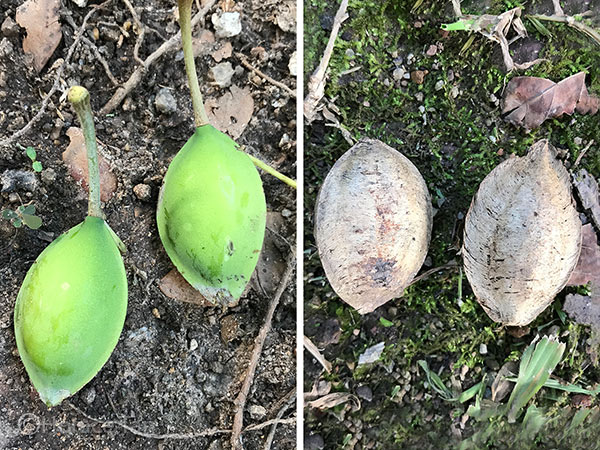


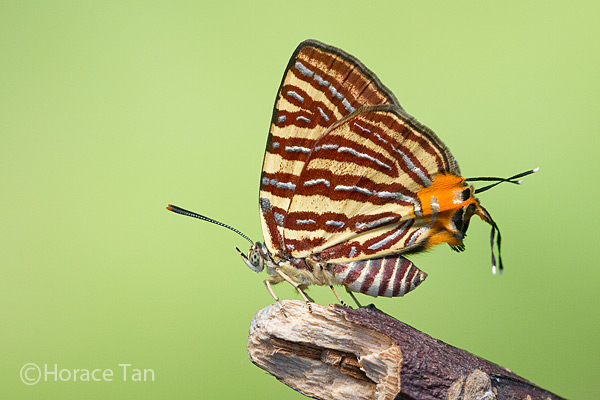

Our local host plant Sea Almond (Terminalia catappa) and three of the butterfly species that this plant supports in their early stages

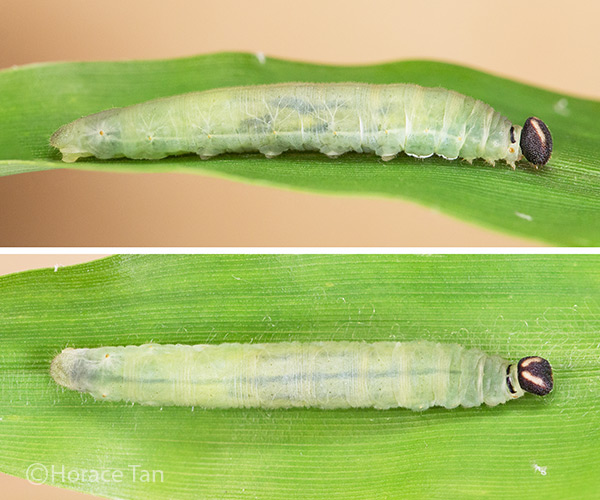
This year, Horace added two more species to his meticulous documentation of Singapore's butterfly species with the inclusion of an update to the early stages of the Purple Duke (Eulaceura osteria kumana) and the Ganda Dart (Potanthus ganda). Horace also shared one article on the Larval Host Plants of Butterflies, featuring the Sea Almond (Terminalia catappa). At least 3 butterfly species have been successfully bred on this host plant in Singapore.


Six additional butterflies' favourite nectaring plants were featured in 2017

Our Butterflies' Favourite Nectaring Plants series added six flowering plants that our local butterflies are attracted to. This topped up our list to fourteen such nectaring plants that every butterfly garden should be cultivated with. Not all the plants are your typical landscaping material, and some of them are often considered as 'weeds' to gardeners. However, it is important to have the diversity of nectaring sources to attract a wider variety of butterflies.


On the social media front, the original FaceBook site set up for sharing butterflies of Singapore took a different direction and changed its focus more and more towards the international scene. This has pros and cons, but I feel that the original mission of setting up a sharing group that features Singapore's butterfly biodiversity first, has been diluted beyond recognition.


Hence a back-to-basics Butterflies of Singapore FB group was re-created in June this year. Whilst the community is a much smaller group now, there is better local relevance and focus on Singapore's butterflies and activities. The previous group concentrates on a global thrust which does not do much to promote butterfly conservation, community engagement outings and educational activities that are specific to our local scene. I will devote my time and effort to the local group and wish the more international-outlook group all the best in pursuing their own objectives, whatever those may be.


The ever-active and enthusiastic Mr Foo contributing his time and energy to encourage butterfly enthusiasts to participate in community butterfly gardens and sharing of knowledge

ButterflyCircle's collaboration with Foo JL's Nature @ Seletar Butterfly Group has also reaped dividends for butterfly conservation and education efforts that are more tailored towards, and of particular benefit to Singapore. It is important to leave behind a legacy that cultivates the next generation of butterfly enthusiasts for Singapore to ensure a sustainable conservation community that continues to be active locally so that nature continues to have a place in our lives, despite the pressure of intensive developments on our small 715 sq km island.


The original ButterflyCircle forum that was set up in 2004 is left to take on a more scientific and taxonomic purpose. It remains a very useful resource on butterflies, particularly when we still have the invaluable expertise of Dr Seow TL in the identification of the cryptic lookalikes amongst our butterflies. Although the forums have not been as active as before, the information that is relevant still comes in very useful from time to time.


In the next part of this article, we will share more of the educational and community engagement efforts that ButterflyCircle has participated in over the past year. As we head our to our respective Christmas Eve celebrations and parties with our friends and loved ones this evening, I would like to take this opportunity to wish all our friends and readers a blessed and MERRY CHRISTMAS!!!

Text by Khew SK : Photos by Khew SK, Loh MY, Loke PF and Horace Tan

30 September 2017

Life History of the Ganda Dart

Life History of the Ganda Dart (Potanthus ganda)


Butterfly Biodata:
Genus: Potanthus Scudder, 1872
Species: ganda Fruhstorfer, 1911
Wingspan of Adult Butterfly: 21-24mm
Caterpillar Local Host Plant: Centotheca lappacea (Poaceae, common name: Sefa).


Physical Description of Adult Butterfly:
On the upperside, the wings are dark brown with orange-yellow markings. On the hindwing, a spot is present in space 7, but usually none or a small spot in space 6. On the forewing, the postdiscal band is dislocated at vein 6, and the spot in space 3 barely overlaps with the spot in space 4. On the underside, the wings are black but heavily dusted with orange-yellow scales and adorned with orange-yellow bands as above. On both upperside and underside, the veins crossing the yellow bands in the hindwing are not, or minimally, darkened.


Field Observations of Butterfly Behaviour:
Ganda Dart is a recent addition to the Singapore Checklist and is typically found in forested ares in the nature reserves. It has a similar appearance as the more commonly found Lesser Dart (Potanthus omaha). The adults fly with the usual fast and skittish manner, and can be found sunbathing in sun-lit environments and visiting flowers for nectar in the nature reserves.


Early Stages:
Centotheca lappacea, commonly found in the nature reserves, have been recorded as the local larval host for Ganda Dart. The caterpillars of the Ganda Dart feed on leaves of the host plant, and live in shelters made by joining edges of a leaf or cut segment together with silk threads. As with other skipper species, the caterpillars have the habit of forcefully ejecting their frass pellets.

Local host plant: Centotheca lappacea.

The eggs are typically laid singly on the underside of a leaf of the host plant. Occasionally eggs can also be found on the upperside and near the leaf base. Each dome-shaped egg is whitish-yellow with numerous, fine longitudinal straitions. The base diameter is about 0.85mm with a height of about 0.75mm.

Two views of an egg of the Ganda Dart.

Two views of a maturing egg of the Ganda Dart.

It takes about 4.5-5 days for the egg to hatch. The young caterpillar eats just enough of the shell to emerge, and will devour the rest of the egg shell after emergence. The newly hatched has a length of about 2mm. Its whitish body has a tuff of long setae at the posterior end. The head capsule is entirely black and there is a black collar just behind the head on the dorsum of the prothorax.

Two views of a newly hatched caterpillar of the Ganda Dart.

A newly hatched caterpillar of the Ganda Dart, in the midst of constructing its first leaf shelter at the leaf tip.

The newly hatched constructs its leaf shelter at the leaf tip soon after it is done with the egg shell. The body color changes to pale yellowish green after a few feeding sessions on the leaf. The 1st instar takes about 5 days to complete with body length increases to about 4mm.

Two views of a 1st instar caterpillar, length: 3.3mm.

Two views of a late 1st instar caterpillar, dormant prior to its moult, length: 3.8mm.

Leaf shelter of an early instar caterpillar of the Ganda Dart.

The 2nd instar caterpillar is yellowish green with a black head capsule. The black prothoracic collar is still present. This instar lasts about 5-6 days with the body length reaching about 7-7.5mm.

Two views of a 2nd instar caterpillar, newly moulted.

Two views of a 2nd instar caterpillar, length: 5.5mm.

Two views of a late 2nd instar caterpillar, dormant prior to its moult, length: 7mm.

The 3nd instar caterpillar resembles the 2nd instar caterpillar closely but with its anal plate turning brown to black in most specimens. This instar lasts about 5-6 days with the body length reaching about 11-12mm.

Two views of a 3rd instar caterpillar, length: 8.5mm.

Two views of a 3rd instar caterpillar, length: 10.8mm.

Two views of a late 3rd instar caterpillar, dormant prior to its moult, length: 10.5mm.

The 4th instar caterpillar bears a strong resemblance to the 3rd instar caterpillar but with the anal plate now broad and dominantly black. This penultimate instar lasts about 5-6 days with the body length reaching up to 17-18mm.

Two views of a 4th instar caterpillar, newly moulted.

Two views of a 4th instar caterpillar, length: 17mm.

Two views of a late 4th instar caterpillar, dormant prior to its moult, length: 17.5mm.

The 5th instar ushers in a drastic change in the appearance of the head capsule. It is dark brown along frontal cleavage lines and the periphery, but whitish coloration fills in the area between the two. The body is pale yellowish green, and the anal plate not longer as in the previous instar. This final instar takes about 7-8 days to complete with the body length reaching up to about 31-33mm.

A newly moulted 5th instar caterpillar of the Ganda Dart.

Two views of a 5th instar caterpillar, length: 33mm.

Two views of another 5th instar caterpillar, late in this stage, length: 26.5mm.

Towards the end of the 5th instar, the body of the caterpillar shortens and its coloration changes uniformly to whitish-yellow. Typically the basal part of the leaf is devoured bare of any lamina and the pupation shelter is constructed by folding and sealing the remaining part of the leaf blade. Within the shelter, it spins a silk pad to secure itself. Whitish waxy substance is deposited on the inner wall of the shelter in moderately large quantity. It stays dormant in the prepupatory phase which lasts for about 1 day.

A pre-pupatory larva of the Ganda Dart.

A pupation shelter of the Ganda Dart.

The pupa is secured within the tight confine of the pupation shelter. Its long, slender body is mostly pale yellowish brown and coated with the white waxy substance. There are two rather large, reddish brown "eye" markings at the anterior end. Length of pupae: 15.5-18mm.

Two views of a pupa of the Ganda Dart.

On the last day of the pupal period, the pupa becomes mostly dark brown to black. The next day, after about 9 days of the pupal phase, eclosion takes place with the adult emerging from the pupal case.

Two views of a mature pupa of the Ganda Dart.

A newly eclosed Ganda Dart.

References:
  • [C&P4] The Butterflies of The Malay Peninsula, A.S. Corbet and H.M. Pendlebury, 4th Edition, Malayan Nature Society, 1992.
  • Butterflies of Thailand, Pisuth Ek-Amnuay, 2nd Edition, 2012.
  • A Field Guide to the Butterflies of Singapore, Khew S.K., Ink On Paper Communications, 2010.
Text by Horace Tan, Photos by Koh Cher Hern, Khew SK  and Horace Tan