Showing posts sorted by date for query Lexias pardalis. Sort by relevance Show all posts

23 March 2019

Three Archdukes

Three Archdukes
Singapore's Archduke butterfly species


A male Archduke foraging amongst the leaf litter in the shaded forest understorey

In my earlier article on this blog, I postulated that the English common naming convention of butterflies could have been possibly coined after the titles of English peerage or Imperial gentry and military ranks. In this article, we take a look at the Archduke butterfly species that can be found in Singapore.


A female Dark Archduke on leaf litter 

Unlike the English peerage titles, the Archduke (feminine: Archduchess) was a title that originated from the Habsburg rulers of the Archduchy of Austria. It denotes a rank within the former Holy Roman Empire, which sat just below that of Emperor and King.


Hierarchy of titles in Imperial, royal, noble, gentry and chivalric ranks © Wikipedia

The etymology of the word Archduke originates from various European languages and purportedly signifies authority or primary (Arch) and leader (Duke). Notwithstanding the historical origins of the royalty-linked name, the Archduke butterflies are no less majestic in their size and prominence in the butterfly world, befitting of their common name.


A Yellow Archduke perches on a leaf in the forested nature reserves

There are 3 extant species of Archdukes that can be found in Singapore. Belonging to the genus Lexias, which features large, robust-bodied and fast-flying butterflies that prefer the heavily shaded forests rather than open sunny areas. All are considered forest-dependent and not found in urban parks and gardens. They are usually found foraging for over-ripened fruits and feeding amongst the leaf litter on forest paths.

The Archduke (Lexias pardalis dirteana)


Upperside and underside of a male Archduke

The commonest species of the genus, the Archduke displays sexual dimorphism in that the male is physically very different from the female. The male is dark velvety black above with a broad blue hindwing border, which is continued (usually in a lighter shade) along the termen of the forewing. The underside is a deep reddish brown with yellow spots.


Upperside and underside of a female Archduke

The female is dark brown above, with prominent yellow spots on both wings, including the body of the butterfly. The underside is a light brown with the yellow spots showing through. The hindwing is a pale-greyish blue throughout.


Note the bright orange apical tip of the Archdukes' antennae

In both sexes, the apical portion on the topside of the antennae is prominently orange. The orange colour is continued on the underside of the antennae as well. This is the most reliable distinguishing characteristic that separates the Archduke from its very closely related Dark Archduke.

The Dark Archduke (Lexias dirtea merguia)


A male Dark Archduke on leaf litter

Almost identical to the Archduke, the Dark Archduke (previously called the Dark-Tipped Archduke), is also sexually dimorphic, with the male and female's appearance corresponding to the Archduke. The habit of this species mirrors the Archduke, and individuals are often found feeding on rotting fruit and other organic matter amongst leaf litter on the forest floor.


Upperside and underside of a female Dark Archduke

The male and female of the Dark Archduke closely resemble the corresponding sexes of the Archduke. The male is velvety black above with the blue marginal border on the hindwing, which extends to the termen of the forewing. The female is dark brown with yellow spots on both wings.


Note the black antennal tips of the Dark Archduke male and female

The primary difference between the Archduke and Dark Archduke is that the apical portion of the antennal club is black instead of orange. The underside of the antennae can still show some orange colouration like the Archduke. It is almost impossible to distinguish the two species when in flight, although there are some key, but still variable differences on the wings of both species to help distinguish them.

The Yellow Archduke (Lexias canescens pardalina)


Yellow Archduke puddling on the forest floor

The third, and smallest species of the three Archdukes is the Yellow Archduke. Of great interest is that it is the only species in the Lexias genus that is not sexually dimorphic! Both the male and female look alike, although the female is usually much larger. Displaying the same forest-floor foraging habits as its two other cousins, it is also a forest-dependent species.


Upperside and underside of the Yellow Archduke

The Yellow Archduke is dark brown above with large yellow spots on both wings, resembling the females of the Archduke and Dark Archduke. However, both the males and females look alike. The underside of the hindwing only has the dorsal margin a pale-greyish blue with the larger part of the wing brown and yellow.


Mating pair of the Yellow Archduke

On the upperside of the forewing, the line of yellow spots at the post-basal area features a spot (the 4th spot from the base) which is coalesced into a single spot. In the female Archduke and Dark Archduke, this yellow spot is split into two spots. This is the most reliable characteristic to separate the Yellow Archduke from its two close cousins.

Text by Khew SK : Photos by Khew SK, Koh CH, Nelson Ong, Simon Sng and Jonathan Soong

16 September 2018

Taxonomic Classification in Butterflies

Taxonomic Classification in Butterflies
What is a Subspecies?


The Swedish naturalist, Carolus Linnaeus (Carl von Linne) pioneered the internationally recognised naming system for every creature and plant. Realising that every organism should be classified systematically according to its relationship with other organisms, he created the Linnaean system in his works, Systema Naturae in 1735 - a catalogue of the names of all known animals and plants. The 10th edition of Systema Naturae in 1758 is often adopted as the starting point for biological classification of animals and plants by family, genus and species.


According to the Linnaean system, all animals and plants are known by a combination of two names - the first indicating the genus, and the second, the species. This system, referred to as binominal nomenclature is also applied to the naming of butterflies. Furthermore, classification of butterflies used by many researchers and authors extend one more level to a rank below species. This is the subspecies. This method of naming the subspecies is known as the trinominal system and is now in general use for the scientific naming of butterflies.


A Pea Blue in Singapore is also known as a Long-Tailed Blue in Australia and Europe.  But its scientific name, Lampides boeticus, is consistent, wherever it is found.

I have sometimes been asked about what a subspecies is, and how a butterfly subspecies comes about. This blogpost discusses the definition of subspecies, and the way it is applied to the scientific naming of butterflies. Although most amateurs and hobbyists prefer to use English common names for butterflies, this can often be confusing, and common names tend to differ amongst different countries and published references. Scientific names, however, are adopted universally and Lampides boeticus is the name used for the species, whether in England or in Singapore. The English common name, however, may vary from Long-Tailed Blue to Pea Blue, depending on where the butterfly is sighted!


Before we examine the concept of subspecies, let's consider what makes a species. A species is a group of living things with very similar traits that can interbreed. For example, elephants can breed with each other, but not with hippopotamuses. Different species rarely interbreed. On the occasions when they do, either by human intervention or naturally, the offsprings of the interbreeding are typically sterile, and are unable to reproduce further.


By definition, a subspecies is an individual or a group within a species that has become somewhat physically different from the species. However, they are still biologically similar enough to interbreed with individuals of the same species. Now let's take a look at why some species branch into subspecies. One major reason for this is the geographic isolation of a particular population of that species e.g. by physical distance or geographical separation, like an island. They are still the same species, but the group that became isolated may take on some different physical features simply due to their location.


The southern Malaysian and Singapore subspecies malayana (left) has less dense striations on its wings than the northern Malaysian subspecies nina (right)

However, we need to understand that the science of taxonomy is ever-evolving. Scientists often find themselves in disputes about which genus a particular species belongs to, or whether two or more butterflies with very similar physical characteristics should be classified as separate species or as subspecies. With recent developments in microbiology, phylogenetics, DNA sequencing, and the study of the early stages of a butterfly often results in new insights on the relationships between species. This newfound knowledge regularly results in the necessity to make revisions to the adopted classifications of butterflies.


Scientific name of the Lime Butterfly is :
[Genus]Papilio [Species]demoleus [Subspecies]malayanus

In the trinominal system of naming of butterfly species, we have the [Genus] followed by the [species name] and then by the [subspecies name]. Hence for a Lime Butterfly, the scientific name would be Papilio demoleus malayanus. Note that only the genus name is capitalised. The species and subspecies name should never be capitalised.


Different subspecies of butterflies found in Singapore vs those found in Northern Thailand
Top : Moduza procris procis (Chiang Dao) vs Moduza procris milonia (Singapore)
Middle : Cheritra freja friggia (Singapore) vs Cheritra freja evansi (Chiang Dao)
Bottom : Lexias pardalis jadeitina (Chiang Dao) vs Lexias pardalis dirteana (Singapore)

For amateur observers (and even for the more knowledgeable enthusiasts), it is sometimes difficult to ascertain the physical differences between two subspecies of butterflies. Very often, purely due to geographical distances, a butterfly that shows very little perceptible physical differences is given a different subspecies name. Others, however, are more obvious where the physical differences are clear.


Examples of butterflies which has only the species name, suggesting that the physical appearance of these species have no significant differences irrespective of where they are found - Lampides boeticus (Pea Blue), Acreae terpsicore (Tawny Coster), Udaspes folus (Grass Demon) and Plastingia naga (Chequered Lancer)

Then what about butterflies with only species name given to it? This suggests that the species is consistent throughout its range and there are no discernible physical differences in its appearance, no matter where it is geographically found. Some examples of such butterflies that are extant in Singapore are the Pea Blue, Grass Demon, Tawny Coster and Chequered Lancer. Interestingly, quite a number of butterflies that have been described down to only species level are from the Lycaenidae and Hesperiidae families.


Left : Subspecies malayana and Right : subspecies parkeri are both found in Singapore

Left : Subspecies bolina and Right : subspecies jacintha are both found in Singapore

Left : Subspecies pratipa and Right : subspecies bisaltide are both found in Singapore. However, subspecies pratipa has not be reliably seen since 2007.

Left : Female subspecies bisalitide and Right : subspecies pratipa showing their differences on the upperside of their wings

In Singapore, there are 3 occurrences of butterflies of which there are two subspecies observed here over the years. These are the Knight (Lebadea martha parkeri and Lebadea martha malayana), the Great / Jacintha Eggfly (Hypolimnas bolina bolina and Hypolimnas bolina jacintha) and the Autumn Leaf (Doleschallia bisaltide bisaltide and Doleschallia bisaltide pratipa). Being an island separated from mainland Malaysia, it is likely that these subspecies' range overlap between Singapore and Malaysia and the evolution of the subspecies may continue until one is eventually eliminated.


Top : Caterpillar of the Autumn Leaf subspecies bisaltide and Bottom : subspecies pratipa

In the case of the Autumn Leaf, the subspecies pratipa which is usually found in Malaysia has a distinctively different caterpillar that is more obvious than the adult butterflies. However, subspecies pratipa was last seen in Aug 2007 at the Mandai Zoo and it is unknown if this subspecies still occurs in Singapore. The other two species continue to have sightings of their respective subspecies to this day.

As taxonomic science continues to evolve, technical methods and new knowledge are gained, it is inevitable that changes and updates to the scientific names of butterflies will continue.

Text by Khew SK : Photos by James Chia, Khew SK, Anthony Wong and Mark Wong

28 January 2018

Favourite Nectaring Plants #15

Butterflies' Favourite Nectaring Plants #15
The Spicate Eugenia (Syzygium zeylanicum)


A Plane (Bindahara phocides phocides) feeding on the flower of Syzygium zeylanicum

This article features a relatively widespread species of the Syzygium genus, the Spicate Eugenia (Syzygium zeylanicum). The genus Syzygium comprise flowering plants that belongs to the myrtle family, Myrtaceae. The genus comprises about 1200–1800 species, and has a native range that extends from Africa and Madagascar through southern Asia east through the Pacific. Its highest levels of diversity occur from Malaysia to northeastern Australia, where many species are very poorly known and many more have not been described taxonomically.


A Spicate Eugenia tree in full bloom along the fringe of the nature reserves

Several species of Syzygium are well-known as a popular local fruit called "Jambu", a pink or red crunchy and thirst-quenching fruit that is often eaten "off the tree". The flowers of the Syzygium spp are quite unique in that they often bloom in bushy white clusters, giving the tree a "wintry" appearance. When in full bloom, many species of the Syzygiums attract insects and other pollinators to feed on the nectar of its flowers.


Buds and flowers of the Spicate Eugenia

Whilst we feature the Spicate Eugenia as our 15th butterflies' favourite nectaring plant, there are several other local Syzygium species, like S. glaucum, S. myrtifolium, S. lineatum and probably several other species that look quite similar to the Spicate Eugenia and whose flowers are equally as attractive to butterflies. These plants can be found in Singapore's parks and nature reserves and whenever they are in bloom, it is always a delight to enjoy the numerous species of butterflies feeding on the flowers of these plants.


The genus name Syzygium is derived from 'syzygos' (Greek for 'joined'), alluding to the opposite paired leaves. The species name 'zeylanicum' refers to Ceylon (old name for Sri Lanka), where the species is also naturally distributed. The Spicate Eugenia is native to Singapore and has a distribution range across East Madagascar, through India, South China to Southeast Asia.

Plant Biodata:
Family: Myrtaceae
Genus: Syzygium
Species: zeylanicum
Synonyms: Eugenia longicauda, Eugenia zeylanica, Eugenia varians, Myrtus zeylanica, Syzygium spicatum, Eugenia spicata
Country/Region of Origin: Native to Singapore
English Common Names: Spicate Eugenia
Other Local Names: Kelat Nasi Nasi, Kelat Nenasi, Gelam Tikus, Gelam Paya, Gelam Tikus Laut, Kelat Merah, 锡兰蒲桃


A Spicate Eugenia tree in full bloom.  Can you spot the two butterflies feeding on the flowers?

The Spicate Eugenia is a small to medium-sized tree that can grow up to 18 m tall, attain 100 cm in girth size, with oval to rounded crown.. The bark of the tree is reddish-brown and papery-flaky in young specimens. Where cultivated in parks or the fringes of nature reserves, it is planted single in rows or close together to form a hedge or a visual screen. It is sometimes seen growing wild on our natural coastal cliffs such as those on St John's Island and Labrador Park. In other areas, it is cultivated at Singapore Botanic Gardens, Upper Seletar Reservoir Park, Pulau Ubin, Pulau Tekong, Telok Blangah Hill Park and many other parks in Singapore.


Leaves of the Spicate Eugenia. Young leaves are orangish-pink and glossy

The leaves are opposite, short-stalked and leathery, elliptical to lance-shaped, 5–11 cm long by 2–5 cm wide with a pointed leaf tip. Each leaf has one vein running parallel to the leaf margin, and 10–14 pairs of side veins. Mature leaves dark glossy green above, paler green below, with numerous secondary veins spaced 2-3 mm apart and at 80°-85° angle from midvein, veins conspicuous on upper leaf surface and slightly raised on bottom surface. The young leaves are purplish to orangish-pink and very glossy.


Close up of the flowers of the Spicate Eugenia

The flowers of the Spicate Eugenia are bisexual and are white, faintly fragrant, and found in up to 2.5–4 cm long flower clusters located at ends of its branches, or axils of its leaves. The flowers are bushy, often described to look like "pom-poms" and are highly attractive to butterflies and other insect pollinators. When in full bloom, the tree looks like it is covered in white "snow". The flowers are delicate, and usually do not last for more than a week.


The whitish-green fruits of the Spicate Eugenia with a Copper Flash standing guard

The plant produces fleshy fruits that are oblong-round, 0.5–0.7 cm in diameter, white and each fruit contains one greenish seed. The small berries ripen from greenish to white and freckled with several brownish spots. The relatively thin pulp is soft and fleshy, and is edible. The seeds are eaten by birds, squirrels and other fruit-eating animals.


The Spicate Eugenia flowers infrequently - sometimes once to three times a year, and occasionally it may flower weakly and the tree does not reach a full bloom. However, when it does flower (and often several trees in the same vicinity flower together at once), the butterfly species that visit the flowers for their nectar is an awesome sight to behold! Where the tree grows at the fringes of the nature reserves, many rare and otherwise not-often-encountered species can be observed.


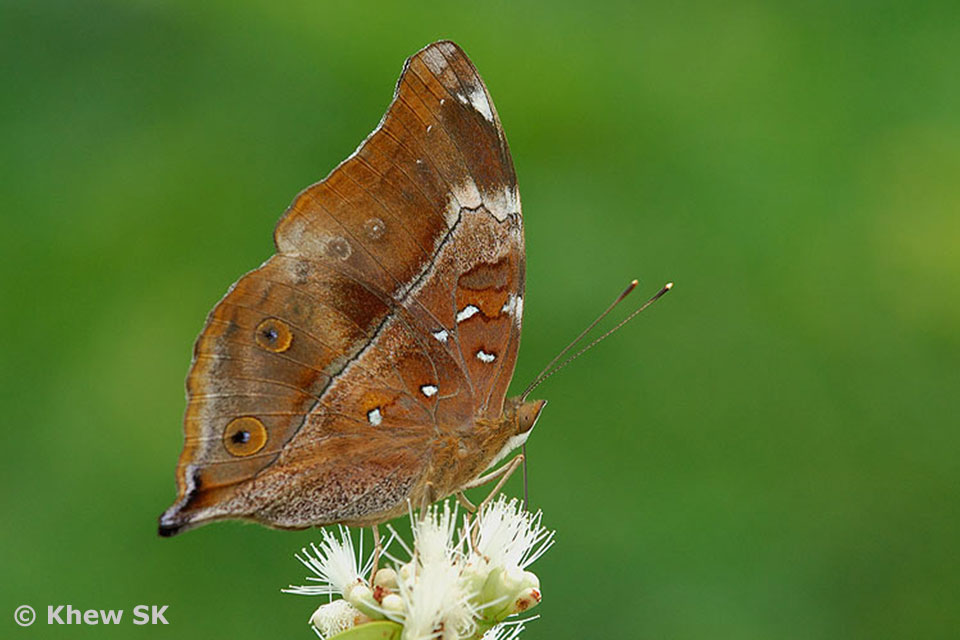
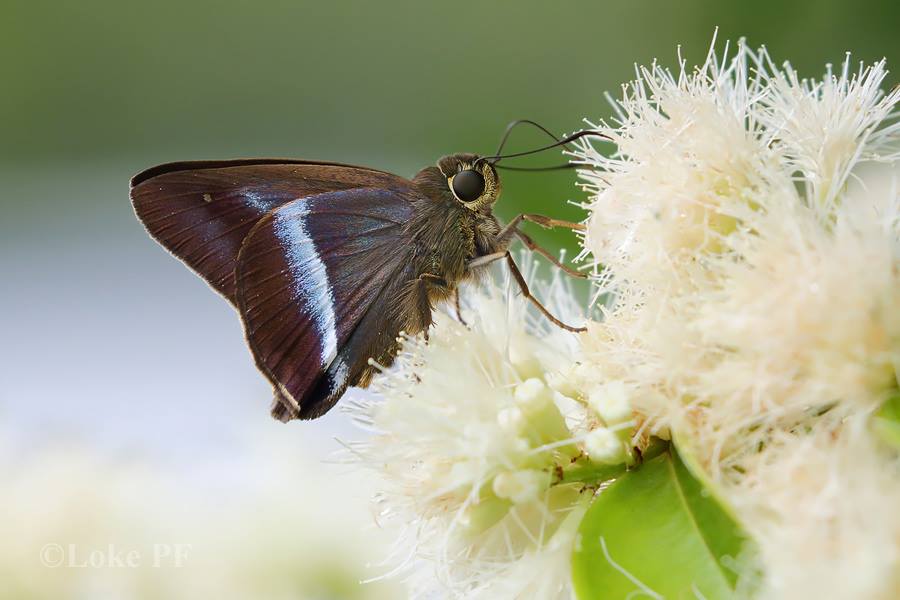
Butterflies of all sizes and species are attracted to the flowers of the Spicate Eugenia

A tree in full bloom attracts many representatives from five of the six families of butterflies in Singapore - with the exception being the Riodinidae, which I have personally not encountered any of the species feeding on the flowers of the Spicate Eugenia. It is interesting to note that the physical structure of the flowers are almost universal to allow butterflies of all shapes and sizes to feed on the nectar in the flowers - from the large Papilionidae to the diminutive Lycaenidae and the long-proboscis endowed Hesperiidae.


Very subtle differences between the leaf margin veins between S. zeylanicum and S. lineatum

The Spicate Eugenia is often confused with the very similar-looking Common Kelat (Syzygium lineatum). Both trees, when flowering, are equally as attractive to butterflies. The distinguishing veins on the underside of the leaf of the Common Kelat has two veins running parallel to the leaf margin, whereas the Spicate Eugenia's leaf has only one vein.


Another closely-related species, Syzygium glaucum and some butterflies that feed on the flowers

Another related species, Syzygium glaucum, has almost similar looking flowers that are equally attractive to butterflies and is also featured here with several butterfly species feeding on the flowers. This Syzygium species has been cultivated at Pasir Ris Park near the mangrove walk, and should also be observed for its attractiveness to the butterflies in this urban park.


Whilst the fragrance of the flowers is not often detectable by the human nose, once the Spicate Eugenia trees or bushes flower, particularly in nature areas, it will be swarming with butterflies, bees, moths and all sorts of insects. This strongly suggests that the nectar in the flowers must be attractive enough to bring all these visitors, which are otherwise shy and not often observed, to the flowering trees.


The usually shade-loving Archdukes come out to feed on the flower of the Spicate Eugenia.
Top : Male Archduke Bottom : Female Archduke

It is always amazing to see so many species of butterflies visiting the flowers of the Spicate Eugenia, and even the ground feeders can be seen. For example, the Archduke (Lexias pardalis dirteana), usually found in the shaded understorey of forested areas and typically feed on rotting fruits on the forest floor, has been seen feeding at the flowers of the Syzygium in the open. This observation is evidence of a change in behaviour of the shade-preferring Archdukes, whenever they are attracted to the flowers of this plant.


Various Hesperiidae and Lycaenidae feed on the Spicate Eugenia flowers

For the many other species of butterflies which an observer may encounter when the Spicate Eugenia (and several other related Syzygium spp) flowers, there are too many to name in this article. We will continue to be surprised at the diversity of butterflies that are attracted to this flowering tree and it is certain one of the 'butterfly magnets' that NParks should continue to cultivate, particularly in the vicinity of the nature catchments.

Text by Khew SK : Photos by Khew SK, Henry Koh, Loke PF, Bene Tay and Teo Siyang