Showing posts sorted by date for query Badamia exclamationis. Sort by relevance Show all posts

30 April 2024

Butterfly of the Month - April 2024

Butterfly of the Month - April 2024
The Brown Awl (Badamia exclamationis)


It has been a very hot hot April, with temperatures in Singapore soaring in the high 30's. All over Asia, temperatures are at an unprecedented high, and we are not even in the summer months yet! If this is not climate change, then I don't know what is. Historical highs are being recorded year after year and it is quite widely acknowledged by butterfly watchers and enthusiasts that butterfly populations are down in many parts of Asia, compared to a decade ago.


This month, our feature butterfly is the unremarkable Brown Awl (Badamia exclamationis). This is a skipper from the sub-family Coeliadinae and the only representative of its genus in the region. It is a relatively large butterfly and is a fast-flyer like most Hesperiidae species. I've always been intrigued by the latin species name of this Skipper. It's as though the scientist who first described it screamed out loud when he first discovered this butterfly!


The Brown Awl is moderately rare in Singapore, usually observed singly in the early hours of the morning. It has also been observed to puddle occasionally, but where it is encountered, it is more often seen feeding on moisture off damp rocks, stone walls and timber structures in the cooler morning air. There have been few records of the Brown Awl feeding on flowers.


The species is more often encountered in the forested nature reserves than in urban parks and gardens, although it is widely distributed across Singapore and found in various habitats where its caterpillar host plants, Combretum sundaicum and Terminalia calamansanai (both from the Combretaceae family) are found. Where they are observed, they are usually encountered singly.

A Brown Awl perched on a damp rock after feeding off moisture from the rock
A Brown Awl feeding on the flower of the String Bush at Tampines Eco Green

The wings of the Brown Awl are very elongated and the hindwing is caudate at vein 1b, and strongly excavate between veins 1b and 2. Above, the wings are dark brown with greyish green scaling at the wing bases. The female has prominent and elongated hyaline streaks in spaces 1b, 2 and 3, and the cell in the forewing. In contrast, these streaks in the male are rather small and subdued.

A partial upperside view of a male Brown Awl

On the undersides, both sexes are pale greyish brown and largely unmarked. There is a small yellowish sub-tornal spot in space 1b of the hindwing, which usually goes unnoticed as the hindwings typically fold up at the dorsal area. The prominent veins on the underside gives the butterfly a streaked-like appearance. The abdomen of the butterfly is prominently yellow-banded.

Under leaf behaviour of the Brown Awl where it clings on to the underside of a leaf to rest

The Brown Awl occurs from Sri Lanka, India, China through the Malay Peninsula and Singapore to New Guinea, Australia and as far east as Samoa. In Singapore, it is usually encountered feeding at damp rocks or at flowering plants (uncommonly). It has a habit of perching on the undersides of foliage with its wings folded upright and often adopts this position when it is disturbed and flies off to hide under a leaf.

Text by Khew SK : Photos by Khew SK, Koh CH, Dr Lee PC, Billy Oh, Jonathan Soong and Horace Tan

12 May 2019

Awls of Singapore : Part 1

Awls of Singapore : Part 1
Featuring the Awl skippers in Singapore

A Orange Tailed Awl puddles on a damp timber plank

This weekend's blogpost takes a look at the various butterfly species that carry the English common name "Awl". The name Awl usually refers to a group of Hesperiidae (Skippers) that are medium-sized, robust-bodied butterflies classified under the sub-family Coeliadinae. In Singapore, the Awls come from three main genera - Badamia, Bibasis and Hasora.


A Common Awl perches in its typical under leaf pose

I did a word search to investigate the background of the name "Awl" and to look for the possible theories as to why this name was chosen for these butterflies. Invariably, the majority of online dictionaries define awl as a "A small pointed tool used for piercing holes, especially in leather." It is therefore interesting to consider why a butterfly is associated with a pointed tool for its common name!


This is what an "awl" is - a sharp tool to pierce holes in leather

Firstly, is it perhaps the broad bodies of the butterflies and sharply pointed wingtips that gave the early authors the idea that these species are reminiscent of the pointed tool? Or did these authors originally intending to name these butterflies after the bird "Owl" instead? There could always be a possibility that this name was misspelt as Awl? The group of butterflies are known to be crepuscular (active in the dim light in the dawn or dusk hours of the day), and hence could have been associated with nocturnal owls instead?


A Brown Awl extends its long proboscis to feed

It is not common to come across butterflies named after inanimate objects as its common name. In many of my discussions on the English or vernacular common names of butterflies, they are named after birds, animals, colour, people, behaviour, ranks, etc., but names after objects are few and far in between. We will never know for sure, the reasons why the early authors referred to these species as "Awls", but it can always be an interesting subject for debate!


This two-part blog article takes a look at the seven extant species of Awls in Singapore, with Part 1 showcasing three of the seven species. Amongst the butterflies called Awls, five are under the genus Hasora, and one each from the genus Badamia and Bibasis.

1) Brown Awl (Badamia exclamationis)


A Brown Awl feeding on the flower of the String Bush

The first of the Awls is a single genus-single species representative butterfly in Singapore. Globally, there are only two known species in the genus - the other being Badamia atrox, that flies in the islands of New Caledonia and Fiji. The Brown Awl has a large geographical range, starting from India at its western-most range, stretching all the way to Japan in the north-east and Australia in the south-east extremity of its range. In Singapore, the Brown Awl appears intermittently throughout the year, and can be found in the nature reserves as well as urban parks and gardens.


The Brown Awl is regularly observed hiding upside down on the undersides of leaves

The Brown Awl is a medium brown on the upperside, with elongate white hyaline streaks on the forewing in the female. These streaks are near-obscure in males of the species. The wing bases are greyish-green on the upperside. The underside is a drab greyish-brown and unmarked. The abdomen of the butterfly is striped brown and yellow. The wing shape of the Brown Awl is uniquely elongated with the hindwing strongly caudate, giving it a silhouette of a stealth bomber.


The Brown Awl is moderately rare and is usually encountered singly. It has a habit of hiding under leaves with its wings folded upright. It is skittish and a fast flyer. The species has been successfully bred on two caterpillar host plants in Singapore - Combretum sundaicum and Terminalia calamansanai.

2) The Orange Tailed Awl (Bibasis sena uniformis)


An Orange Tailed Awl puddling at a sandy streambank

The Orange Tailed Awl is rare, and a new discovery for Singapore when it was first observed in the forested nature reserves of Singapore. Subsequently, the caterpillars of the species were found in numbers in the Singapore Botanic Gardens on Hiptage benghalensis. However, the adult butterflies are still rarely seen, perhaps due to its crepuscular habits.


The Orange Tailed Awl is dark brown on its uppersides and unmarked. The wings are long and angular with the hindwing tornal cilia a deep orange yellow in pristine individuals. The underside has a broad white discal band on both wings and a purple-blue sheen. The hairs on the legs of the butterfly are orange yellow.

3) The Common Awl (Hasora badra badra)


A Common Awl perches on the underside of a palm frond

The Common Awl is a relatively widespread species in Singapore, and has been observed in urban parks and gardens as well as the forested nature reserves. It is one of five species in the genus Hasora. It is also closely associated with the mangrove and back-mangrove environments where its caterpillar host plant, Derris elliptica, grows wild as a creeper. It tends to prefer shaded habitats and has a habit of flying rapidly and then settling with its wings folded upright on the underside of a leaf to hide itself.


The Common Awl is often encountered puddling at footpaths, bird droppings, damp tree trunks and in the case of the last photo, even on damp brick walls!

The male Common Awl is dark brown above with the wings usually unmarked, although in some individuals, small sub-apical spots may be present. The female has three large pale yellowish sub-apical spots and large hyaline spots in the cell area of the forewing. The underside is brown with a light purplish glaze with a prominent circular white spot in the cell of the hindwing. When photographed with a flash, the purple glaze is enhanced, bringing out a strong purple blue sheen that is not usually seen in natural light.

In the next part of the Awls of Singapore, we take a look at the remaining four Awls that are extant in Singapore, all of which belong to the genus Hasora.

Text by Khew SK : Photos by David Chan, Khew SK, Koh CH, Michael Soh, Jonathan Soong and Horace Tan

16 January 2016

Butterfly Photography at Our Local Parks - Seletar Country Club

Butterfly Photography at Our Local Parks
Featuring : Seletar Country Club Butterfly Garden


Welcome to the Seletar Country Club Butterfly Garden

Golf courses are large tracts of greenery that are, ironically, not very "green". A typical golf course occupies tens of hectares of land that is usually cleared of vegetation for the course to serve its purpose. Referred to as "green deserts" by Dr Richard Corlett (formerly from the NUS), the greenery on golf courses may mislead one to think that the greens are rich with biodiversity. This is usually furthest from the truth, as the amount of environmentally-unfriendly fertilisers and pesticides used to keep golf greens pristine and manicured can adversely affect biodiversity.


However, one man set out to at least make an effort to mitigate the "golf course effect" at his club. Mr Foo Jit Leang, owner of a private software company, wanted to show that golf courses need not necessarily be devoid of wildlife. During a visit by Prof Peter Ng of the Lee Kong Chian Natural History Museum, and the Seletar Country Club Chairman, Mr Khoo Teng Chye, they challenged Mr Foo to try to create pockets of planted areas that can attract biodiversity to the club premises.


Armed with only his love for nature, and the information that he could get from available books and the internet, and amongst the nature community in Singapore, Mr Foo set out to plant butterfly-attracting host and nectaring plants at a small patch of land next to the clubhouse in 2012. Today, the Seletar Country Club Butterfly Garden, as it is known, occupies an area of about 500-600 sqm and is usually teeming with butterflies on a good sunny day.


Mr Foo and the visitors who spent time at the Butterfly Garden have, to date, spotted a total of 102 butterfly species at the three-year old project. On a good day, an observer can usually expect to see about 20-25 different species of butterflies, from the large Papilionidaes to the small and skittish Hesperiidaes. Combining host plants with nectaring plants around the garden, the SCC Butterfly Garden is now a magnet for butterflies, as well as other insects, birds and even small reptiles.


Different views of the SCC Butterfly Garden - from open areas to intimate corners for butterflies

This morning, I visited Mr Foo and the SCC Butterfly Garden. It was a bright sunny day when I arrived and the butterflies were already up and about, and feeding on the flowers of the String Bush and Shepherd's Needles bushes. A few Plain Tigers and Dark Glassy Tigers were chasing each other amongst the shrubbery.


I spotted a Leopard (Phalanta phalantha phalantha) ovipositing on its caterpillar host plant, the Batoko Plum. A Lime Butterfly (Papilio demoleus malayanus) zipped past me, stopping for a fleeting moment to feed on the flower of the Pink Snakeweed.


Mr Foo and our young ButterflyCircle member Jonathan Soong joined me, and we walked around the garden as Mr Foo shared his stories of the challenges of setting up the butterfly garden, and maintaining the momentum of his initiative. He had to "educate" the club's gardeners not to spray pesticides and not to pull out plants that they considered "weeds". Many butterfly host plants are what landscape designers see as invasive and ugly weeds. However, without these host plants, one cannot expect to see a wider variety of butterfly species. Mr Foo proudly shared that he has bred a total of 42 different species of butterflies found at the garden.


The "closed-loop" water-based habitat for butterflies, dragonflies and other critters

Besides the lush greenery that the Butterfly Garden showcases today, Mr Foo also brought us to the "closed-loop" stream nearby. This stream creates a water-based habitat with appropriate plants to attract dragonflies and butterflies. The body of water is constantly moving, using the topography of the land and a simple pump to move the water around. We noticed a number of the diminutive Pygmy Grass Blues fluttering happily around the bushes near the stream.


Walking back to the main Butterfly Garden, I spotted a hungry Painted Jezebel (Delias hyparete metarete) feeding on the flowers of the String Bush. It kept me busy chasing it for about half an hour, teasing me as it came close, and then quickly flitted away as I approached it. After a tiring game of cat-and-mouse with it, I finally managed to take a decent shot of it on the String Bush flowers.


The scorching overhead noon sun was taking a toll on us, and we quickly retreated to the clubhouse for a yummy lunch, courtesy of Mr Foo. Looking back at the Butterfly Garden, I would consider it a successful rehabilitation of a piece of land adjacent to a somewhat sterile golf course. The butterfly diversity is considered very good, and it took a simple initiative to populate an otherwise featureless piece of land with butterfly-attracting plants to rejuvenate the biodiversity.


Mr Foo sharing his stories about the Butterfly Garden

Mr Foo has gone on to spread his enthusiasm to schools, childcare centres, community gardens, and to anyone who is interested to set up a butterfly garden. He has unselfishly shared plant cuttings, seeds and always willing to impart his experience and knowledge to give a helping hand to our butterflies to survive and thrive in urban areas in Singapore.


"Green Desert" alert!! - a view across the Butterfly Garden to the golf course beyond

Mr Foo has also shown golf course owners that they can do something for nature, and to use part of the large tracts of land that these golf courses sit on, to support our local biodiversity, instead of maintaining their unsavoury reputation for being "green deserts" in Singapore. Interestingly, for a small island of only about 714 sqkm, Singapore has 21 golf courses! Imagine if small Butterfly Gardens sprout up in all these golf courses. We will need more people like Mr Foo to achieve this dream!


And so we have another local "garden" at the Seletar Country Club that is a haven for butterflies. Photographers and nature lovers can visit this SCC Butterfly Garden to have their fill of nature's flying jewels, and you might meet Mr Foo walking around and infect you with his passion for nature and butterflies!

How to get to Seletar Country Club Butterfly Garden


Driving/Taxi : From the Central Expressway heading north, use the exit 16 to Seletar West Link and turn into Seletar Club Road.  There is ample free parking at the premises.

By MRT/Bus : Drop at Khatib MRT, and cross the road.  Take Bus 85 to just before the TPE, alight and switch to Bus 103 and alight just before West Camp Road and walk to Seletar CC. Alternatively, take Bus 39 and alight at the stop before Seletar Camp G and switch to Bus 103 and alight just before West Camp Road and walk to Seletar CC.

Text by Khew SK : Photos by Janice Ang, Bob Cheong, Foo JL, Khew SK, Koh CH and Jonathan Soong

Checklist of Butterflies Spotted at Seletar CC Butterfly Garden as at Jan 2016 (by Mr Foo JL)


  1. Common Birdwing - Troides helena cerberus  
  2. Common Rose - Pachliopta aristolochiae asteris 
  3. Common Mime - Papilio clytia clytia
  4. Lime Butterfly - Papilio demoleus malayanus
  5. Common Mormon - Papilio polytes romulus
  6. Common Bluebottle - Graphium sarpedon luctatius
  7. Tailed Jay - Graphium agamemnon agamemnon
  8. Painted Jezebel - Delias hyparete metarete
  9. Striped Albatross - Appias libythea olferna
  10. Mottled Emigrant - Catopsilia pyranthe pyranthe
  11. Lemon Emigrant - Catopsilia pomona pomona
  12. Orange Emigrant - Catopsilia scylla cornelia
  13. Common Grass Yellow - Eurema hecabe contubernalis
  14. Three Spot Grass Yellow - Eurema blanda snelleni
  15. Plain Tiger - Danaus chrysippus chrysippus
  16. Common Tiger - Danaus genutia genutia
  17. Blue Glassy Tiger - Ideopsis vulgaris macrina
  18. Common Evening Brown - Melanitis leda leda
  19. Common Palmfly - Elymnias hypermnestra agina
  20. Malayan Eggfly - Hypolimnas anomala anomala
  21. Great Eggfly - Hypolimnas bolina bolina
  22. Jacintha Eggfly - Hypolimnas bolina jacintha
  23. Autumn Leaf - Doleschallia bisaltide bisaltide
  24. Chocolate Pansy - Junonia hedonia ida
  25. Grey Pansy - Junonia atlites atlites
  26. Peacock Pansy - Junonia almana javana
  27. Blue Pansy - Junonia orithya wallacei
  28. Tawny Coster - Acraea terpsicore
  29. Leopard Lacewing - Cethosia cyane
  30. Green Baron - Euthalia adonia pinwilli
  31. Plain Nawab - Polyura hebe plautus
  32. The Apefly - Spalgis epius epius
  33. Lesser Grass Blue - Zizina otis lampa
  34. Pygmy Grass Blue - Zizula hylax pygmaea
  35. Cycad Blue - Chilades pandava pandava
  36. Gram Blue - Euchrysops cnejus cnejus
  37. Ciliate Blue - Anthene emolus goberus
  38. Pointed Ciliate Blue - Anthene lycaenina miya
  39. Centaur Oak Blue - Arhopala centaurus nakula
  40. Peacock Royal - Tajuria cippus maxentius
  41. Common Tit - Hypolycaena erylus teatus
  42. Chestnut Bob - Iambrix salsala salsala
  43. Palm Bob - Suastus gremius gremius
  44. Yellow Palm Dart - Cephrenes trichopepla
  45. Common Palm Dart - Telicota colon stinga
  46. Small Branded Swift - Pelopidas mathias mathias
  47. Lesser Dart - Potanthus omaha omaha
  48. Large Dart - Potanthus serina
  49. Plain Palm Dart - Cephrenes acalle niasicus
  50. Conjoined Swift - Pelopidas conjunctus conjunctus
  51. Dingy Bush Brown - Mycalesis perseus cepheus
  52. Dark Brand Bush Brown - Mycalesis mineus macromalayana
  53. Common Four Ring - Ypthima huebneri
  54. Palm King - Amathusia phidippus phidippus
  55. Short Banded Sailor - Phaedyma columella singa
  56. Malayan Lascar - Lasippa tiga siaka
  57. Dark Glassy Tiger - Parantica agleoides agleoides
  58. Pea Blue - Lampides boeticus
  59. Copper Flash - Rapala pheretima sequeira
  60. Black Veined Tiger - Danaus melanippus hegesippus
  61. Chocolate Albatross - Appias lyncida vasava
  62. Detached Dart - Potanthus trachala tytleri
  63. Cornelian - Deudorix epijarbas cinnabarus
  64. Slate Flash - Rapala manea chozeba
  65. Transparent Sixline Blue - Nacaduba kurava nemana
  66. Dark Malayan Sixline Blue - Nacaduba calauria malayica
  67. Blue Nawab - Polyura schreiber tisamenus
  68. Dark Caerulean - Jamides bochus nabonassar
  69. Common Line Blue - Prosotas nora superdates
  70. Formosan Swift - Borbo cinnara
  71. Colonel - Pandita sinope sinope
  72. Common Sailor - Neptis hylas papaja
  73. Leopard - Phalanta phalantha phalantha
  74. Common Banded Awl - Hasora chromus chromus
  75. Striped Blue Crow - Euploea mulciber mulciber
  76. Common Dartlet - Oriens gola pseudolus
  77. Chocolate Demon - Ancistroides nigrita maura
  78. Tailless Line Blue - Prosotas dubiosa lumpura
  79. Contiguous Swift - Polytremis lubricans lubricans
  80. Vagrant - Vagrans sinha sinha
  81. Bush Hopper - Ampittia dioscorides camertes
  82. Striped Black Crow - Euploea eyndhovii gardineri
  83. Plain PlushBlue - Flos apidanus saturatus
  84. Brown Awl - Badamia exclamationis
  85. Great Swift - Pelopidas assamensis
  86. Cabbage White - Pieris canidia canidia
  87. Besta Palm Dart - Telicota besta bina
  88. Grass Demon - Udaspes folus
  89. Common Red Flash - Rapala iarbus iarbus
  90. King Crow - Euploea phaenareta castelnaui
  91. Banana Skipper - Erionota thrax thrax
  92. Common Awl - Hasora badra badra
  93. Baron - Euthalia aconthea gurda
  94. White Tipped Skipper - Erionota hiraca apicalis
  95. Pale Grass Blue - Zizeeria maha serica
  96. Pale Palm Dart - Telicota augias augias
  97. Bamboo Paintbrush Swift - Baoris farri farri
  98. Vinous Oakblue - Arhopala athada athada
  99. Full Stop Swift - Caltoris cormasa
  100. Linna Palm Dart - Telicota linna
  101. Silver Forget-Me-Not - Catochrysops panormus exiguus
  102. Rustic - Cupha erymanthis lotis

01 August 2015

Butterfly Photography at Our Local Parks - Jurong Eco Garden

Butterfly Photography at Our Local Parks
Featuring : Jurong Eco Garden


Jurong Eco Gardens' Butterfly Garden

Over on the "western front" of Singapore, sits a quiet and serene park near the Nanyang Technological University campus. This 5Ha park, developed by Jurong Town Corporation (JTC), was planned as part of the CleanTech Park (CTP) masterplan. The park offers tenants and neighbouring community a venue for social, educational and recreational activities, and the natural wildlife that make up the unique ecology of the site.


An overview of Jurong Eco Garden

The CleanTeck Park development by JTC attempts to push the boundaries of sustainable masterplanning for a largely industrial development. Typically, industrial parks in Singapore are densely planned to optimise land use, with buildings organised in a rather regimented and utilitarian manner. The CTP departs from the compact planning that is usually associated with industrial parks. At the heart of the CTP masterplan sits a lush park called the Jurong Eco Garden. JEG has four areas - Summit Forest, Wildlife Corridor, Stream Ravine and Freshwater Swamp Forest - seamlessly interspersed with the CleanTech building parcels.


Bioswales and stairs leading to the Summit Forest

Efforts were made to conserve the natural environment and biodiversity of the area during planning and development stages. Through the implementation of green initiatives (e.g. tree conservation) and a phased development approach, JTC made a laudable effort to preserve the biodiversity within the business park. From a baseline biodiversity survey conducted before development commenced, subsequent comparisons with post-development observations showed that the diversity of butterflies did not suffer too much of an adverse impact.


In a holistic effort to promote a sustainable development JTC worked with the landscape designers to create a wildlife corridor and a green "heart" to the overall development masterplan. Fruit- and nectar-producing plants are spaced carefully around the gardens to attract wildlife into the park. Where possible, trees were conserved to provide shade and promoting walkability in CTP. Raw material from felled trees on site were used for signage and site furniture. Rich topsoil was harvested during construction and used for softscape planting in JEG.


Recycled rocks from Jurong Rock Caverns used in the bioswales and hardscape at JEG

Over 11,340 tons of excavated rocks from JTC's Jurong Rock Caverns were used in the construction of Summit Lookout, swales, gabion walls, signage and art sculpture. Stormwater management is one of the most ambitious green features of JEG. When the estate is fully developed and occupied (by 2030), this storm water management system will leverage the undulating terrain to channel and detain 65% of the estate run offs.


Storm-water detention ponds and a system of phytoremediation strategies using plants to cleanse the water for re-use

The water collected is cleansed during conveyance by the biotopes put in place. It is then reused for non-potable use like toilet flushing and irrigation of plants during dry periods. This system is estimated to save 12,600 litres of water each month. Swales run throughout JEG, connecting microhabitats within the park and serving as a source of water for fauna. Various aquatic animals, dragonflies, damselfies and butterflies can be found along the swales.


JEG Butterfly Garden

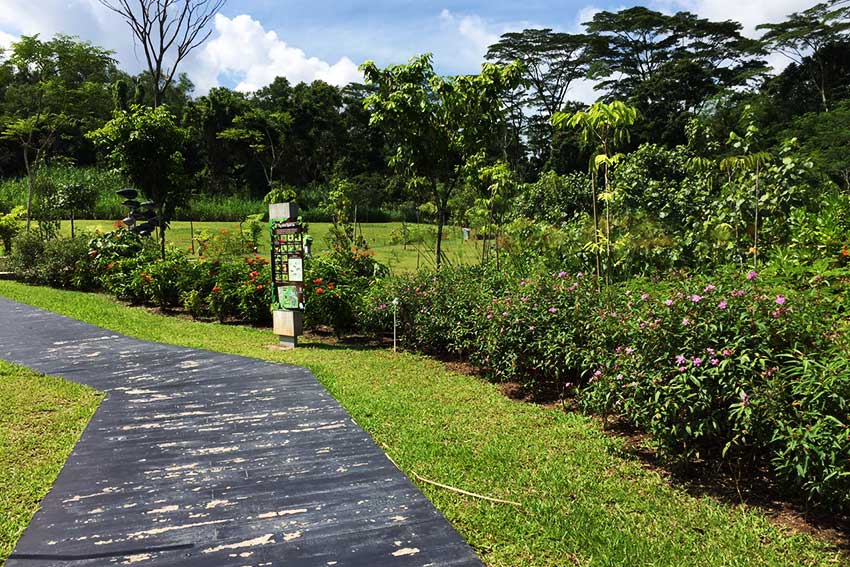
For butterfly enthusiasts, a dedicated butterfly garden was developed within JEG. Situated near the Central Plaza and next to the Composting Station, the butterfly garden features specially-selected butterfly attracting nectaring and host plants. Covering an area of about 1,500 m2, the JEG butterfly garden teems with butterfly life on a good sunny day.


Swallowtails shot at JEG's Butterfly Garden

Of particular interest is the presence of the Common Birdwing (Troides helena cerberus) which is considered vulnerable in Singapore. We have found this species' caterpillar host plant, Aristolochia acuminata, growing wild in the adjacent forests. This host plant is also being cultivated to sustain the population of the Common Birdwing and also the Common Rose, which shares this host plant. Other Papilionidae that have been spotted here include the Common Mormon, Lime Butterfly, Common Rose and Tailed Jay.


Lime Butterfly feeding in Stachytarpheta mutabilis flowers

The lush Lantana and Ixora bushes are the best places to park yourself, if you want to see these butterflies fluttering and feeding.  Many of the other nectaring plants like Leea indica, Leea rubra, Stachytarpeta indica and mutabilis also attract many species of butterflies.


Caterpillar host plants for species like the Plain Tiger, Blue Pansy, Great Eggfly, Autumn Leaf are interspersed within the butterfly garden to attract a greater variety of butterflies to the area. With the forested catchment in the vicinity of JEG, other species that are forest dependent are occasionally spotted feeding on the buffet of nectaring plants in the butterfly garden.


A skipper feeding on the red Ixora javanica flowers

In the early hours of the day, a butterfly watcher should be able to spot many Hesperiidae zipping around the bushes and feeding greedily on the nectar-rich flowers. As the sun warms the butterfly garden, the faster-flying Pieridae like the Lemon, Orange and Mottled Emigrants appear, flying strongly from flower to flower to feed.


On a good day, a butterfly watcher/photographer can expect to see at least 10-15 different species at the butterfly garden. As the butterflies are distracted whilst feeding on the flowers, it is also easier to approach and photograph these skittish creatures.


Combination of conserved trees and introduced flora at JEG

There is even a nature trail next to the butterfly garden where one can walk in the shady forest understorey, to look for the shade-loving butterflies like the Common Faun (Faunis canens arcesilas) and other denizens that lurk in the low-light environment.


As the butterfly garden matures and more butterfly-attracting plants are brought into the area, we can expect the diversity of the butterfly population will continue to grow in the coming years. JEG is JTC’s first attempt to develop a community space within an industrial estate focusing on sustainability and biodiversity. JEG can also be used to engage the different communities such as residents from nearby housing estates, neighbouring schools, as well as interest groups, in particular nature photographers and biodiversity enthusiasts.


School groups are involved in various programmes at JEG

Today, a total of 13 schools have been involved in programmes hosted in JEG, which focus on the areas of sustainability, biodiversity and the arts. For example, River Valley High School uses JEG as an educational platform for their students to learn about topography studies, microclimate studies and water monitoring. In addition, Rulang Primary School also uses JEG to showcase their students' artwork. Since the official opening of JEG in June 2014, it has hosted over 200 students through various school curriculum and community programmes.


CleanTech One building.  Development will invariably sacrifice biodiversity.  Can we find a balance?

Whilst JTC has made a good start to create a man-made garden to conserve the biodiversity of the CTP, it is important not to overlook the "wilder" areas in the vicinity. Stronger focus should be made to conserve these areas, instead of converting them for people, rather than the fauna that exists within these forests. It is primarily because of these sanctuaries of biodiversity that thrive within these undisturbed areas that JEG is successfully attracting birds, butterflies and other fauna for its visitors to enjoy.


Ample directional signage at JEG to guide you around

So, if you have some time to enjoy a nature walk on a nice weekend, do pay Jurong Eco Garden a visit. You will be surprised to see the diversity of wildlife in this small patch of greenery. As it is located away from the hustle and bustle of urban residential areas, JEG is usually quieter and less crowded.

How to Get There :
By Bus : Take the feeder service No 199 from Boon Lay Interchange and alight at Nanyang Ave. Walk past CleanTech One building as shown on the map, and there will be signs to show you where JEG is.

By Car : See map for details. Park at either CleanTech One (ERP parking) or just outside the Thow Kwang Dragon Kiln (free parking but limited lots).


Text by Chen Yimin & Khew SK : Photos by Bob Cheong, Khew SK and Simon Sng.

Special thanks to Chen Yimin of JTC for added information for this article.

Checklist of Butterflies Observed at JEG to date :

  1. Troides helena cerberus (Common Birdwing)
  2. Pachliopta aristolochiae asteris (Common Rose)
  3. Papilio clytia clytia (Common Mime)
  4. Papilio demoleus malayana (Lime Butterfly)
  5. Papilio demolion demolion (Banded Swallowtail)
  6. Papilio polytes romulus (Common Mormon)
  7. Graphium sarpedon luctatius (Common Bluebottle)
  8. Graphium agamemnon agamemnon (Tailed Jay)
  9. Delias hyparete metarete (Painted Jezebel)
  10. Leptosia nina malayana (Psyche)
  11. Appias libythea olferna (Striped Albatross)
  12. Catopsilia pyranthe pyranthe (Mottled Emigrant)
  13. Catopsilia pomona pomona (Lemon Emigrant)
  14. Catopsilia scylla cornelia (Orange Emigrant)
  15. Eurema hecabe contubernalis (Common Grass Yellow)
  16. Eurema blanda snelleni (Three Spot Grass Yellow)
  17. Danaus chrysippus chrysippus (Plain Tiger)
  18. Danaus genutia genutia (Common Tiger)
  19. Danaus melanippus hegesippus (Black Veined Tiger)
  20. Parantica agleoides agleoides (Dark Glassy Tiger)
  21. Ideopsis vulgaris macrina (Blue Glassy Tiger)
  22. Euploea mulciber mulciber (Striped Blue Crow)
  23. Elymnias panthera panthera (Tawny Palmfly)
  24. Elymnias hypermnestra agina (Common Palmfly)
  25. Mycalesis mineus macromalayana (Dark Brand Bush Brown)
  26. Mycalesis perseus cepheus (Dingy Bush Brown)
  27. Mycalesis visala phamis (Long Brand Bush Brown)
  28. Orsotriaena medus cinerea (Dark Grass Brown)
  29. Ypthima baldus newboldi (Common Five Ring)
  30. Hypolimnas anomala anomala (Malayan Eggfly)
  31. Doleschallia bisaltide bisaltide (Autumn Leaf)
  32. Junonia hedonia ida (Chocolate Pansy)
  33. Junonia almana javana (Peacock Pansy)
  34. Junonia orithya wallacei (Blue Pansy)
  35. Acraea terpsicore (Tawny Coster)
  36. Cethosia cyane (Leopard Lacewing)
  37. Phalanta phalantha phalantha (Leopard)
  38. Cupha erymanthis lotis (Rustic)
  39. Pandita sinope sinope (Colonel)
  40. Neptis hylas papaja (Common Sailor)
  41. Phaedyma columella singa (Short Banded Sailor)
  42. Tanaecia iapis puseda (Horsfield's Baron)
  43. Polyura hebe plautus (Plain Nawab)
  44. Taxila haquinus haquinus (Harlequin)
  45. Allotinus unicolor unicolor (Lesser Darkwing)
  46. Zizula hylax pygmaea (Pygmy Grass Blue)
  47. Lampides boeticus (Pea Blue)
  48. Jamides celeno aelianus (Common Caerulean)
  49. Anthene lycaenina miya (Pointed Ciliate Blue)
  50. Surendra vivarna amisena (Acacia Blue)
  51. Iraota rochana boswelliana (Scarce Silverstreak)
  52. Hypolycaena thecloides thecloides (Dark Tit)
  53. Tajuria cippus maxentius (Peacock Royal)
  54. Badamia exclamationis (Brown Awl)
  55. Iambrix salsala salsala (Chestnut Bob)
  56. Udaspes folus (Grass Demon)
  57. Suastus gremius gremius (Palm Bob)
  58. Plastigia naga (Chequered Lancer)
  59. Unkana ambasa batara (Hoary Palmer)
  60. Potanthus omaha omaha (Lesser Dart)
  61. Telicota besta bina (Besta Palm Dart)
  62. Pelopidas mathias mathias (Contiguous Swift)
  63. Pelopidas conjunctus conjunctus (Conjoined Swift)
  64. Polytremis lubricans lubricans (Small Branded Swift)