Showing posts sorted by date for query Abisara savitri. Sort by relevance Show all posts

29 May 2021

Butterfly of the Month - May 2021

Butterfly of the Month - May 2021
The Malay Tailed Judy (Abisara savitri savitri)

A Malay Tailed Judy perched on a fern in its typical shaded habitat in the forest understorey

The daily global news of Earth's battle with an "unseen" enemy is beginning to sound like a sci-fi movie, with each battle won or lost and which side is gaining ground in this war. It is not like the storyline hasn't been thought of already, with movies like Outbreak (1995), Contagion (2011), Flu (2013), Containment (2016) Pandemic (2016) and Virus (2019). Today, what the world is experiencing is a real-life experience of fighting Covid19 and trying to get a semblance of what our lives used to be before it struck more than a year ago.


Different countries' effectiveness in combating the pandemic is often a combination of political leadership, residents' compliance, human rights, healthcare facilities, affluence, geography, weather and a whole host of variable factors. Whilst China, a country of over 1 billion people (and where the virus purportedly originated) is able to keep the pandemic at bay, its equally populous neighbour, India is struggling hard to control the outbreak.

A Malay Tailed Judy feeding on a fallen fruit

The US continues to be top on the infections leaderboard, with over 33 million infections, but India is slowly but surely creeping up with 27 million infections and counting. Over the past few weeks, the average rate in India outstrips the US, even as each country manages its own population in their own unique way. Being a producer/exporter of the Covid vaccine, the US certainly has an advantage over India as it moves towards herd immunity across the country.


Closer to home, our neighbours in Malaysia have been scrambling to keep the lid on rising infection cases, which crossed the 8,000 mark yesterday. This prompted the government to announce a full 2-week lockdown from the 1 June. Whilst being mindful of keeping the economy buzzing, each measure of control has to balance the possibility of a resurgence in infections. To add to the confusion, more variations of the virus are being discovered as it mutates and fights back against human interventions.


The sudden surge of daily cases, particularly those that are unlinked, in Singapore caused its slowly re-opening control measures on the backfoot. The appearance of infections attributed to the mutant strain B1-617 sparked off a possibility of a 2nd wave of infections in the community. Swift action by the government and a largely cooperative population appeared to have stemmed the initial exponential increase in daily infections over the past two weeks. And so the story continues...


Our May 2021 feature butterfly is the Riodinid, the Malay Tailed Judy (Abisara savitri savitri). There have been recent changes to the taxonomic classification of the genera in the family Riodinidae and a recent scientific paper has proposed that this species be placed under the genus Archigenes. However, taking after the latest edition of the Butterflies of the Malay Peninsula 5th edition (2020), we will leave the genus as Abisara for the time being, until the taxonomic changes are updated in successive reference literature.


The Malay Tailed Judy is a moderately rare species and prefers the shaded understory of our forested areas in Singapore. It is rarely seen, if ever, in urban parks and gardens. The species belongs to the family better known as the "Metalmarks" which are characterised by reddish-brown butterflies, some of which have pretty iridescent metallic scales on their wings.


The species has a unique habit of stopping with partially opened wings on the top surfaces of leaves in heavily shaded habitats, and then twisting and turning and hopping from perch to perch. They are generally timid and skittish, moving quickly away from any threatening movements. Occasionally, they appear to stop and remain stationary as though to "sleep".

A typical partially-opened wing pose of a Malay Tailed Judy in its natural habitat

The Malay Tailed Judy has been observed to puddle on forest footpaths amongst leaf litter, often foraging for damp decomposed matter and overripe fruits. Like its other cousins in the family, it is seldom seen feeding on flowers but instead uses its proboscis to feed on the surfaces of leaves for some unseen matter.

A rare open winged shot, showing the upperside of the Malay Tailed Judy

The Malay Tailed Judy differs from the other species in the genus in that the ground colour of the butterfly is a pale purple-brown instead of dark red. It has a pair of prominent white tipped tails at vein 4 of the hindwing. On the forewings is a pair of sullied white transverse sub-apical stripes, which is more distinct on the underside of the wings than on the upperside.

A newly-eclosed Malay Tailed Judy perched above its empty pupal case

The basal area of both wings are paler on the underside,  There are large black eyespots at the apical and tornal areas of the hindwing.  The eyes of the species are dark brown and nearly opaque.  The species has been successfully bred in Singapore on the local host plants Embelia ribes and Embelia canescens.

Text by Khew SK : Photos by David Chan, Huang CJ, Khew SK, Nelson Ong, Richard Ong, Nona Ooi, Jonathan Soong, Horace Tan and Benjamin Yam.


01 April 2018

Singapore's Judys

Singapore's Judys
Featuring the Abisara spp. (Judys) of Singapore


The family Riodinidae was previously classified as sub-family Riodininae of the Lycaenidae family (ref : Butterflies of the Malay Peninsula 4th Edition), but raised to family status subsequently in more recent publications. Many species in the family feature metallic markings on their wings, giving rise to their collective common English name of "Metalmarks".


Female Spotted Judy perched on a leaf

In the Southeast Asian region, the Riodinidae is characterised by small, reddish-brown butterflies that prefer deep forest shade habitats. They have a unique, short, hopping flight and alight on the upper surfaces of leaves with half-opened wings. When active, they will twist and turn on the leaf with jerky walking movements, often to the frustration of the butterfly photographer who is trying to get an ideal angle to shoot them.


Male Malayan Plum Judy perched on a fern

Many species of the Riodinidae have yellow-green eyes. A special characteristic of the family is that the forelegs of the males are under-developed, appearing more like hair tufts. The females, on the other hand, have all six legs fully developed.


In Singapore, the Riodinidae is represented by five species in three genera. Of the five species, three belong to the genus Abisara. The species in this genus are collectively named Judy. It is interesting that the common names of the group of butterflies in the Riodinidae originate from the traditional beach puppet or marionette show of "Punch and Judy". The species of another Riodinidae genus, the Dodona, have all their species named after Punch. However, this genus is not extant in Singapore.


Male Spotted Judy

This article introduces the three Judy species found in Singapore. The extant species of the Abisara spp. in Singapore are the Malayan Plum Judy (Abisara saturata kausambioides), the Spotted Judy (Abisara geza niya) and the Malay Tailed Judy (Abisara savitri savitri). It was earlier thought that another Malaysian species, the Straight Judy (Abisara kausambi kausambi) also exists in Singapore, but further research showed that this species is not found here.

The Malayan Plum Judy (Abisara saturata kausambioides)


The most common of the three Abisara species found in Singapore, the Malayan Plum Judy is found at urban parks and gardens as well as in the forested areas of the nature reserves. It can also be found on the offshore island of Pulau Ubin. Males are more often seen, but both sexes display the typical Riodinidae behaviour of hopping from leaf to leaf and turning around with their wings half-opened.


The upperside of the male Malayan Plum Judy shows a deep purple-blue colour in angled lighting


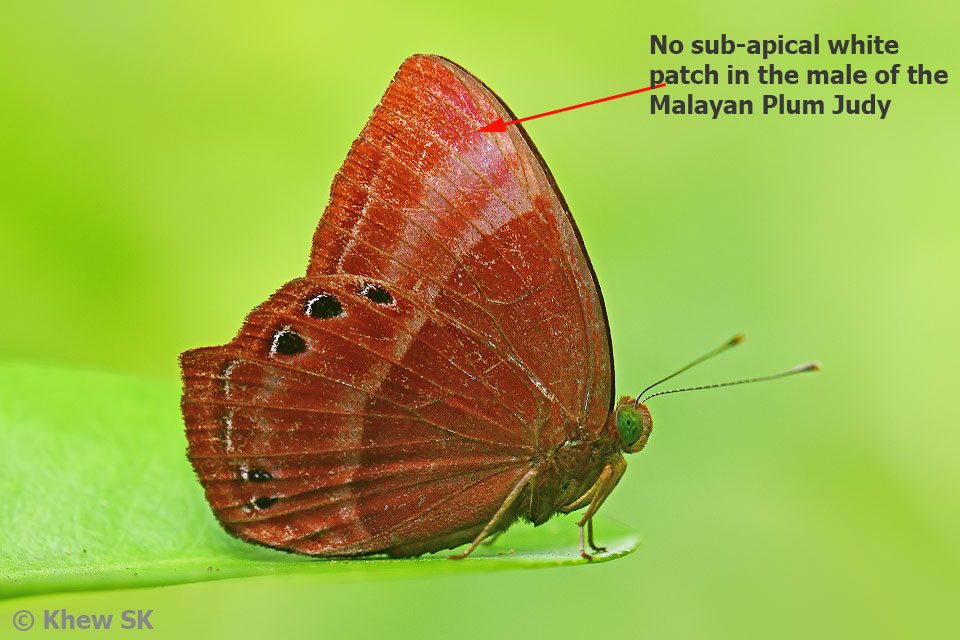
The upperside of the male is a deep crimson brown without any markings. When viewed in a sidelight, the upperside may show a purple-blue colouration. The paler underside features a pair of diffused pale purplish post-discal bands. The outer band on the hindwing has a series of large black, white-edged submarginal spots.


The paler female has a diffused white sub-apical patch on the forewing, whilst the hindwing "tail" is prominently angled at vein 4 and appears to flare out wider than in the male. The Malayan Plum Judy has been successfully bred on two alternative host plants - Ardisia elliptica (Myrsinaceae), Embelia ribes (Myrsinaceae).

The Spotted Judy (Abisara geza niya)


The second of the Judy species found in Singapore is the Spotted Judy. This species is superficially similar to the Malayan Plum Judy in appearance. Also a deep crimson brown in colour, the male of the Spotted Judy differs from the Malayan Plum Judy in the whiter diffused subapical patch on the outer post-discal band.


Female Spotted Judy.  Note less extensive sub-apical white patch on the forewing and the dislocated post-discal band at vein 4 of the hindwing.

In the female, the diffused sub-apical patch is more restricted than in the Malayan Plum Judy. The hindwing "tail" is also prominently angled at vein 4 and displays the similar flare that is wider than in the male. Both sexes can be separated from the Malayan Plum Judy in their diagnostic characteristic hindwing post-discal band that is dislocated at vein 4.


Upperside of the male Spotted Judy.  The structural scales diffract light at certain angles where the wing colour shows a purple-blue.

The Spotted Judy is moderately rare, but can be found in generally the same habitats as the Malayan Plum Judy. Males are sometimes seen 'dog-fighting' in the late hours of the day. The species can be found in urban parks and gardens as well as in the forested nature reserves, preferring heavily shaded environments. It has been successfully bred on Embelia ribes (Myrsinaceae) and Embelia canescens (Myrsinaceae).

The Malay Tailed Judy (Abisara savitri savitri)


The third and rarest Judy found in Singapore is the Malay Tailed Judy. It is found mainly in the heavily shaded forested areas of the nature reserves. This forest-dependent species is generally larger than its previous two related species. It also differs from the other two in that, instead of the crimson brown wings, the Malay Tailed Judy is a pale beige with a light tinge of violet.


It cannot be mistaken for any other species in Singapore. The Malay Tailed Judy features two diffused white transverse sub-apical stripes on the forewing. It has a distinctly longer white tipped tail at vein 4 of the hindwing. It shares the behavioural characteristic of hopping on the upper surfaces of leaves with half-opened wings.


The Malay Tailed Judy has been successfully bred on the same host plants as the Spotted Judy - Embelia ribes (Myrsinaceae) and Embelia canescens (Myrsinaceae). The species can be occasionally observed feeding on overripe fruits on the forest floor.

Text by Khew SK : Photos by James Chia, Huang CJ, Khew SK, Nelson Ong, Jonathan Soong, Horace Tan and Benjamin Yam.

23 October 2016

Revision to the Common Names of Butterflies 5

A Revision to the Common Names of Butterflies
Part 5 : An Analysis of Name Changes


In this fifth part of the series where we discuss the Common Names of Butterflies in the region, we continue our discussion to one species from the Riodinidae family and the species of the Lycaenidae family. In Part 2, Part 3 and Part 4, we framed the background of the naming convention of the English Common Names of butterflies, and also some of the changes in the book by Dr Laurence Kirton.


We also indicated the references of available published work, from which we researched into the Common English names of butterflies. However, in recent years, the usage and acceptance of these common names appear to be largely driven by regular usage by hobbyists and butterfly enthusiasts - particularly on social media and cyberspace. Once a name is coined, and used by the larger community on the internet, there is a high chance that the name becomes adopted quickly, especially if the names are repeated by frequent usage on blogs, photo repositories, social media and websites.


Unlike the taxonomic names, which fall in the domain of researchers and experts who pen scientific papers, common names are often coined by amateurs and hobbyists. Today, even some of the scientific names are being debated as new information becomes available, but often, there is no central body to moderate such changes and some new recommendations can take some time to gain acceptance - even amongst the experts. Butterflies' common names' acceptance is more of a result of frequent and regular usage and availability of books and references on the internet, rather than by any scientific means.


Continuing from where we left off in Part 4 of our discussions on common names, we consider the single species of contention in the Riodinidae family - Abisara savitri savitri. This species has been renamed to Malayan Tailed Judy. As rationalised in our earlier discussions on the common names that have been amended from "Malay" to "Malayan", we see no necessity for this change.


The name Malay Tailed Judy had been used since Evans' time (1927) and continued to be used by various authors of several butterfly books without exception. The sole book that shows the name as "Malayan Tailed Judy" is the one by Dr Kirton, and for all intents and purposes, completely outnumbered by all available literature on butterflies in the region.

Recommendation : Abisara savitri savitri should retain its common name Malay Tailed Judy.

We now move on to the Blues and Hairstreaks in the family Lycaenidae. This family is by far the largest family of butterflies in the Malaysian, Singaporean and Thai region. Many of the species are very similar looking, making it even more challenging to associate logical and justifiable common names for the butterflies.


The first species of that has multiple common names across the region, is Curetis saronis sumatrana. In Evans (1927), the species Curetis saronis is given the name Burmese Sunbeam. Dr Kirton adopted this historical reference name for this species. In Thailand, the subspecies Curetis saronis indosinica is known as Indo-Chine Sunbeam. In Singapore, subspecies sumatrana has been given the name Sumatran Sunbeam.


No other Malaysian reference has given a common name for the species Curetis saronis sumatrana other than Dr Kirton's book. The name Sumatran Sunbeam has appeared in at least four references in Singapore - Butterflies of Singapore 2010, Butterflies of Singapore 2nd Edition 2015, Caterpillars of Singapore's Butterflies 2012 and Singapore Biodiversity : An Encyclopedia of the Natural Environment and Sustainable Development 2011. Whilst there is probably no compelling reason to adopt any of the common names over the others, it is probably from common usage that the name Sumatran Sunbeam has gained a wider acceptance in the local scene.

Recommendation : Curetis saronis sumatrana should retain its common name Sumatran Sunbeam.

The next subfamily under Polyommatinae, or the Blues, comprise a large group of mainly small and delicate butterflies of which many have blue uppersides. The first species that had its name changed in Dr Kirton's book, is Neopithecops zalmora zalmora to Inornate Blue. The original name found in most literature across the region, and all the way back to Evans' "The Identification of Indian Butterflies" (1927), is The Quaker.


It is not clearly understood why Dr Kirton amended the name of this species, but it is probably classified under "Where the original name is socially unacceptable / derogatory". A search on the Internet indeed turned out some information that pointed to Quaker as being derogatory in some societies. However, the tenuous link to anything socially unacceptable or derogatory is probably in some obscure circles that is totally irrelevant today.


Even in commercial products, where I previously used the example in Darkie toothpaste being changed to Darlie toothpaste to avoid the minefield of associations to a derogatory or racist word, there are no such changes. Today, we still eat Quaker Oats. The company has a website, and products on the market still carry the word Quaker. I am not aware of any society or group that violently objects to the word "Quaker" in the modern world. Hence I do not believe that there is any issue with the continued use of the name Quaker for the species Neopithecops zalmora zalmora.

Recommendation : Neopithecops zalmora zalmora should retain its common name The Quaker.

The next species of discussion is Megisba malaya sikkima. In Evans' book, the name The Malayan was coined for this species. Thus far, all the publications that I have come across, have retained that common name for this species. The only book that has altered its name to "Malayan Pied Blue" is Butterflies of Peninsular Malaysia, Singapore and Thailand.


Whilst Dr Kirton may have a good reason for changing the name of this species by adding "Pied Blue" to the common name, it is unlikely that the rest of the amateurs and enthusiasts in the butterfly world would agree with him. Hence the name "Malayan", through legacy usage and frequent reference in cyberspace, would continue to be the primary name for this species from India to Southeast Asia and Hong Kong.


Recommendation : Megisba malaya sikkima should retain its common name The Malayan.

Text by Khew SK : Photos by May Chan, Sunny Chir, Khew SK, Simon Sng, Jonathan Soong, Horace Tan and Benjamin Yam.

Earlier articles in this series :
Revision to the Common Names of Butterflies Part 1
Revision to the Common Names of Butterflies Part 2
Revision to the Common Names of Butterflies Part 3
Revision to the Common Names of Butterflies Part 4

05 October 2013

Greening of Eco-Link @ BKE

Greening of Eco-Link @ BKE
A Safe Passage for Wildlife


The completed Eco Link spanning across the BKE

Way back in 1986, when the roads engineers of the then Public Works Department designed the Bukit Timah Expressway (or BKE as we acronym-mad Singaporeans know it by), their emphasis was to create an efficient transport link from the Causeway to downtown Singapore. Back then, probably the most efficient route took the expressway right through the Central Catchment, splitting the Bukit Timah Nature Reserve from the rest of the Central Catchment Nature Reserve.


Elbowed Pierrot (Caleta elna elvira) one of the species observed 

Over the decades that passed, nature observers lamented the fragmentation of the two major high biodiversity nature areas by the BKE. Animals separated by the BKE remained on the two sides and were unable to cross the expressway without the risk of being killed by vehicles. The expressway became an insurmountable barrier.


Lesser Harlequin (Laxita thuisto thuisto)

In 2005, the nature community and the government authorities mooted the idea of a nature or green corridor to re-connect BTNR to the CCNR. After some debate and feasibility studies, the location selected for this biodiversity-bridge was confirmed. It took some time for the realisation of this Eco-Link as there were issues like design, budget, effectiveness and environmental impact of the link to be dealt with.


After further delays, the contract was finally awarded to local contractor Eng Lee Engineering for a contract sum of $11.8M. The Ground Breaking Ceremony for the Eco Link was held on 30 Jul 2011. Today, slightly over two years after work commenced on the Eco Link, I attended the Greening of the completed Eco Link.


Group Photo at the Tree Planting site (via Twitter by ©Debby Ng)

This was basically an event to celebrate the completion of the biodiversity link with a tree-planting ceremony involving the nature community. The event was graced by the Minister of State for National Development, Mr Desmond Lee.


The morning started with an imminent threat of another thunderstorm. The NEA weather radar showed a massive front coming in from Sumatra, and it had begun raining cats and dogs in parts of Singapore. However, the nature community, being a determined bunch, braved the prospects of planting trees in the heavy rain!


When I arrived at the meeting point, I was pleasantly surprised to see that a decent crowd had already made their way to the Dairy Farm area. The dark rain clouds were also beginning to clear up, and it looked like the event was a go!


MOS Desmond Lee hard at work digging the tree hole

The guests were ferried to the Eco Link by coaches, and before long, the group made its way to the top of the Eco Link, led by MOS Desmond Lee. After the traditional group photo, everyone got busy with the tree planting. MOS was even game enough to plant more than one!


As everyone took in the sights around the Eco Link and the speeding vehicles on the BKE below, I could imagine that this "narrow" 50m wide link could indeed be a bridge across which animals can use to move safely between BTNR and CCNR.


I was also told that the Eco Link will not be opened to the general public and will be kept inaccessible so that the animals that may use it will not be disturbed by human presence. There was also concerns that poachers may also use it as a convenient means to capture their prey.


MOS Desmond Lee entertaining the crowd with his handling of the Oriental Whip Snake

Very soon, all the trees were planted, and the group made its way down to the exhibition area and our much-needed refreshments. As if on demand, a couple of snakes showed up and got the attention of the group, including our Guest of Honour. As it was still cool and cloudy, I didn't manage to spot any butterflies in the area.


As for ButterflyCircle's involvement, members had earlier conducted a pre-construction survey in April 2011 in the area. On that single day alone, a total of 54 species of butterflies were recorded. A few rarities like the Lesser Harlequin, Malay Tailed Judy, Indigo Flash were spotted. After the contractors vacate the site and the vegetation recovers on the Eco Link and the surrounding forests, another survey will be conducted to ascertain the butterfly count.


So there you have it, a biodiversity bridge over an expressway, just for nature. There were concerns that the Eco Link would not be effective or is too narrow for animals to want to use it. Will all this effort will be in vain? To me, it is a little effort that may go a long way in trying to bridge the fragmented nature reserves. These reserves are important in the sense that the forest-dependent butterfly species are dependent on the preservation of this habitat. Although the Eco Link itself may not be directly beneficial to butterflies, since they can easily fly across the BKE, the selection of plants and regeneration of habitats across the bridge may help butterfly populations to spread between the two nature reserves.


An exhibition showing the flora and fauna of the Nature Reserves

The Central Catchment and Bukit Timah Nature Reserves are the last remaining remnants of a once awesome primary forest that covered Singapore. These are certainly worth preserving as our natural heritage, and as a home to an amazing diverse spectrum of flora and fauna. The controversy that surrounds the construction of an underground MRT line cutting across the southern part of the Central Catchment Nature Reserve in the MacRitchie Reservoir area stems primarily from the critical need to protect this precious 'green heart' that is home to an awesome biodiversity. That debate is still ongoing, and it will be another story for another time on this blog.

Text & Photos by Khew SK : Group Photo courtesy of Debby Ng

References and Past Articles about the Eco Link


  • From WildSingapore : http://wildsingaporenews.blogspot.sg/2010/12/singapore-bukit-timah-eco-bridge-to.html
  • From the Biology Refugia : http://biologyrefugia.blogspot.sg/2009/09/ecological-corridor-for-bukit-timah-and.html
  • From SGLinks : http://sglinks.com/pages/1202944-eco-link-bke-links-nature-reserves
  • From IYB 2010 : http://iyb2010singapore.blogspot.sg/2010/05/bridge-for-biodiversity-eco-link-to.html


List of Butterflies observed during the pre-construction survey on 9 Apr 2011 :

1) Papilio polytes romulus (Common Mormon)
2) Graphium sarpedon luctatius (Common Bluebottle)
3) Chilasa clytia clytia (Common Mime) (caterpillar)
4) Euploea mulciber mulciber (Striped Blue Crow)
5) Leptosia nina malayana (Psyche)
6) Catopsilia pomona pomona (Lemon Emigrant)
7) Eulaceura osteria kumana (Purple Duke)
8) Eurema blanda snelleni (Three-Spot Grass Yellow)
9) Elymnias hypermnestra agina (Common Palmfly)
10) Elymnias panthera panthera (Tawny Palmfly)
11) Mycalesis mineus macromalayana (Dark Brand Bush Brown)
12) Mycalesis perseus cepheus (Dingy Bush Brown)
13) Mycalesis visala phamis (Long Brand Bush Brown)
14) Mycalesis fusca fusca (Malayan Bush Brown)
15) Orsotriaena medus cinerea (Nigger)
16) Ypthima baldus newboldi (Common Five Ring)
17) Ypthima pandocus corticaria (Common Three Ring)
18) Tanaecia iapis puseda (Horsfield's Baron)
19) Tanaecia pelea pelea (Malay Viscount)
20) Lebadea martha parkeri ( The Knight )
21) Moduza procris milonia (Commander)
22) Hypolimnas anomala anomala (Malayan Eggfly)
23) Athyma nefte subrata (Colour Sergeant)
24) Junonia hedonia ida (Chocolate Pansy)
25) Junonia almana javana (Peacock Pansy)
26) Lasippa tiga siaka (Malayan Lascar)
27) Phaedyma columella singa (Short Banded Sailor)
28) Abisara saturata kausambiodes (Malayan Plum Judy)
29) Abisara savitri savitri(Malay Tailed Judy)
30) Laxita thuisto thuisto ( Lesser Harlequin )
31) Logania marmorata damis (Pale Mottle)
32) Acytolepis puspa lambi (Common Hedge Blue)
33) Caleta elna elvira (Elbowed Pierrot)
34) Eooxylides tharis distanti (Branded Imperial)
35) Iraota rochana boswelliana (Scarce Silverstreak)
36) Surendra vivarna amisena (Acacia Blue)
37) Zizina otis lampa (Lesser Grass Blue)
38) Jamides celeno aelianus (Common Caerulean)
39) Prosotas dubiosa lumpura (Tailless Line Blue)
40) Arhopala centaurus nakula (Centaur Oakblue)
41) Arhopala major major
42) Anthene emolus goberus (Ciliate Blue)
43) Zeltus amasa maximinianus (Fluffy Tit)
44) Rapala varuna orseis (Indigo Flash)
45) Rapala pheretima sequeira (Copper Flash)
46) Hypolycaena erylus teatus (Common Tit)
47) Neopithecops zalmora zalmora ( The Quaker)
48) Pelopidas mathias mathias (Small Branded Swift)
49) Tagiades japetus atticus (Common Snow Flat)
50) Tagiades calligana (Malayan Snow Flat)
51) Hasora badra badra (Common Awl)
52) Iambrix salsala salsala (Chestnut Bob)
53) Potanthus omaha Omaha (Lesser Dart)
54) Taractrocera archias quinta (Yellow Grass Dart)