Showing posts sorted by relevance for query Terinos terpander robertsia. Sort by date Show all posts

03 August 2013

Life History of the Royal Assyrian

Life History of the Royal Assyrian (Terinos terpander robertsia)


Butterfly Biodata:
Genus: Terinos Boisduval, 1836
Species: terpander Hewitson, 1862
Subspecies: robertsia Butler, 1867
Wingspan of Adult Butterfly: 60-70mm
Caterpillar Local Host Plant : Rinorea anguifera (Violaceae).


Physical Description of Adult Butterfly:
The wings are angled with the hindwing slightly toothed at the end of vein 4. Above, the wings are rich purplish blue with two white spots in spaces 3 and 4 on the hindwing. Underneath, the wings are purple-brown with reddish brown and pale blue (shiny in fresh specimens) fasciae crossing both wings. The hindwing has a white submarginal band which is broader and more lunulate in spaces 2 to 4, and a series of dark purple brown post-discal spots which are ringed in orange.


Field Observations of Butterfly Behaviour:
The Royal Assyrian is moderately rare in Singapore. The species is usually encountered in parts of the nature reserves where its host plant, Rinorea anguifera, is growing. The adults have been observed to visit flowers for nectar. When resting, the adults typically perch on the underside of a leaf with its wings closed. The males have also been observed to puddle on damp patches.

21 June 2008

Butterfly of the Month - June 2008

BUTTERFLY OF THE MONTH - JUNE 2008
The Royal Assyrian (Terinos terpander robertsia)


The Royal Assyrian belongs to the butterfly sub-family Heliconiinae of the family Nymphalidae. The genus Terinos features medium sized butterflies with angled wings. Of the three species found in Malaysia and Singapore, only the Royal Assyrian is known to exist in Singapore. All three species are rich purple above with white or pale orange area on the hindwings.


The Royal Assyrian is not uncommon in Singapore, and can be found in the nature reserves where its host plant, Rinorea anguifera (Violaceae) grows. Seasonally, several individuals are encountered together in the vicinity of its host plant. The species is most often seen along MacRitchie Nature Trail and on the fringes of some of the reservoir parks.


Males are sometimes observed puddling along damp paths in the forests. A peculiar behaviour of the species is that some individuals, when disturbed, fly and stop on the undersides of leaves with their wings folded shut. The Royal Assyrian is not a particularly strong flyer, but flits from leaf to leaf in the shaded understorey of the forested areas. When alarmed, however, it takes off quite quickly to the treetops.


In the early morning hours, they can be observed to open their wings flat to sunbathe, displaying the attractive rich purple colours of the uppersides of the wings. The spectacular purple upperside of the wings are a sight to behold and is quite unlike any other butterfly species in Singapore.


Text by Khew SK : Photos by Federick Ho, Tan BJ, Horace Tan, Bob Cheong, LC Goh and Khew SK

02 September 2017

Upside Down Butterflies

Upside Down Butterflies
Peculiar habits of some Butterfly Species


A Common Yeoman perches upside down with its wings folded upright

Most regular butterfly watchers will know that the flying speed and style of flying vary amongst the species of butterflies found in Singapore (and elsewhere for that matter). After a time of watching them, a butterfly watcher should be able to tell the difference between the fast-flying Papilionidae like a Tailed Jay or a Banded Swallowtail, always flying as though the devil were at their heels; and the slow, unhurried graceful flight of a Common Tree Nymph.


A Little Maplet peeks from its upside down perch

Besides having their preferred habitats, many butterfly species have unique behavioral adaptations that are interesting and help to narrow down the identification of several species, simply from the way they behave in the field. One such interesting behaviour amongst butterflies, is the peculiar habit of flying and then settling on the underside of a leaf, hanging upside down like a bat.


Anderson's Grass Yellow perches upside down on a grass blade

It is not fully understood why some butterflies do this. Perhaps to hide from a predator? Or is it for some other reason? Not much research has been made to establish why some butterflies rest upside down on the underside of its leaf perch. In most cases, the butterfly just rests on the underside of a leaf and stays there, doing absolutely nothing. There is usually no food source nor is the butterfly engaging in any specific activity. There are some species that oviposit on the underside of a leaf, but here, we are discussing those species that do nothing else except perch on the underside of a leaf.


A male Purple Duke perches upside down.  This species is most often encountered in the nature reserves displaying this under-leaf habit

The "king" of the upside down butterflies should be the Purple Duke (Eulaceura osteria kumana) also known as the Elegant Emperor in some countries. This species is regularly seen displaying the under-leaf habit. When disturbed by any movement, the Purple Duke darts out, flies rapidly and then suddenly stops on the underside of a leaf to perch with its wings folded upright. It will repeat this behaviour again and again.


Purple Duke males (Top and Middle) and female (Bottom) showing their usual upside down perching behaviour

This unique upside down behaviour occurs in both males and females of the Purple Duke. Occasionally, it perches on the top of a leaf and opens its wings flat to sunbathe. But getting a good shot of an open winged Purple Duke is quite challenging, as it usually sunbathes in the early hours of the morning before the sun warms up the environment.


The Papilionidae usually perch on the tops of leaves when they need to rest after flying, like this female Great Helen is doing.  Sightings of them perching under a leaf are extremely rare, if ever!

Going through the families of butterflies, we start at the Papilionidae. I have not come across any species of the Swallowtails and Birdwings in Singapore that displays the perching under-leaf behaviour. Perhaps due to their large size, it would be physically difficult for a Papilionidae to hold on comfortably to the underside of a leaf. The Crows and Tigers of the subfamily Danainae also do not display this behaviour at all.

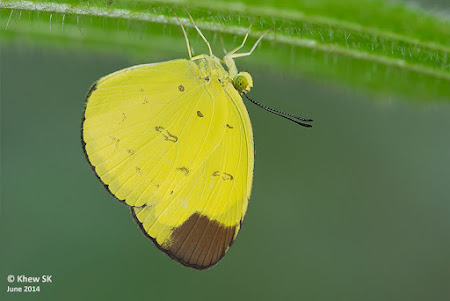


Different species of the Eurema are often encountered perching in an upside down position on the underside of a leaf

Surprisingly, there are some species of the Pieridae, particularly the Eurema spp. or Grass Yellows, displaying this habit. Although it is not a frequent habit amongst these species, they have quite often been seen to rest on the underside of a leaf with their wings folded upright. This is more often observed when there is a whole group of puddling Grass Yellow butterflies and some will fly off to nearby bushes to rest upside down after feeding.


A Common Grass Yellow clings upside down on the underside of a leaf

However, they are skittish and alert and will fly off elsewhere if disturbed. Unlike the Purple Duke, they may not fly to another upside down perch. Amongst the other Pieridae, I have observed some species of the Catopsilia often referred to as the Emigrants, hiding on the underside of a leaf. However, such sightings are not common.


Although not often seen displaying the under-leaf behaviour, the Jacintha Eggfly (Top) and the Autumn Leaf (Bottom) are sometimes seen hiding upside down on the underside of a leaf

Moving on to the family Nymphalidae, I have not had the chance of observing any of this upside down behaviour amongst the subfamilies Danainae, Satyrinae, Charaxinae Biblidinae and Limenitidinae. Amongst some species of the Nymphalinae, I have come across this under-leaf behaviour in the Autumn Leaf, Malayan Eggfly, Great Eggfly and Jacintha Eggfly. However, the occurrence of such upside down habit is rare and in some cases, the butterfly that I observed was ovipositing or feeding on some sap on the underside of the leaf.


The Cirrochroa species found in Singapore - Malay Yeoman, Banded Yeoman and Common Yeoman are seen to display this upside down perching behaviour at times.  In this photo, a Banded Yeoman clings onto the underside of a leaf with its wings folded upright.

The subfamily that features several species that has the habit of resting on the underside of a leaf is Heliconiinae. In Singapore, all three species of the Cirrochroa spp. usually referred to as the Yeoman butterflies, are often observed to hide on the underside of a leaf with their wings folded upright to rest. Although this behaviour does not happen quite as often as in the Purple Duke, there are more frequent sightings of the Yeoman butterflies displaying this upside down habit. In some observations, the butterfly clung on to the underside of a leaf, but kept opening and closing its wings for a period of time.


The Royal Assyrian is another species that is often encountered perched upside down on the underside of a leaf with its wings folded upright.

Another species in the Heliconiinae family that can be said to often display this under-leaf habit, is the Royal Assyrian (Terinos terpander robertsia). This species is the only representative of the genus in Singapore, but again, it has often been photographed whilst perched on the underside of a leaf with its wings folded upright. In some encounters, the butterfly was in full view although perched on the underside of a leaf, giving reason to wonder if it was doing so to avoid being seen, or for some other reason yet to be discovered.


The Little Maplet has a habit of perching upside down on the underside of a leaf with its wings opened flat.  It flaps its wings slowly and is alert to any intrusion to its hiding place

In the last subfamily of the Nymphalidae, is the sole representative of Cyrestinae in Singapore - the Little Maplet (Chersonesia peraka peraka). This small butterfly is very skittish and has the habit of stopping on the underside of a leaf with its wings opened flat. It then flaps its wings slowly open and close whilst perched in the upside down position. When disturbed, it repeats this behaviour and moves from leaf to leaf, often testing the photographer's patience to the limit!


So, if anyone out there has done specific research on why some butterfly species displays this behaviour of perching upside down like a bat, on the underside of a leaf, please share your views in the comments section below. Or if anyone has other photos of other species displaying this under-leaf behaviour, kindly also share your observations.  The next part of this article will feature species from the Lycaenidae and Hesperiidae species that also display this upside down habit.

Text by Khew SK : Photos by Chng CK, Federick Ho, Khew SK, Jonathan Soong, Horace Tan and Anthony Wong

28 September 2019

Singapore's Royalty - Part 2

Singapore's Royalty - Part 2
Featuring the Royal Butterflies of Singapore


A male Banded Royal opening its wings to sunbathe at Bt Timah Nature Reserve

In this second part of our weekend's feature blogpost, we introduce the rarer species of "Royal" butterflies found in Singapore. In Part 1, we introduced the 4 "Royals" - Peacock, Felder's, Chocolate and White. Those species, though considered moderately uncommon, are more likely to be spotted by butterfly watchers and enthusiasts as they are widely distributed and sometimes frequent urban parks and gardens.


An Influent Royal feeding on the fruits of Singapore Rhododendron

This weekend's blogpost features some of the rarer "Royals" - some of which have been observed only a handful of times in Singapore over the past two decades. Of the five species featured, 4 are from the subfamily Theclinae of the Lycaenidae family and with the only exception from the subfamily Heliconiinae of the Nymphalidae family.

5. The Banded Royal (Rachana jalindra burbona)


The Banded Royal has often been observed to perch upside down on the underside of a leaf to rest

A species that was re-discovered in 2006 in the Central Catchment Nature Reserves, the Banded Royal is a species that has been observed more regularly than the other rare species featured in this blogpost. A fast-flying butterfly, the Banded Royal is occasionally spotted feeding at the ripened fruits of the Singapore Rhododendron (Melastoma malabathricum). Males are known to appear from time to time, perched on the tops of leaves or sunbathing with their wings partially open.


The male is a deep shining blue above with narrow black borders. The female is a drab brown above with some black spots at the hindwing tornal area. The underside is white with a broad brown distal border where the inner half is a darker brown. The hindwing has two tails at veins 1b and 2. One of the black tornal spots is orange-crowned and some blue scaling along the tornal area. The eyes of the Banded Royal are jet-black.


A Banded Royal feeding on the ripened fruit of the Singapore Rhododendron

The caterpillar host plant is likely to be a parasitic plant like Macrosolen cochinchinensis or one of the Loranthus spp that many of these rarer Theclinae's caterpillars tend to favour. Its life history has not been successfully recorded yet in Singapore.

6. The Influent Royal (Tajuria dominus dominus)


An Influent Royal perches on the flowers of the Bandicoot Berry

This Royal is considered very rare in Singapore and is the smallest of the three Tajuria species currently recorded in Singapore. It was first re-discovered in 2006 at Alexandra Hospital's Butterfly Trail, feeding on the ripened fruits of the Singapore Rhododendron. Subsequently, it was spotted sporadically over the years when its caterpillars or pupae were discovered and bred to adulthood. It is a rapid flyer and probably prefers to remain at the treetops.


The name "Influent Royal" was christened by Pisuth Ek-Amnuay in the Butterflies of Thailand books, although the origin of the English name is curious. The meaning of influent refers to "a stream flowing into another stream." Or perhaps the author is trying to refer to influent to mean influential? For the time being, we will use this common name until some other more logical or apt name is coined for this species.


An Influent Royal feeding on the ripened fruit of the Singapore Rhododendron

The male is bright blue above with a deep black visual brand at the end of the forewing cell. The forewing has a broad black apical border like many of the other species in the genus. The underside is a drab grey with the post-discal stripe placed closer to the cell than the termen. The two black tornal spots are orange-crowned, with the orange coalesced into a large tornal patch. There are two white-tipped tails and veins 1b and 2 on the hindwing.

7. The Silver Royal (Ancema blanka blanka)


The upperside of a male Silver Royal

The Silver Royal has been seen only a few times in Singapore, but at least twice at the Southern Ridges hill tops. It was a re-discovery in 2005 when it was spotted feeding at the flowers of a Syzygium tree. A fast-flying species, it is usually skittish and probably prefers treetop habitats unless individuals descend to the lower shrubbery to feed or oviposit.


The male of the Silver Royal is a bright shining blue with broad black forewing borders and darkened veins on both wings. The female is a lighter shade of blue and has rounder wings. The underside is distinctive of this species and sports a silvery sheen when light shines at a certain angle on the wings. There are two prominent black tornal spots that are orange-crowned and there are two tails at veins 1b and 2 on the hindwing.


A Silver Royal puddling at a damp footpath

The species is sometimes observed to puddle at damp roadside paths and males are seen to occasionally opens its wings to sunbathe, showing the blue splendour of its iridescent wings. The caterpillar host plant is likely to be a parasitic plant but its life history has hitherto not been recorded in Singapore yet.

8. The Golden Royal (Pseudotajuria donatana donatana)


A Golden Royal perches on the buds of Javanese Ixora

Another re-discovered species in Singapore in 2005, the very rare Golden Royal (also known as the Dawnas Royal) has only been spotted no more than 3 times in Singapore. First spotted at a reservoir park, the species has proven to be extremely elusive although it is by no means considered a vagrant or a seasonal visitor.


The male Golden Royal is a shining blue above with broad black borders on both wings. The female is of a lighter blue with the colour confined to the wing bases only. The underside is a rich golden yellow and unmarked on the forewing. The hindwing has a pair of black tornal spots and edged generously with metallic green scales. There are two white-tipped tails at veins 1b and 2 on the hindwing.


It is also observed puddling at damp streambanks and footpaths at times. The caterpillar host plant is unknown in Singapore, although it is likely to also depend on parasitic plants for its early stages.

9. The Royal Assyrian (Terinos terpander robertsia)


The last of our "Royals" has the name royal as a prefix to its common English name, unlike the 8 preceding species. The sole representative of its genus in Singapore, the Royal Assyrian is moderately rare and is a forest-dependent species that is rarely seen outside the forested nature reserves of Singapore. It has a habit of resting on the underside of leaves with its wings folded upright. At certain times of the day, it may be seen sunbathing with its wings opened flat, showing off its majestic purple uppersides.


The Royal Assyrian is rich purple above with a white patch on the hindwing. The underside is purple-brown with a series of reddish-brown and pale blue stripes crossing both wings. The hindwing also features a series of large orange-ringed post discal spots.


A Royal Assyrian puddling at a damp walkway at BTNR

The species has been successfully bred on the host plant Rinorea anguifera which can be found growing mainly in Singapore's forested nature reserves. The Royal Assyrian can sometimes be spotted puddling at damp footpaths and sandy streambanks in forested areas.

And that completes our introduction to all the Royal butterflies of Singapore.  I am sure that one day, there will be a few more Royals to add to our checklist, but that will be another story for another time.

Text by Khew SK : Photos by Khew SK, Jonathan Soong, Tan Ben Jin and Horace Tan