Showing posts sorted by relevance for query Prosotas nora superdates. Sort by date Show all posts

22 February 2013

Random Gallery - Common Line Blue

Random Butterfly Gallery
The Common Line Blue (Prosotas nora superdates)


Puddling butterflies sip water rich in minerals and other essential nutrients (mostly salts and nitrogen-rich solutions) that have leached from soil and rocks, or tainted with organic animal material excretions. Puddlers are usually males of butterfly species (but not always exclusive to males), and across several of the families from Papilionidae, Pieridae, Nymphalidae, Lycaenidae and Hesperiidae.

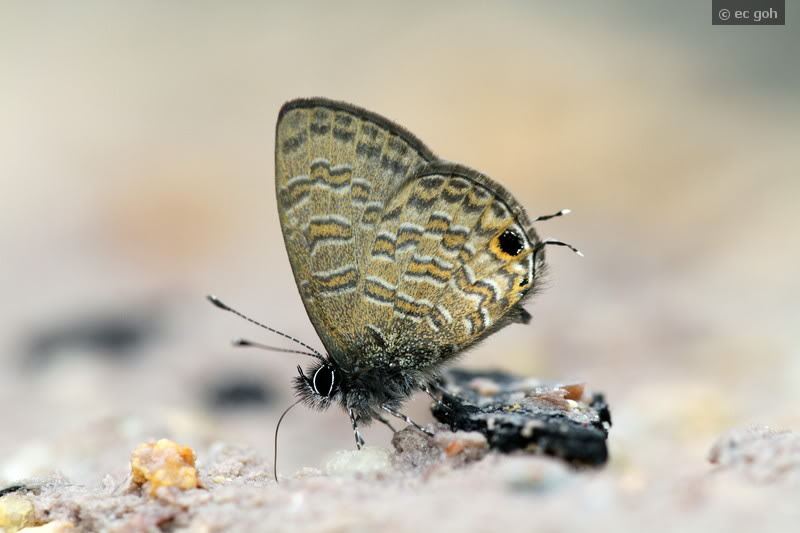
This Common Line Blue (Prosotas nora superdates) is one of three species from the genus Prosotas found in Singapore. All three species have been observed to puddle.  This shot of a puddling Common Line Blue was taken within the nature reserves by ButterflyCircle member Lemon Tea Yi Kai.


15 November 2020

Butterfly of the Month - November 2020

Butterfly of the Month - November 2020
The Common Line Blue (Prosotas nora superdates)

A Common Line Blue feeding at the flower of the Spanish Needle (Bidens alba)

It is the 11th month of a tumultuous 2020 and many of us would just wish that we could wake up in 2021 and all the nightmares of this year will be over! But if only the pandemic that has spread across the whole world will be so easy to get rid of. News of a viable and safe vaccine are already making their rounds and we can only wait with baited breath that there is light at the end of this dark tunnel that we have been crawling through for most of this year.


Over on the other side of the globe, the US Presidential Election is over. Or is it? Although the official results show that the US now has a new 46th President, there are still some quarters that harbour a different view that the incumbent still has a whisker of a chance to wrest the Presidency back. Whilst the rest of the world get down to the business of making our nations safe again, and to kick start the ailing economies, it should be a matter of time before we see a new President in the White House.


Back home on our Little Red Dot, the Covid-19 situation appears to be under control, with daily single digit or no new community infections for the past couple of weeks. Whilst there are still the irritating imported cases almost every day, the anticipation of a "new normal" or a semblance of getting our lives back, grows by the day. There is talk of a "Phase 3" on the cards, but it comes with a warning of a second wave, if we let our guard down. But looking around us in Singapore, it would appear that we are beginning to see a bit of pre-Covid normalcy, albeit with face masks as a default as we go about doing our daily business.


Our feature butterfly of the month of November 2020 is the small and inconspicuous Common Line Blue (Prosotas nora superdates). With a wingspan of only about 20-25mm, the Common Line Blue is a small species that is not easy to spot. It can hardly be considered "common", although it is quite widespread in distribution across habitats like urban parks and gardens. It can also be found in the forested nature reserves. Due to its diminutive size and erratic flight, it is not easy to identify the species when it is on the wing.

A mating pair of Common Line Blue : Left - Male, Right - Female

The male Common Line Blue is bluish-purple on its uppersides, with a very thin and almost imperceptible border. The upperside of the female is dark brown and mostly unmarked. The underside is ochreous in the male, and sometimes appears almost like a small orange butterfly, whilst the female is greyish buff with ochreous speckles.


There is a prominent tornal orange-crowned black eyespot edged with pale green iridescent scales on the underside of the hindwing. There is a long white tipped filamentous tail at vein 2 of the hindwing. The large eyes of the Prosotas species are jet black, whilst the thorax, palpi and the dorsal margin of the hindwing are covered with hairs, giving the butterfly a particularly shaggy and unshaven look.

The Common Line Blues are most often seen puddling at damp footpaths and sandy streambanks

The Common Line Blue has a weak but erratic flight, and often seen flying restlessly at low levels amongst shrubbery. At times, the butterflies are seen feeding at flowering plants, but males are most often spotted puddling at damp footpaths and sandy streambanks that are contaminated with animal excretions and other organic matter. Females are much rarer.


When stopped at rest, the species usually perches on the tops of leaves and twigs with their wings folded upright. At times during hot sunny days, male Common Line Blues are occasionally observed to sunbath with their wings almost fully open, to reveal their purplish-blue uppersides.


The Common Line Blue's life history has been recorded on two host plants in Singapore - Entada spiralis and the non-native Australian Wattle (Acacia auriculiformis).

Text by Khew SK : Photos by Janice Ang, David Chan, Chng CK, Goh EC, Khew SK, Koh CH and Horace Tan

25 January 2014

New Record of a 4th Prosotas species

New Record of a 4th Prosotas in Singapore
Discovery of Prosotas aluta nanda 


The Lycaenidae and Hesperiidae species often pose a great challenge to identification, with many lookalikes with very similar features. The challenge of identifying the many lookalikes can sometimes be mitigated with research into their early stages, (where the physical appearances and diagnostic features of the caterpillars can be a great aid to separating the species,) or with voucher specimens to scrutinise.


Field shots are often not the best for reliable identification, especially those where colour or size are diagnostic features, or where the physical markings may be difficult to be used to distinguish between two species, due to perspective distortions of the photographs. In some cases, where the field-shot individual is not pristine or with significant wear and tear on the wings, identification may also be problematic.


Hence for some of these lookalikes, it is often prudent to research and analyse carefully, before jumping to conclusions about the identity of a species. Over the years, ButterflyCircle has had some misidenfications, and has now adopted greater rigour in validation before establishing the identity of a species for inclusion into the Singapore Checklist. In recent years, the identification of the more challenging species has been made less onerous with the invaluable help of experts like Dr TL Seow, Dr L.G. Kirton and others.


So we now announce the inclusion of the fourth Prosotas species to the Singapore Checklist. This latest addition, Prosotas aluta nanda had been recorded several times over the past years, but its identity was kept under consideration until a higher level of confidence could be accorded to its ID. Recently a voucher specimen was obtained from a location in the nature reserves of Singapore, and the specimen scrutinised to validate the ID.


The first record shot of the Barred Line Blue by Horace Tan on 26 Feb 2008

From photographic records in ButterflyCircle's forums, the earliest posted shot of this species was documented by Horace Tan, who shot this species on 26 Feb 2008, feeding on a flower of the Bandicoot Cherry (Leea indica) in the nature reserves. There were many subsequent sightings and photos of this species, usually found puddling at sandy streambanks, that followed in subsequent years.


ButterflyCircle member Mark Wong recorded this individual on 15 Mar 2008

This Line Blue joins three others in the genus Prosotas that are extant in Singapore - Common Line Blue (Prosotas nora superdates), Tailless Line Blue (Prosotas dubiosa lumpura) and Banded Line Blue (Prosotas lutea sivoka).  The last named was only recently discovered in Singapore in Oct 2012. Both these recently-discovered Prosotas were not previously recorded in Singapore before.


This species has been given the common English name "Banded Line Blue" in most Indian and South Asian references, but since this common name has already been assigned to the species Prosotas lutea sivoka in South East Asia (ref : Butterflies of Thailand by Pisuth Ek-Amnuay Vol 2), it would generate more confusion to refer to it by the similar name. In his book, Pisuth has coined the name "Barred Line Blue" for Prosotas aluta nanda. Whilst it would be interesting to understand why "Barred" was coined to refer to this species, we see no reason not to use this common name for Prosotas aluta in the South East Asian region covering Thailand, Malaysia and Singapore - until someone comes up with a better alternative for the English common name of this species!


An annotated visual identification comparison between P. aluta and a N.berenice highlighting the diagnostic features of P.aluta

The Barred Line Blue has been described as "confined to the forested plains and is usually taken singly". It closely resembles the berenice group of the genus Nacaduba. In C&P4, the authors also added that "most examples can be recognised by having the post-discal spot in space 3 on the forewing below shifted in(wards) very slightly basad of the spot in space 4". The striae are also described as "clear white" in Prosotas aluta.


The upperside of the males of this species is blue with a narrow black border whilst the female is brown with a shining greenish-blue discal patch on the forewing. Another consistent feature that separates this species from the other lookalikes (but must be used in combination with the post-discal spot in space 3 of the forewing), is that the marginal spots, particularly the one next to the tornal orange-crowned eyespot, are arrow-shaped or distinctly pointed. In most individuals, the striae in space 4 of the forewing are also dislocated, and distinctly angled towards the termen.


The Barred Line Blue has an erratic flight and is usually skittish, as is the case with the other species in the Prosotas and Nacaduba genera. Thus far, all the sightings of this species have been in the forested nature reserves, and more often, males are encountered puddling at sandy streambanks on hot sunny days, usually attracted to decomposing animal matter or excretions.

And so we add the Barred Line Blue as species #309 to the Singapore Checklist. At this point in time, there are several other Lycaenidae and Hesperiidae that are awaiting further validation, either from their life histories, or with voucher specimens, before adding them to the Singapore Checklist. However, we are in no hurry to do so, until we have a high level of confidence on the ID and concurrence amongst the expert advisers to ButterflyCircle.

Text by Khew SK : Photos by Chng CK, Huang CJ, Khew SK, Horace Tan & Mark Wong

References :


  • [C&P4] The Butterflies of The Malay Peninsula, A.S. Corbet and H.M. Pendlebury, 4th Edition, Malayan Nature Society, 1992.
  • Butterflies of Thailand, Pisuth Ek-Amnuay, 2nd Edition, 2012

04 July 2020

Singapore's Line Blues - Part 1

Singapore's Line Blues - Part 1
Featuring the Line Blue Butterflies of Singapore


A male Common Line Blue puddling at a sandy streambank

The "Line Blue" butterflies are a group of rather small species that belong to the subfamily Polyommatinae of the family Lycaenidae. The Polyommatinae are often referred to as the "Blues". A large number of the species in this subfamily are small and delicate butterflies with many of them sporting thin filamentous white-tipped tails on their hindwings. Many species, particularly the males, have blue uppersides, hence the English common name for the group.


A Pointed Line Blue perched on top of a leaf

This blogpost introduces the seven extant species found in Singapore that carry the English common name "Line Blue" in their names. All these species feature a series of striations across the undersides of both the fore- and hindwings. They have the typical "eyespot" at the tornal area of the hindwing and, in some of the species, coupled with the thin tails, form a decoy to fool predators into attacking a less critical part of their wings.


A Tailless Line Blue feeding on the flower of the Stringbush

In this article, we introduce three of the seven species that are found in Singapore. Ironically, of these "Line Blues" found in Singapore, four are new discoveries. Based on reference literature, these four were not recorded in Singapore by the early authors. We will feature these four "exotics" in Part 2 of the article next weekend. We will now highlight the three native, and relatively common species in Singapore.

1. The Pointed Line Blue (Ionolyce helicon merguia)


A puddling Pointed Line Blue

The Pointed Line Blue is the sole representative of the genus Ionolyce in the region. It is relatively common and widespread in distribution across the island. It can be found in urban parks and gardens, and sometimes in the forested nature reserves as well. Males are regularly found puddling at damp streambanks and muddy footpaths, and are partial to human perspiration as well.


It is a fast flyer, and flies erratically, and is often skittish, until it comes down to puddle on the forest floor. Once it is a feeding mood, it can also be coaxed to feed on a sweaty finger. The forewings of the males are more pronounced and pointed than other lookalike species in the subfamily.


A male Pointed Line Blue opens its wings to sunbathe

The male Pointed Line Blue is a deep purple-blue on top, with a very thin black margin and unmarked. The female is predominantly brown on her uppersides with the discal areas and wing bases overlaid with bluish-purple. The undersides are dull greyish-brown with narrow whitish wavy lines across both wings. There is an orange-crowned eye spot at the tornal area of the hindwing and a black filamentous tail which is tipped with white at vein 2 of the hindwing.

2. The Common Line Blue (Prosotas nora superdates)


A Common Line Blue feeding on the Spanish Needle flower

The Common Line Blue is a small butterfly that has a wingspan of around 25-28mm and considered moderately common. It can be found in urban parks and gardens but can also be found in the forested nature reserves. Males of the Common Line Blue are attracted to damp footpaths and streambanks where they come down to puddle for salts.


A male Common Line Blue puddling with its wings opened

The male Common Line Blue is bluish-purple on the upper surfaces with a thin black border, whilst the upperside of the female is dark brown and unmarked.  The underside of the male appears orangey whilst the base colour of the female is greyish buff.


A mating pair of Common Line Blue.  Left : Male Right : Female

The underside features white-edged dark lines across both wings with the interstitial spaces orange in the males, and grey with orange speckles in the female. There is a large orange crowned black eyespot at the tornal area of the hindwing below, with iridescent greenish scales. At vein 2 of the hindwing is a filamentous white-tipped tail.

3. The Tailless Line Blue (Prosotas dubiosa lumpura)


A Tailless Line Blue puddling

The Tailless Line Blue is a closely related species from the same genus as the Common Line Blue. But as its name suggests, there is no tail on the hindwing of this species. It is common, and sometimes seasonally abundant where two dozen individuals or even more, can be observed, frolicking amongst the shrubbery.


A male Tailless Line Blue opens its wings to sunbathe

The male Tailless Line Blue is bluish-purple on top with an almost imperceptible border. The female is brown on the uppersides with a blue discal patch. The underside is greyish, with the usual white-edged dark lines across both wings. There is a large tornal spot on the underside of the hindwing with some iridescent pale green scales.


A mating pair of Tailless Line Blues

Males are sometimes found puddling at damp footpaths, drains and wet areas. Females are more often found at flowering plants like the Stringbush. The species is widely distributed and is common throughout Singapore in urban parks and gardens.

Text and Photos by Khew SK

08 November 2014

Butterflies of Pulau Ubin

Butterflies of Pulau Ubin
Butterfly Hill @ Pulau Ubin


Aerial view of Butterfly Hill @ Pulau Ubin - © National Parks Board

Pulau Ubin, an offshore island of Singapore of about 10.2 sqkm, is often considered the "last frontier" of rural ambience and rich biodiversity in Singapore. Local Malays once called it "Pulau Batu Ubin" or Granite Stone Island. In the past this small island supplied the local construction industry with granite and sand, from which coarse aggregates and the sand were used to construct roads, manufacture concrete and other building materials. The granite was also used to make floor tiles, or Jubin as it was called in Malay.


A map of Pulau Ubin - © National Parks Board

Today, the 7km long by 2km wide island is a favourite weekend destination for adventure lovers and nature enthusiasts taking a short bumboat ride from the Changi Ferry Terminal. The island is known for its rich biodiversity and rustic environment to which many weekend visitors flock to get away from Singapore's hectic urban lifestyle.


On the bumboat back from Ubin with senior government officials and nature enthusiasts

In early 2014, the Ministry of National Development, led by Minister of State Desmond Lee, visited Pulau Ubin with a group of nature enthusiasts, heritage experts and community leaders. The visit was part of the wider plan to initiate a conversation with Singaporeans on how we can all play a part to sensitively enhance the natural environment of Pulau Ubin, which was announced by Mr Desmond Lee in Parliament in March 2014.


A group photo of Friends of Ubin Network taken at Singapore Botanic Gardens

Subsequently, the Friends of Ubin Network (FUN) was set up to continue to engage the stakeholders whilst a public feedback portal and even an Ubin Symposium was organised to openly discuss possible options for Ubin. There have been numerous media articles and blog articles discussing what different groups of people want for Ubin.


Blue Glassy Tiger (Ideopsis vulgaris macrina) - a "resident" species at Butterfly Hill

On 30 Nov 2014, a public event to celebrate Pulau Ubin, will be resurrected by Ria Tan and Grant Pereira.  The event, known as Ubin Day, was previously held in 2002 and 2003, and this will be the 3rd instalment of this event, featuring different activities by various groups in many parts of the island. The event's objective is to introduce the diversity of activities that can be enjoyed by the general public on this little island, and to showcase the amazing biodiversity that we have on Ubin.


A peep at the Butterfly Hill during earthworks back in 2005

Let's come back to Pulau Ubin's Butterfly Hill. In 2005, the Jelutong Campsite was created out of a piece of wasteland reclaimed from the sea during past granite quarrying operations. Within the campsite sits Butterfly Hill – a knoll created specially to conserve and showcase butterflies. Back then, I worked with NParks' staff, Robert Teo, Choi Yook Sau, Jacky Soh and How Choon Beng to build up Butterfly Hill from scratch. I remember vividly when the hill was completely wiped clean except for a solitary tree, and the hill was just covered with red earth.


Black Veined Tiger (Danaus melanippus hegesippus) - a regular visitor at Butterfly Hill

Fast forward to 2014, it's been almost 10 years in the making, and the Butterfly Hill continues to be a good place to observe butterflies, yielding the occasional surprise in terms of rare species. Over the period since the Butterfly Hill was designed and planted with butterfly host and nectaring plants, we have recorded over 150 species (and counting!). On a typical day, one can expect to be greeted by the resident Plain Tigers, Blue Glassy Tigers, Pea Blues, Great Eggflies, Common Birdwings and others. A half day butterfly watching outing should easily yield about 20 different species.


Common Line Blue (Prosotas nora superdates) feeding on Bidens flower at Butterfly Hill

Amongst the uncommon butterflies that have been spotted and photographed at Ubin's Butterfly Hill are :

Mangrove Tree Nymph (Idea leuconoe chersonesia) - This large Danainae is very rare, previously known only from Pulau Tekong. This individual was photographed at Butterfly Hill recently.


Malayan Birdwing (Troides amphrysus ruficollis) - A large and showy Birdwing, this species was first recorded in Singapore from a caterpillar discovered at Alexandra Hospital's Butterfly Trail. This species was seen on Butterfly Hill and there have been subsequent sightings in the past year.


Great Mormon (Papilio memnon agenor) - This large swallowtail frequents Butterfly Hill because its caterpillar host plant, Pomelo (Citrus grandis) is cultivated here.


Lesser Striped Black Crow (Euploea eyndhovii gardineri) - This Crow is uncommon and often encountered singly. Butterfly Hill is one location where this species is observed quite regularly.


Dwarf Crow (Euploea tulliolus ledereri) - The Dwarf Crow is thus far known reliably only from Pulau Ubin. Whilst it was previously seen regularly at Butterfly Hill, it has become rarer and not often seen in the past two years.


Bamboo Tree Brown (Lethe europa malaya) - A shy and skittish shade lover, this species is regularly seen amongst the bamboo clumps at Butterfly Hill.


Forest Hopper (Astictopterus jama jama) - This elusive skipper has regularly been spotted at Butterfly Hill usually flying rapidly amongst the low shrubbery.


Conjoined Swift (Pelopidas conjunctus conjunctus) - This large and fast-flying skipper has been observed at Butterfly Hill on several occasions by ButterflyCircle members.


Plain Palm Dart (Cephrenes acalle niasicus) - This skipper, though not often spotted, has been seen several times at Butterfly Hill, particularly when there are flowering Syzygiums.


So when you visit Pulau Ubin's Butterfly Hill, do look out for some of these rarities, and we hope that you can also add more to the checklist of butterflies on Butterfly Hill by spotting other new species!


On 30 Nov 2014's Ubin Day, ButterflyCircle members will be on site to share tips on butterfly watching and photography. For those who are keen to join us, please sign up here.  We look forward to an enjoyable morning with nature's flying jewels!

Text by Khew SK : Photos by Brian Goh, Khew SK, Simon Sng, Jonathan Soong, Anthony Wong, Yong Wei Hoong