Showing posts sorted by relevance for query Iraota rochana boswelliana. Sort by date Show all posts

31 December 2011

Butterfly of the Month - December 2011

Butterfly of the Month - December 2011
The Scarce Silverstreak (Iraota rochana boswelliana)


On this New Year's Eve, we feature the last of our series of Butterfly of the Month feature species for the year 2011. This is the 49th species that we have on the Butterfly of the Month series since this monthly feature was started way back in Dec 2007 with the Malay Lacewing.  It's been four years already?!


The year 2011 has indeed been a tumultuous year around the world. The most significant phenomenon that has affected lives all across the globe would have to be the protracted financial crisis that has plagued the US and then Europe. Businesses and the economies in the rest of the world, and in particularly in Asia which is of relevance to many of us in Singapore, were also affected.


Between the twin disasters in Japan, the earthquakes in New Zealand, the floods in Thailand and a whole series of 'natural' occurrings, these events give us an indication that ol' Mother Earth is not exactly in the pink of health. A sign of the effects of global warming?


Even in Singapore, where unprecedented "once-in-50-years" floods happened like every few months, engineers are scrambling to review design capacities of drainage systems. Conventional Codes of Practice may be way outdated and grossly inadequate for the deluge of water coming down from the heavens these days!


At a personal front, 2011 has indeed been an eventful year, with changes in my workplace that took many of us by surprise. As the company looks forward to a new future with a new shareholder in 2012, there is optimism ahead, as we put behind us 7 years of 'colonialism' under a foreign shareholder that spent very little effort to grow the business. The potential new shareholder, of Chinese origin, can hopefully bring the company forward, with Asia, and particularly China, being at the forefront of driving the world economy in the years to come.


For our beloved butterflies, it has also been a good year, with several new discoveries and re-discoveries recorded in 2011. As the Singapore Checklist crossed the 300 mark in March this year, ButterflyCircle has consolidated its expertise and had been more rigourous in recording new finds with further validation by experts in the region and even abroad. In particular, many other new finds in the Lycaenidae and Hesperiidae families remain unannounced as validations continue at the scientific level behind the scenes. We are confident that many of these discoveries will be unveiled in the year ahead.

 
It has also been encouraging to see more community effort in butterfly conservation projects, as government organisations like the National Parks Board moves up another gear into better nature conservation and biodiversity enhancement efforts at a strategic level. Even so, there are those who consider these efforts inadequate and too late for Singapore. However little that can be done, there is always still hope for nature, and for our flying jewels.


The birthstone for December is the turquoise. This precious gemstone is an opaque blue-green mineral that is a hydrous phosphate of copper and aluminium. The stone has been used in a very wide range of applications, from the usual rings, bracelets and pendants in jewellery, to the inlays of the famous burial mask of King Tutankhamen, to entire domes of Iranian palaces and mosques!


If cold December gave you birth,
The month of snow and ice and mirth,
Place on your hand a turquoise blue;
Success will bless whate'er you do.

- Gregorian Birthstone Poems


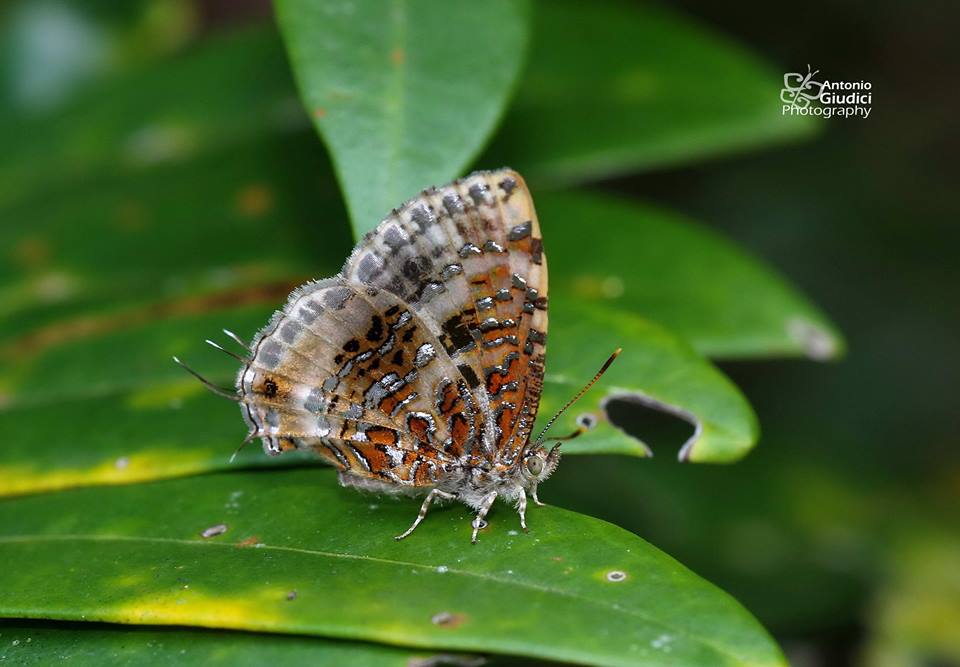
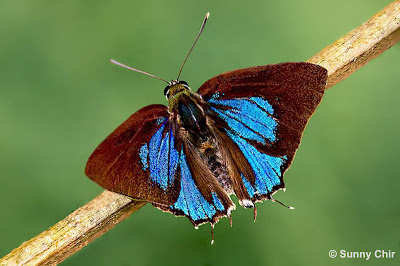
For the month of December and on this last day of 2011, we feature the elegant Lycaenid, the Scarce Silverstreak (Iraota rochana boswelliana). With a wingspan of about 36mm, this robust hairstreak is a zippy butterfly and is able to fly around at high speeds.


The Scarce Silverstreak is not really as scarce as its English common name suggests, although we would hardly describe the species to be very common either. Due to the fact that its caterpillar host plant, Ficus microcarpa is cultivated as a common roadside bush at many of our parks and as low barrier roadside hedges in Singapore, the butterfly is more often seen in urban areas and parks than in the nature reserves.


The males are a shining greenish-blue, reminescent of a pretty turquoise jewel. With jet-black broad apical borders, the upperside of the butterfly is a sight to behold if and when the male Scarce Silverstreak opens his wings to sunbathe (which unfortunately, is a rare occurrence). Females are a dull bronzey brown above and unmarked.


The underside of both sexes feature cryptic patterns of brown and silvery-white streaks, with dashes of blue and gold on the hindwings. There is a large black eyespot at the tornal lobe and blue-green scaling at the tornal area. The hindwing sports 3 tails, with the one at vein 3 slightly more pronounced in the female.


The butterfly is a rapid flyer, with females more often seen than males. Perhaps this is more due to the fact that females are more regularly encountered when they descend from the treetop canopies to oviposit at their host plants in urban areas. Sightings are more often made in the late mornings and early afternoons. The life history of the Scarce Silverstreak has been recorded here.


The Scarce Silverstreak is quite regularly observed at the Southern Ridges in Singapore, primarily at the hillside parks at Mount Faber, Telok Blangah Hills Park and Kent Ridge Park. They usually stay at treetop level, descending to feed at flowers or the fruits of the Singapore Rhododendron (Melastoma malabathricum). Females tend to open their wings to sunbathe more often than the rarely-seen males.


And so on this final day of December 2011, we feature this pretty Lycaenid, as we look forward to many more years of butterflying ahead. On behalf of all the members ButterflyCircle, I wish all our readers and friends all around the world a Happy New Year ahead!   Three Cheers to our Butterflies!


Text by Khew SK : Photos by Sunny Chir, Goh LC, Khew SK, Nelson Ong, Jonathan Soong and Horace Tan

This blog article is specially dedicated to Sunny Chir, who goes by the nick 'Silverstreak' in our ButterflyCircle community.  Sunny is an amazing photographer and butterfly watcher who has single-handedly delivered some of the best photographs of rare species that I've seen anywhere!  He has also contributed to many discoveries and re-discoveries to the Singapore checklist due to his untiring efforts out in the field, and exceptionally eagle-eyed observations of our butterfly fauna. 

18 December 2016

Revision to the Common Names of Butterflies 6

A Revision to the Common Names of Butterflies
Part 6 : An Analysis of Name Changes


A mating pair of Dark Caeruleans (or is it Dark Ceruleans?)

In Part 6 of our discussion on Common Names of Butterflies in the Southeast Asian region, we continue with the remaining species in the Lycaenidae family for which recent references had updated or amended the English common names of these species. As in the earlier parts of this series, the primary reference that made significant changes to the common names is the book by Dr Kirton.


After writing the earlier parts, it is interesting to note that even with the rationalisation of certain common names, the regular usage of names in cyberspace and social media appears to take precedence over any printed literature. Once a name is coined and repeated through frequent usage and cross-referencing across the internet, these names are difficult to change.


A Pygmy (or Tiny?) Grass Blue perches on the flower bud of Lantana camara

In any case, we continue our discussion on some of these changes proposed by Dr Kirton in his book, Butterflies of Peninsular Malaysia, Singapore and Thailand. The first species that we will discuss in this article is Zizula hylax pygmaea. Across the hardcopy references in the region, most books refer to it as the Tiny Grass Blue.


However, the common name Pygmy Grass Blue has more frequently been used in the Singapore context and the name appears to have been adopted by common usage in the local references. Perhaps it may be apt to use the name for subspecies pygmaea (where the common name makes sense when reference is made to the latin scientific name, for obvious reasons).


Recommendation : Zizula hylax pygmaea should retain its common name Pygmy Grass Blue but may also be simultaneously referred to as Tiny Grass Blue (Zizula hylax hylax) and its various subspecies in the Asian region.


Malaysian Butterflies - An Introduction (1983) by Prof Yong Hoi-sen : Chilades pandava is called Cycad Blue

The next species, Chilades pandava pandava, is a common urban species whose caterpillar feeds on the Sago Palm (Cycas revoluta) and several other Cycas spp. (commonly referred to as Cycads). It is no wonder that the name Cycad Blue was coined by Prof Yong Hoi-sen in his book, Malaysian Butterflies - An Introduction, back in 1983. Elsewhere in the region, most references refer to this species as Plains Cupid.


A Guide to Common Butterflies of Singapore (1996) by Steven Neo : Chilades pandava is called Cycad Blue

In another Singapore reference, A Guide to Common Butterflies of Singapore, the author Steven Neo also referred to this species as Cycad Blue. In reference websites in the region, both names are used interchangeably in social media and other digital media.


Recommendation : Chilades pandava pandava is referred to by its common names Cycad Blue and Plains Cupid interchangeably, and there is no preference for either name through common usage, and time will tell which becomes the adopted name in this region.


The next group of butterflies under the Jamides genus comes under scrutiny. The common name that varies amongst different literature is how the name "Cerulean" is spelt. Some references show "Cerulean" whilst others show "Caerulean". Upon checking different sources, the spelling is correct in both cases.


Wikipedia references state that Cerulean and Caerulean are both correct, and the word refers to a colour with the hue ranging between blue and cyan. The etymology of "Cerulean/Caerulean" originates from the Latin word caeruleus, "dark blue, blue, or blue-green", which in turn probably derives from caerulum, diminutive of caelum, "heaven, sky".


Malaysian Butterflies - An Introduction (1983) by Prof Yong Hoi-sen uses "Caerulean" to refer to the Jamides spp.

Again, in Prof Yong's book in 1983, he spelt the name of these butterflies as "Caerulean". In Corbet and Pendlebury's Butterflies of the Malay Peninsula, the spelling "Caerulean" is adopted. Elsewhere in the region, Cerulean is more commonly used. In both editions of Butterflies of Singapore, I used "Caerulean". Both names are also found in digital media across many websites, social media and online references and apps.


Caerulean is spelt with the extra 'e' in Corbet and Pendlebury's Butterflies of the Malay Peninsula 4th Edition (1992)

Recommendation : The Jamides species' common names can be referred to as Cerulean or Caerulean as both spellings are deemed acceptable, and it depends on how individuals prefer to use it.


In Pisuth's Butterflies of Thailand 2nd Edition, he coined the name Green-scaled Acacia Blue for the species Surendra vivarna amisena. In Dr Kirton's book, he calls it the Burmese Acacia Blue. Local references in Singapore refer to this species as just the Acacia Blue.


Corbet and Pendlebury's Butterflies of the Malay Peninsula 4th Edition (1992) refers to Surendra vivarna amisena as Acacia Blue

It is obvious that in the region, there are other species of the genus Surendra, hence prompting authors to coin names for the different species to differentiate them. Corbet and Pendlebury refers to Surendra vivarna amisena as "Acacia Blue". In Singapore, there is only a single species of the genus, and hence there is unlikely to be any confusion to refer to Surendra vivarna amisena as Acacia Blue.


Recommendation : Surendra vivarna amisena should retain its common name as just Acacia Blue.


The next species of interest is Iraota rochana boswelliana. Most references in the region use the common name "Scarce Silverstreak Blue" for this species. The Singapore references dropped the "Blue" in the name, and through common usage, it has often been referred to as only Scarce Silverstreak.


The other species found in Singapore (and only 1 sighting has been confirmed in the past 20 years), is Iraota distanti distanti. This species, which was referred to as the Spotted Silverstreak, also omitted the "Blue" from its name. In Thailand, this species is referred to as the Malayan Silverstreak Blue.


Recommendation : The species Iraota rochana boswelliana should be named Scarce Silverstreak Blue. However, for convenience and common usage, the "Blue" is likely to be left out. Again, time will tell which is the preferred name that will be more often used by the general community.


The next species, Catapaecilma major emas is referred to as the Greater Tinsel by Dr Kirton. A related species, C. elegans was given the name Lesser Tinsel in the same book. Elsewhere in the region, reference books refer to C. major as Gray Tinsel and C. elegans as Common Tinsel in Butterflies of Thailand.


In his latest book, Isaac Kehimkar's Butterflies of India refers to C. major as Common Tinsel, as C. elegans is probably not found in India. Our local Singapore butterfly references refer to C. major as Gray Tinsel.

Recommendation : It is not likely that the confusion across the region can be resolved in the immediate future. We recommend that the name Gray Tinsel be retained for the species Catapaecilma major emas until such time enough authors come together to have a common stand on the name of this species.


The final species of interest in this series of discussions on Lycaenidae is Horaga syrinx maenala. Dr Kirton calls it the Yellow Onyx. Several Indian references call it by the same name. (However, the species is rare in India, and many hardcopy references do not feature this species). Pisuth refers to it as Ambon Onyx in Butterflies of Thailand.


We have adopted the name Ambon Onyx for this species in Singapore references and the name has been regularly used in cyberspace. An online article from Bhutan, as recently as last week, calls this species the Ambon Onyx as well.


Again, it does not appear that there is any common consensus on the English common name of this butterfly, and hence the jury is still out on the matter. However, through common usage, time will tell which of the two common names will be preferred by amateur enthusiasts.

Recommendation : The name Ambon Onyx will be retained for the species Horaga syrinx maenala.

Text by Khew SK : Photos by Bob Cheong, Sunny Chir, Chng CK, Huang CJ, Khew SK, Loke PF and Jonathan Soong

Earlier articles in this series :
Revision to the Common Names of Butterflies Part 1
Revision to the Common Names of Butterflies Part 2
Revision to the Common Names of Butterflies Part 3
Revision to the Common Names of Butterflies Part 4
Revision to the Common Names of Butterflies Part 5

06 June 2009

Life History of the Scarce Silverstreak

Life History of the Scarce Silverstreak (Iraota rochana boswelliana)


Butterfly Biodata:
Genus: Iraota, Moore,1881
Species: rochana Horsfield, 1829
Sub-species: boswelliana, Distant, 1855
Wingspan of Adult Butterfly: 36mm
Caterpillar Local Host Plants:
Ficus microcarpa `Golden' (Moraceae, common name: Indian Laurel Fig), Ficus benjamini (Morrel, 1957).

Physical Description of Adult Butterfly:
Above, the male is dark brown with greenish blue at base of the forewing below the cell and between veins 1-6 of the hindwing; the female is entirely brown. Underneath, both sexes are buff to reddish brown with areas of white streaks and spots. The forewing has a longitudinal silvery white streak in the cell, and the discal spot in space 4 is elongated and nearly reaching the termen. The hindwing has a broad basal streak running along the costa up to the termen. Both sexes have the hindwing tailed at veins 1b and 2, the latter being longer. There is also an additional stumpy tail (or tooth) at vein 3 for both sexes. All tails are white-tipped.


A female Scarce Silverstreak perching near its host plant.


A maler Scarce Silverstreak enjoying the ripened fruit of the
Singapore Rhododendron (Melastoma malabathricum).


A female Scarce Silverstreak sunbathing on its host plant, giving us a view of its
brown upperside.


A male Scarce Silverstreak proudly displaying its striking upperside.

Field Observations of Butterfly Behaviour:
This species is uncommon in Singapore. Sightings have been reported at a few sites around the main island, with the Sourthern Ridges being the most likely place for an encounter. The adults fly rapidly and may sometimes be missed due to the speed at which they fly around. Between the two sexes, the female is more likely to be sighted, especially when they make ovipoisiton visits to the ficus hedges in hill parks. The males usually stay high at tree-top level, and rarely perch low enough for any good photo captures. Both sexes visit flowers for nectar.

Early Stages:
The local host plant, Ficus microcarpa `Golden' is a strangling fig with numerous, slender aerial roots growing from branches, some of which developing into trunk-like pillar roots. Leaves are blunt, with young leaves on new shoots bright yellowish green. Formerly found on coastal and riverine situations, this species is now very common in all parts of Singapore where they are typically used roadside hedges or as ornamental plants in gardens.


Host plant: Ficus microcarpa 'golden'.
Left: young tree with hanging aerial roots; Right: close-up on young leaves.


A mating pair of the Scarce Silverstreak.


A mother Scarce Silverstreak laying one egg on the leaf underside of the host plant.

Eggs of Scarce Silverstreak are laid singly on the stem or the leaf underside of the host plant. The freshly egg is covered in a dark yellowish viscous coating which dries up in a matter of few hours to give the egg a bright yellowish appearance. The egg is shaped like a burger bun with many irregular polygonal pits, and has its micropylar lying at the polar position encircled with a number of smaller pits. The egg is rather large for a lycaenid species with a diameter of about 1.2mm.


Three views of an egg of the Scarce Silverstreak, diameter is about 1.2mm.
Left: a freshly laid egg. Right and middle: 5-hour old egg.


Pics of a mature egg showing the ``infant'' larva eating egg shell to create a sufficiently large exit.

The egg hatches after 2.5-3 days of development. The young larva spends a couple of hours eating away the top portion of the egg shell in order to make its exit. The newly hatched is orangy brown with darker lateral bands. It has long dorsal setae and sub-spiracular setae. Length: about 2mm. Soon after its emergence, the newly hatched turns around and works meticulously at nibbling away the empty egg shell. It only moves on to eating the leaf when it has consumed almost the entire egg shell.


A newly hatched Scarce Silverstreak eating its egg shell.

The 1st instar grazes on the surface of the young leaves, and grows to a length of about 4mm in about 1.5 to 2 days before the moult to the next instar. Prior to the moult, the caterpillar shortens to about 3mm and stays dormant for up to half a day. This body shortening routine occurs for every subsequent moult.


Two views of a 1st instar caterpillar, late in this stage, length: 3.8mm.


A shortened 1st instar caterpillar lying dormant before the moult to 2nd instar, length: 3mm


The 2nd instar caterpillar is orangy brown and features faint and obscure dorsal markings. It has lost the long dorsal setae seen in the 1st instar, but ts body is covered with numerous short setae. The prothoracic shield has the same color as the base color and thus does not stand out. This instar lasts for 2-3 days, and the body length increases to about 8mm.


Two views of a 2nd instar caterpillar, length: 6mm.


The 3rd instar caterpillar initially resembles the 2nd instar caterpillar with its orangy brown body color and short setae. As the caterpillar grows rapidly in 2 days up to a length of 14-15mm, the caterpillar gradually takes on varying shades of green. While some caterpillars retain a large degree of brown coloration, there are others which turn light green. Towards the end of this instar, prior to the moult, two dorsal-lateral brown markings appear on the 1st abdominal segment, and faint reddish brown saddle markings appear on the 5th abdominal segment.


Two 3rd instar caterpillars, lengths: 10mm (top); 8.5mm (bottom).


3rd instar caterpillars, late in this stage, lengths: 15.5mm (top); 14mm (bottom)


One 3rd instar caterpillar found on the underside of a leaf in Southern Ridges.
Note the presence of an attending ant.


The 4th (and final) instar caterpillar is similar in appearance to the late 3rd instar caterpillar. Color variations from the light brown form to the green form can observed from those seen in the wild and those bred in indoor environment. It is also observed that caterpillars of the light brown form become much greener as the instar progresses. For some caterpillars, the two dorsal-lateral markings on the 1st abdominal segment and the saddle marking on the 5th abdominal segment are rather prominent, but for others, these markings can be rather faint or even absent.


Another 4th instar caterpillar, light brown form, early in this stage, length: 16mm


4th instar caterpillar, late in this stage, length: 25mm


Another 4th instar caterpillar, late in this stage, length: 27mm.
This one developed into a male adult.
Note the different ant species attending it as compared to the field shot of
a 3rd instar caterpillar featured earlier.

After 4-5 days of growth and reaching a maximum length of around 27mm in the 4th (and final) instar, the body of the caterpillar gradually shortens, and the color intensifies to either a dark green or deep purplish red. The caterpillar eventually comes to rest on a spot on the leaf surface for its pupation. At the chosen spot, the caterpillar readies itself for pupation by spinning a silk pad and a few silk strands across its body. The caterpillar secures itself to the silk pad via claspers on its posterior end.


Two views of a pre-pupa of the Scarce Silverstreak,


The pupation event of a Scarce Silverstreak caterpillar.


Pupation takes place after one day of the pre-pupal stage. The pupa has the typical lycaenid shape. It is covered in various violet red patches which eventually turns to various shades of brown which remains for most of the remaining pupal period of 9 days. Each pupa has a length of about 13.5-14.5mm.


Two views of a newly formed pupa of the Scarce Silverstreak,


Two views of a pupa of the Scarce Silverstreak.

Eight days later, the pupa becomes darkened in color signaling the imminent emergence of the adult. The markings on the upperside of the forewing become visible through the pupal skin, and it is now possible to tell the gender of the soon-to-emerge adult. The next day the adult butterfly emerges from the mature pupa
.


Mature pupae: Female (bottom); Male (top). Note the difference in the wing pads.


A newly eclosed female Scarce Silverstreak

References:
  • The Butterflies of The Malay Peninsula, A.S. Corbet and H.M. Pendlebury, 4th Edition, The Malayan Nature Society.
  • Butterflies of Thailand, Pisuth Ek-Amnuay, 1st Edition, 2006
Text by Horace Tan, Photos by Benedict Tay, Sunny Chir, Khew SK and Horace Tan