
Butterfly Biodata:
Genus: Ariadne Horsfield, 1829
Species: ariadne Linnaeus, 1763
Subspecies: ariadne Linnaeus, 1763
Wingspan of Adult Butterfly: 38-45mm
Caterpillar Local Host Plant: Ricinus communis (Euphorbiaceae, common name: Castor Oil Plant)


Physical Description of Adult Butterfly:
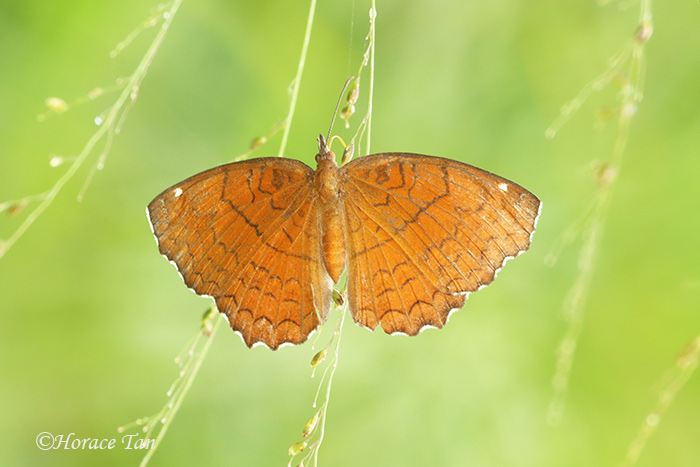
On the upperside, the wings are orangey to reddish brown and traversed by five or six narrow and sinuate black lines. A single black discal line lies just beyond the cell-end on both wings. On the underside, the wings are pale crimson brown and crossed with several irregular bands in darker coloration. Small whitish wing scales are featured dotting the wing surface, in much greater abundance in the female than the male. A prominent white sub-apical spot is featured in the forewing on both under- and uppersides.
The upper- and underside views of both male and female adults of the Angled Castor.
 A male Angled Castor perching on the underside of a leaf.
 A male Angled Castor perching on a flower of the Coat Buttons plant.
 A sun-bathing Angled Castor perching on a grass blade.
Field Observations of Butterfly Behaviour:
Angled Castor was re-discovered in Singapore in 2013 when a single individual was observed in an area within the Central Catchment Reserve on mainland Singapore. More recently, in late 2018, a small colony of this species was found in a location on Pulau Ubin, in an area where its host plant, the Castor Oil Plant, grew in abundance. The slow flying adults could be seen feeding on grass flowers in that location, and puddling on damp muddy areas at that site.
 An Angled Castor taking nectar from flowers of a grass species.
 Another Angled Castor taking fluid from grass flowers.
 A male Angled Castor perching on a twig.
 An Angled Castor sunbathing on a leaf.
 A female Angled Castor displaying its beautiful wing underside.
Early Stages:
Across the regions where Angled Castor occurs, the preferred larval host plant is the Castor Oil Plant (Ricinus communis) from the Euphorbiaceae family. This is also true in Singapore. In India, several Tragia species, also belonging to the Euphorbiaceae, have also been identified as larval host plants. Caterpillars in all instars of the Angled Castor feed on leaves of the Castor Oil Plant.
On the upperside, the wings are orangey to reddish brown and traversed by five or six narrow and sinuate black lines. A single black discal line lies just beyond the cell-end on both wings. On the underside, the wings are pale crimson brown and crossed with several irregular bands in darker coloration. Small whitish wing scales are featured dotting the wing surface, in much greater abundance in the female than the male. A prominent white sub-apical spot is featured in the forewing on both under- and uppersides.
The upper- and underside views of both male and female adults of the Angled Castor.


Field Observations of Butterfly Behaviour:
Angled Castor was re-discovered in Singapore in 2013 when a single individual was observed in an area within the Central Catchment Reserve on mainland Singapore. More recently, in late 2018, a small colony of this species was found in a location on Pulau Ubin, in an area where its host plant, the Castor Oil Plant, grew in abundance. The slow flying adults could be seen feeding on grass flowers in that location, and puddling on damp muddy areas at that site.



Early Stages:
Across the regions where Angled Castor occurs, the preferred larval host plant is the Castor Oil Plant (Ricinus communis) from the Euphorbiaceae family. This is also true in Singapore. In India, several Tragia species, also belonging to the Euphorbiaceae, have also been identified as larval host plants. Caterpillars in all instars of the Angled Castor feed on leaves of the Castor Oil Plant.


Eggs of the Angled Castor are laid singly on the surface of a leaf of the host plant. The yellowish green egg is oval-shaped with a flat base, and a small flat top with the micropylar sitting in the middle. The surface is marked with rows of long, whitish hairs. Each egg has a height of about 0.8mm.


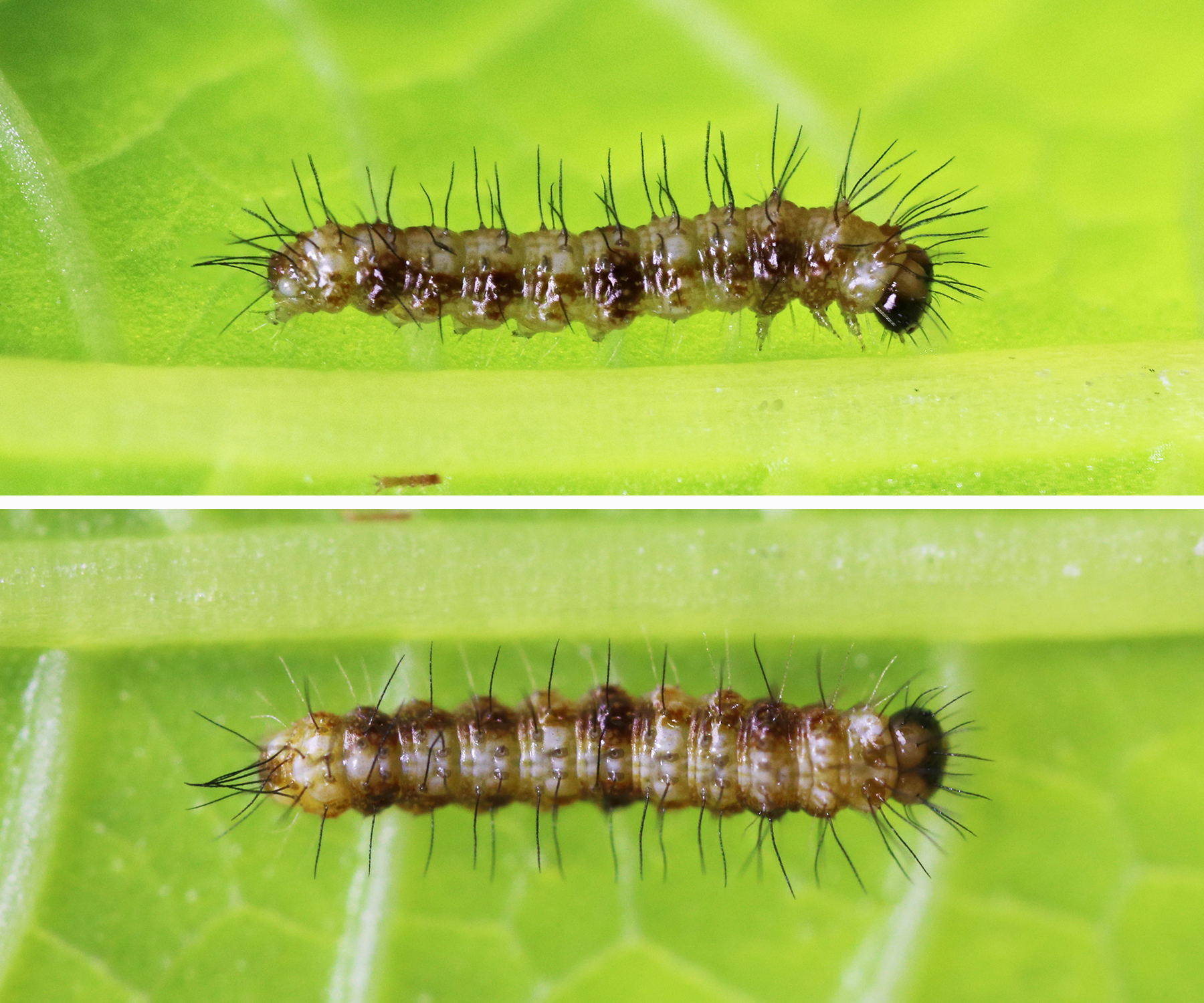
The egg takes about 2.5 to 3 days to hatch. The young caterpillar emerges by eating a sufficiently large part of the egg shell. The newly hatched is about 1.6mm in length and it has a cylindrical and pale yellowish brown body covered with rows of long black setae (hair) dorsally and dorso-laterally, and white setae laterally. The body is also marked with several reddish brown patches laterally. The head capsule is pale brown to dark brown.

The 1st instar caterpillar feeds on the leaf lamina. As it feeds and grows, the lateral dark patches and the head capsule turn dark brown. After reaching about 3.5mm in 2-2.5 days, the caterpillar moults to the 2nd instar.

The body of the 2nd instar caterpillar is yellowish brown with dark brown lateral patches on most body segments. Moderately long tubercles, each of which is endowed with dendritic spines and setae, run along the length of the body. On each side of the body, there are three series of such tubercles: one occurs dorso-laterally, another laterally and the last sub-spiracularly. The colour of the tubercles on the metathorax, 3rd, 5th and 7th abdominal segments are dark brown, while those on the remaining body segments are yellowish brown. The head capsule is dark brown with two brownish cephalic horns, each of which is also endowed with dendritic spines and setae. This instar lasts about 1.5 days with the body length reaching about 5.5mm.


The 3rd instar caterpillar resembles the 2nd instar caterpillar closely, with the same three series of tubercles. These tubercles and associated dendritic spines are proportionately longer (than those in the 2nd instar) and uniformly dark brown in coloration. The body is mostly dark brown dorsally and laterally, except for the prothorax, the posterior segment and lower portion of each segment, which are yellowish brown. Tiny, whitish specks can be seen on the dark dorsum. The cephalic horns are also much longer proportionally and feature a number of lateral spines. The head capsule is completely dark brown to black. This instar takes about 2 days to complete with body length reaching about 8-9mm.


The 4th instar caterpillar closely resembles the 3rd instar caterpillar, but with dark coloration on the dorsum much more intense than in the 3rd instar, and the cephalic horns longer proportionately as well. The 4th instar lasts about 2.5-3 days with the body length reaching about 17-18mm. In late 4th instar, a band of small greyish white patches can be seen on the dorsum.


The 5th (and final) instar caterpillar is similar to the 4th instar caterpillar. As in the late 4th instar, a band of small whitish patches appear on the dorsum of the 1st to the 7th abdominal segments. The strong contrast between the white patches and dark coloration of the dorsum makes this band a striking and easy identifiable feature of the 5th instar. A noteworthy point: The base of the dorsal and dorso-lateral tubercles on the mesothorax, metathorax, and the 1st to 8th abdominal segments can be red in some individuals, or black in others.


The 5th instar lasts for 3-3.5 days, and the body length reaches up to 30-31mm. On the last day, the body becomes shortened and the caterpillar ceases feeding and wanders around. Eventually it stops at a spot on the underside of a leaf or a stem and spins a silk pad from which it hangs vertically to take on the pre-pupatory pose.

The pupation event of a Angled Castor caterpillar.
Pupation takes place about 0.5 day later. The pupa suspends itself from the silk pad with no supporting silk girdle. It occurs in two color forms, with the brown form appearing pale yellowish brown with dark brown spots and patches on the dorusm, and the green form appearing pale yellowish green with dark green spots and patches on the dorsum. The dorsum of the thoracic segments are raised to tall ridge at the mesothorax. At the anterior end, there are two short cephalic horns. Length of the pupa: 20-22mm.


After about 5 days of development, the pupal skin of the mature pupa turns translucent and the whole pupa becomes mostly dark brown at this stage. The eclosion event takes place the next day.
The eclosion event for both male and female Angled Castor.


An interesting fact. All 5 instars of the Angled Castor larval stage have the habit of forcefully ejecting their frass pellets. This is not a common feature among butterflies. Previously, we have only observed this behaviour in members of the Ypthima and Mycalesis genera, as well as Discophora sondaica (Common Duffer).
Forceful ejection of frass pellets by caterpillars of the Angled Castor.
References:
- [C&P5] The Butterflies of The Malay Peninsula, A.S. Corbet and H.M. Pendlebury; G. and N. van der Poorten (Eds.), 5th Edition, Malayan Nature Society (2020).
- Butterflies of Thailand, Pisuth Ek-Amnuay, 2nd Edition, 2012.
- K. Saji, H. Ogale and M. Bhakare. 2021. Ariadne ariadne (Linnaeus, 1763) – Angled Castor. Kunte, K., S. Sondhi, and P. Roy (Chief Editors). Butterflies of India, v. 3.06. Indian Foundation for Butterflies.
http://www.ifoundbutterflies.org/sp/493/Ariadne-ariadne
Text by Horace Tan, Photos by Loh Mei Yee, Khew S K and Horace Tan, Videos by Horace Tan.


