
Butterfly Biodata :
Genus : Laxita Butler, 1881
Species : thuisto Hewitson, 1861
Subspecies : thuisto Hewitson, 1861
Wingspan of Adult Butterfly : 18-23mm
Caterpillar Host Plant : Connarus sp. (Connaraceae).


Physical Description of Adult Butterfly:
On the upperside, the male is black to deep blue with no marking, while the female is reddish brown with black spots on both wings and several white apical spots on the forewing. On the underside, both sexes are orange-brown, ornamented by blue-edged black spots and bluish basal striae. The female has larger and more prominent white apical spots on the forewing.
 Upperside view of a male Lesser Harlequin.
 Upperside view of a female Lesser Harlequin.
 A male Lesser Harlequin.
Field Observations:
The Lesser Harlequin is rare in Singapore. It is found in the forested and well-shaded areas of the nature reserves. The adults have a habit of hopping from leaf to leaf in the shade and settles with half-opened wings. Males tend to be more active and fly faster than the females.
 A male Lesser Harlequin.
 A male Lesser Harlequin.
 A female Lesser Harlequin.
Early Stages:
The only local host plant identified for the Lesser Harlequin is a climber in the Connaraceae family and a member of the Connarus genus. However, the id at the species level still requires further verification by plant experts. On this plant, the early stages of the Lesser Harlequin mostly feed on the mature leaves of the host plant.
 Local host plant: Connarus sp. (exact id to be confirmed).
Eggs are laid singly on the underside of a leaf of the host plant. Each egg is pale yellowish grey when freshly laid. It has a rounded-conical shape with a base diameter of about 0.7-0.75mm.
 Top: a female Lesser Harlequin laying an egg on the leaf underside. Bottom: leaf underside showing the tiny egg.
 Two close-up views of an egg of the Lesser Harlequin on the day of oviposition.
 A sequence of frames showing the egg development over a few days.
It takes about 4.5-5 days for the egg to hatch. The young caterpillar consumes just enough of the egg shell to emerge. It is pale orangy brown in coloration, and has a length of about 1.1mm. Long setae (hairs) run along the length of the body dorso-laterally as well as sub-spiracularly. After emergence, the young caterpillar proceeds to devour most of the egg shell, before proceeding to feed on leaf lamina nearby.
 A newly hatched caterpillar next to its empty egg shell, length: 1.1mm.
 Two views of a newly hatched caterpillar, length: 1.1mm.
 Two views of an early 1st instar caterpillar, after a few nibbles of the leaf lamina, length: 1.3mm.
From the 1st to the 3rd instar, the caterpillars of the Lesser Harlequin feed by grazing on the leaf surface, on both sides of the leaf. As growth progresses in the 1st instar, dorso-lateral tubercles and lateral flat extensions on all body segments become distinguishable. The dorso-lateral tubercles on the mesothorax and 8th abdominal segment are entirely whitish. Outer fringe of the base of all dorso-lateral tubercles is also whitish. The 1st instar lasts about 3 days with the body length increased to about 2.4mm.
 A 1st instar caterpillar resting to the right of its feeding site, length: 1.5mm.
 Two views of a 1st instar caterpillar, length: 2.2mm.
 A late 1st instar caterpillar of the Lesser Harlequin, dormant prior to the moult to the next instar.
The 2nd instar caterpillar is mostly similar to the late 1st instar caterpillar with a few exceptions. Now the tubercles on the prothorax and the 9th abdominal segment are distinctly longer than the rest, with the one on the prothorax projecting forward, and the one at the rear end projecting backward. The body base color is dark reddish brown. The 2nd instar lasts for about 4 days, with the body length reaching up to 3.4mm.
 A newly moulted 2nd instar caterpillar, eating its
old skin.
A newly moulted 2nd instar caterpillar, eating its
old skin.
 Two views of a 2nd instar caterpillar of the Lesser Harlequin, length: 3.3mm.
 Two views of a 2nd instar caterpillar, late in this stage, dormant prior to its moult.
The 3rd instar caterpillar mostly resembles the 2nd instar caterpillar but with the lateral extensions on the 1st-3rd abdominal segments much wider than the rest. The outer edge of the lateral extensions also turn distinctly whitish. Between the 4th and 5th abdominal segments, the whitish coloration from the body fringe extends upwards to the dorso-lateral tubercles. The body base colour becomes dominantly reddish in this instar. After about 3 days in the 3rd instar, and the body length reaches up to about 5-5.1mm, the caterpillar moults to the next instar.
 Two views of a newly moulted 3rd instar caterpillar, eating its old skin.
 Two views of a 3rd instar caterpillar, length: 5mm.
 Two views of a late 3rd instar caterpillar, dormant prior to its moult to the next instar.
The 4th instar caterpillar resembles the 3rd instar caterpillar but with some changes. Its body base colour now deepens to a vivid shade of rose red. The head capsule is adorned with two lateral whitish stripes set against the pale reddish brown base colour. A whitish dorsal band and two lateral whitish patches appear on the 6th and 7th abdominal segments. From this (4th) instar onwards, the caterpillar changes its feeding habit to munching on the lamina from the leaf edge. The 4th instar lasts about 5 days with the body length reaching up to 7.6mm.
 Two views of a newly moulted 4th instar caterpillar, resting next to its old skin.
 Two views of a 4th instar caterpillar, length: 7.6mm.
 Two views of a late 4th instar caterpillar, dormant prior to the next moult.
The 5th instar caterpillar resembles the 4th instar caterpillar in most body features/markings. Multiple obscure whitish lateral striae appear on all body segments, and the whitish band along the body fringe starts to take on a yellowish hue. The 5th instar lasts about 5 days with the body length reaching up to 10mm.
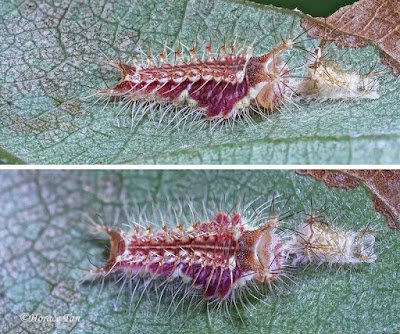 Two views of a newly moulted 5th instar caterpillar, eating its old skin.
 Two views of a 5th instar caterpillar, length: 10mm.
 Two views of a late 5th instar caterpillar, dormant prior to the next moult.
The 6th instar caterpillar resembles the 5th instar caterpillar closely. Two small black markings appear at the base of the prothorax tubercles in this instar. As growth progresses, all whitish markings on the body gradually take on a subtle yellowish hue and the body base colour gradually turns pinkish. The dorso-lateral tubercles turn orangy in the later part of this instar. All these color changes give the caterpillar a very striking appearance. The 6th (and penultimate) instar lasts about 6 days with the body length reaching up to 13.8mm.
 Two views of a newly moulted 6th instar caterpillar, eating its old skin.
 Two views of a 6th instar caterpillar, early in this stage, length: 10.6mm.
 Two views of a 6th instar caterpillar, length: 13.6mm.
 Two views of a late 6th instar caterpillar, dormant prior to the next moult.
The 7th instar caterpillar resembles the 6th instar caterpillar closely. As growth progresses, the body base colour changes from reddish to pinkish, and all dorso-lateral tubercles as well as the fringe of lateral extensions in the 1st-3rd abdominal segments turn bright orange. The intense orange coloration contrasts strongly with the increasing paler body base colour. The 7th (and final) instar lasts about 7-8 days with the body length reaching up to 20mm.
 Two views of a newly moulted 7th instar caterpillar, eating its old skin.
 Two views of a 7th instar caterpillar, early in this stage, length: 14.2mm.
 Two views of a 7th instar caterpillar, length: 14.8mm.
 Two views of a 7th instar caterpillar, late in this stage, length: 20mm.
As it enters the pre-pupatory phase of its life cycle, the caterpillar ceases its feeding activity and its body gradually shrinks in length. For the pupation site, typically the caterpillar picks a spot on the underside of a leaf of the host plant. At the chosen site, it stays dormant for about 0.5 day before spinning a silk girdle and a silk pad to which it attaches itself via claspers at the posterior end.
 Two views of an early pre-pupa of the Lesser Harlequin.
 Two views of a late pre-pupa of the Lesser Harlequin.
About 0.5 day after the pre-pupatory caterpillar secures itself to the pupation spot, pupation takes place. The pupa is held firmly via the silk girdle around the wing pad and the cremastral attachment. The pupa has a flat and broad appearance. It is pale yellowish brown in the thorax but darker yellowish brown in the abdomen. There is a pair of small cephalic horns, and there are lateral tubercles on the prothorax and the abdomen with setae protruding from them. Length of pupa: 13.5-14.5mm.
 Two views of a pupa of the Lesser Harlequin, length: 14.5mm.
 Two views of a mature pupa of a male Lesser Harlequin.
Six days later, the pupa becomes darkened in color signaling the imminent emergence of the adult. The next day (day 7) the adult butterfly emerges from the mature pupa.
 A newly eclosed male Lesser Harlequin resting next to its pupal case.
References:
On the upperside, the male is black to deep blue with no marking, while the female is reddish brown with black spots on both wings and several white apical spots on the forewing. On the underside, both sexes are orange-brown, ornamented by blue-edged black spots and bluish basal striae. The female has larger and more prominent white apical spots on the forewing.


Field Observations:
The Lesser Harlequin is rare in Singapore. It is found in the forested and well-shaded areas of the nature reserves. The adults have a habit of hopping from leaf to leaf in the shade and settles with half-opened wings. Males tend to be more active and fly faster than the females.


Early Stages:
The only local host plant identified for the Lesser Harlequin is a climber in the Connaraceae family and a member of the Connarus genus. However, the id at the species level still requires further verification by plant experts. On this plant, the early stages of the Lesser Harlequin mostly feed on the mature leaves of the host plant.

Eggs are laid singly on the underside of a leaf of the host plant. Each egg is pale yellowish grey when freshly laid. It has a rounded-conical shape with a base diameter of about 0.7-0.75mm.


It takes about 4.5-5 days for the egg to hatch. The young caterpillar consumes just enough of the egg shell to emerge. It is pale orangy brown in coloration, and has a length of about 1.1mm. Long setae (hairs) run along the length of the body dorso-laterally as well as sub-spiracularly. After emergence, the young caterpillar proceeds to devour most of the egg shell, before proceeding to feed on leaf lamina nearby.


From the 1st to the 3rd instar, the caterpillars of the Lesser Harlequin feed by grazing on the leaf surface, on both sides of the leaf. As growth progresses in the 1st instar, dorso-lateral tubercles and lateral flat extensions on all body segments become distinguishable. The dorso-lateral tubercles on the mesothorax and 8th abdominal segment are entirely whitish. Outer fringe of the base of all dorso-lateral tubercles is also whitish. The 1st instar lasts about 3 days with the body length increased to about 2.4mm.


The 2nd instar caterpillar is mostly similar to the late 1st instar caterpillar with a few exceptions. Now the tubercles on the prothorax and the 9th abdominal segment are distinctly longer than the rest, with the one on the prothorax projecting forward, and the one at the rear end projecting backward. The body base color is dark reddish brown. The 2nd instar lasts for about 4 days, with the body length reaching up to 3.4mm.


The 3rd instar caterpillar mostly resembles the 2nd instar caterpillar but with the lateral extensions on the 1st-3rd abdominal segments much wider than the rest. The outer edge of the lateral extensions also turn distinctly whitish. Between the 4th and 5th abdominal segments, the whitish coloration from the body fringe extends upwards to the dorso-lateral tubercles. The body base colour becomes dominantly reddish in this instar. After about 3 days in the 3rd instar, and the body length reaches up to about 5-5.1mm, the caterpillar moults to the next instar.


The 4th instar caterpillar resembles the 3rd instar caterpillar but with some changes. Its body base colour now deepens to a vivid shade of rose red. The head capsule is adorned with two lateral whitish stripes set against the pale reddish brown base colour. A whitish dorsal band and two lateral whitish patches appear on the 6th and 7th abdominal segments. From this (4th) instar onwards, the caterpillar changes its feeding habit to munching on the lamina from the leaf edge. The 4th instar lasts about 5 days with the body length reaching up to 7.6mm.


The 5th instar caterpillar resembles the 4th instar caterpillar in most body features/markings. Multiple obscure whitish lateral striae appear on all body segments, and the whitish band along the body fringe starts to take on a yellowish hue. The 5th instar lasts about 5 days with the body length reaching up to 10mm.


The 6th instar caterpillar resembles the 5th instar caterpillar closely. Two small black markings appear at the base of the prothorax tubercles in this instar. As growth progresses, all whitish markings on the body gradually take on a subtle yellowish hue and the body base colour gradually turns pinkish. The dorso-lateral tubercles turn orangy in the later part of this instar. All these color changes give the caterpillar a very striking appearance. The 6th (and penultimate) instar lasts about 6 days with the body length reaching up to 13.8mm.


The 7th instar caterpillar resembles the 6th instar caterpillar closely. As growth progresses, the body base colour changes from reddish to pinkish, and all dorso-lateral tubercles as well as the fringe of lateral extensions in the 1st-3rd abdominal segments turn bright orange. The intense orange coloration contrasts strongly with the increasing paler body base colour. The 7th (and final) instar lasts about 7-8 days with the body length reaching up to 20mm.


As it enters the pre-pupatory phase of its life cycle, the caterpillar ceases its feeding activity and its body gradually shrinks in length. For the pupation site, typically the caterpillar picks a spot on the underside of a leaf of the host plant. At the chosen site, it stays dormant for about 0.5 day before spinning a silk girdle and a silk pad to which it attaches itself via claspers at the posterior end.


About 0.5 day after the pre-pupatory caterpillar secures itself to the pupation spot, pupation takes place. The pupa is held firmly via the silk girdle around the wing pad and the cremastral attachment. The pupa has a flat and broad appearance. It is pale yellowish brown in the thorax but darker yellowish brown in the abdomen. There is a pair of small cephalic horns, and there are lateral tubercles on the prothorax and the abdomen with setae protruding from them. Length of pupa: 13.5-14.5mm.


Six days later, the pupa becomes darkened in color signaling the imminent emergence of the adult. The next day (day 7) the adult butterfly emerges from the mature pupa.

- [C&P5] The Butterflies of The Malay Peninsula, A.S. Corbet and H.M. Pendlebury, G. and N. van der Poorten (Eds.), 5th Edition, Malayan Nature Society, 2020.
- Butterflies of Thailand, Pisuth Ek-Amnuay, 2nd Edition, 2012.
- A Field Guide to the Butterflies of Singapore, Khew S.K., Ink On Paper Communications, 2nd Edition, 2015.


