06 January 2024

Life History of the Dwarf Crow

Life History of the Dwarf Crow (Euploea tulliolus ledereri)


Butterfly Biodata:
Genus: Euploea Fabricius, 1807
Species: tulliolus Fabricius, 1793
Sub-species: ledereri C. & R. Felder, 1860
Wingspan of Adult Butterfly: 60-70mm
Caterpillar Local Host Plant: Malaisia scandens, (Moraceae, syn: Trophis scandens, common name: Burny Vine).


Upperside view of a female Dwarf Crow.

Physical Description of Adult Butterfly:
The Dwarf Crow is the smallest member of the Euploea genus. On the upperside, the wings are reddish brown and the apical portion of the forewing is deep-blue with a few bluish or whitish discal and submarginal spots. The hindwing is unmarked in the male but the female has submarginal series of small, diffused whitish spots. The male has much rounded wings and deeply curved forewing dorsum. There is no brand in the male's forewing, but there is a raised patch of pale yellow scent scales at the front part of the cell in the hindwing. On the underside, the wings are brown with the usual Euploea white spotting along the wing margins.

Upperside view of a male Dwarf Crow.


Field Observations of Butterfly Behaviour:
Dwarf Crow was earlier assumed to be locally extinct in Singapore, but since its re-discovery in 2002 in the offshore island of Pulau Ubin, it has been regularly observed there. From time to time, the species can be rather abundent at certain localities. In its habitats, the adults have been observed visiting flowers of various weeds and cultivated plants for nectar. The males also have the habit of puddling on wet grounds for minerals.

A group of Dwarf Crow seen during a time of abundance.


Early Stages:


A video clip showing the adult and immature stages of the Dwarf Crow.

Only one local host plant, Malaisia scandens (syn: Trophis scandens, Burny Vine), has been recorded thus far. This vine is rather common in Pulau Ubin, and this is probably the main reason behind the frequent sightings of Dwarf Crow in the offshore island. Caterpillars of the Dwarf Crow mainly feed on young to immature leaves of the vine.

Host plant: Malaisia scandens (Burny Vine).

Eggs of the Dwarf Crow are laid singly on the underside of a leaf (typically young leaf) of the host plant. The creamy yellow eggs are tall (about 1.3mm in height) and somewhat cylindrical (diameter: about 0.85mm) with a rounded top. The egg surface is ribbed.

Far view of an egg of the Dwarf Crow laid on the underside of a young leaf of Burny Vine.

Close-up view of an egg of the Dwarf Crow.

Two views of a fully developed egg of the Dwarf Crow.

The egg takes about 3 days to hatch. The young caterpillar emerges by eating away part of the egg shell. The rest of the egg shell becomes the first meal for the newly hatched, which has a length of about 2.5mm. The newly hatched has a pale yellowish body and black head capsule. A pair of very short and inconspicuous protuberances can be found on the dorsum of each of the 2nd, 3rd thoracic segments and the 8th abdominal segment.

Two views of a newly hatched caterpillar of the Dwarf Crow.

Once the newly hatched moves on to feed on the leaf lamina, its body starts to take on a green undertone. All its legs also turn conspiculously black in colour. In the final half day of the 1st instar, the body takes on a dark yellowish coloration, with the short protuberances turning dark brown at the same time. This first instar lasts for about 1.5 days with the body length doubled up to 5 mm.

Two views of a 1st instar caterpillar of the Dwarf Crow, length: 3.2mm.

Two views of a 1st instar caterpillar of the Dwarf Crow, length: 4.8mm.

Two views of a late 1st instar caterpillar of the Dwarf Crow, dormant prior to its moult, length: 5mm.

The body of the 2nd instar caterpillar has yellowish brown transverse rings interspersed with whitish stripes. A whitish band runs sub-spiracularly across the body segments. Another change is the slight lengthening of the 6 tiny protuberances, each of which is dark brown in colour. There are two small black spots on the dorsum of the prothorax, and one black patch (anal plate) on the posterior end of the body. This instar lasts only 1.5 days with the body length reaching 8.5mm before the moult to the 3rd instar.

Two views of a 2nd instar caterpillar of the Dwarf Crow, length: 8.4mm.

Two views of a late 2nd instar caterpillar of the Dwarf Crow, dormant prior to its moult.

The 3rd instar caterpillar is similar in appearance to the 2nd instar caterpillar with one obvious change being the proportionally longer protuberances, especially the pair present on the 2nd thoracic segment. In some specimens, two faint whitish lateral streaks appear on the black head capsule. This instar takes about 1.5 days to complete with body length reaching up to about 13.5mm.

Two views of a newly moulted 3rd instar caterpillar of the Dwarf Crow.

Two views of a 3rd instar caterpillar of the Dwarf Crow, length: 13.5mm.

Two views of a late 3rd instar caterpillar of the Dwarf Crow, dormant prior to its moult.

Compared to the 3rd instar, the 4th instar caterpillar has proportionally longer protuberances which also have its color changed to reddish brown. The pair of protuberances on the 2nd thoracic segment is the longest among the three pairs present. On the body segments, the transverse white stripes have become more prominent with one stripe being broader on the dorsum of each abdominal segment. More strikingly, all yellowish brown transverse rings turn reddish as growth progresses in this instar. Small yellowish to orangy patches are also featured above the sub-spiracular white band. The black head capsule features two frontal, and oblique  white stripes and an outer peripheral white ring. This instar lasts about 2.5 days with the body length reaching about 24.5mm.

Two views of a newly moulted 4th instar caterpillar of the Dwarf Crow.

Two views of a 4th instar caterpillar of the Dwarf Crow, length: 19.5mm.

Two views of a 4th instar caterpillar of the Dwarf Crow, length: 21mm.

Two views of a late 4th instar caterpillar of the Dwarf Crow, dormant prior to its moult.

The 5th instar caterpillar is largely similar to the 4th instar caterpillar except for having proportionately longer protuberances. Generally, the reddish transverse rings are broader than those in the previous instar, giving the caterpillar a more striking appearance.

Two views of a newly moulted 5th instar caterpillar of the Dwarf Crow.

Two views of a 5th instar caterpillar of the Dwarf Crow, length: 26mm.

Two views of a 5th instar caterpillar of the Dwarf Crow, length: 31mm.

Two views of a late 5th instar caterpillar of the Dwarf Crow, length: 26mm.

The 5th instar lasts about 2.5-3 days, and the body length reaches up to 31-33mm. On the last day, the caterpillar ceases feeding, and its body becomes shortened and decolorised to a shade of pale yellowish brown. For pupation, the caterpillar typically chooses a spot on the mid-rib of a leaf underside. At this pupation site, the caterpillar spins a silk pad from which it then hangs vertically to take on the pre-pupatory pose.

Two views of a late 5th instar caterpillar of the Dwarf Crow, with body in the midst of decolorization.

Three views of a pre-pupatory caterpillar of the Dwarf Crow

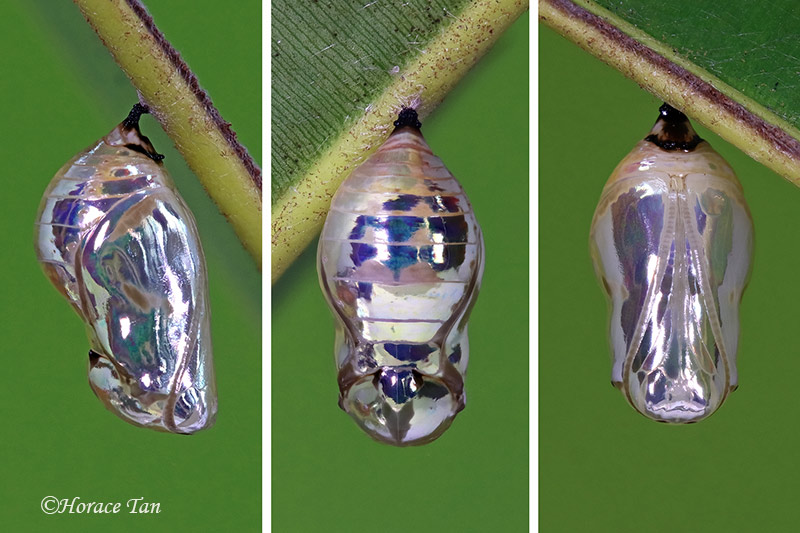
Pupation takes place about 0.5 days after the caterpillar assumes the hanging posture. The pupa has a length of about 18-19mm, and suspends itself from the silk pad with no supporting silk girdle. Initially, the pupa is in a light shade of pale yellowish brown, but the surface gradually takes on a silvery glitter about a day later. The pupa is rather rotund, and has a few tiny black spots  on the dorsum.

Three views of a newly formed pupa of the Dwarf Crow.

Three views of a one-day old pupa of the Dwarf Crow.

Three views of a maturing pupa of the Dwarf Crow.

Three views of a fully developed pupa of the Dwarf Crow with eclosion to occur soon.

After about 6 days of development, the pupal turns black as the development within the pupal case comes to an end. The white spots on the forewing upperside become discernible through the now translucent skin. In the following morning, the adult butterfly emerges from the pupal case, and perches nearby to expand and dry its wings before taking its first flight.

A newly eclosed Dwarf Crow hanging on to its pupal case.

References:
  • [C&P5] The Butterflies of The Malay Peninsula, A.S. Corbet and H.M. Pendlebury, G. and N. van der Poorten (Eds.), 5th Edition, Malayan Nature Society, 2020.
  • Butterflies of Thailand, Pisuth Ek-Amnuay, 2nd Edition, 2012.
  • Seasonal Appearances - Featuring the Dwarf Crow (Euploea tulliolus ledereri), Khew S.K., ButterflyCircle blog, 24 Feb. 2018.
  • A Field Guide to the Butterflies of Singapore, Khew S.K., Ink On Paper Communications, 2nd Edition, 2015.
Text by Horace Tan, Photos by Bob Cheong, David Ho, Khew S K, Loh Mei Yee, Loke PF, Jonathan Soong and Horace Tan.

31 December 2023

Butterfly of the Month - December 2023

Butterfly of the Month - December 2023
The Dark Flat (Tapena thwaitesi bornea)

A female Dark Flat feeds on Bidens alba flower at a forest edge

December 2023 is almost over, and we count down to a new year ahead! Christmas has come and gone, as we reflect on what we have achieved over the past year and make resolutions and set targets for the new year. The month of December belongs to the astrological sign Sagittarius. For those born between 23 November to 21 December, you are a Sagittarian. We featured Capricorn, Aquarius, Pisces, Aries, Taurus, Gemini, Cancer, Leo and Virgo in the preceding Butterfly of the Month blogposts and will now move into the next in the series. The 12 zodiac signs are Aries, Taurus, Gemini, Cancer, Leo, Virgo, Libra, Scorpio, Sagittarius, Capricorn, Aquarius, and Pisces.

A male Dark Flat puddling at a damp footpath

Sagittarius (♐︎) (Greek: Τοξότης, romanized: Toxótēs, Latin for "archer") is the ninth astrological sign, which is associated with the half human and half horse, Centaur of mythology - the learned healer whose higher intelligence forms a bridge between Earth and Heaven. Also known as the Archer, Sagittarius is represented by the symbol of a bow and arrow. As an archer, Sagittarius never fails in hitting the mark and this depiction alludes to the power of prophecy, hence, the claim that seers and prophets are born in this sign.

Underside of a puddling male Dark Flat

The primary strength of Sagittarians is their optimism. Being born with a bold, jovial disposition, Sagittarians usually find it easy to feel happy, enthusiastic, and to see the bright side of life. Being influenced by Jupiter's affirming and confident nature, Sagittarians rarely succumb to self-doubt and are usually able to propel themselves forward in life, believing that everything will work out for the best.


Personal integrity is very important to Sagittarians, and they will have a difficult time accepting a situation which puts them in situations they feel to be false or inauthentic roles, ideas, or laws. Sagittarians are very unlikely to be possessive or materialistic since their lives prioritize being able to change, move, and adapt easily. Though they can be non-committal, they are also rarely jealous, extending the same freedoms to others who would also love to enjoy themselves.


Sagittarians will passionately state their points of view or principles in the moment, yet reserve the right to always change their mind, stating just as passionately their amended views later on. This can be disorienting for others who were sure they knew a Sagittarian's position on a matter, giving them a reputation for being fickle, or at times unreliable. Due to their adventurous spirit, and love of change and travel, Sagittarians are famously non-committal when it comes to plans, as they also reserve the right to change their agendas with their moods.

Female (top) and male (bottom) Dark Flats

The final Butterfly of the Month for 2023 is the moderately rare skipper, The Dark Flat (Tapena thwaitesi bornea). It belongs to the subfamily Pyrginae from the family Hesperiidae, referred collectively as "Flats", where the adult skippers are usually observed with their wings spread opened flat. It was a new discovery for Singapore when first recorded in the 1990's as it was not on the early authors' checklists for Singapore. It is the sole representative of its genus Tapena in the region.


Though moderately rare, it makes its appearance regularly in the forested areas of Singapore, and is widely distributed across the island. It is usually skittish and a fast-flyer but is able to be photographed when perching on the tops of leaves to sunbathe, or puddling on bird droppings and other organic matter on the forest floor.

Underside of a female Dark Flat

The Dark Flat is a dark brown on the upperside with obscure dark blotchy patches on both wings. On the forewing, there are usually two or three small hyaline subapical spots in the male. The female sports a few larger hyaline spots at the cell end on both wings and is usually larger in size. The species has been successfully bred in Singapore on the host plant Dalbergia rostrata (Leguminosae).

Text by Khew SK : Photos by Federick Ho, Khew SK, Henry Koh, Lee YT, Loke PF, Sebastian Ow, Zick Soh, Anthony Wong and Mark Wong

16 December 2023

Life History of the Pale Fourline Blue

Life History of the Pale Fourline Blue (Nacaduba hermus swatipa)


Butterfly Biodata:
Genus: Nacaduba Moore, 1881
Species: hermus C. Felder, 1860
Subspecies: swatipa Corbet, 1938
Wingspan of Adult Butterfly: 27-30mm
Caterpillar Local Host Plant: Barringtionia racemosa (Lecythidaceae, common name: Common Putat, Fish-Killer Tree, Fish-Poison Tree, 水茄笗, 玉蕊).


A female Pale Fourline Blue resting on a flower of Bidens alba (Spanish Needle).

A male Pale Fourline Blue resting on a flower of Tridax procumbens (Coat Buttons).

A female Pale Fourline Blue visiting inflorescence of Leea indica (Bandicoot Berry).

Physical Description of Adult Butterfly:
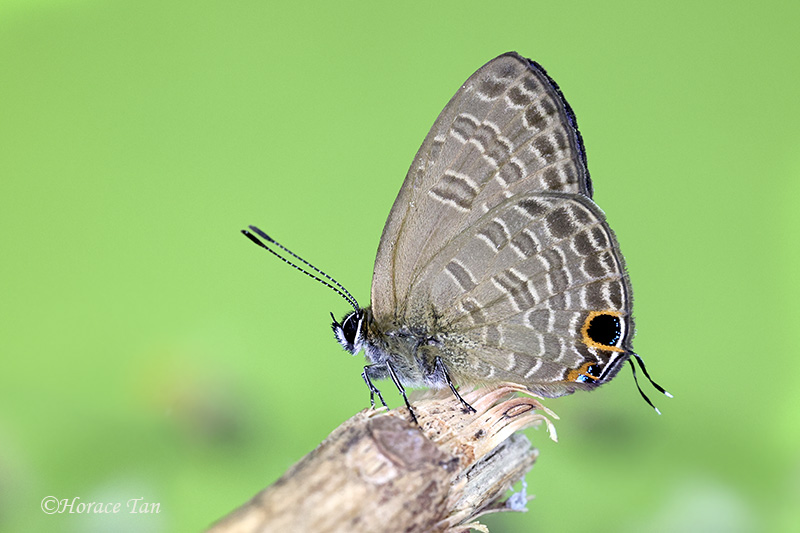
As a member of the pavana group, the adult does not have a basal pair of lines in the underside forewing cell. Above, the male is violet blue (with a slightly frosted appearance) with a thread-thin border; the female is pale shining blue with broad brown borders. Underneath, both sexes are greyish brown with the bands (post-discal, discal) composed of a double series of whitish striae inwardly lined with dark striae. Forewing postdiscal band is usually not dislocated at vein 6. On each hindwing, there is an orange-crowned tornal spot in space 2 lightly speckled with bluish-green metalic scales. Next to the tornal spot, a pair of filamentous white-tipped tails occurs at end of vein 2. Marginal and submarginal spots are dark greyish brown, and submarginal spots are mostly broadly lunulate. In the hindwing, the postdiscal band is usually close to the submarginal band.

A male Pale Fourline Blue resting on a tree trunk in a nature park.

A male Pale Fourline Blue showing its violet blue upperside.

A male Pale Fourline Blue resting on a broken stem.

A male Pale Fourline Blue feedinig on a flower of Tridax procumbens (Coat Buttons).

Field Observations of Butterfly Behaviour:
The Pale Fourline Blue was recorded by early researchers in Singapore, but the species has been rarely sighted in the past two decades. However, in the second half of this year, sightings have increased markedly, thanks to the keen eyes of a few devoted young naturalists. These recent sightings are confined to the central and northern parts of the Singapore island where the local host plant, Barringtonia racemosa, is growing in abundance. The adults have been seen flying in the vicinity of the host plant, visiting flowering plants, puddling on wet grounds and performing oviposition rituals at developing inflorenscences of the host plant.

A male Pale Fourline Blue resting on a tree trunk in a nature park.

A Pale Fourline Blue checking out a flower bud of Barringtonia racemosa.

A female Pale Fourline Blue perching on a leaf surface in a nature park.

Another female Pale Fourline Blue perching on a leaf surface in a nature park.

Early Stages:

The Pale Fourline Blue is polyphagous. In other countries/regions, plants such as Entada rheedii, Embelia subcoriacea and Nephelium lappaceum have been recorded as larval hosts. However, for Singapore, only one local host plant, Barringtonia racemosa, has thus far been recorded. The caterpillars of the Pale Fourline Blue mainly feed on flower buds of Barringtonia racemosa, but at times, also feed on the rachis and pedicel of the inflorescence. As in the case for most lycaenidae species, the caterpillars of the Pale Fourline Blue are tended by a number of ant species.

Local host plant: Barringtonia racemosa. Left: leaves in clusters. Right: an inflorescence bearing flower buds.

A mother Pale Fourline BLue ovipositing on a flower bud of Barringtonia racemosa.

A mother Pale Fourline BLue ovipositing on a young flower bud of Barringtonia racemosa.

Eggs are laid singly on a flower bud or the rachis of an inflorescence of Barringtonia racemosa. It is not uncommon for a number of eggs to be found in the same inflorescence. Each egg is whitish with a green undertone. It has a thick discoid shape, and features a depressed micropylar on top. The egg surface is finely reticulated, slightly raised at the intersections of criss-crossing ridges. Th egg has a diameter of about 0.5mm.

Eggs on flower buds of Barringtonia racemosa.

Two views of an egg of the Pale Fourline Blue.

It takes about 3 days for the egg to hatch. The young caterpillar consumes part of the egg shell to emerge. With a length of about 0.9mm, it has a pale yellowish body with long setae (hairs) dorsally and sub-spiracularly. The head is black in colour in this instar. The body color changes gradually to a brighter shade of yellow as growth progresses. The first instar lasts for 2-3 days and the body length reaches about 1.8mm before the moult to the 2nd instar.

Two views of a newly hatched caterpillar having its few meal on a flower bud

Two views of a 1st instar caterpillar, length: 1.1mm.

An early 1st instar caterpillar exploring a flower bud. Inset: a close-up view.

Two views of a 1st instar caterpillar, late in this stage, length: 1.8mm.

In the second instar, dorsal setae are much shortened proportionately compared to those in the first instar. Moreover, there are numerous short setae present all over the body surface. The body color is mainly yellow with a hint of reddish brown in the anterior and posterior segments. In some individuals, the pale reddish brown coloration is more extensive. The 2nd instar lasts for 2-3 days and the caterpillar grows to a length of about 3.3mm to 3.5mm.

Two views of a 2nd instar caterpillar, freshly moulted to this instar.

Two views of a 2nd instar caterpillar, early in this instar, length: 1.9mm.

Two views of a 2nd instar caterpillar, length: 3.4mm.

A 2nd instar caterpillar observed in the field feeding on a flower bud.

A 2nd instar caterpillar observed in the field with an ant attending to it.

Two views of a 2nd instar caterpillar, dormant prior to its moult.

As in the 2nd instar, the 3rd instar caterpillar is yellowish with varying extent of pale reddish brown coloration on body segments. In most individuals, the pale reddish hue is present in the thoracic segments and the last 4-5 abdominal segments, as well as in the dorsum of first 4-5 abdominal segments. The prothoracc shield is whitish in color. The dorsal nectary organ and tentacular organs are also easily discernible. After 3 to 4 days in this instar with the body length reaching about 6.8-7mm, the next moult brings the caterpillar to its final instar.

Two views of a newly moulted 3rd instar caterpillar, feeding on its exuvia.

Two views of a 3rd instar caterpillar, length: 3.5mm.

Two views of a 3rd instar caterpillar, length: 5.9mm.

Two views of a 3rd instar caterpillar, dormant prior to its moult.

A 3rd instar caterpillar with an attending ant in the field.

The 4th instar caterpillar are similar to the 3rd instar caterpillar but with all red and reddish brown patches much more prominently marked and in strong contrast to the ground color. Some individuals can even be entirely reddish brown to pinky red in all body segments. As in the 3rd instar, the prothorcic shield is whitish and the dorsal nectary organ and tentacular organs are prominent on the posterior segments. Tentacular organs are readily everted when the caterpillar senses a threat (such as from a competing caterpillar) or when attending ants are present.

Two views of a newly moulted 4th instar caterpillar, with exuvia yet to be eaten.

Two views of a 4th instar caterpillar, length: 7.8mm.

A 4th instar caterpillar attended by several ants in a nature park.

Two views of a 4th instar caterpillar, length: 12mm.

Two views of a red-form 4th instar caterpillar, length: 13mm.

A 4th instar caterpillar attended by a large ant.

The 4th instar lasts for 3-4 days and the body grows up to a length of about 13-13.5mm. On the last day of this stage, the caterpillar ceases food intake and its body shrinks in length and decolorises to a dull shade of yellowish to pinky brown. The fully grown caterpillar finally comes to rest on a spot among leaves where it readies the site for pupation by spinning a silk pad and a silk girdle to secure itself.

Two views of a 4th instar caterpillar, late in this stage, with color change taken place.

Two views of a girdled-down pre-pupa of the Pale Fourline Blue.

About 0.75 day later, pupation takes place. The pupa has the typical lycaenid form, and is 9.6-10.2mm in length. It is mostly yellowish brown and speckled with black spots of various sizes and shapes.

Two views of a pupa of the Pale Fourline Blue

Four to five days later, the pupa becomes darkened in color signaling the imminent emergence of the adult. The markings on the forewing upperside becomes increasing obvious through the pupal skin. The next day the adult butterfly emerges from the mature pupa.

Two views of a mature male pupa showing the extensive purplish blue coloration in the wing pad.

Two views of a mature female pupa showing the much less extensive bluish coloration in the wing pad.

A newly eclosed male Pale Fourline Blue.

A newly eclosed female Pale Fourline Blue.

References:
  • [C&P5] The Butterflies of The Malay Peninsula, A.S. Corbet and H.M. Pendlebury, G. and N. van der Poorten (Eds.), 5th Edition, Malayan Nature Society, 2020.
  • Butterflies of Thailand, Pisuth Ek-Amnuay, 2nd Edition, 2012.
  • Kawthankar N, Nitin R, Balakrishnan VC, Churi PV, Kalesh S, Satya Prakash & Kunte K (2023) Larval host plants and other hosts of Indian butterflies. In Kunte K, Sondhi S & Roy P (eds.). Butterflies of India, v. 4.12. Indian Foundation for Butterflies. https://www.ifoundbutterflies.org/larval-hosts.
Text by Horace Tan, Photos by Sebastian Ow, Zick Soh, Low JK, Khew SK  and Horace Tan.