
Butterfly Biodata:
Genus: Fryeria Courvoisier, 1920
Species: putli Kollar, 1844
Wingspan of Adult Butterfly: 12-16mm
Caterpillar Local Host Plant: Indigofera spicata (Fabaceae, common name: Creeping Indigo).
 A Jewelled Grass Blue resting on an inflorescene of the Creeping Indigo.
 A Jewelled Grass Blue resting on an inflorescene of the Creeping Indigo.
 A Jewelled Grass Blue resting on a leaflet of the Creeping Indigo.
Physical Description of Adult Butterfly:
With a wing span of only 12-16mm, the Jewelled Grass Blue is a small and tailess butterfly, easily overlooked by casual observers. On the upperside, both sexes are dark brown with a row of black marginal spots in the hindwing. On the underside, both wings are gray to pale brown in ground colour, and feature brown cell-end bars. On the forewing, there is a post-discal series of white-bordered spots and a submarginal series of white-bordered spots. Each hindwing has a row of prominently orange-crowned marginal spots speckled with shining metallic scales. There is also a series of white-bordered post-discal spots, a white-bordered black costal spot, four transverse black subbasal spots and one small black basal spot in space 1.
 A sunbathing Jewelled Grass Blue showing its brown upperside.
 A Jewelled Grass Blue resting on an inflorescene of the Creeping Indigo.
 A Jewelled Grass Blue feeding on a flower of the White Heads.
Field Observations:
The Jewelled Grass Blue was recently recorded in early September this year by local naturalist Fiora Li. Although the species is extant across a wide region ranging from India, Hong Kong, Taiwan and even to Australia, it has never been observed previously in Singapore. A small population was observed to be flying and breeding in an open grassy field where the host plant, the Creeping Indigo (Indigofera spicata), is growing in abundance. The adult butterflies typically fly at a low height above ground, feeding on flowers of the host plant as well as those of other weeds such as the White Heads (Eclipta prostrata) and Coat Buttons (Tridax procumbens). The male has also been observed to puddle on wet grounds in the same field.
 A Jewelled Grass Blue puddling on a mud trail.
 A Jewelled Grass Blue feeding on a tiny flower.
 A Jewelled Grass Blue feeding on a flower of the Coat Buttons.
Early Stages:
A video clip showing the adult and immature stages of Jewelled Grass Blue.
Thus far, only one plant, Indigofera spicata (Creeping Indigo), has been recorded as the local host plant for the Jewelled Grass Blue. In other countries/regions, the larval host plants also include other Indigofera species, and a number of species in other plant families. The caterpillars of the Jewelled Grass Blue feed on flowers and leaves of the Creeping Indigo, with a strong preference for the former.
 Local host plant: Indigofera spicata (Creeping Indigo).
 A mating pair of Jewelled Grass Blue.
 A mother Jewelled Grass Blue attempting to oviposit on an inflorescence of the Creeping Indigo.
 A mother Jewelled Grass Blue ovipositing on an inflorescence of the Creeping Indigo.
 A mother Jewelled Grass Blue resting on an inflorescence of the Creeping Indigo where an egg has earlier been oviposited.
The mother butterfly lays her eggs singly on the host plant, either among young floral buds on a developing inflorescence or on the surface of a young leaflet. Each greenish egg is about 0.5mm in diameter. It is discoid-shaped with a depressed micropylar at the center of the upper surface. The egg surface is reticulated with a fine pattern of whitish ridges and indentations.
 Two views of an egg of the Jewelled Grass Blue laid on leaf surface.
 Two views of an egg of the Jewelled Grass Blue laid among floral buds. Left: a few hours after oviposition. Right: a few hours before hatching.
It takes about 2 to 2.5 days for the egg to hatch. The newly hatched has a pale yellowish body with a length of about 0.7-0.8mm. The body also features long setae dorso-laterally and along body fringe. Its head capsule is black in color, and will remain so for all four instars. Depending on the oviposition site, the young caterpillar either feeds on the floral buds or the leaf lamina of leaflets near the empty egg shell. After about 1.5-2 days of growth in the first instar, and reaching a length of about 1.6mm, the caterpillar moults to the next instar.
 A newly hatched caterpillar of the Jewelled Grass Blue after it emerges from the egg shell.
 Two views of a 1st instar caterpillar feeding on a floral bud, length: 1.2mm.
 Two views of a late 1st instar caterpillar, dormant prior to its moult.
In the 2nd instar, besides the long setae which occur dorso-laterally and along body fringe, there are short and fine setae covering the body surface, and tiny black spots scattered across the body surface. The caterpillar is yellowish or greenish. Whitish and narrow intermittent bands occur dorsally, dorso-laterally and sub-spiracularly. The 2nd instar caterpillar reaches a length of about 2.5-2.6mm, and after about 1.5-2 days in this stage, it moults again.
 Two views of a newly moulted 2nd instar caterpillar, lying next to its exuvia.
 Two views of a 2nd instar caterpillar feeding on a floral bud, length: 1.7mm.
 Two views of a 2nd instar caterpillar feeding on a leaflet, length: 2.4mm.
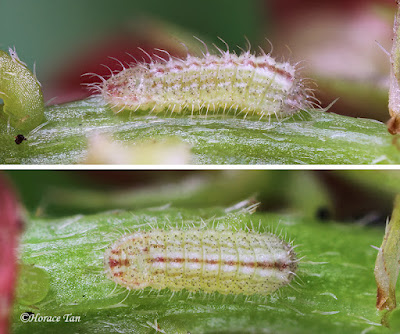 Two views of a late 2nd instar caterpillar, dormant prior to its moult, length: 2.2mm.
Compared to the 2nd instar caterpillar, the 3rd instar caterpillar bears a denser coat of proportionately shorter setae on its body. The body could be pale yellowish green entirely or featuring reddish shading dorsally and along body fringe. The dorsal nectary organ and the pair of tentacular organs, on the 7th and 8th abdominal segments, are now readily observed. The 3rd instar takes about 1.5 to 2 days to complete with the body length reaching about 5-5.3mm.
 Two views of a newly moulted 3rd instar caterpillar, exiting from its old larval skin.
 Two views of a 3rd instar caterpillar with reddish markings, length: 3mm.
 Two views of a 3rd instar caterpillar, length: 4.5mm.
 Two views of a late 3rd instar caterpillar with reddish markings, dormant prior to its moult, length: 4.5mm.
 Two views of another late 3rd instar caterpillar, dormant prior to its moult, length: 5mm.
While having similar body markings as in the 3rd instar, the 4th instar caterpillar has a more distinctive appearance, featuring a dense coat of short whitish setae all over the body surface. The body coloration could be entirely greenish or pale yellowish green with reddish dorsal and sub-spiracular bands.
 Two views of a 4th instar caterpillar with reddish markings feeding on floral buds, early in this stage, length: 5.5mm.
 A 4th instar caterpillar of the Jewelled Grass Blue feeding on a leaflet.
 Two views of a 4th instar caterpillar of the Jewelled Grass Blue with reddish markings feeding on floral buds, late in this stage, length: 9.8mm.
 Two views of a 4th instar caterpillar of the Jewelled Grass Blue with reddish markings, late in this stage, length: 9.5mm.
After about 2-2.5 days of feeding and reaching a length of about 9.5-10mm, the caterpillar stops feeding and seeks out a pupation site. During this time, its body gradually shortened and markings decolorised to pale greenish. Typically the caterpillar chooses a leaflet of the host plant, on either side for its pupation site. The pre-pupatory caterpillar prepares for pupation by spinning a silk girdle and a silk pad to which it attaches itself via anal claspers.
 Two views of a pre-pupa of the Jewelled Grass Blue on the uperside of a leaflet.
After about 0.75-1 day as a pre-pupa, pupation takes place. The fresh pupa is predominantly yellowish green to green. It has a typical shape of a lycaenid pupa. With the exception of the wing pads, there are long whitish fine setae on the entire pupal body. Pupal length: 6.8-7.2mm.
 Two views of a pupa of the Jewelled Grass Blue.
Four days later, the pupa starts to turn black, first in the wing pad and thorax, then progressively in the abdomen. The next day, the pupal stage comes to an end (pupal period: 5 days) with the emergence of the adult butterfly.
 Two views of a mature pupa of the Jewelled Grass Blue on the underside of a leaflet of the host plant.
 A newly eclosed Jewelled Grass Blue.
References:
Genus: Fryeria Courvoisier, 1920
Species: putli Kollar, 1844
Wingspan of Adult Butterfly: 12-16mm
Caterpillar Local Host Plant: Indigofera spicata (Fabaceae, common name: Creeping Indigo).


Physical Description of Adult Butterfly:
With a wing span of only 12-16mm, the Jewelled Grass Blue is a small and tailess butterfly, easily overlooked by casual observers. On the upperside, both sexes are dark brown with a row of black marginal spots in the hindwing. On the underside, both wings are gray to pale brown in ground colour, and feature brown cell-end bars. On the forewing, there is a post-discal series of white-bordered spots and a submarginal series of white-bordered spots. Each hindwing has a row of prominently orange-crowned marginal spots speckled with shining metallic scales. There is also a series of white-bordered post-discal spots, a white-bordered black costal spot, four transverse black subbasal spots and one small black basal spot in space 1.


Field Observations:
The Jewelled Grass Blue was recently recorded in early September this year by local naturalist Fiora Li. Although the species is extant across a wide region ranging from India, Hong Kong, Taiwan and even to Australia, it has never been observed previously in Singapore. A small population was observed to be flying and breeding in an open grassy field where the host plant, the Creeping Indigo (Indigofera spicata), is growing in abundance. The adult butterflies typically fly at a low height above ground, feeding on flowers of the host plant as well as those of other weeds such as the White Heads (Eclipta prostrata) and Coat Buttons (Tridax procumbens). The male has also been observed to puddle on wet grounds in the same field.


Early Stages:
A video clip showing the adult and immature stages of Jewelled Grass Blue.
Thus far, only one plant, Indigofera spicata (Creeping Indigo), has been recorded as the local host plant for the Jewelled Grass Blue. In other countries/regions, the larval host plants also include other Indigofera species, and a number of species in other plant families. The caterpillars of the Jewelled Grass Blue feed on flowers and leaves of the Creeping Indigo, with a strong preference for the former.


The mother butterfly lays her eggs singly on the host plant, either among young floral buds on a developing inflorescence or on the surface of a young leaflet. Each greenish egg is about 0.5mm in diameter. It is discoid-shaped with a depressed micropylar at the center of the upper surface. The egg surface is reticulated with a fine pattern of whitish ridges and indentations.


It takes about 2 to 2.5 days for the egg to hatch. The newly hatched has a pale yellowish body with a length of about 0.7-0.8mm. The body also features long setae dorso-laterally and along body fringe. Its head capsule is black in color, and will remain so for all four instars. Depending on the oviposition site, the young caterpillar either feeds on the floral buds or the leaf lamina of leaflets near the empty egg shell. After about 1.5-2 days of growth in the first instar, and reaching a length of about 1.6mm, the caterpillar moults to the next instar.


In the 2nd instar, besides the long setae which occur dorso-laterally and along body fringe, there are short and fine setae covering the body surface, and tiny black spots scattered across the body surface. The caterpillar is yellowish or greenish. Whitish and narrow intermittent bands occur dorsally, dorso-laterally and sub-spiracularly. The 2nd instar caterpillar reaches a length of about 2.5-2.6mm, and after about 1.5-2 days in this stage, it moults again.


Compared to the 2nd instar caterpillar, the 3rd instar caterpillar bears a denser coat of proportionately shorter setae on its body. The body could be pale yellowish green entirely or featuring reddish shading dorsally and along body fringe. The dorsal nectary organ and the pair of tentacular organs, on the 7th and 8th abdominal segments, are now readily observed. The 3rd instar takes about 1.5 to 2 days to complete with the body length reaching about 5-5.3mm.


While having similar body markings as in the 3rd instar, the 4th instar caterpillar has a more distinctive appearance, featuring a dense coat of short whitish setae all over the body surface. The body coloration could be entirely greenish or pale yellowish green with reddish dorsal and sub-spiracular bands.


After about 2-2.5 days of feeding and reaching a length of about 9.5-10mm, the caterpillar stops feeding and seeks out a pupation site. During this time, its body gradually shortened and markings decolorised to pale greenish. Typically the caterpillar chooses a leaflet of the host plant, on either side for its pupation site. The pre-pupatory caterpillar prepares for pupation by spinning a silk girdle and a silk pad to which it attaches itself via anal claspers.

After about 0.75-1 day as a pre-pupa, pupation takes place. The fresh pupa is predominantly yellowish green to green. It has a typical shape of a lycaenid pupa. With the exception of the wing pads, there are long whitish fine setae on the entire pupal body. Pupal length: 6.8-7.2mm.

Four days later, the pupa starts to turn black, first in the wing pad and thorax, then progressively in the abdomen. The next day, the pupal stage comes to an end (pupal period: 5 days) with the emergence of the adult butterfly.


References:
- Butterflies of Thailand, Pisuth Ek-Amnuay, 2nd Edition, 2012.
- A Photographic Monograph on Hong Kong Butterflies, Volume 3, p.388, Hong Kong Lepidopterists' Society.
- Li FY (2023) Biodiversity Record: New record of the butterfly, Freyeria putli, in Singapore. Nature in Singapore, 16: e2023102. DOI: 10.26107/NIS-2023-0102.
- Kawthankar N, Nitin R, Balakrishnan VC, Churi PV, Kalesh S, Satya Prakash & Kunte K (2023) Larval host plants and other hosts of Indian butterflies. In Kunte K, Sondhi S & Roy P (eds.). Butterflies of India, v. 4.12. Indian Foundation for Butterflies. https://www.ifoundbutterflies.org/larval-hosts.


