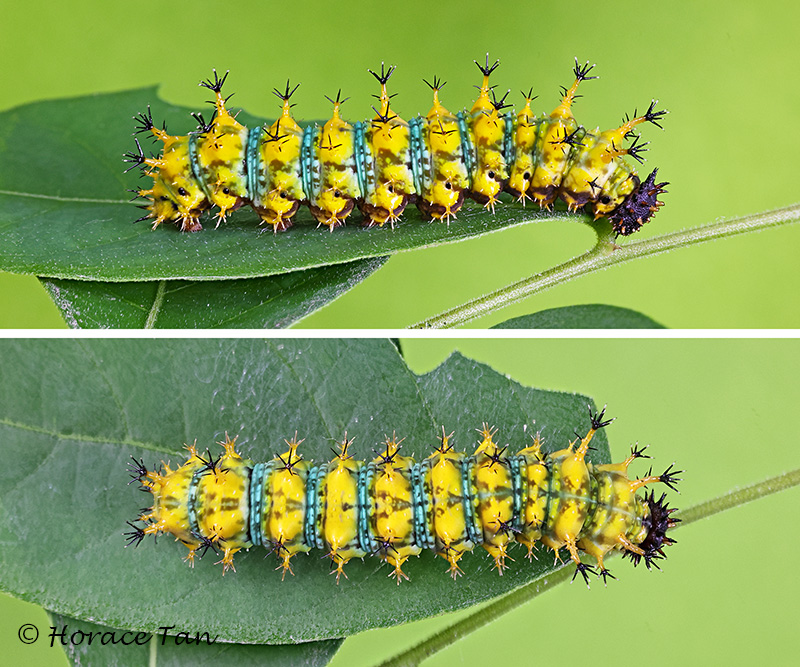
22 July 2023

Life History of the Chocolate Albatross

Life History of the Chocolate Albatross (Appias lyncida vasava)


Butterfly Biodata:
Genus: Appias Hübner, 1819
Species: lyncida Cramer, 1777
Subspecies: vasava Fruhstorfer, 1910

Wingspan of Adult Butterfly: 45-55mm
Caterpillar Local Host Plants: Crateva religiosa (Capparaceae, common name: Sacred Garlic Pear), Crateva magna (Capparaceae, common name: Large Garlic Pear).

A female Chocolate Albatross.

A male Chocolate Albatross.

A female Chocolate Albatross.


Physical Description of Adult Butterfly:
On the upperside, the male is mostly white with a dentate dark brown border on both forewing and hindwing; the female is dark brown with several whitish distal streaks in both the forewing and hindwing. On the underside, the male is lemon-yellow with broad dark brown border in the hindwing and dark brown with white distal streaks and yellow apical spots in the forewing; the female is white yellow-dusted with a broad brown border in the hindwing and brown with white distal streaks in the forewing.

Upperside of a male Chocolate Albatross.

A male Chocolate Albatross.

Upperside of a female Chocolate Albatross.

A female Chocolate Albatross.

Field Observations of Butterfly Behaviour:
The Chocolate Albatross is considered a seasonal migrant in Singapore. The adult butterflies are usually sighted more frequently during certain times of the year flying in both nature reserves and urban parks across Singapore. Typically in each sighting only one single individual is observed. It is believed that they fly from southern Malaysia where they occur in abundance during the April to June period. The scarcity of their host plants (in Capparaceae) in Singapore likely contribute to the absence of a sustainable adult population.

A puddling male Chocolate Albatross.

A group of puddling male Chocolate Albatross sighted in Malaysia.

A puddling male Chocolate Albatross.

A female Chocolate Albatross.

Early Stages:

Early stages of the Chocolate Albatross undergo rapid growth in all five instars. The entire life cycle, from oviposition to the eclosion of the adult lasts only 15-16 days.


A video clip depicting the life cycle of the Chocolate Albatross.

The recorded local host plants for the Chocolate Albatross are Crateva religiosa and Crateva magna. Caterpillars of the Chocolate Albatross feed on young leaves of both host plants, and they have the habit of feeding together on the same leaf in all five instars of the larval stage.

Local host plant: Crateva religiosa, showing flowers and mature leaves.

Young leaves of Crateva religiosa .

A male Chocolate Albatross (left) doing a courtship flight near a female (right).

A tattered female Chocolate Albatross attempting to oviposit on a leaf surface.

The eggs of the Chocolate Albatross are laid in a small cluster on a leaf of the host plant. The egg is spindle-shaped and standing on one end with a height of about 1mm, about 2.5 times as tall as it is wide. It has vertical ridges and numerous transverse striations. The vertical ridges end in short projections encircling the micropylar. The color of the egg is initially white but changes to orange overnight.

A close-up view of a group of eggs of the Chocolate Albatross.

Maturing eggs of the Chocolate Albatross. Note the color change.

The egg takes about 2 days to hatch. The newly hatched has a length of about 1.3mm and a yellowish beige head capsule. Its cylindrically-shaped body is in a similar shade of yellow beige and featuring sub-dorsal, dorso-lateral and lateral rows of small tubercles running lengthwise. Each tubercle has a moderately long setae emerging from the middle of it. The end of each setae bears a tiny droplet. The translucent body also features some reddish patches.

A group of three newly hatched caterpillars of the Chocolate Albatross.

After emergence, the newly hatched only eats a small portion of the egg shell for its first meal, and soon moves on to eat the leaf lamina in the vicinity. Its body takes on a green undertone with the intake of leaf diet. In about 1.5 days, the caterpillar grows to a length of about 3.3mm before the moult to the 2nd instar.

Two views of a 1st instar caterpillar, length: 2.1mm.

A group of four 1st instar caterpillars of the Chocolate Albatross.

Two views of a late 1st instar caterpillar, dormant prior to its moult, length: 3mm.

The 2nd instar caterpillar is yellowish green in body color with similar droplet-bearing setae as in the 1st instar. In addition, there are numerous small, black, conical tubercles dotting the body surface. Each of tubercles has a short setae emerging from it. The head is pale yellowish green in color. This instar lasts about 1.5 days with the body length reaching about 6.2mm.

Two views of a newly moulted 2nd instar caterpillar, length: 3mm.

Two views of a 2nd instar caterpillar, length: 5mm.

A group of three 2nd instar caterpillars, in both early and late stage of the instar.

Two views of a late 2nd instar caterpillar, dormant prior to its moult, length: 6.1mm.

The 3rd instar caterpillar resembles the 2nd instar caterpillar closely except for the appearance of a whitish sub-spiracular band. The body surface has numerous tiny setae, and in some specimens, the base of these setae are darker green than the body base colour of yellowish green, giving the caterpillar a dotted appearance. This instar takes about 1 to 1.5 days to complete with body length reaching about 10mm.

Two views of an early 3rd instar caterpillar, length: 6mm.

Two views of a 3rd instar caterpillar, length: 9mm.

Two 3rd instar caterpillars of the Chocolate Albatross.

Two views of a late 3rd instar caterpillar, dormant prior to its moult, length: 10mm.

Again, the 4th instar retains all the features as the 3rd instar. Both the whitish sub-spiracular band and the dotted appearance of the body surface are now more prominent. This penultimate instar lasts about 1.5 days with body length reaching up to 16.5mm.

Two views of a newly moulted 4th instar caterpillar of the Chocolate Albatross, length: 10mm.

Two views of a 4th instar caterpillar, length: 15.8mm.

A group of two 4th instar caterpillars and one 3rd instar caterpillar of the Chocolate Albatross.

Two views of a late 4th instar caterpillar, dormant prior to its moult, length: 15.5mm.

The 5th and final instar caterpillar mostly resembles the 4th instar caterpillar. The tiny black tubercles regularly dotting the yellowish green body surface gives it a distinctive speckled appearance. In addition, the head capsule also takes on a black-dotted appearance. Towards the end of the instar, a thin yellowish dorsal band appears on the body. When disturbed, the caterpillar usually reacts by standing tall on its prolegs and arching its anterior segments. This final instar lasts for 2-2.5 days, and the body length reaches up to 34mm.

Two views of a newly moulted 5th instar caterpillar, with exuvia and "old" head capsule in the vicinity.

Two views of an early 5th instar caterpillar, length: 21.8mm. Note the black speckled appearance on the body and head.

Two views of a 5th instar caterpillar, length: 33mm.

Two views of a 5th instar caterpillars taking up its on-guard stance.

On the last day of the 5th instar, the caterpillar ceases feeding and its body gradually shortens. It wanders around and comes to rest on the surface of a leaf, usually on the underside. Here the caterpillar spins a silk pad and a silk girdle to secure itself and then becomes immobile in a head-up pre-pupatory pose.

An early pre-pupatory larva of the Chocolate Albatross.

A late pre-pupatory larva of the Chocolate Albatross.

Pupation takes place about 0.75 day later. The greenish, lightly black-speckled pupa secures itself with the silk girdle spun in the pre-pupal stage, but with cremaster replacing claspers in attaching the posterior end to the silk pad on the leaf surface. It sports a yellowish, thoracic dorsal ridge which is sharply raised at thoracic segment 2. This ridge ends in a pointed yellow cephalic horn at the anterior. This horn has a narrow dorsal black ridge. The abdominal segments 2-4 are produced laterally into a pointed tooth at each side of the abdominal segment 2. Two lateral yellowish ridge lines run lengthwise along the entire length of the abdomen. In addition, two small translucent arm-like appendages adorn the side of the prothorax. Length of pupae: 23-24mm.

Two views of a pupa of the Chocolate Albatross.

A close-up view of the anterior of a pupa of the Chocolate Albatross, showing the cephalic horn and arm-like appendages.

After about 4.75 to 5 days of development, the pupal skin turns translucent as the development within the pupal case comes to an end. The markings on the forewing upperside become discernible and indicative of the gender of the soon-to-emerge adult. The following day, the adult butterfly emerges from the pupal case.

Three progressive views of the maturing pupa of a male Chocolate Albatross.

Three progressive views of the maturing pupa of a female Chocolate Albatross.

A newly eclosed male Chocolate Albatross resting near its pupal case.

A newly eclosed female Chocolate Albatross resting near its pupal case.

References:
  • [C&P5] The Butterflies of The Malay Peninsula, A.S. Corbet and H.M. Pendlebury, G. and N. van der Poorten (Eds.), 5th Edition, Malayan Nature Society, 2020.
  • Butterflies of Thailand, Pisuth Ek-Amnuay, 2nd Edition, 2012.
  • A Field Guide to the Butterflies of Singapore, Khew S.K., Ink On Paper Communications, 2nd Edition, 2015.
Text by Horace Tan, Photos by Benjamin Yam, Ben Jin Tan, Chng CK, Khew SK and Horace Tan

08 July 2023

Life History of the Common Sergeant

Life History of the Common Sergeant (Athyma perius perius)


Butterfly Biodata:
Genus: Athyma Westwood, 1850
Species: perius Linnaeus, 1758
Subspecies: perius Linnaeus, 1758
Wingspan of Adult Butterfly: 45-55mm
Caterpillar Local Host Plant: Glochidion obscurum (Phyllanthaceae).


Physical Description of Adult Butterfly:
Forewing cell is wholly open. On the black-and-white forewing upperside, the white cell streak is divided into four portions, with the distal portion being arrowhead-shaped. There are widely separated white post-discal spots in spaces 1b, 2 to 6. The cell streaks of the left and right forewings are connected via a dorsal band on the thorax. On the hindwing upperside, white sub-discal band and post-discal band run from the costa to the dorsum. Small black spots are embedded at the basal end of the post-discal spots. On the underside, the spots and streaks are arranged as on the upperside but with the ground colour rich ochreous. As in the upperside, the white post-discal band on the hindwing has a series of small black spots.


Field Observations of Butterfly Behaviour:
The Common Sergeant was re-discovered in Singapore in 2022 at the northern edge of the central catchment reserve. Since then the fast-flying adults have been sighted at forest fringes, and along forest trails where the host plant is growing. Adults have been observed to visit flowers and ripened fruits for sugary contents. The male has also been sighted puddling on forest trails.


Early Stages:
Thus far only one plant, Glochidion obscurum, has been locally recorded as the larval host for the Common Sergeant in Singapore. It is likely that other local Glochidion spp. can act as larval host plants.

Local host plant: Glochidion obscurum.

The caterpillars of the Common Sergeant adopt the same feeding and frass management routines as described for other Athyma species in earlier blog articles. The caterpillars feed on mature leaves of the host plant in all five instars of its larval stage. On each leaf, they feed systematically from the leaf tip towards the petiole, leaving the midrib intact. From the 1st to the 4th instar, they build an extension of the exposed midrib using frass pellets held together by silk. Frass pellets are also sewn together beneath the midrib at the base of the extension. The caterpillars rest on either the frass extension or the exposed midrib just beyond the bundle of frass pellets. In the 5th (and final) instar, the caterpillars abandon these habits, and switches to resting on the leaf upperside and feeding along the leaf margin.

Eggs laid on the leaf underside of multiple leaves on a branch of Glochidion obscurum. How many eggs can you spot in the picture?

The eggs of the Common Sergeant are laid on the underside of a leaf of the host plant. Each dome-shaped egg is yellow in colour, with its surface marked with polygonal ridges which are tipped with fine, translucent spines at intersections of these ridges. Basal diameter is approximately 1.1mm.

Two views of an egg of the Common Sergeant.

The egg takes about 3 days to hatch. The young caterpillar nibbles away a portion of the egg shell to exit and then proceeds to devour the rest of the egg shell. It has a cylindrical body in pale, dull brown, and an initial body length of about 2.5mm. The body is covered with fine setae, and rows of dorso-lateral, lateral and sub-spiracular tubercles. Dorso-lateral tubercles occur on the 2nd and 3rd thoracic segments, and on the 2nd, 4th, 6th to 8th abdominal segments, are more prominent with darker brown coloration. The head is brown to dark brown in colour.

Two views of a fully developed egg of the Common Sergeant.

Two views of a newly hatched caterpillar of the Common Sergeant.

Two views of a first instar caterpillar of the Common Sergeant, length: 2.5mm.

Soon after its emergence, it feeds on the leaf lamina around the midrib, and builds an extension of the exposed midrib using frass pellets sewn together with silk. The first instar lasts about 2 days with the body length increases to about 4.8mm.

Two views of an early 1st instar caterpillar, resting on the frass extension, length: 3.2mm.

Two views of a late 1st instar caterpillar, length: 4.8mm.

Two views of a late 1st instar caterpillar, dormant prior to its moult, length: 4.8mm.

In the 2nd instar, the caterpillar has an overall dark brown appearance. The dorso-lateral, lateral and sub-spiracular tubercles are now transformed to short spines with small terminal branches. Pale beige dorsal patches occur on the 3rd and 5th abdominal segments. The dark brown head sports short pale brown tubercles and peripheral spines. The 2nd instar lasts about 2 days with the body length reaches about 7.5mm.

Two views of a 2nd instar caterpillar, newly moulted, length: 4.9mm.

Two views of a 2nd instar caterpillar, length: 7.5mm.

Two views of a late 2nd instar caterpillar, dormant prior to its moult, length: 7.2mm.

The 3rd instar caterpillar mostly resembles the the second instar caterpillar, but with the body and head spines longer and more prominent. The body and the head are now much darker, and pale brown dorsal patches more distinct. This instar takes about 2 days to complete with body length reaching about 10.5mm.

Two views of a 3nd instar caterpillar, early in this stage, length: 8mm. Inset: head.

Two views of a 3nd instar caterpillar, length: 9mm.

Two views of a late 3nd instar caterpillar, dormant prior to its moult, length: 10mm.

The 4th instar caterpillar has distinctly longer dorso-lateral branched spines. Peripheral head spines are also longer than those in the previous instar. The 4th instar lasts about 2 days with body length reaching about 16-16.5mm.

Two views of a 4th instar caterpillar, early in this stage, length: 9.5mm. Inset: head.

Two views of a 4th instar caterpillar, length: 16mm.

Two views of a late 4th instar caterpillar, length: 16mm.

The next moult brings the caterpillar to its 5th and final instar. Now the dorso-lateral spines are elongated and branched distally. Peripheral spines on the head becomes much more pointed. The body colour is initially yellowish brown, but turning green after about a day. At the same time, the dorso-lateral and lateral processes turn reddish (except for the distal branches on the dorso-lateral spines which remain black in color). The base of the dorso-lateral spines is ringed in a bright shade of blue. The head is dark brown to black. Tubercles present on the head are yellowish brown.

Two views of a newly moulted 5th instar caterpillar.

Two views of a 5th instar caterpillar, with color change, length: 19mm.

Two views of a 5th instar caterpillar, length: 23mm.

Two views of a 5th instar caterpillar length: 28mm. Inset: head.

Front view of a 5th instar caterpillar found in the field.

Towards the end of the 5th instar, the body ground colour changes to green, then yellow and finally pale beige. The tubercles one the head also turn bluish. The 5th instar lasts about 3.5-4 days, with the body length reaches up to 30mm. On the last day, the caterpillar ceases feeding and seek out a spot on the underside of a leaf (usually on the midrib) or a stem/branch to spin a silk pad. It then anchors itself there via its posterior end, and assumes its upside-down pre-pupatory pose.

Two views of a 5th instar caterpillar, body color starts to change as the instar drawing to an end, length: 29mm.

Two views of a 5th instar caterpillar, yellow dominating over green in the color-change process, length: 29mm.

Two views of a 5th instar caterpillar, body color completely decolorized to a pale beige.

Two views of a prep-pupa of the Common Sergeant. Left: early. Right: late.

After about 0.5 day of the immobile pre-pupatory phase, the transformation process to the pupal phase takes place. The pale brown pupa has cephalic protuberances with their apices extended laterally. There are also dorsal protuberances on the first thoracic segment and the first abdominal segment which are long and keeled, and pointed towards each other. The pupa is initially pale biege brown but turning orange-brown with golden patches a few hours later. Length of pupae: 23-25mm.

Video: A Common Sergeant caterpillar's journey from the final instar to the pupal stage.

Three views of a pupa of the Common Sergeant.

After about 6 to 7 days of development, the pupa becomes darkened in color, and the spots/streaks on the forewings are visible through the pupal skin in the wing pads. The next day the eclosion event takes place with the adult butterfly emerges to start the next phase of its life cycle.

Three views of a fully developed pupa of the Common Sergeant.

A newly eclosed Common Sergeant.

References:
  • [C&P5] The Butterflies of The Malay Peninsula, A.S. Corbet and H.M. Pendlebury, G. and N. van der Poorten (Eds.), 5th Edition, Malayan Nature Society, 2020.
  • Butterflies of Thailand, Pisuth Ek-Amnuay, 2nd Edition, 2012.
Acknowledgment:
I would like to express my gratitude to Han Peng Lim for sharing sighting information of early stages of the Common Sergeant in the field.

Text by Horace Tan, Photos by Han Peng Lim, Loh Mei Yee, Khew SK and Horace Tan.