26 June 2022

Butterfly of the Month - June 2022

Butterfly of the Month - June 2022
The Chestnut Bob (Iambrix salsala salsala)

A mating pair of Chestnut Bob perched on a leaf

The first half of 2022 is almost over, and the world has made good progress to pivot towards a post-pandemic normalcy. Whilst the dark memories of lockdowns and facing the spectre of Covid19 is still fresh in the minds of everyone, over two years of an unprecedented battle against the pandemic seems to be almost over. With only a few countries still adopting a different stance towards managing the virus outbreaks, the rest of the world begins to shift towards a new world of living with it.

Chestnut Bobs feeding on wildflowers - top : Elephant's Foot weed and bottom : Singapore Daisy

Inter-country travel has very much resumed as many countries welcome tourists and a boost to their respective economies. Businesses, battered by over two years of economic slowdown, start to claw their way out and work towards recovery. However, with the Russia-Ukraine war still going on, with no apparent hope of a ceasefire yet, the world braces itself for increased costs, inflation and further economic turmoil.

A Chestnut Bob feeding on the flower of the Bandicoot Berry

Back in Singapore, day-to-day existential issues like rising costs and inflation have begun to pinch at the pockets of the ordinary Singaporean. The Malaysian chicken ban didn't help things as another favourite meat item will be more costly in the near term. It's also the first time for many years that I can remember, that the price of the basic 95 Octane petrol has risen to over S$3.00 per litre! 

A Chestnut Bob feeding on the flower of the White Weed

The weather phenomenon has also been rather erratic, with the prevailing South West monsoons hitting Singapore, with more rainy days in June than normal. This is apparently due to a more prominent La Nina effect, which is supposedly predicted to weaken in the following months. However, from the postings of the diversity of butterfly species on our FaceBook group, the weather did not seem to have an adverse effect on our butterfly activity.

A Chestnut Bob feeding on the flower of the Spanish Needle

Our Butterfly of the Month for June 2022 is the diminutive and rather common Skipper, the Chestnut Bob (Iambrix salsala salsala). It is one of two species from the genus Iambrix to be found in Singapore. A widely distributed species, the Chestnut Bob has been recorded all over Singapore, but is most common in open grassy areas in urban parks and gardens. As its caterpillar host plants are common grasses - Ottochloa nodosa and Axonopus compressus (Common Cow Grass), the butterfly is commonly seen.

Upperside of the Chestnut Bob - Top : Male, Bottom : Female

The Chestnut Bob is dark brown above, with a curved macular post-discal band on the forewing above. This band is replaced by whitish spots in the female of the species. On the underside, the wings are dusted reddish-brown with a series of black-edged white spots on the underside of both wings. The cilia is brownish-black on both wings.

A mating pair of Chestnut Bobs being harassed by another male

The abdomen is banded, whilst the palpi is pale orange-yellow and thick and hairy. The antennae are brown throughout and the apiculus prominent. The eyes are dark chocolate brown throughout. The legs are pale orange-yellow and spiked, as with many skippers. It is a small butterfly, with an average wingspan of about 25mm.

A Chestnut Bob feeding on the flower of the Red Tree Shrub

The Chestnut Bob is skittish and flies rapidly, usually at low level above open grassland and shrubbery. It stops to sunbathe with its wings partially opened in the usual skipper fashion. It is often observed feeding on wildflowers and various other small flowering plants. Occasionally, it is also seen feeding on bird droppings on the top surface of leaves.

Text by Khew SK : Photos by David Chan, Huang CJ,  Khew SK, Loh MY, Loke PF and Horace Tan


29 May 2022

Butterfly of the Month - May 2022

Butterfly of the Month - May 2022
The Malayan Snow Flat (Tagiades calligana)


Once again, another month passes. In Singapore, May 2022 can go down in history as our "Independence Month" - a month where the control measures on Covid19 have been rolled back to such an extent that an almost pre-Covid normalcy is back in our lives. Shopping malls are crowded, restaurants and other food-and-beverage establishments fully booked, workers are back in offices, traffic is back to the normal rush-hour crawls and people walking about in open spaces without face masks.

A sunbathing Malayan Snow Flat with its typical open winged pose

It is a very much needed boost to the economy, although not without certain challenges. Besides the Great Resignation exodus affecting many industries, salaries are rising rapidly and talent attraction is far more difficult than it ever was in the past few years. Business challenges continue in a more competitive and aggressive environment. And the prediction of an impending recession is already in the air.


Globally, it has become accepted that the pandemic is under control, and travel restrictions are lifted in most countries. The Omicron variant of the virus is, whilst more infectious, is also fortunately, less dangerous and is generally less fatal than its predecessors. China, on the other hand, maintains its zero-covid strategy, and continues to lock down its cities the moment infection cases rise. Whether this is the correct strategy when the rest of the world has taken a different stance in accepting the virus as endemic, remains to be seen.


Singapore's 13th edition of the Festival of Biodiversity was held on 21-22 May 2022 at the Singapore Botanic Gardens. Despite fewer booths compared to past Festivals, it was good to get out and meet fellow nature enthusiasts in person again. This year, Minister for Education, Chan Chun Sing was the guest of honour, as the theme pointed towards the education of our younger generations in the area of nature conservation.

A Malayan Snow Flat takes refuge on the underside of a leaf

ButterflyCircle also worked with NParks to come out with a simple and very portable field guide to the butterflies of Singapore. Special thanks to the contributors who shared their butterfly photos in the field guide. The guide is not for sale, but given free to volunteers of NParks BioBlitz and Butterfly Watch surveys. Do look out for these events on the NParks social media and official websites.


Our Butterfly of the Month for May 2022 is the Malayan Snow Flat (Tagiades calligana), one of four "Snow Flats" that are found in Singapore. The Snow Flats from the family Tagiades, belong to the subfamily Pyrginae, featuring skippers that typically pose with their wings opened flat on top or below leaf surfaces. Even when feeding at flowers, the wings of the Pyrginae skippers are opened flat as they maneuver themselves to probe their proboscis into the flowers for nectar.


The Malayan Snow Flat is a moderately rare species that inhabits the forested nature reserves. Preferring to forage along the forest edges amongst shrubs and bushes, it is usually active in the earlier hours of the day. In the mornings, it can sometimes be seen sunbathing on the uppersides of leaves. As the day wears on and the weather gets warmer, it typically adopts the behaviour of many of the "Flats" in flying rapidly and settling on the undersides of leaves with its wings spread open flat.

Male, female and underside shots of a Malayan Snow Flat

The Malayan Snow Flat is dark brown above, with the usual hyaline and sub-apical spots on the forewing. On the forewing, there is a white hyaline spot in each of spaces 3,4,5,6,7,8 and 11. The forewing cell features an elongate upper spot, and in some specimens, a smaller lower spot. Additionally, the female has one spot in space 2. On the hindwing, there is a large white tornal area with its inner edge reaching vein 6. In this whitened area, there are black marginal spots at the end of veins 1b, 2 3 and 4, with the one at vein 1b rather faint and even absent in some specimens.


The hindwing tornal area is almost pure white and contrasts with the darker parts of the wings. The submarginal spots on the upperside of the hindwings are large and rounded and usually lacks a spot at vein 1b, which distinguishes this species from its lookalike cousins. The white area on the underside is more extensive and extends to the basal area.

A Malayan Snow Flat feeding at the flowers of the Spicate Eugenia (Syzygium zeylanicum)

The species has been successfully bred in Singapore on the caterpillar host plant Dioscorea pyrifolia (Dioscoreaceae). The adult butterflies are sometimes seen feeding on flowering plant like Syzygium and on bird droppings on the forest floor and on vegetation.

Text by Khew SK : Photos by Khew SK, Koh CH, Low JK, Tan BJ, Horace Tan and Jonathan Soong.

30 April 2022

Butterfly of the Month - April 2022

Butterfly of the Month - April 2022
The Yellow Palm Dart (Cephrenes trichopepla)

A Yellow Palm Dart perched on the flower of the Feather Cockscomb

The month of April is almost over, but overall, it has been an optimistic month for most of the world's governments who are dealing with the pandemic. It has been more than two and a half years since the dreaded coronavirus descended on the world and covid-fatigue has set in for most communities around the world. Economies and livelihoods have been battered blue-black for many months, and many countries have begun to deal with the virus as an "endemic".


The virus continues to mutate, but the more recent variants, though highly transmissible, have a milder effect on infected individuals, albeit there are still some fatalities. It is the combination of the milder variants, a highly vaccinated population and healthcare systems in place, that Singapore has reverted to a largely pre-covid normalcy. Malls and places of public resort, food and beverage outlets, recreational facilities and so on, are now open without having entrance restrictions.


Other than certain mask-on requirements in enclosed spaces, our environment in Singapore has gone back to almost pre-covid conditions in 2020 before the lock-downs all started. As the citizenry heave a collective sigh of relief, we pick up the pieces and look forward to a world that we were used to. Travel is no longer the luxury of a privileged few, and cross-border forays are now enjoyed by all and sundry.


Over in northern Europe, the Russia-Ukraine war continues unabated, although the invaders still have to contend with a very tenacious and surprisingly determined defence forces of the Ukrainian. As with all wars, it is the civilians and commoners who suffer and this is no different in Ukraine. No one can tell what the outcome will be, or when the invasion will end. But the world is watching and gleaning learning lessons from such an invasion of a sovereign nation by an aggressive neighbour.


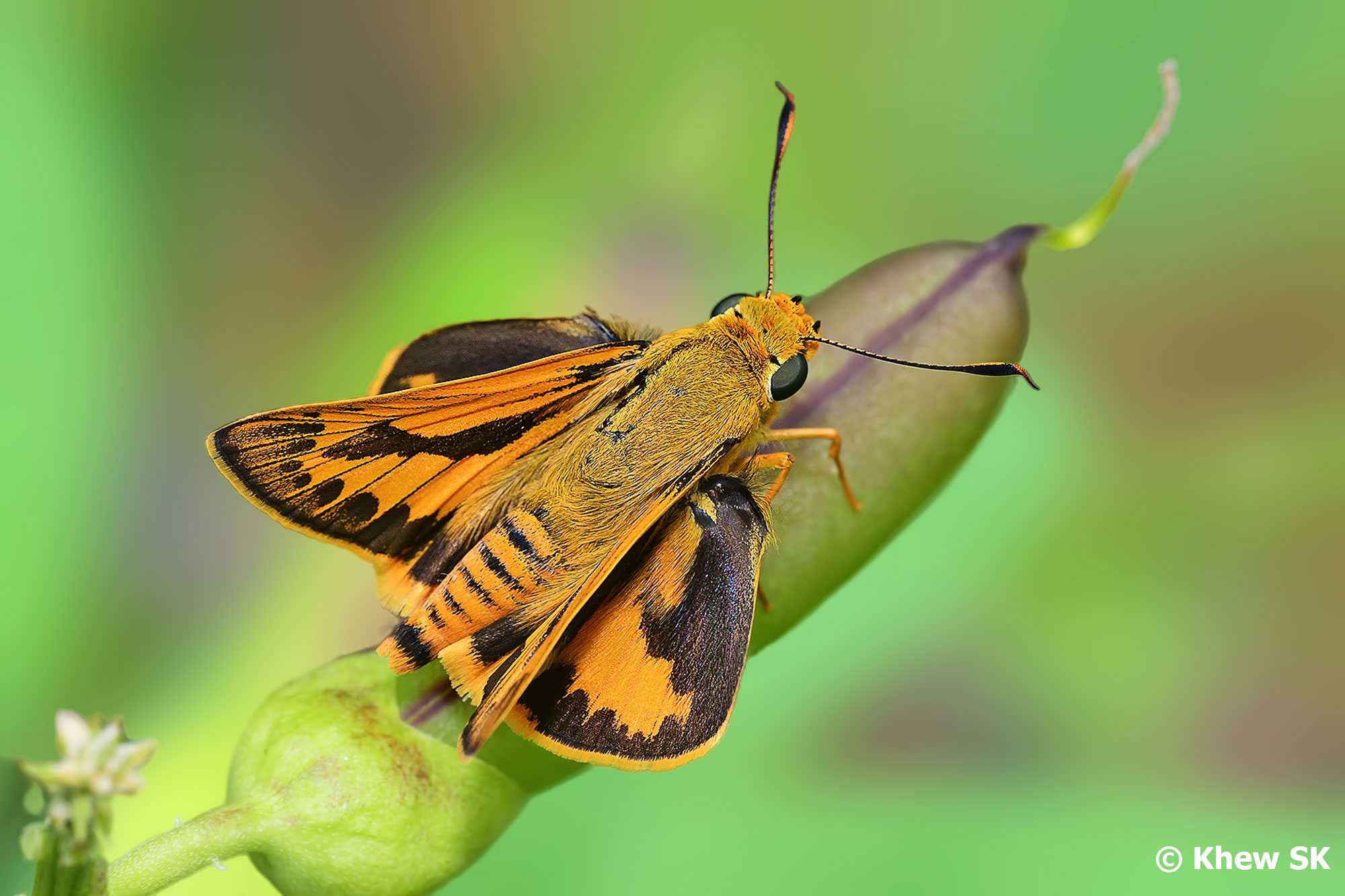
Our Butterfly of the Month for April 2022 is a recent addition to the Singapore butterfly fauna - the Yellow Palm Dart (Cephrenes trichopepla). Originally a native to the Australian region, the Yellow Palm Dart was first confirmed recorded in Singapore in 2009 after some years of skepticism that this species actually existed in Singapore. However, records show that it was probably extant in Singapore as early as 1999 when a sighting of this species was reported but not confirmed.

Yellow Palm Darts are often observed perched on the top surfaces of leaves to rest with their wings folded upright

The Yellow Palm Dart is considered a widespread and common species in Singapore today, where it can be found in various habitats from urban gardens to the forested nature reserves and offshore islands. Where its preferred caterpillar host plant can be found - the common coconut palm (Cocos nucifera), this species is often not too far away. It is now found in Malaysia and has also been reported from as far west as Sri Lanka.

A Yellow Palm Dart feeding on the pink flowers of Lantana camara


The species is swift on the wing, and skittish if disturbed. However, it occasionally perches to rest with its wings opened to sunbathe in the typical skipper fashion. It can sometimes be observed feeding on flowering plants in urban parks and gardens. It is also attracted to bird droppings.

A Yellow Palm Dart perches on the seed pod of a Rattlebox Weed with its wings opened to sunbathe

The Yellow Palm Dart's wings are black above with prominent orange-yellow streaks and spots that are typical of the genera Cephrenes. The orange yellow colour of the post-discal band on the forewing above is continued along the veins towards the termen. The males of this species do not possess a sex brand on the forewing above. The abdomen is orange banded and there is a black patch at the abdominal tip.

A mating pair of the Yellow Palm Dart

On the underside, the colour of the wings are a deep orange-yellow. The post-discal band on the underside of the hindwing is distinctly edged with black, and the band itself is a deeper orange than the surrounding ground colour of the wings. The antennal tips are orange on the inward side of the club, whilst the outer side is black.


The species' caterpillar feeds on various palms, like the Coconut Palm (Cocos nucifera), Livistona sp. (Arecaceae) and Lipstick Palm (Cyrtostachys renda). Given the widespread distribution of the Yellow Palm Dart, it is likely that the caterpillars feed on other species of palms. 

Text and Photos by Khew SK

23 April 2022

Life History of the Silver Royal

Life History of the Silver Royal (Ancema blanka blanka)


Butterfly Biodata:
Genus: Ancema Eliot, 1973
Species: blanka de Níceville, 1894
Subspecies: blanka de Níceville, 1894
Wingspan of Adult Butterfly: 28-33mm
Caterpillar Local Host Plant: Viscum ovalifolium (Santalaceae, common name: Oval-leaved Mistletoe).


A Silver Royal taking nectary fluid from flowers of the Mile-a-minute.

A female Silver Royal.

A male Silver Royal puddling on muddy ground.

Physical Description of Adult Butterfly:
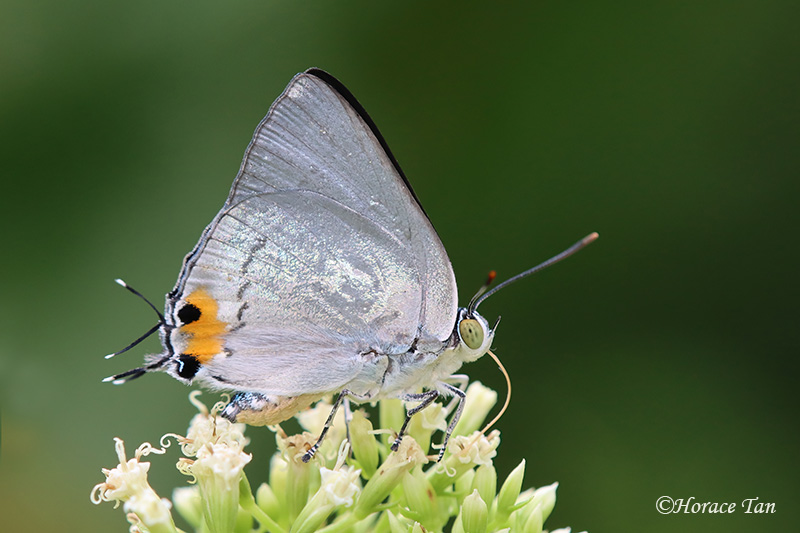
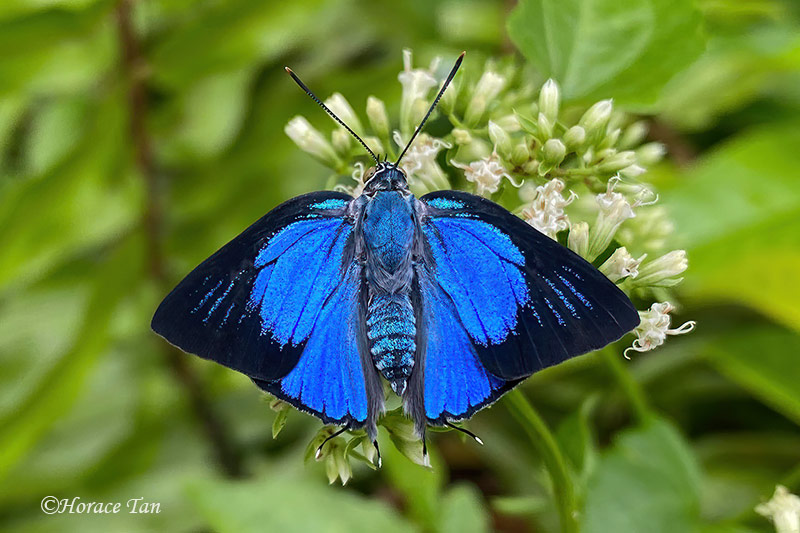
The eyes are greenish. On the wing upperside, the male is bright shining blue with black border and radiating blue streaks towards the termen. The female is of a paler blue with broad black border on both fore- and hindwing which are rounder than those of the male. On the wing underside, the male is greyish white with a slivery sheen whereas the female is pale greyish brown. There is a post-discal series of narrow dark streaks, very much more obscure on the forewing than on the hindwing. In the hindwing, there are black tornal spots in spaces 1a and 2, crowned with orange patches. Each hindwing has a pair of white-tipped black tails at ends of veins 1b and 2.

The upperside view of a puddling male Silver Royal.

The upperside view of a sun-bathing female Silver Royal.

The upperside view of a sun-bathing male Silver Royal.

Field Observations:
The Silver Royal is very rare in Singapore. It was re-discovered in 2005 where a single individual was spotted feeding at the flowers of a Syzygium tree. Since then there have been a few sporadic sightings at various locations in the Southern Ridges. The fast flying adults have often been sighted while visiting flowers at tree top or hill top. The male has also been observed to puddle at damp footpaths.

A female Silver Royal visiting flowers of the Ivy Palm.

A female Silver Royal visiting a flower of the Spanish Needle (Bidens alba).

A male Silver Royal.

A female Silver Royal visiting flowers of the Mile-a-minute.

Early Stages:
In Singapore, so far only one larval host plant for Silver Royal has been identified. This plant is the Oval-leaved Mistletoe (Viscum ovalifolium ), the same parasitic plant utilized by the early stages of the Golden Royal (Pseudotajuria donatana donatana). On this plant, the early stages of the Silver Royal in all instars feed mainly on the leaves, and occasionally the flower buds of the host plant.

Local host plant: Viscum ovalifolium (Oval-leaved Mistletoe).

Eggs are laid singly on various parts of the host plant, such as the leaf, flower buds and fruits. Each whitish egg is about 0.8mm in diameter. It is dome-shaped with a depressed micropylar at the pole and its entire surface is covered with pits. When freshly laid, the egg has a strong greenish tone in the micropylar and surface pits.

Two vlews of an egg of the Silver Royal, diameter: about 0.8mm.

Left: mature egg with a hole made by the soon-to-emerge caterpillar. Right: newly emerged caterpillar of the Silver Royal.

It takes about 3 days for the egg to hatch. The young caterpillar consumes just enough of the egg shell to emerge. It is pale yellowish brown in coloration, and has a length of about 1.2mm. Long setae (hairs) run along the length of the body dorsally as well as sub-spiracularly. The head is brown in colour. The newly hatched does not bother to eat the remnant of the egg shell and proceeds to feed on leaf surface in the vicinity. The 1st instar lasts about 2 days with the body length increased to about 2.5mm. Before the moult, the caterpillar typically take up its position on the surface of a leaf, and becomes immobile.

An empty egg shell of the Silver Royal.

Two views of a newly hatched caterpillar taking its first meal on the leaf surface, length: 1.2mm.

Two views of a 1st instar caterpillar, length: 2.5mm.

Two views of a late 1st instar caterpillar of the Silver Royal, dormant prior to the moult to the next instar.

The 2nd instar caterpillar has numerous short setae covering its body surafce. The caterpillar now features a dark-brown diamond-shaped prothoracic shield. The dorsal nectary organ on the dorsum of the 7th abdominal segment is discernible and whitish. As it grows in this instar, the yellowish brown body gradually turns greenish. The 2nd instar lasts about 2 days, with the body length reaching up to about 4.1mm.

A newly moulted 2nd instar caterpillar of the Silver Royal.

Two views of a 2nd instar caterpillar of the Silver Royal, length: 3.4mm.

Two views of a 2nd instar caterpillar of the Silver Royal, taking on a greenish undertone, length: 3.7mm.

Two views of a late 2nd instar caterpillar of the Silver Royal, dormant prior to the moult to the next instar.

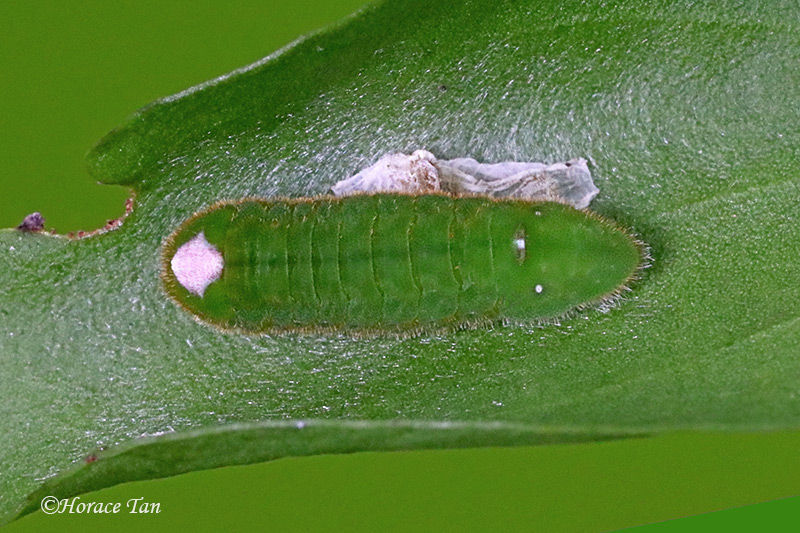
The 3rd instar caterpillar resembles the 2nd instar caterpillar initially, but with a prominent and proportionately larger prothoracic shield and greater density of body setae. The prothoracic shield is dark brown with a central white streak and two small lateral white patches. As it grows in this instar, the body turns increasingly dark greenish overall. The dorsal nectary organ at this late stage has the white coloration confined to its central part. The 3rd instar lasts about 2 days and the body length increases up to 7.5mm.

Two views of a newly moulted 3rd instar caterpillar.

Two views of a 3rd instar caterpillar feeding on a flower bud, length: 6.9mm.

Two views of a 3rd instar caterpillar feeding on a young leaf of the host plant.

A view of a 3rd instar feeding on the leaf, showing the damage caused to the leaf.

Two views of a late 3rd instar caterpillar, dormant prior to its moult.

The 4th instar caterpillar resembles the late 3rd instar caterpillar in most body features/markings. One distinguishing feature is that the prothoracic shield is now mostly whitish. The 4th instar lasts about 3 days with the body length reaching up to 13mm.

A newly moulted 4th instar caterpillar of the Silver Royal, yet to begin eating its old skin.

Two views of a 4th instar caterpillar, early in this instar, length: 8mm. Inset: The prothoracic shield.

Two views of 4th instar caterpillar of the Silver Royal feeding on young leaf of the Oval-leaved Mistletoe.

A 4th instar caterpillar of the Silver Royal feeding along the leaf edge, length: 13mm.

Two views of a late 4th instar caterpillar, dormant prior to its moult.

The 5th instar caterpillar resembles the 4th instar caterpillar closely in most body features/markings which are proportionately larger than those in the 4th instar. The 5th (and final) instar lasts about 3 days with the body length reaching up to 22mm.

A newly moulted 5th instar caterpillar, yet to eat its old skin.

Two views of a 5th instar caterpillar of the Silver Royal eating along the leaf edge, length: 15.5mm.

Two views of a 5th instar caterpillar of the Silver Royal, length: 20mm. Inset: prothoracic shield.

Two views of a late 5th instar caterpillar eating along leaf edge, length: 22mm.

As it enters the pre-pupatory phase of its life cycle, the caterpillar ceases its feeding activity and wanders around for a pupation site. As is the case for the Golden Royal, the pre-pupatory caterpillar of the Silver Royal settles for a spot on the upperside of a leaf with a strong preference for a leaf with curled up edges offering some degrees of concealment. At the chosen site, it spins a silk pad and a silk girdle to secure itself to the leaf.

Two views of an early pre-pupa of the Silver Royal.

Two views of a late pre-pupa of the Silver Royal.

After about 1 day of the pre-pupal period, pupation takes place. The pupa is held via its cremaster to the silk pad on the leaf surface. It is 12 to 13mm in length, with the typical shape for a lycaenid pupa, albeit more rotund and broader than usual. The pupa is yellowish green with numerous whitish transverse streaks. In addition, reddish brown spots appear on the dorsum of the abdomen. There is near-diamond-shaped reddish brown patch on the dorsum of the metathorax with two small black spots anterior to the patch.

Two views of a pupa of the Silver Royal.

Two frontal views of a pupa of the Silver Royal.

The pupal period is observed to be 7.5 days for the female and 8.5 days for the male. On the night before ecloson, the pupa becomes darkened in color signaling the imminent emergence of the adult. One can now tell the sex of the soon-to-emerge butterfly from the coloration of the wing pad at this stage. The next morning the adult butterfly emerges from the mature pupa.

Two views of a mature pupa of a female Silver Royal.

Two views of a mature pupa of a male Silver Royal.

A newly eclosed female Silver Royal resting next to its empty pupal case.


A male Silver Royal emerging from its pupal case.

References:
  • [C&P5] The Butterflies of The Malay Peninsula, A.S. Corbet and H.M. Pendlebury;  G. and N.  van der Poorten (Eds.),  5th Edition, Malayan Nature Society (2020).
  • Butterflies of Thailand, Pisuth Ek-Amnuay, 2nd Edition, 2012.
  • A Field Guide to the Butterflies of Singapore, Khew S.K., Ink On Paper Communications, 2nd Edition, 2015.
Text by Horace Tan, Photos by Loke PF, Loh Mei Yee, Khew SK and Horace Tan, Video by Horace Tan.