15 November 2020

Butterfly of the Month - November 2020

Butterfly of the Month - November 2020
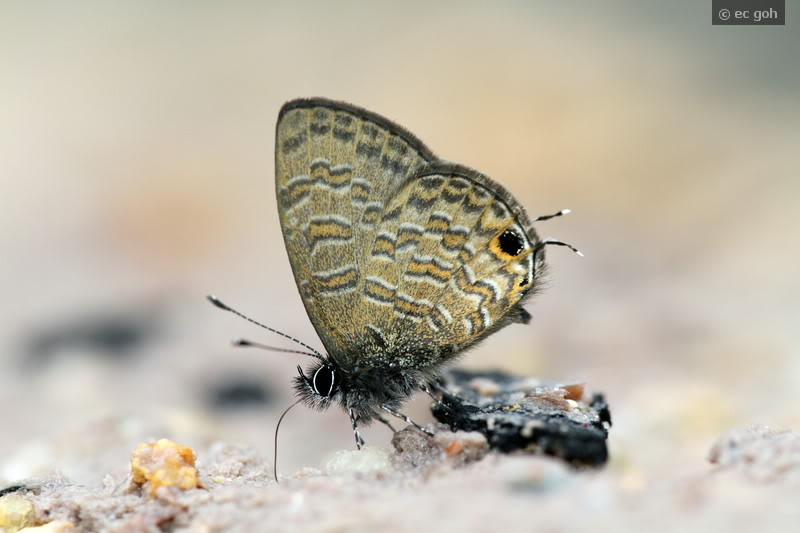
The Common Line Blue (Prosotas nora superdates)

A Common Line Blue feeding at the flower of the Spanish Needle (Bidens alba)

It is the 11th month of a tumultuous 2020 and many of us would just wish that we could wake up in 2021 and all the nightmares of this year will be over! But if only the pandemic that has spread across the whole world will be so easy to get rid of. News of a viable and safe vaccine are already making their rounds and we can only wait with baited breath that there is light at the end of this dark tunnel that we have been crawling through for most of this year.


Over on the other side of the globe, the US Presidential Election is over. Or is it? Although the official results show that the US now has a new 46th President, there are still some quarters that harbour a different view that the incumbent still has a whisker of a chance to wrest the Presidency back. Whilst the rest of the world get down to the business of making our nations safe again, and to kick start the ailing economies, it should be a matter of time before we see a new President in the White House.

Back home on our Little Red Dot, the Covid-19 situation appears to be under control, with daily single digit or no new community infections for the past couple of weeks. Whilst there are still the irritating imported cases almost every day, the anticipation of a "new normal" or a semblance of getting our lives back, grows by the day. There is talk of a "Phase 3" on the cards, but it comes with a warning of a second wave, if we let our guard down. But looking around us in Singapore, it would appear that we are beginning to see a bit of pre-Covid normalcy, albeit with face masks as a default as we go about doing our daily business.


Our feature butterfly of the month of November 2020 is the small and inconspicuous Common Line Blue (Prosotas nora superdates). With a wingspan of only about 20-25mm, the Common Line Blue is a small species that is not easy to spot. It can hardly be considered "common", although it is quite widespread in distribution across habitats like urban parks and gardens. It can also be found in the forested nature reserves. Due to its diminutive size and erratic flight, it is not easy to identify the species when it is on the wing.

A mating pair of Common Line Blue : Left - Male, Right - Female

The male Common Line Blue is bluish-purple on its uppersides, with a very thin and almost imperceptible border. The upperside of the female is dark brown and mostly unmarked. The underside is ochreous in the male, and sometimes appears almost like a small orange butterfly, whilst the female is greyish buff with ochreous speckles.


There is a prominent tornal orange-crowned black eyespot edged with pale green iridescent scales on the underside of the hindwing. There is a long white tipped filamentous tail at vein 2 of the hindwing. The large eyes of the Prosotas species are jet black, whilst the thorax, palpi and the dorsal margin of the hindwing are covered with hairs, giving the butterfly a particularly shaggy and unshaven look.

The Common Line Blues are most often seen puddling at damp footpaths and sandy streambanks

The Common Line Blue has a weak but erratic flight, and often seen flying restlessly at low levels amongst shrubbery. At times, the butterflies are seen feeding at flowering plants, but males are most often spotted puddling at damp footpaths and sandy streambanks that are contaminated with animal excretions and other organic matter. Females are much rarer.


When stopped at rest, the species usually perches on the tops of leaves and twigs with their wings folded upright. At times during hot sunny days, male Common Line Blues are occasionally observed to sunbath with their wings almost fully open, to reveal their purplish-blue uppersides.


The Common Line Blue's life history has been recorded on two host plants in Singapore - Entada spiralis and the non-native Australian Wattle (Acacia auriculiformis).

Text by Khew SK : Photos by Janice Ang, David Chan, Chng CK, Goh EC, Khew SK, Koh CH and Horace Tan

08 November 2020

Flying Tigers 3.0

Flying Tigers 3.0
Featuring Singapore's Tiger Butterflies


And we're back again... Over twelve years ago, in Jan 2008, when we featured the different "Flying Tiger" species in Singapore, we had only five species of these Tigers recorded then. After many years of continued observations by butterfly enthusiasts in Singapore, the list of "Tigers" was updated to include more recent sightings of other species that were either vagrants, strays or seasonal migrants to Singapore. Back in that 2019 update, we featured 8 species (but inadvertently missed out one! Oops!)


So in this latest refresh, we add in the latest Tiger spotted at Butterfly Hill on Pulau Ubin recently - the Swamp Tiger (Danaus affinis malayana), and to correct the one we left out in the Flying Tigers 2.0 update : the Yellow Glassy Tiger (Parantica aspasia aspasia). Hence we now currently have 10 Flying Tigers spotted in Singapore as at 2020.

One of our extinct "Tigers" in Singapore, the Chocolate Tiger (Danaus melaneus sinopion) which has not been seen here in over a century!

One of the Tigers recorded by the early authors but has since gone extinct in Singapore is the Chocolate Tiger (Danaus melaneus sinopion). According to references, it has not been seen in Singapore since the 1900's. Nevertheless, it was listed as an extant species on the Singapore Checklist but its status is classified as extinct. However, it was even featured on an TransitLink stored-value ticket some years back, even though no one has actually seen the species in the wild in the past century.

A white-hindwinged form-intermedius Common Tiger feeding on the flowers of the Red Tree Bush (Leea rubra)
An orange-hindwinged form-genutia Common Tiger on the seed pod of the Rattlebox Plant (Crotalaria retusa)
A white-hindwinged form-alcippoides Plain Tiger feeding on the yellow flowers of the Blood Flower (Asclepias curassavica)
A two-in-one shot of a male orange-hindwinged form-chrysippus courting a feeding female white-hindwinged form-alcippoides.  Note the male's hair pencils extruded to spray pheremones to attract the female
A mating pair of Black Veined Tigers

The first group of Tigers under the genus Danaus features the more colourful species with colours that are reminiscent of their feline mammalian namesake - black and orange. Of the species found here in Singapore, the Common Tiger (Danaus genutia genutia), Plain Tiger (Danaus chrysippus chrysippus) and the Black Veined Tiger (Danaus melanippus hegesippus) are relatively common and can be sometimes found in numbers where their respective host plants and other Danainae-attracting plants are grown.

The latest addition to the Flying Tigers in Singapore - the Swamp Tiger (Danaus affinis malayanus)

The fourth and most recent species, the Swamp Tiger (Danaus affinis malayanus) was recently spotted on Pulau Ubin in Aug 2020. A single female individual was feeding at the flowers of the Bandicoot Berry (Leea indica) and stopped to rest at some vines. The species is known to prefer mangrove habitats in Malaysia, and was probably a stray from the mangroves of nearby Johor.  Pulau Ubin also has its patches of healthy mangroves and it is possible that the Swamp Tiger was looking for its host plant in the habitat.
A Dark Glassy Tiger feeding on the flower of the Spanish Needle (Bidens alba)
The seasonal Yellow Glassy Tiger feeding on the flower of the White Weed (Ageratum conyzoides)

The next genus of species of Tigers would be the Parantica, which features two species - the Dark Glassy Tiger (Parantica agleoides agleoides) and the seasonal Yellow Glassy Tiger (Parantica aspasia aspasia). The Dark Glassy Tiger is common in urban parks and gardens where the Rattlebox Plant (Crotalaria retusa) is cultivated. The Yellow Glassy Tiger, on the other hand, is a very rare vagrant that has only been seen in Singapore a handful of times in the field over the past 3 decades (although it is not uncommon in Malaysia).

A Blue Glassy Tiger feeding on the flower of the Golden Dewdrop (Duranta erecta)
A Grey Glassy Tiger perched on a palm frond. Note the much paler markings and the almost white hindwing cell

The genus Ideopsis hosts two species of Tigers that have been seen in Singapore. The first one, Blue Glassy Tiger (Ideopsis vulgaris macrina) is common and can be seen in various habitats and widely distributed all over Singapore. The more recently discovered Grey Glassy Tiger (Ideopsis juventa sita) is a rare vagrant that has only been seen twice so far - on Pulau Ubin and at the Singapore Botanic Gardens. This species is not rare in the coastal areas of Johor, and could have strayed over to Singapore on favourable winds.

A Dark Blue Tiger feeding on the flower of the Spanish Needle at Pasir Ris Park Butterfly Garden
A Blue Tiger puddling at a rocky outcrop

The final two Tigers are recent additions from the genus Tirumala. In the early records, there were no observations of any species of this genus in Singapore. It was only in the past decade that two species from this genus were spotted in Singapore. The Dark Blue Tiger (Tirumala septentrionis septentrionis) has been observed a handful of times in Singapore and the individuals were believed to be vagrants coming in from Malaysia. The Blue Tiger (Tirumala limniace) of which only a single sighting was made so far, was probably a stray or a stowaway that made its way to Singapore.


We have updated the list of Flying Tigers in Singapore to 10 this year, but will we ever see the remaining 5 that fly in Malaysia - a few of them montane or found only in the northern part of the peninsula? Who knows? With Mother Nature, there will always be surprises.

Text by Khew SK : Photos by David Chan, Khew SK, Loh MY, Loke PF and Mei Hwang

01 November 2020

Bush Browns of Singapore : Part 2

Bush Browns of Singapore : Part 2
Featuring the Mycalesis species of Singapore

A Burmese Bush Brown (Mycalesis perseoides perseoides) puddling at damp sand

In this second part of the article on the Bush Browns of Singapore, we take a look at the remaining 3 species of Bush Browns that are cryptic and are more challenging to distinguish due to their generally similar appearances. These 3 species are not uncommon and are widely distributed across Singapore from parks and gardens to the forested nature reserves.

A Dark Brand Bush Brown (Mycalesis mineus macromalayana) perches on a leaf

The species are not particularly attractive to the casual observer, being typically brown with a series of submarginal ocelli across both wings. As they are alert and skittish and when disturbed, quickly fly off amongst the low shrubbery and grassy habitats where they prefer, many observers will often ignore them in the field.

A Long Brand Bush Brown (Mycalesis visala phamis) perches on a blade of grass

The Bush Browns are sometimes seen feeding on the ripened fruits of the Singapore Rhododendron (Melastoma malabathricum). They are rarely seen feeding at flowers, but occasionally encountered puddling at damp trails and streambanks or feeding on the sap of damaged trees and branches. Most of the time, they are spotted perched on the tops of leaves with their wings folded upright.Occasionally, particularly in the early morning hours, some individuals may be seen opening their wings to sunbathe.

4. The Dark Brand Bush Brown (Mycalesis mineus macromalayana)


The Dark Brand Bush Brown is probably the most common and widespread amongst the Bush Brown species. It can be found in urban parks and gardens and even in pockets of greenery the vicinity of residential estates. The species' caterpillar host plants are grasses - Cow Grass (Axonopus compressus) and Buffalo Grass (Paspalum conjugatum).

Upperside of a sunbathing Dark Brand Bush Brown
A Dark Brand Bush Brown feeding on the ripened fruit of the Singapore Rhododendron

The species is a drab greyish-brown upperside and a paler underside that features a white post-discal band across both wings (this band is much wider in the female compared to the male). There are usually two large ocelli on the underside of the forewing with some obscure smaller ocelli which can be variable in different individuals.


ID Key and Tips - What to Look Out For :
  1. White striae around the eyespots are thin and narrow.
  2. Hindwing inner margins of eyespots form a sharply triangular and deep indentation from the white band in the upper half.
  3. Lower 4 eyespots in line. (This ID Key is used to separate this species with the Dingy Bush Brown featured in Part 1 of this article)
  4. Discal line may be absent in some individuals.
5. The Long Brand Bush Brown (Mycalesis visala phamis)


The Long Brand Bush Brown appears quite similar to the previous species, and found in almost the same localities and habitats. The Bush Browns usually prefer shaded or semi-shaded environments and fly low amongst the grassy undergrowth. The caterpillar host plants are also grasses but different from those of the Dark Brand Bush Brown. The two locally known host plants are Isachne globosa and Ottochloa nodosa, which the species shares with a number of other Satyrinae and Hesperiinae butterflies.

A rare "dry season form" of the Long Brand Bush Brown with reduced ocelli

The Long Brand Bush Brown is very similar to the Dark Brand Bush Brown and is difficult to separate when in flight or from field observations. However, the Long Brand Bush Brown usually has faint squiggly lines on the underside of both wings.


ID Key and Tips - What to Look Out For :
  1. White striae around the eyespots are thickened and enhanced.
  2. Hindwing inner margins of ocelli form a more regular shallow indentation opposite the white band.
  3. Dark discal line less irregular but without a spike or "tooth" at vein 1b of the hindwing.
6. The Burmese Bush Brown (Mycalesis perseoides perseoides)


The Burmese Bush Brown is the last of the lookalike Mycalesis species that is found in Singapore. It closely resembles the preceding two species and the diagnostic physical features should be scrutinised from photographs to distinguish the differences amongst these lookalike species of Bush Browns. It is also found in the same habitats as the earlier two species and occasionally flies together with the other two species in the same localities.

Upperside of a sunbathing Burmese Bush Brown

The Burmese Bush Brown is a dull brown on the upperside with a large yellow-ringed ocellus in space 2 of the forewing. This is typical of the other species of this genus. The underside is a paler brown with the characteristic white post discal band across both wings. The submarginal ocelli are yellow-ringed. On the underside of the forewing, there are occasionally faint lines. The brown discal line is irregular and stretches down to almost the dorsal edge, with a "tooth" at vein 1b.


ID Key and Tips - What to Look Out For :
  1. White striae around the eyespots are thickened and enhanced.
  2. Hindwing inner margins of ocelli form a jagged edged indentation opposite the white band.
  3. Dark discal line is irregular and with a spike or "tooth" at vein 1b of the hindwing.
Hopefully, this article can help in a small way to aid butterfly watchers to distinguish the different species of Bush Browns in Singapore.  There are two other species of lookalikes in Malaysia and it is hoped that we will be able to find them in Singapore one day in the future.

Text by Khew SK : Photos by James Chia, Khew SK, Loke PF, Nelson Ong and Horace Tan

References : 

Special thanks to Dr Seow TL for his help in crafting the ID keys to separate field shots of these Mycalesis species.