10 May 2020

Butterfly of the Month - May 2020

Butterfly of the Month - May 2020
The Pointed Ciliate Blue (Anthene lycaenina miya)


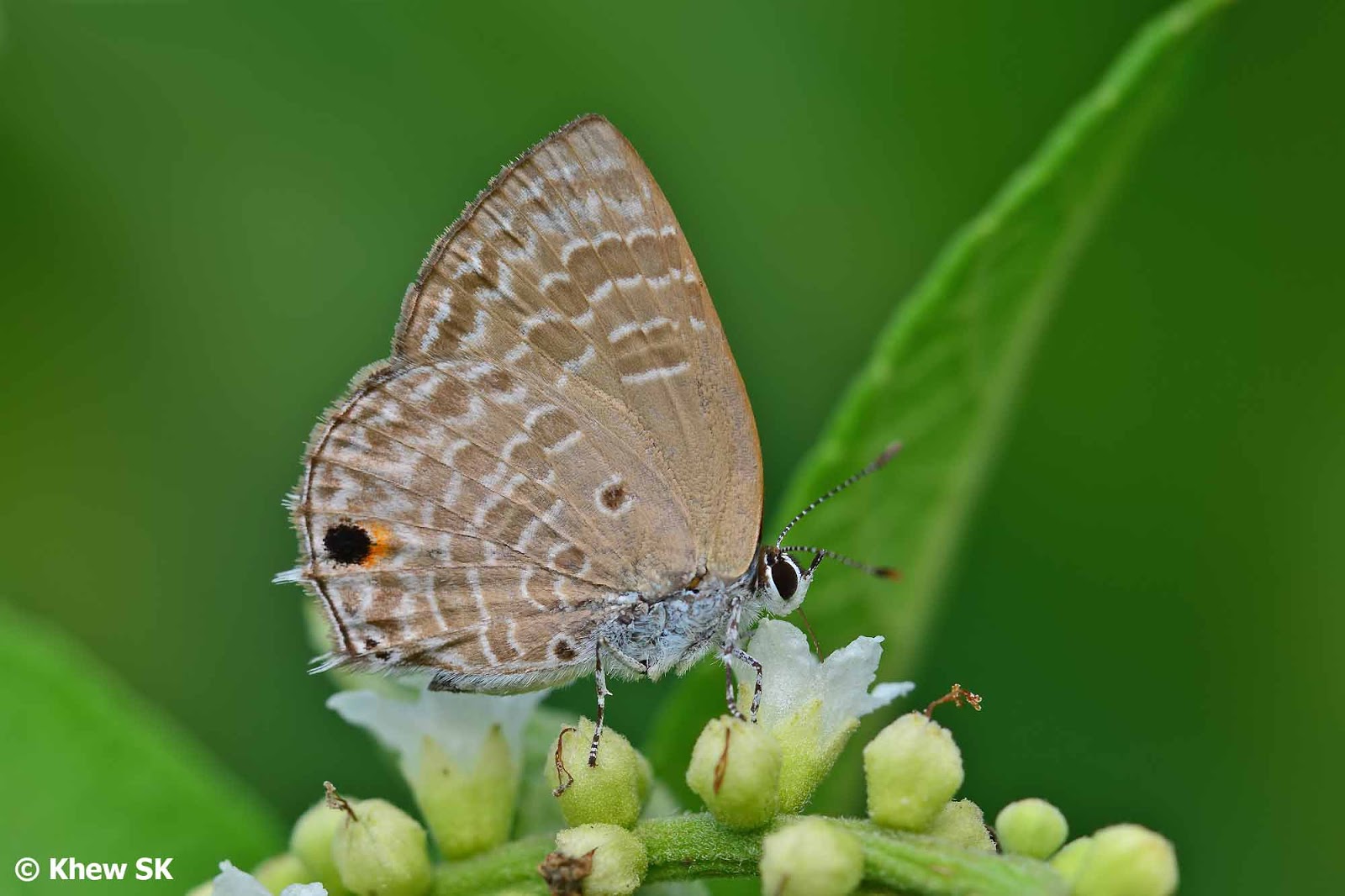
A female Pointed Ciliate Blue perched on an inflorescence of a String Bush

We have crossed the half-way mark of the extended stay-home-as-much-as-possible "Circuit Breaker" period in Singapore. A less draconian partial lock-down when compared with other countries, Singapore's CB allows residents to access essential services and even go out to exercise with precautions to be taken. It is now mandatory to wear face-masks whenever we go out of our homes, and it is the norm to see everyone masked, except for some individuals who insist on challenging the laws (and paying dearly for it).


The COVID-19 scourge continues its relentless march all around the world, and this will go down in history as one of the most severe pandemics of our 21st century era. The toll on the health and safety of each country's residents varies, as are the measures that have been taken to "flatten the curve" in infection rates.


A male Pointed Ciliate Blue feeding off a sweaty backpack


Just a month ago, I wrote that Singapore had just crossed the 2,000 mark in terms of confirmed infections. As of yesterday, the official number was 22,400! - more than a tenfold increase in just about 30 days. Singapore's "2nd wave" of infections occurred mainly in the large concentrations of foreign workers housed in dedicated dormitories. Coupled with intensive testing and a whole regime of healthcare protocols, the number of COVID-19 infections skyrocketed on our little island.


A male Pointed Ciliate Blue pudding at a sandy streambank 

Over in other parts of the world, the pace of infections and easing of lockdowns varies. There is always fear of a 2nd wave of infections as people let down their guard and begin to socialise and meet in groups again. At the moment, most countries have some form of border controls to limit imported infections, but there will come a time when this too, will be eased. Hence there are many fronts and weak links that each country needs to tackle.


The world economy has taken a severe beating, and analysts have already compared this period to the Great Depression and various other severe recessions in recent history. The balance between infection control and re-booting the economy weighs hard on the minds of the governments of many countries. Many people fear for their future as salaries and jobs will be impacted for sure. Whatever it may be, life will not be the same again, as we look towards a new norm, post COVID-19.


Wild flowers, in this case, Coat Buttons, growing abundantly due to lack of grass cutting and maintenance because of the partial lockdown in Singapore.

We head into the hotter months of the year, and temperatures are certainly warming up in Singapore, despite the intermonsoon rainstorms descending on us. There have been observations of more butterflies in our urban landscapes, primarily due to reduced grasscutting and more wildflowers/weeds sprouting with wild abandon - a good side effect of lockdowns?


Our Butterfly of the Month for May 2020 is the Pointed Ciliate Blue (Anthene lycaenina miya) a small Lycaenid that is considered moderately common. It has a widespread distribution across Singapore, being found in urban parks and gardens as well occasionally in the forested areas. It is a small butterfly, with an average wingspan of 25-30mm. It has a rapid and erratic flight.


The partially opened wings of a male Pointed Ciliate Blue showing the uppersides


It is one of two species of the genus Anthene that occurs in Singapore, the other species being the more common Ciliate Blue (Anthene emolus goberus). The two species frequent generally the same localities, but the Pointed Ciliate Blue is rarer. The Pointed Ciliate Blue also has more angular wings and the forewing is more pointed and sharper.


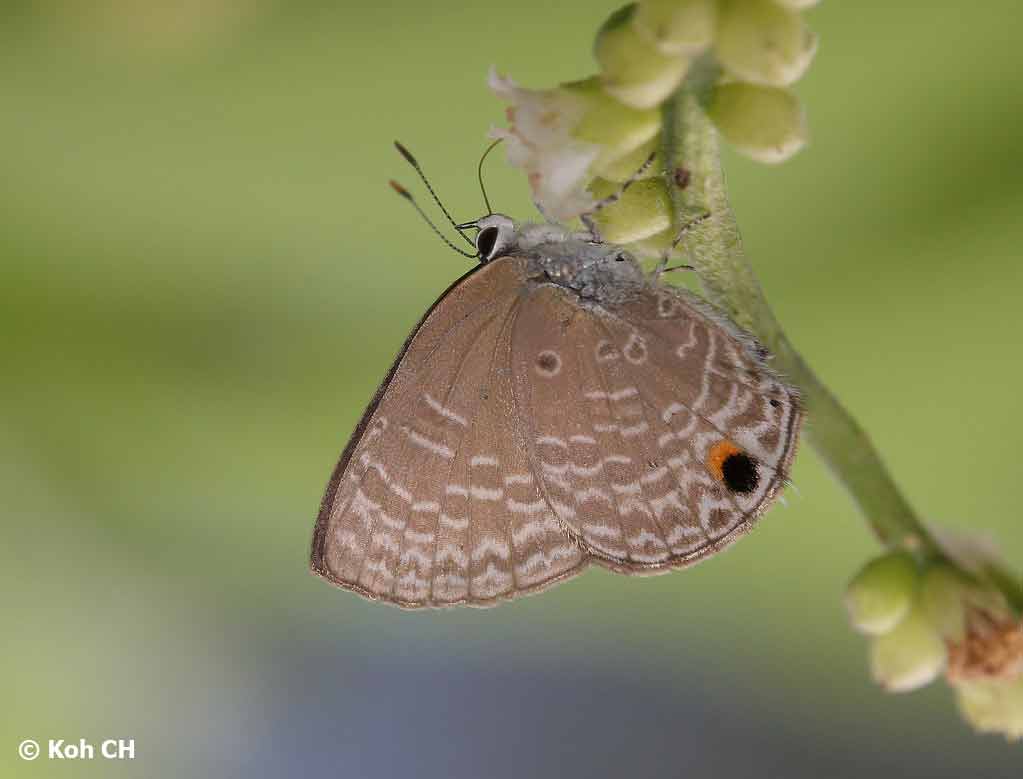
The upperside of the Pointed Ciliate Blue is a pale purple blue in the male. The female is dull brown with blue wing bases. The underside is a pale greyish brown with a series of white striations on both wings. The distinguishing marking in the Pointed Ciliate Blue is the large black spot at the base of space 7 on the underside of the hindwing.


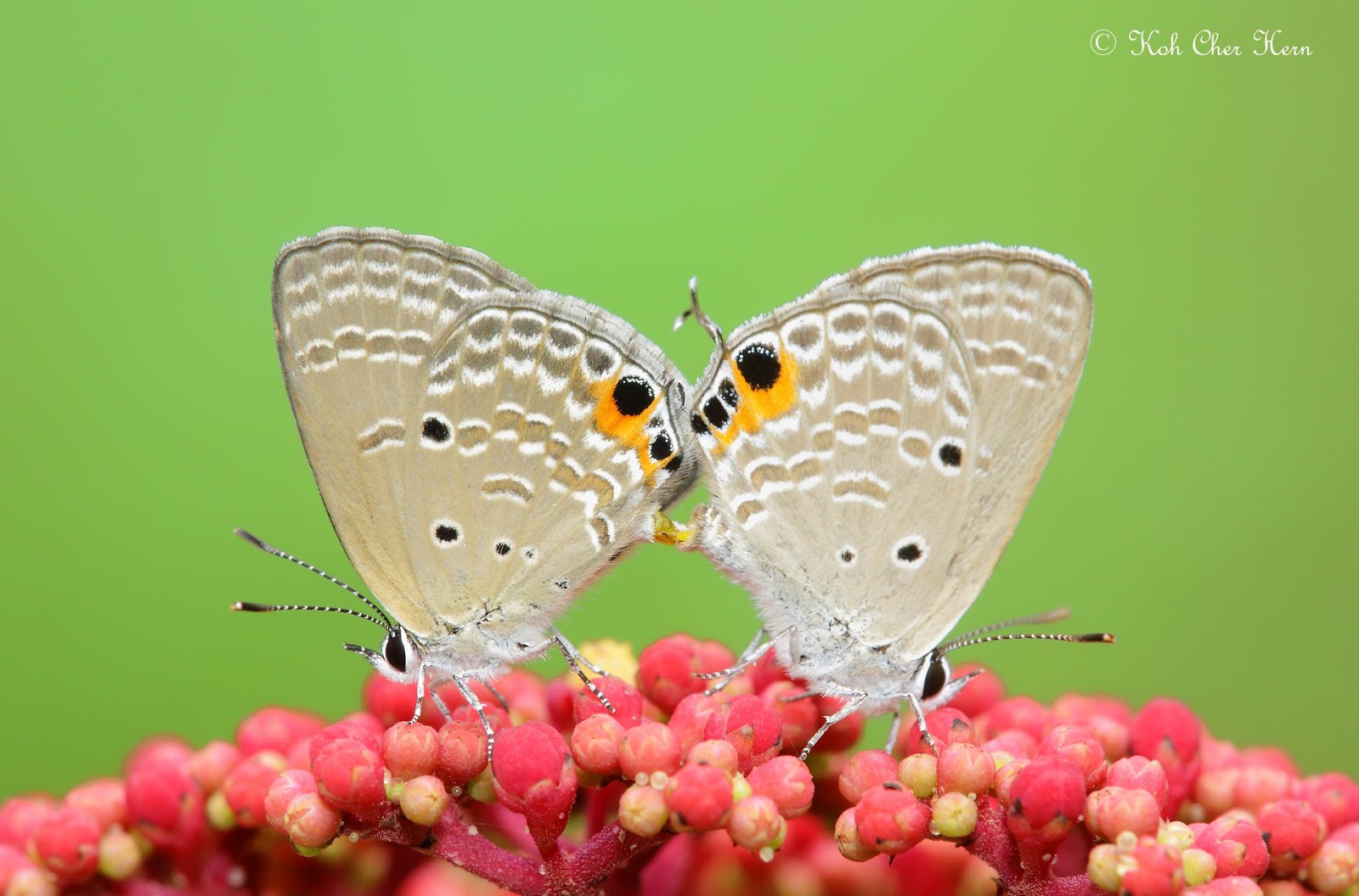
A mating pair of Pointed Ciliate Blue - female on the left, male on the right


A unique feature of the Anthene species is the pair of short fine white "tails" at veins 1b and 2 of the hindwing. These "tails" are actually extensions of the hindwing cilia (short fringe hairs along the wing margins). In pristine individuals, particularly females, there is also an extension of the cilia at vein 3 to suggest another very short indistinct "tail".


Males of the Pointed Ciliate Blue are often seen puddling at damp footpaths, sometimes in the company of other Lycaenid puddlers. Females are more regularly encountered feeding at flowering bushes. The termen (outer margin) of the forewing of the females is more curved compared to the males.

Text by Khew SK : Photos by May Chan, Foo JL, Khew SK, Koh CH, Loh MY, Neo TP, Billy Oh, Michael Soh, Jonathan Soong, Tea YK and Horace Tan
03 May 2020

Hidden in Plain Sight!

Hidden in Plain Sight!
Discovery of the female Malay Staff Sergeant


Abstract of the paper published in Raffles Bulletin of Zoology

The recent publication of our paper in the Raffles Bulletin of Zoology Vol 68(2020) on 29 Apr 2020 entitled the "Discovery of the previously overlooked female of Athyma reta, and its taxonomic implications" was a culmination of over 4 years of research and meticulous studies of references and specimens across the region. The discovery that the female of the Malay Staff Sergeant (Athyma reta moorei) is black-and-orange started as far back as 2015, when our early stages expert, Horace Tan stumbled upon the caterpillars of the Malay Staff Sergeant in Singapore and bred a few batches of the caterpillars.


A mating pair of the Malay Staff Sergeant - one of the pieces in the puzzle that led to the discovery of the black and orange female

The study took a long time to complete because of the thorough examination of some 90 specimens. The paper compares the early stages of the Malay Staff Sergeant with the Colour Sergeant. It analyses the colour patterns of the females using statistical techniques in order to find the best distinguishing characters of these females that can be so difficult to tell apart. In addition it explores the possibility of other female forms existing in the Malay Staff Sergeant, just as they do in the Colour Sergeant, but we came to the conclusion that the female is always black-and-orange. The paper also discusses many taxonomic implications of the new finding.


Specimens of male/female, upperside/underside of Malay Staff Sergeant (top) and Colour Sergeant (bottom)

Based on existing literature and references, the Malay Staff Sergeant has been described as "sexes similar" (e.g. in Fleming), implying that the male and female of the species are similar. In various books, ranging from Butterflies of the Malay Peninsula to Butterflies of Thailand, only males were shown. Even in the classic online reference that many of us often refer to, Inayoshi-san's site, A Check List of Butterflies in Indo-China, only a male specimen of Athyma reta was depicted. Many other regional references imply that the species is sexually monomorphic.


Colour Sergeant female f-neftina

Malay Staff Sergeant female

Over the years, both butterfly experts and enthusiasts accepted that the Malay Staff Sergeant is sexually monomorphic. A number of references even show photos of the so-called black-and-white females. Originally, early authors thought that the Malay Staff Sergeant may be sexually dimorphic, but that possibility was eventually overlooked. Everyone followed Fruhstorfer in thinking the female was like the male. Except in India. In India, strangely, they thought the female was black-and-grey-brown. This was actually because the Colour Sergeant's female-form subrata was confused as the female of the Malay Staff Sergeant. In fact, the article shows that the Malay Staff Sergeant most likely does not occur in India or even north of South Thailand.


Colour Sergeant female f-neftina upperside

In examining specimens in collections that were purportedly black-and-white females, all of them were actually males of the Malay Staff Sergeant. This paper and discovery is hence of major taxonomic significance. It changes the identification keys and descriptions of Athyma reta and its related species.


Colour Sergeant female f-neftina underside

Whilst the paper is prepared with the expected scientific rigour and detailed research commensurate with the standard of a peer-reviewed scientific publication, many layman readers may find the level of information rather daunting to try to understand. Hence, what do the conclusions and outcomes generally mean for the nature enthusiasts, hobbyists, photographers and layman readers on social media and online platforms?


Colour Sergeant female f-neftina

Malay Staff Sergeant female

Comparison of the forewing arrowheads in museum specimens

Basically, to many of us who are out in the field, and who are interested in photographing butterflies and trying to put accurate names to what we have shot, the paper tells us that :
a) the species Malay Staff Sergeant is sexually dimorphic - the male is black-and-white and the female is black-and-orange.
b) the female resembles the female of the more commonly seen species, the Colour Sergeant's orange female form-neftina.
c) many of our images that we have labelled as Colour Sergeant female f-neftina may actually be a female of the Malay Staff Sergeant.


Annotated diagrams of the 2 key diagnostic features between the Malay Staff Sergeant and the Colour Sergeant

So how do we differentiate the two? In the paper, two reliable key diagnostic characteristics that separate the two species are described :
a) the thoracic band on the upperside of the butterfly. It is orange or yellow in the Malay Staff Sergeant, but is white in the Colour Sergeant female f-neftina.
b) In the Malay Staff Sergeant, the upper margin of the basal half of the cell-end arrowhead is convex, whilst in the Colour Sergeant, it is concave.


Colour Sergeant female f-neftina - on the underside, the markings and bands are narrower, with a light pinkish tinge

Malay Staff Sergeant female - on the underside, the markings and bands are much wider, and generally pale orange.

Other less reliable (or visually discernible) differences are :
a) wider orange markings in Malay Staff Sergeant.
b) clearer submarginal spot in space 4 of the forewing upperside between the postdiscal and narrow marginal bands
c) a generally stronger orange colour on the underside
d) more orange scaling flanking the underside markings
e) pale orange underside bands and spots, instead of almost white with pink/orange tint in the Colour Sergeant.


Underside and upperside of different individuals of the female Malay Staff Sergeant

The paper is a good example of cross-border collaboration between Malaysia and Singapore, with Dr Laurence Kirton and Dr Phon Chooi Khim coming in to present the findings in a manner that meets the stringent requirements of a refereed journal like the Raffles Bulletin of Zoology. They used their expertise to analyse the data from various perspectives and putting across the findings and observations with full scientific rigour.


A female Malay Staff Sergeant sunbathes on the top of a leaf

Finally, the elusive female Malay Staff Sergeant has been discovered. It was there all the time, in museum and private collections, and photographic folders on our hard drives. It was indeed "hidden in plain sight" all this time. For those of us with photos that have been filed as Colour Sergeant female f-neftina, it is time to take a re-look at our archives.  You may have a shot of that elusive female Malay Staff Sergeant after all!


Text by Khew SK and LG Kirton : Photos by Brian Goh, Huang CJ, Khew SK, Koh CH, Simon Sng, Jonathan Soong and Horace Tan

Special thanks to Drs LG Kirton and Phon Chooi Khim (FRIM, Malaysia) and A/Prof Horace Tan for making this discovery possible.

26 April 2020

It Takes Two! : Part 2

It Takes Two! : Part 2
a.k.a. Butterfly Sex!


A mating pair of Common Posy resting on a leaf 

In this 2nd part of the series featuring mating butterflies, we investigate the diversity of mating species amongst the remaining three families of butterflies - Riodinidae, Lycaenidae and Hesperiidae. Unlike the larger butterfly species in the previous week's blogpost, the species of these 3 families of butterflies are much smaller in size and it takes a bit of luck, opportunity and patience on the part of the butterfly photographer to shoot these mating pairs.


A mating pair of Pale Mottle with the larger female on the right

It is difficult to establish with certainty, whether the males or females of these mating pairs do the flying in the field. In our observations as recorded in the families with larger butterflies or slow flyers, we could study them as they move from perch to perch. These smaller species in the remaining three families prove slightly more challenging to follow when they are in flight.


A mating pair of Large Snow Flat, with their wings opened flat

The mating pairs of these smaller butterflies are generally more skittish, and are able to fly quite rapidly out of reach, if disturbed. Some move under leaves to hide, whilst others fly to treetop levels to get out of harm's way. However, if approached stealthily, a photographer may be able to capture a good shot of the mating pair that are undisturbed and stay still.

Family : Riodinidae


A mating pair of the Spotted Judy at Mt Faber Park

There are only 5 species in this family that are extant in Singapore. Most are relatively uncommon and at least one species, the Harlequin, is critically endangered as its local habitat where a small colony is found in, is in danger of being wiped out by development. All the other species are shy and prefer heavily shaded habitats and forested areas.


A mating pair of the Malayan Plum Judy with the male on the right

Observations of mating pairs of the Riodinidae are rare and we have on record, only the Malayan Plum Judy and Spotted Judy. They are still quite skittish even when mated and are easily spooked off when disturbed. It is difficult to say for sure whether the male or female does the flying for the pair as there have been few observation records of mating pairs.

Family : Lycaenidae Subfamilies : Curetinae, Poritiinae, Miletinae and Aphnaeinae


Mating pairs of Malayan Sunbeam (top) and Sumatran Sunbeam (bottom)

Collectively, these four subfamilies of the family Lycaenidae support a total of 13 extant species in Singapore. Of the Curetinae (or Sunbeams), there are only 2 species found here, we have had records of mating pairs of both. Both species, the Malayan Sunbeam and Sumatran Sunbeam, are moderately common with a wide distribution all over Singapore in their preferred habitats.


Mating pair of Sumatran Gem

The Sumatran Gem is the only representative of the subfamily Poritiinae which we have recorded a mating pair. Both the local species are rare and very local in distribution, preferring the heavily shaded forest understorey in the nature reserves of Singapore.


Mating pairs of the Pale Mottle (top) and Lesser Darkwing (bottom)

Amongst the seven species from the subfamily Miletinae, mating pairs of the Pale Mottle are quite regularly encountered, judging from the number of such posts on forums and butterfly groups on social media. Other species in the subfamily have occasionally been spotted mating in their preferred habitats in forested areas.


Mating pairs of Bigg's Brownwing (top) and Apefly (bottom)

The Bigg's Brownwing, Apefly and Lesser Darkwing are species that have records of mating pairs that have been encountered by butterfly photographers over the years. These are moderately common species and due to their caterpillars' carnivorous feeding habits, they are well distributed all over the island in a wide variety of habitats.


Mating pair of the Long Banded Silverline 

Of the subfamily Aphnaeinae, there are only 2 extant species in Singapore. Both species are not uncommon and can be found in habitats from urban parks and gardens to the forested nature reserves. Mating pairs are rarely encountered, but the Long Banded Silverline has been photographed mating.

Family : Lycaenidae Subfamily : Polyommatinae


This subfamily is often referred to as the "Blues", and are small delicate butterflies. Many of them have thread-like filamentous tails and are adorned with spots and streaks or iridescent tornal scales on the undersides of their hindwings. This is one of the largest group of butterflies compared to all the other families.


Mating pairs of the Grass Blues - Pygmy Grass Blue (top), Lesser Grass Blue (middle) and Pale Grass Blue (bottom)

Many of the species are very small in size, and the Pygmy Grass Blue (Zizula hylax pygmea) is the smallest species in the region. Mating pairs of the Grass Blues are not difficult to find, as they are urban butterflies and quite common. Lesser Grass Blue and Pale Grass Blue are the others that are usually encountered.


Mating pairs of the Indian Cupid (top) and the Malayan (bottom)

The rare Indian Cupid makes occasional appearances in Singapore, and then mysteriously disappears for long periods of time before showing up again. Interestingly, when they do appear, I have encountered mating pairs at least 3 times before. The Malayan, which is more common, is also featured here.


Mating pairs of Pea Blue (top), Gram Blue (middle) and Cycad Blue (bottom)

Other common species like the Pea Blue, Gram Blue and Cycad Blue are urban butterflies that can be found in our parks and gardens. These are species with long white-tipped filamentous tails and can be spotted in numbers at times, especially when their respective caterpillar host plants are abundant.


Mating pairs of Jamides and Nacaduba species

Mating pairs of the lookalike species of the genera of Jamides and Nacaduba are also regularly encountered. They are easier to photograph when mating and left undisturbed, as the species are generally active and always on the move unless feeding. Here are just a few examples of these species' mating pairs.


Mating pairs of the Two Spotted Line Blue (top) and White Fourline Blue (bottom)

Of special note are the Two Spotted Line Blue (Nacaduba biocellata) which is an exotic species of Australian origin. This species is very seasonal, where it appears in large numbers at certain times of the year and then disappearing altogether until the next outbreak. The next one is the White Fourline Blue (Nacaduba angusta kerriana) which is very rare, and only appearing for a short period and even was "common" for a short period of time when we were able to record its life history.

Family : Lycaenidae Subfamily : Theclinae


A mating pair of Green Imperial

The next large group of butterflies from the sub-family Theclinae features small, but robust-bodied, swift-flying species. The sub-family is also known for a number of spectacular long-tailed butterflies, of which many are forest-dependent species.


Mating pairs of various Theclinae species

Some are very rare and seldom seen, much less a mating pair! A photographer must be very lucky to see mating pairs of these species, like Semanga superba deliciosa, Scarce Silverstreak, Ambon Onyx and Acacia Blue. This is because the males of these species tend to stay more often at the treetops and the majority of individuals spotted are usually females.


Some long-tailed mating pairs - Branded Imperial (top), Common Imperial (middle) and Common Posy (bottom)

The long-tailed beauties like the Branded Imperial, Common Imperial, Green Imperial and Common Posy are more usually encountered in the forested areas of Singapore. But occasionally, mating pairs are spotted and provides good opportunities to photograph them in ideal environments with good composition and background.

Family : Hesperiidae Subfamily : Pyrginae


A mating pair of the Large Snow Flat

We come to the last of the six butterfly families in Singapore, the Hesperiidae or Skippers. The first sub-family Coeliadinae has very few records of mating pairs and are thus not featured here. The next sub-family, Pyrginae (or Flats) are represented by 12 species extant in Singapore. Thus far, only two species have been spotted as mating pairs, although others have been seen, but not photographed.


A mating pair of the Hieroglyphic Flat

Of the two species, the Hieroglyphic Flat has had a few occasions where mating pairs were spotted. This iconic butterfly is one of the prettiest skippers found here in Singapore. The other "Flat" which has a photographic records of mating pairs is the Large Snow Flat. Note that even when mating, the species are seen with their wings opened flat.

Family : Hesperiidae Subfamily : Hesperiinae


A mating pair of Bengal Swift

The final sub-family Hesperiinae features over 50 species extant in Singapore, and counting. Many of the species are cryptic and appear irritatingly similar to each other, making identification in the field very challenging. Coupled with their variability, in-species variability in markings and male-female differences, the Hesperiinae needs more research into their identifications.


Mating pairs of various skippers - Dark Banded Ace (top), Chestnut Bob (middle) and Grass Demon (bottom)

Mating pairs of the rare Dark Banded Ace (Halpe ormenes vilasina) have turned up once in a while, whilst the common Chestnut Bob, Banded Demon and Grass Demon mating pairs do show up more often. Even so, some of them are still as skittish and hard to photograph in the field when they are not in a cooperative mood to be photographed.


Mating pair of Banded Demon

Mating pair of the sexually dimorphic Quedara monteithi monteithi - the all-brown male is on the right, whilst the white banded female is on the left


A rare encounter with the sexually-dimorphic Quedara monteithi monteithi's mating pair shows very clearly the male-female differences. However, mating pairs of the more common Small Branded Swift and Contiguous Swift turn up more regularly, but harder to distinguish, as the sexes are almost identical.


Mating pairs from the genera Taractrocera (top), Potanthus (middle) and Telicota (bottom)

Of the last few genera of the orange-black species from Taractrocera, Potanthus and Telicota, photographs of mating pairs turn up once in a while, especially of the more common species extant in Singapore. The photos featured here are not exhaustive.


Mating pair of the Lesser Dart

And there you have it, a series of photographs of butterflies procreating, compiled from the creative works of many butterfly photographers over the years. There is no doubt that there will be more species recorded in the coming years as more and more photographers who are spending more time out in the field will surely encounter these paired butterflies.

Text by Khew SK : Photos by Sunny Chir, Chng CK, Antonio Giudici, Huang CJ, Khew SK, Koh CH, Lim CA, Loh MY, Loke PF, Neo TP, Richard Ong, Simon Sng, Tan BJ, Bene Tay, Tea YK, Anthony Wong, Mark Wong and Siaomouse Wong

It Takes Two! : Part 1