Back to Mahua Waterfall in Sabah

After a very fruitful trip on our maiden outing to Mahua Waterfall last year, we started planning for a return trip in 2020. We decided that a trip just after the lunar new year would be good, as the weather was supposed to dry at this time of the year. So a 7D/6N trip was planned for the second week of February and bookings were made in 2019 for accommodation, flights and car rental.

The environment around the Mahua Waterfall is rich with all sorts of biodiversity
This time around, we had 5 people, Cheng Ai, David, Elaine and Mei Yee joining in for the trip and the group was looking forward to this Sabah adventure and hunting down the endemic species in the Kinabalu area to photograph. What we didn't expect, was that the global virus pandemic (COVID-19) was worsening, but after checking with various government websites, there weren't any travel advisories nor any measures to ban travellers from Singapore. So the trip was on!
Day 1 (9 Feb 2020) : Singapore to Kota Kinabalu to Mahua Rainforest Paradise Lodge

Our silver steed SUV for the trip, a Nissan X-Trail. It had ample power for 5 passengers, luggage and the mountainous roads
The flight from Changi Airport to Kota Kinabalu International Airport took about 2hrs and 15 minutes and we took precautions to don face masks, just in case. The flight was uneventful, and we cleared customs and immigration without a hitch. Our rental car was ready, and this time, I selected a Nissan X-Trail SUV to accommodate our group of 5 (plus luggage) more comfortably. The car rental company, EuropCar provided us with a relatively new car and we headed straight out of the airport and made our way to the Mahua Rainforest Paradise, where we booked our accommodation like our previous trip.

The trip from Kota Kinabalu Airport to Mahua Rainforest Paradise Lodge covered about 87 km and took just slightly under 2 hours.
The trip across from KK Airport to the Mahua Rainforest Paradise Lodge took about 2 hours across the Crocker Range, along a rather winding road. It was raining along the way, and I drove at a rather slow speed, as safety was our priority. However, being a Saturday, the traffic was light, and we made good time to reach our Lodge. After settling the rooms and offloading our luggage, our ever-enthusiastic Cheng Ai was out hunting for butterflies already! Even at the late hour of past 6pm, she spotted a resting skipper, and recorded our first species for the trip - a Spotted Grass Dart (Taractrocera ardonia sumatrensis)!

Locally-cooked dishes of chicken, fish and vegetables for dinner at a Tambunan coffee shop
We drove about 18km to the nearest town of Tambunan where we had our dinner and bought groceries and our supplies for the days ahead. Then it was back to the Lodge. Don't be misled by the name "Rainforest Paradise Lodge". The accommodation is spartan but acceptably clean. And the common toilets/bathrooms even had one cubicle with hot water! The water supply was low and water pressure was not ideal. But each room has a ceiling fan, adequate power supply and was fitted with four power sockets (enough to charge all our digital devices and more)! At SGD25 per night, one should not expect 5-star amenities!
Day 2 (10 Feb 2020) : Mahua Waterfall

Our first full day at Mahua Waterfall. The skies were overcast for most of the day
Most of us were awake just after 6:30am, and we were greeted by the sound of rushing water from the nearby stream and birds chirping in the cool morning air. The thought of corona-virus COVID-19 was the furthest from our minds when we were in such a splendid natural environment with the best of mother nature's creations.

A Plain Banded Awl feeding on damp concrete in the early hours of the morning
Our ever on-the-ball photographers were already out chasing a number of Plain Banded Awls (Hasora vitta vitta) that were buzzing around outside our dormitory. The Awls were often up and about before 7am and seemed to like feeding on the morning dew from the walls and columns of the buildings.

A Plain Banded Awl feeding on damp concrete in the early hours of the morning
Our ever on-the-ball photographers were already out chasing a number of Plain Banded Awls (Hasora vitta vitta) that were buzzing around outside our dormitory. The Awls were often up and about before 7am and seemed to like feeding on the morning dew from the walls and columns of the buildings.

The Red Helen was a common sight and several individuals were often seen feeding on the Impatiens flowers at the garden around the Admin Building
After suiting up in our photography gear, we headed out to the carpark's main puddling ground to look for other subjects to shoot. A key difference this trip was that the compound had more flowering Impatiens sp. that attracted several Red Helens (Papilio helenus) and other skippers to feed on orange-red flowers in the early morning hours.

The territorial Malayan Owl greeted us at the shaded trail to the waterfall

Cheng Ai taking a video of four puddling Red Helens
The weather was not ideal, as it was cloudy for most of the day. However, the walk to the Mahua Waterfall was always full of surprises with regular butterfly activity for most of the day. There were sightings of many species under the forest canopy, but photographing them properly is another matter altogether. One of the species we encountered along the shady forest path was a Malayan Owl (Neorina lowii lowii), a skittish species that is hard to shoot.

A female Black Prince, which was a common species around the waterfall


Other common species seen puddling were the Red Helen, Cruiser and Straight Line Mapwing
Up near the waterfall, there was some activity in the sunlit areas and we encountered a freshly-eclosed female Black Prince (Rohana parisatis borneana) that was more cooperative to pose for our group. The males were common and were sunbathing and puddling in many areas near the waterfall. Other common species spotted were the Cruiser, Straight Line Mapwing, Dark Archduke and Red Helen.

A Banded Angle puddling near the waterfall

A Kinabalu Bush Orange opens its wings to sunbathe
At the waterfall, we spotted a Banded Angle (Odontoptilum pygela pygela) puddling quietly. As the area was overcast and cool, there were few other puddlers around. A Kinabalu Bush Orange (Mycalesis marginata pitana) or now reclassified as Mydosama pitana, a common species seen in the Mahua area, came down to sunbathe on a green leaf.

Endemic to Borneo, the female Stibochiona schoenbergi sunbathes on a leaf near the Mahua Waterfall
Just around noon, I spotted a medium sized fast-flying butterfly foraging near the empty lifeguard hut and it flew rapidly up the slope and perched to sunbathe on a leaf for just a fleeting moment. It was an endemic species, a female Stibochiona schoenbergi. It was skittish and flew away quickly. Over the next few days, I encountered the male of this species on at least 3 occasions, but each time, it was too difficult to photograph.

The iconic Kinabalu Swordtail is another endemic species to Borneo

A Club Beak (Libythea myrrha borneensis) puddling at the car park
Meanwhile, Cheng Ai was happily shooting the iconic Kinabalu Swordtail (Pathysa stratiotes) at the carpark puddling ground as it was bright and sunny at the open area. This area was just a little pond in a depression in the ground that filled up with water after the rain, and the damp soil attracted puddling species over the period when we were there.

Forest trail to the Mahua Waterfall. The mossy green verges of the trail were popular with puddling butterflies

Back along the shady trail, a couple of Striped Ringlets were giving us the runaround, whilst a Yellow Barred and other understorey lurkers kept everyone busy. The trail where there was green mosses made a good place to shoot butterflies if they came down to puddle. The green base was a good change from the usual muddy puddling grounds.

Forest trail to the Mahua Waterfall. The mossy green verges of the trail were popular with puddling butterflies

Back along the shady trail, a couple of Striped Ringlets were giving us the runaround, whilst a Yellow Barred and other understorey lurkers kept everyone busy. The trail where there was green mosses made a good place to shoot butterflies if they came down to puddle. The green base was a good change from the usual muddy puddling grounds.

A female Rajah Brooke's Birdwing feeding on the Impatiens flower
Back out at the Rainforest Paradise HQ area, the Red Helens were still feeding on the flowers, and a female Rajah Brooke's Birdwing came down to compete with them for the nectar. It was late afternoon and we decided to call it a day and headed back to our lodge. After washing up, it was back to Tambunan for dinner and supplies. The night temperature can drop to 18-19deg, so it would be advisable to pack warm clothes when you visit Mahua.
Day 3 (11 Feb 2020) : Mahua Waterfall


A early morning feeder at the Impatiens flower - a Great Mormon
After a quick breakfast, the group was out and about just after 8am. Amongst the Impatiens flowers, was a single male Great Mormon (Papilio memnon memnoides) feeding. After awhile, it flew into some shaded bushes and perched with its wings opened - a habit that this species seemed to repeat.

The endemic Kinabalu White Banded Count stayed at sunlits spots at canopy level
The gate to the waterfall was open, and we headed into the trail. It was intermittently cloudy as the strong winds blew in the clouds, often obstructing the much-needed sunshine in the trail. A pair of Kinabalu White Banded Counts (Tanaecia amisa) teased us from the treetops and refused to come down any lower for a good shot.


There were other species flying higher up at the canopy and skittish Euthalia and Tanaecia spp. moving around the shrubbery, trying to find places where the sunshine penetrates into the rainforest vegetation. A few Horsfield's Barons were flying around at low level, sometimes two or more seen chasing each other, maneuvering effortlessly around the shrubbery.

At the toilet/changing facilities just before the bridge towards the waterfall, a lone Parantica flew slowly, occasionally stopping to feed off the damp concrete bench. A few Dark Archdukes were at the same area where we saw them the previous day, feeding on some fallen fruits from the tree above. The Malayan Oakleaf (Kallima limborgii) were perched higher up on the sunlit leaves, chasing each other occasionally. Quite a few of them were not in the best of conditions, having tattered wings and faded colours.


The Malay Staff Sergeant (top) and Great Sergeant (bottom) sunbathing with open wings
Up at the Mahua Waterfall, the air was still cool, and there wasn't much butterfly activity at this early hour of the morning. We headed back down to the forest trail to explore. Along the way, I encountered a sunbathing Great Sergeant (Athyma larymna elisa). This is one of the largest Sergeant species in Malaysia. We saw several of them on this trip, compared to last year, where the Malay Staff Sergeant (Athyma selenophora amhara) was the more common species.
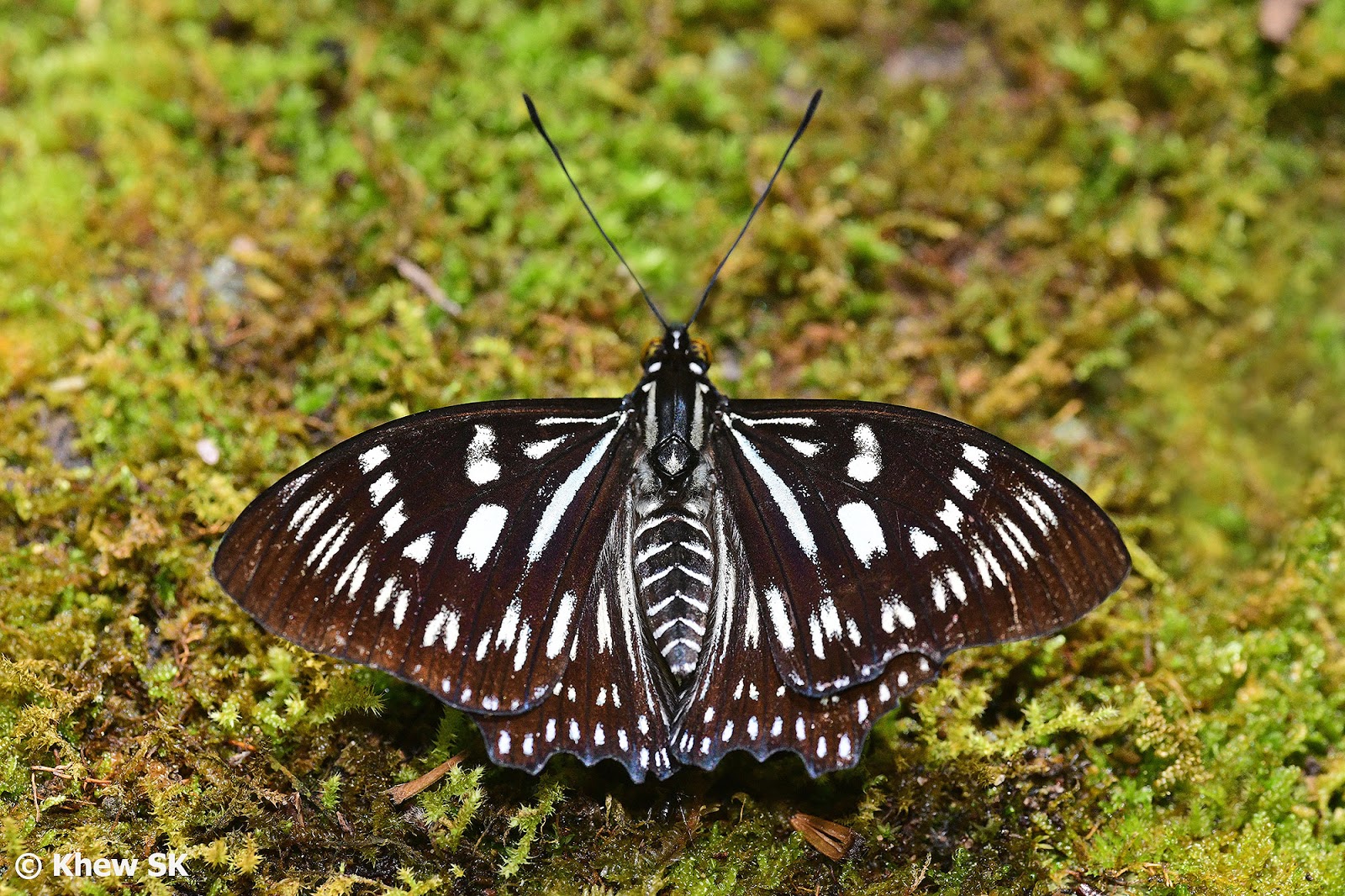
A male Courtesan puddling at the mossy footpath

A "Flat", Coladenia palawana stopped to feed on a mossy rock
As the morning wore on, I noticed a male Courtesan (Euripus nyctelius borneensis) foraging amongst some green moss. There were no signs of the polymorphic females of this species seen on our outings here. Just past 1pm in the afternoon, as I was having my lunch of a vanilla cream bun, I spotted a skipper stopping on a rock nearby. It stayed long enough for some shots before taking off to the canopy again. It was the first time I saw this Coladenia palawana.

A record shot of a male Stibochiona schoenbergi

As the afternoon sun was warming up the environment, the puddlers appeared, as with many other forest species in the semi-shaded understorey. I spotted a male Stibochiona schoenbergi but it only allowed me a record shot of it before it took off. The Malayan Oakleaf came down to forage on the fallen fruits, in the company of the Dark Archdukes and other butterflies.


The endemic Bornean Sawtooth puddling at the carpark
Out in the open carpark, we saw a Common Bluebottle (Graphium sarpedon sarpedon), a Striped Blue Crow (Euploea mulciber portia), more Red Helens and a skittish Bornean Sawtooth (Prioneris cornelia), another Bornean endemic. It was puddling just after 2pm in the afternoon and under the hot direct sun. We took another trip back towards the waterfall to look for the afternoon butterflies, it was mainly more of the same species as the skies clouded over again.


A pristine Malay Red Harlequin in the shaded understorey of the trail
Before making another round back to the waterfall trail, David also managed to shoot a Malay Lacewing (Cethosia hypsea hypsea) feeding on wild flowers around the grounds of the Mahua Rainforest Paradise. Back at the shaded forest trail, a few Malay Red Harlequins were spotted, hopping from leaf to leaf and doing the twist and turn behaviour that is typical of the Riodinidae. We saw several individuals of this species, but they are often in deep shade and a challenge to photograph.

A rare endemic, Pirdana albicornis

The Silky Owl came down to puddle on some fallen fruits
Elaine called out to us when she spotted a Silky Owl (Taenaris horsfieldii occulta) feeding amongst the fallen fruits on the mossy ground. As it was busy feeding, it gave us an opportunity to get it up close and personal. This species appears to be a resident species of Mahua Waterfall area, and we continued to see other individuals flying around over the period when we were at Mahua. Cheng Ai also managed to encounter another Bornean endemic, the skipper Pirdana albicornis.

Typical under-leaf perch that this species, the Ninja, displays.
Along the forest trail, we spotted this interesting species known as the Ninja (Amnosia decora buluana). It has a unique habit of flying strongly around, and then stopping on the underside of a leaf with its wings opened flat, reminiscent of the skippers. However, its large wingspan, antennae and way of flying distinguishes it from the Hesperiidae.

A view towards the adjacent dormitory from the serambi or porch of our lodge
As the sky became overcast, we called it a day and headed back to our lodge to wash up. It drizzled abit as we were heading downtown to Tambunan for dinner. After stocking up on our daily supplies, we headed back to the lodge and an early night, preparing (or hoping) that we would get better and sunnier weather the next day.
Text by Khew SK : Photos by David Chan, Khew SK, Lim CA and Loh MY


