08 December 2019

Butterfly Eyespots

Butterfly Eyespots
Ocelli on A Butterfly's Wings


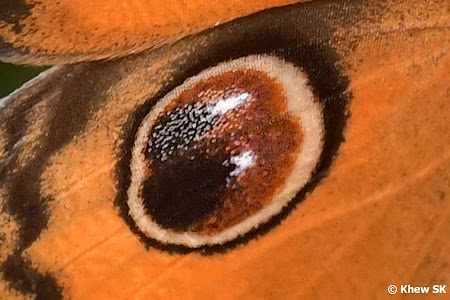
An eyespot on a butterfly's wing, complete with "pupil and iris", and a reflective highlight - all created by the evolutionary adaptation of the scales on the wings

The intricate patterns, markings and colours of a butterfly's wings have long intrigued researchers, many of whom have postulated theories and possible reasons for these markings. Whether these are striations, bands, structural colours, iridescent markings or eyespots, their functional origins or objectives have often been a source of debate amongst scientists.


A female Blue Pansy (Junonia orithya wallacei) complete with colourful "eyes" on the fore and hindwings

The amazing array of designs and spectrum of colours on a butterfly's wings have been admired by nature enthusiasts and butterfly watchers. From black-and-white patterns to multi-coloured designs, each species of butterfly is unique in its own right. Combined with the morphological attributes of wingshape, size and so on, these features are often used for the basic identification of the different species of butterflies.


Underside ocelli of the Blue Morpho (Morphos peleides

Other than just for pure aesthetic reasons to look 'pretty', observers and scientists have been searching for answers as to why the patterns and colours on butterflies' wings are presented in such a way and if there are evolutionary functions of these patterns and markings, whether viewed individually or as a group, to resemble or mimic other organisms.


The large eyespots on the Giant Owl (Caligo memnon) are designed to confuse predators that they are dealing with an animal that is much larger

One of the often-studied features of a butterfly's wing patterns is the presence of ocelli (singular : ocellus) or referred to as "eyespots" on the wings. Eyespots may be a form of mimicry in which a spot on the wings of a butterfly may resemble an eye of a much larger animal to deceive potential predator or prey species. Eyespots may also play a role in intraspecies communication or even in courtship.
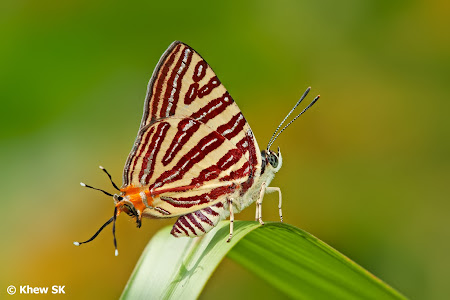

The modified ocelli at the tornal area of the hindwing of the Long Banded Silverline, complete with false antennae moving in the wind, are designed to fool predators into attacking a less critical part of the wings

In some cases, like in Lycaenidae species, the eye spots are a form of self-mimicry, to draw a predator's attention away from the most vulnerable body parts. Coupled with striations which draw attention to the eyespots and the butterfly's wing movements, this form of decoy mimicry has been well studied.


Large tornal "eyes" on a Great Helen's hindwings with its spatulate tails - designed to confuse predators?

Let us take a look at some examples of ocelli-adorned species across the different families of butterflies in Singapore. The Papilionidae do not generally employ ocelli patterns on the majority of the species in the family. A few species like the Helens and Great Mormons feature large tornal ocelli that suggest that these eyespots may be some form of decoy that could either scare predators into thinking that they are dealing with a large animal with red eyes, or perhaps direct a predator to a less fatal spot to attack.


An eyespot on the underside of a Lime Butterfly.  A mere decorative feature, or an eyespot designed to confuse predators?

The Pieridae species of "Whites and Sulphurs" have wings that feature streaks, spots and stripes, but have no particular strong association with the use of ocelli for any form of mimicry or protection. Many of the species of this family display aposematic colouration or simply use their flight speed to avoid predators.


Amongst the subfamilies of the family Nymphalidae, the use of ocelli-like patterns on the wings appear to be mainly limited to the subfamilies Satyrinae and some genera of Nymphalinae. The other subfamilies are generally patterned with stripes and other forms of designs, and usually coloured beautifully.


Eyespots on the wings of the Bush Browns (Mycalesis spp) complete with "irises and pupils"

The Satyrinae in particular, have several genera that have wings adorned with ocelli, e.g. Orsotriaena, Mycalesis, Ypthima, and many others. With the majority of the species in the subfamily that are not known to be distasteful to predators, it is likely that the use of ocelli on their wings give some measure of mimetic decoy as protection from predators.


Ocelli on the hindwing of Ypthima species

The Mycalesis or Bush Browns, and the Ypthima or Rings, have many ocelli on their fore-and hindwings as well as on the uppersides and undersides of their wings. Whether these eyespots are meant to intimidate, confuse or misdirect predators would be an interesting subject for researchers to further investigate.


"I'm looking at you!" - Eyespots on the hindwing of a Palm King (Amathusia phidippus)

Amongst the larger species of butterflies, formerly placed in the Morphinae subfamily, are also examples that feature large animal-like eyespots, particularly on the undersides of the wings. These species tend to lurk in the shaded understorey of forested areas and camouflage themselves well. These eyespots may fool predators into thinking that they are dealing with a larger animal.


© Vallin A1, Jakobsson S, Lind J, Wiklund C : From the research article : Prey survival by predator intimidation: an experimental study of peacock butterfly defence against blue tits.Biological Sciences, 01 Jun 2005, 272(1569):1203-1207

The studies of ocelli and their effect on predation have been largely done by western researchers and the experiments conducted by the Swedish researchers, particularly on the European Peacock butterfly (Inachis io) have produced evidence that these eyespots do deter predators like birds from attacking the butterflies. Essentially, the researchers painted over the ocelli for some of the butterflies and studied them together with the normal individuals and how predators react to them.
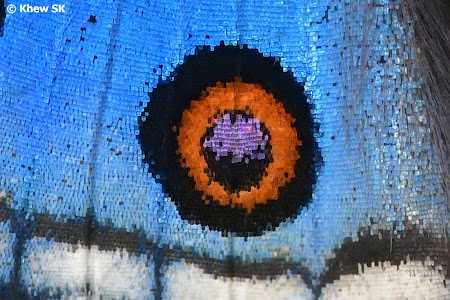
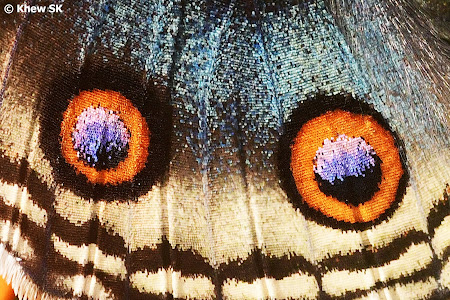
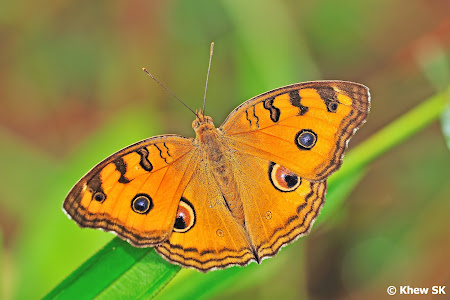

Colourful eyespots on the wings of Junonia spp.

Our local species in the Junonia genus, collectively called the Pansys, offer an almost similar range of ocelli-adorned species as the European Peacock. The Blue, Peacock, Chocolate and Grey Pansy species all have an interesting array of ocelli on their wings that probably function in the same way as their European cousins where the "eyes" are used to intimidate or deter predators.


Adapted ocelli on the tornal edge of the hindwings of Lycaenidae

The Lycaenidae have evolved their utilisation of ocelli into what is referred to as auto-mimicry to fool predators into attacking a less important part of their wings. The eyespots are adapted to look like the head of an organism, usually complete with "antennae" and the movement of the butterfly's hindwings, to direct a predator to attack a less critical part of the butterfly.


It is always interesting to observe how these Lycaenidae utilise colours, patterns and eyespots as a group of features to form a decoy to escape predatory attacks. Some of these eyespots come complete with silvery "eyebrows", orange and black eyespots and iridescent scales to emphasise an eyespot to attract a predator to "look at the wrong end" of the butterfly if it intends to attack.

Text and Photos by Khew SK

References :

01 December 2019

Butterflies of South Africa

Feature Book :
Butterflies of South Africa


A friend who recently visited South Africa managed to get me a copy of the Field Guide to Butterflies of South Africa by Steve Woodhall. A prolific author of several books on butterflies, Steve has effectively introduced the amazing diversity of South African butterflies through his excellent books and on social media to those of us in "faraway" lands who can only drool at the beauty of the butterflies in Steve's backyard.


The Field Guide to the Butterflies of South Africa was first published in May 2005. It was back then, the definitive book for butterfly enthusiasts and sold over 20,000 copies around the world! Steve went on to published several other books on butterflies in 2008, 2013 and 2016 and even has an app for iphones. He is currently working on the 2nd edition of his Field Guide and it is expected to be launched some time in 2020.


A nice "index" at the start of the book that shows all the families/sub-families of the butterflies featured in the species accounts section.

Butterflies of South Africa is a 440-page softcover book in a handy standard A5 sized format. The majority of the 1,800 photos in the book are by Steve and the remaining photos are by a group of his associates. The photos are mainly of field shots of the 660 species in South Africa, with some pinned specimen shots where field shots are not available.


Biogeography, vegetation ecosystems and habitats where the butterflies are found in South Africa

The book starts with the necessary introduction to butterflies - their taxonomic classification, biology, life history. anatomy, life history and so on. As the land area of South Africa is relatively large, the author elaborated on the different biomes (vegetation ecosystems) found in South Africa.


Introduction section with anatomy, taxonomy, etc.  Here, the Comstock system of wing venation is used

The largest section in the book, as can be expected, is the species accounts. The author organised the book by families, starting with the group with the largest number of sub-families - the Nymphalidae. It is then followed by Lycaenidae, Pieridae, Papilionidae and Hesperiidae. It is interesting to note that the 6th family in the butterfly world, Riodinidae (Metalmarks) is missing from South Africa.


This blogpost features some of sample pages of the species accounts. Each pair of pages are organised such that the write-ups are on the left, and the photos of species described are on the right. This is a convenient format for readers, as the pictures correlate directly to the write-ups without having to flip and cross-reference to a set of plates located elsewhere in the book, or even having to turn to a next page to view a photo of a butterfly that was described in a preceding page.


The descriptions of the species and other useful information are formatted on the left page, with the corresponding photos of the species on the right.  Photos are labeled for easy reference and there is no need to flip pages to refer to photos in appendices or plates in other parts of the book.

Each photo is labeled 1A, 1B, 2A and so on, to correlate to the write ups, showing upperside, underside, male or female of a species as the case may be. Where field shots are unavailable, these are supplemented with photos of pinned specimens. As field butterfly photography goes, it is not always possible that one can get good photos of all the uppersides and undersides of every species. Hence the most practical way of allowing readers to have a view of the uppersides (or undersides) of some species, a shot of a pinned specimen may be the best compromise.


Danainae section featuring the genus Amauris

The Danainaes of South Africa look quite different from those of Southeast Asia and have interesting common names to boot. The genus Amauris have common names like Layman, Friar, Novice and Chief! It appears that there are only 6 Danainae species in South Africa, of which the African Monarch (Plain Tiger in Singapore) is one species that we have in common. However, in South Africa, there are no fewer than 7 different forms of this species.


There are 21 Acraea species in South Africa compared to Singapore's single non-native species

The subfamily Heliconiinae is of interest, particularly from the genus Acraea. In Singapore, the Tawny Coster (Acraea terpsicore) was added as a new species in 2006. It is the sole representative of the genus found here. However, in South Africa, there are 21 Acraea species! The diversity in colours and patterns of this genus is quite amazing. But the similarities with A. terpsicore in wing shapes and general appearance are obvious.


The amazing Emperors (Charaxes) species of South Africa

The subfamily Charaxinae features some of the most spectacular butterflies in the world.  Their intricate patterns and colours are often a sight to behold.  Often referred to as the Rajahs in Asia, the genus Charaxes usually features robust-bodied species with twin tails.  Over in South Africa, there are 23 species (of which two species have single tails).  Definitely a country to keep Charaxes enthusiasts busy!


The Pansy species.  Blue Pansy is the name given to Junonia oenone in South Africa

South Africa shares many species of Junonia with Southeast Asia. There are 6 species, of which J. orithya (Blue Pansy in Singapore) is also extant as a different subspecies. However, in South Africa, it is called the Eyed Pansy instead, whilst the common name Blue Pansy is reserved for another species, Junonia oenone oenone.


The Bar species (related to the Silverlines in Asia)

The Lycaenidae family features amongst the largest number of species worldwide. Over in South Africa, the genus Cigaritis is related to the Spindasis found in our part of the world. And indeed, the jury is out (or rather, still debating) on which should be the "right" genus name for these pretty Silverlines. They are called "Bars" in South Africa but are no less pretty than their Asian counterparts.


Amongst these amazing Lycaenidae is the Golden Flash (Chrysoritis phosphor) a sought-after rarity in afromontane forest. Read the humourous article by Paulo and Rob Candotti about how Steve managed to capture one of these beauties.


The family Pieridae features the same white and yellow species that we can find all around the world, and South Africa's diverse range of these usually fast-flying brightly coloured butterflies is no exception. Some of the genera that are similar to the Southeast Asian butterfly fauna are Appias, Leptosia, Eurema and Catopsilia.


The spectacular Swordtail species of South Africa with their long elegant tails

The Birdwings and Swallowtails are amongst the most spectacular butterflies in the world. South Africa has 14 species in only two genera - Papilio and Graphium. As a comparison, Singapore is home to 18 species of Papilionidae. However, the Swordtails of South Africa are gorgeous and also share the same mud-puddling habits of their Asian cousins.


Some colourful Skippers of South Africa

The final family, the skippers or Hesperiidae showcases some pretty amazingly coloured species in South Africa. Generally similar in appearance to their Asian cousins amongst the majority of the species, the Hesperiidae of South Africa features a good variety of brown, orange and spotted species.


Coming Soon! The 2nd Edition of Butterflies of South Africa by Steve Woodhall

With this short blogpost introducing Steve Woodhall's Butterflies of South Africa, I hope that I have whetted your appetite for South African butterflies. If you are thinking of getting a copy of the book, the advice is don't! The reason is that Steve has been working on a 2nd edition of this book and will certainly outdo himself in the forthcoming 2020 edition that will be out on the shelves in May next year (according to Amazon).

Text by Khew SK : Photos reproduced from Butterflies of South Africa, with the kind permission of Steve Woodhall.

24 November 2019

Relative Abundance Indicators

Butterflies : Relative Abundance Indicators
From Common to Rare


A Malay Lacewing feeding on the flower of Lantana camara at Central Catchment Area. Circa 2005

A friend recently asked me, "so has your butterfly survey project concluded?". My answer was yes and no. Firstly, surveys to "inventorise" our local butterfly fauna are always "ongoing". Although each official project may last 1-2 years, like the Bukit Timah Nature Reserve Comprehensive Biodiversity Survey, and the current Pulau Ubin Biodiversity Survey commissioned by the National Parks Board, many local butterfly watchers and enthusiasts continue to observe and keep records of butterfly activity in Singapore.


A Magpie Crow feeding on a sweaty backpack strap at MacRitchie Nature Trail. Circa 2005

With social media and digital photography, it is much easier to collect records and collate information on butterflies today. Apps such as Biome and iNaturalist are relatively good repositories of sightings and documentation of species diversity, abundance and location. Data collected can henceforth be analysed and may give a better overview of butterfly activity across Singapore the years.


In the Red Data Book, the convention used to describe the relative abundance of species is crafted after the International Union for Conservation of Nature (IUCN) guidelines. The Red List Categories and Criteria were basically categorised by "threat to extinction". For the layman, it may be rather scientific and hard to relate to.


Hence, when I was working on the Butterflies of Singapore, I adopted a less scientific approach  and used a more simple "Relative Abundance Indicator" table and layman-friendly 6-category abundance indicators from "Common to Very Rare". The final category of "Seasonal Migrant" covers all the occasional appearances of species that are non-resident in Singapore.


The annual variability and irregularity in the sightings of certain species over the years continue to affect their relative abundance. It is more pronounced in some species compared to others. Hence what was listed as "common" or "moderately common" may be come "rare" and conversely, what was "rare" or "moderately rare" may become "common".


Examples of some of the more obvious species that may require a re-classification of their abundance, are highlighted here. These are certainly not exhaustive nor definitive and the relative abundance indicators will continue to evolve and change over the years, as more data and observations are collected.

1. The Magpie Crow (Euploea radamanthus radamanthus)


A Magpie Crow puddling at a damp streambank near Rifle Range Trail. Circa 2008

The Magpie Crow was widely distributed across Singapore in the past decade and often spotted mainly in the nature reserves. It was most regularly seen at the Bukit Timah Visitor Centre before the upgrading works, but has been spotted at Rifle Range Road Trail, Sime Forest, MacRitchie Reservoir Park, Upper Seletar Reservoir Park and many other localities.


A trio of Magpie Crows puddling at a muddy spot at Upper Seletar Reservoir Park in 2005

A Magpie Crow puddling on a concrete water pipe

Considered "Moderately Common" between 2005 and 2015, the Magpie Crow appears to be rarely sighted in recent years. Records from recent social media posts seem to validate this observation. Have there been any ecological changes that made the species become much rarer? Has its caterpillar host plant been affected in some way and become less common? We will need to keep looking out for this species again in the coming years to see whether its population rebounds.

2. The Malay Lacewing (Cethosia hypsea hysina)


The Malay Lacewing, once a regularly-seen species in the nature trails, appears to be much rarer these days

A favourite amongst butterfly watchers and photographers, the Malay Lacewing features intricate patterns on black and orange coloured wings and is one of the prettiest butterflies in Singapore. The species was also categorised as "Moderately Common" as it was often seen flying around in the Central Catchment Nature Reserves along forest trails and feeding on flowering plants.


A Malay Lacewing perched on a leaf at Ulu Sembawang Park Connector, Mandai. Circa 2013

Again, after 2015, records of sightings of this species have decreased significantly. The non-native Leopard Lacewing, discovered in 2005, was not known to aggressively compete with the Malay Lacewing for its host plant, Adenia macrophylla, as its caterpillars prefer to feed on Passiflora foetida found abundantly in urban areas. Could something have changed and the "invader" has edged the native species out? This is something for the environmental ecologists to study further.

3. The Common Tree Nymph (Idea stolli logani)


Will the Common Tree Nymph soar amongst the treetops as commonly as before?

The large and spectacular Danainae is always a crowd pleaser whenever it appears high up in the forest canopy, soaring and gliding amongst the treetops. It is a forest-dependent species and the Common Tree Nymph has almost exclusively been sighted only within the forested nature reserves of Singapore. Also categorised as "Moderately Common" between 2005 and 2015, sightings of this species have become rarer these days.


Three Common Tree Nymphs frolicking at tree-top level at Upper Seletar Reservoir Park in 2008

In the past decade, when the Spicate Eugenia is in full bloom, the flowers attract a myriad of butterflies.  The Common Tree Nymph is one of the species that makes an appearance.  In recent years, when this tree is in flower, the Common Tree Nymph is sadly absent.

At the forest fringes of the nature reserves, when the Spicate Eugenia (Syzygium zeylanicum) trees flower, there are many species of butterflies that are instantly attracted to feed on the nectar of the flowers. The Common Tree Nymph was one of the species that turns up regularly - sometimes even up to 3-4 individuals. In the past few years, when the Spicate Eugenia trees are in bloom, the Common Tree Nymphs have failed to show up. Has anything changed in the environment to make this species become "Rare"?

4. The Common Three Ring (Ypthima pandocus corticaria)


The Common Three Ring, the largest of the Ypthima species, is no longer as common as before

This "unattractive" butterfly was described in the reference book, Butterflies of the Malay Peninsula to "almost dispute the claim of the Common Grass Yellow to be regarded as the commonest butterfly in Malaya". Usually seen along forest fringes amongst grassy patches, this species was categorised as "Common". It flies close to the ground, and in the past, several individuals can be encountered at its favourite locations.


Today, the species is not as often encountered. Could it be due to the reduction of its grass host plant, Ischaemum muticum? For a common butterfly, its life history is interestingly long - between 30-35 days as a caterpillar. Did something happen in its habitats to interrupt the life history development? Once again, should the Common Three Ring, which was previously "Common" may now have to be reclassified as "Moderately Rare"?


The abundance of various species of butterflies will continue to change and evolve, as the environment, habitats and ecology changes over the years. Climate change may have a strong influence on these factors. Nature groups and researchers with the resources to undertake projects to sustain butterfly populations in Singapore may need to widen their scope to look at some of these previously "common" species and target species recovery programmes to include these butterflies.

Text and Photos by Khew SK