15 December 2018

Butterfly of the Month - December 2018

Butterfly of the Month - December 2018
The Malayan (Megisba malaya sikkima)


A Malayan perched at rest with its wings folded upright

The cold month of December is upon us already as we on the verge of bidding farewell to 2018. All around the world, the countries in the northern hemisphere are already experiencing, or predicting mega-freeze winter conditions in the coming months, where the El Nino event is predicted to spark blizzards of heavy snow. The anticipated cold snaps seem to correlate with the record summer temperatures this year.


Over in Beijing, where the freezing winter months are usually accompanied by extremely bad air quality due to the burning of low-grade coal, the government has imposed strict bans on burning fuel over winter as part of Beijing’s war on pollution. Beijing has said it will be less severe with its pollution curbs this winter as it grapples with slower economic growth and the trade war with the United States.


And speaking of the trade war, the temporary 90-day reprieve between the US and China that will halt new tariffs on both sides is not likely to end in a clear cut resolution between the two economic giants. Already, the economic climate all around the world, and in particular, in the ASEAN countries have shown signs of a looming crisis ahead.


Closer to home, the recent bilateral spats over maritime and airspace between Singapore and Malaysia is a reminder of the delicate cross-border politics between the two countries, recently referred to as "twins". The tactics of a certain veteran politician does not appear to be anything new - when you have domestic problems, just poke the little red dot down south to create some distractions.


In this age and time of lightning speed communications and information, the old tactic of galvanising the citizenry using nationalistic issues still seem to work. Standing united behind their respective countries, each side's netizens trade barbs over social media - something that was not so commonplace in the 70's and 80's when similar tensions arose. Let's hope that common sense and calm minds prevail and good neighbourliness will again stand the test of these political maneuvers.


A Malayan puddling at a sandy streambank

Our final Butterfly of the Month for 2018 will be, coincidentally, the Malayan (Megisba malaya sikkima), although the choice has nothing to do with the country or any particular individual from our neighbours up north. This diminutive butterfly has a wingspan of only about 20mm from wingtip to wingtip.


At a glance, the Malayan is reminiscent of a small Common Hedge Blue (Acytolepis puspa lambi) with the spots and streaks on the underside quite similar. The Malayan is often spotted singly and frequents open paths, fluttering restlessly amongst the shrubbery. It flies erratically but with a rather weak flight, and stops to rest on the top surfaces of leaves, with its wings folded upright.


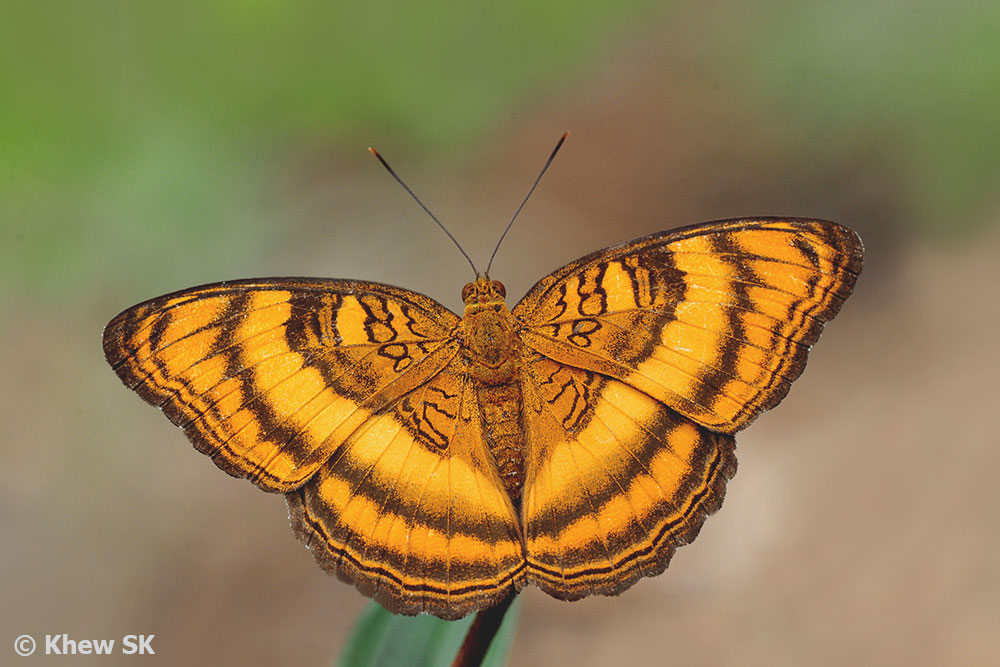
The Malayan is a light brown above, generally unmarked, but with a paler discal area of the forewing. The underside is whitish-grey, with black spots and grey streaks on both the fore- and hindwings. There is a pair of short, delicate white-tipped  tails, which are extensions of the cilia, at vein 2 of the hindwing. In subspecies in other parts of Southeast Asia, the tails may be absent, but subspecies sikkima found in Malaysia and Singapore almost always possesses the tails.


A Malayan feeding at the ripened fruit of the Singapore Rhododendron

A puddling Malayan

The species has large jet-black eyes and its antennae, legs and abdomen are black and white banded. This small butterfly has been observed feeding at flowers, the ripened fruit of the Singapore Rhododendron (Melastoma malabathricum), puddling on damp spots along forest paths, on bird droppings and along sandy streambanks in Singapore.


The species has been successfully bred on Turn-In-the-Wind (Mallotus paniculatus) in Singapore. The Malayan is by no means a very common butterfly, but is regularly encountered singly from urban parks and gardens, to the forested nature reserves and at the backmangroves habitats near the coastal areas of Singapore.

Text by Khew SK : Photos by James Chia, Huang CJ, Khew SK, Loke PF, Nelson Ong, Simon Sng, Michael Soh, Jonathan Soong, Tea Yi Kai, Horace Tan and Bene Tay

08 December 2018

Snow Flats of Singapore

Snow Flats of Singapore
Featuring the Snow Flat Skippers


Amongst the skipper family Hesperiidae, there is a sub-family that features "Flats or Spread-Winged Skippers" - referring to the open-winged pose of the butterflies when at rest, or feeding. This sub-family, Pyrginae, is represented by 12 species in Singapore. The majority of these species are considered rare, and a few of them were only discovered as recently as in 2011 and 2012.


The "Flats" are swift flyers, and has a unique behaviour of stopping under leaves in their typical open winged pose. When disturbed, the butterfly will zip off quickly to search for another leaf to settle on the underside to hide itself. During certain hours of the day, several species are more likely to be observed settled on the upper surfaces of leaves to sunbathe. Even when feeding on flowers or puddling, these "Flats" maintain their open winged pose.


This weekend's blogpost discusses the four species of the Tagiades genus - collectively referred to by their English common name of "Snow Flats". The reference to "snow" in its name probably originates from the whitened tornal area of the hindwing and undersides of the species in the genus. The whitened hindwings often give an appearance of a much smaller white butterfly zipping around the shrubbery when these butterflies are in rapid flight.

Common Snow Flat (Tagiades japetus atticus)


A Common Snow Flat feeding at the flower of Syzygium zeylanicum

Of the four species extant in Singapore, the Common Snow Flat is probably the most often encountered species. It is usually associated with the forested habitats in Singapore, where it is most active in the cooler early morning hours of the day.


The underside of the hindwing of the Common Snow Flat showing bluish-white scales


The Common Snow Flat is pale brown on the uppersides, with small hyaline spots on its forewings. The are dark brown discal markings on the hindwing and a dark brown margin on both the fore- and hindwings. The underside of the hindwing is suffused with bluish-white scaling that may appear white in pristine individuals.


Large Snow Flat (Tagiades gana gana)


A Large Snow Flat sunbathes on the upper surface of a leaf

The Large Snow Flat is the next commonest species in the genus, although it is by no means considered a common butterfly in Singapore. It makes a regular appearance when flowering trees like the Syzygium spp. blooms. It also displays the usual habit of keeping its wings opened flat, even when feeding.


The Large Snow Flat is dark brown on its upper surfaces with rather diffuse brown markings on its wings. There are usually three hyaline sub-apical spots on the forewing. The tornal area of the hindwing is whitened and has small diffused black spots. On the underside, the whitened area is more extensive and reaches the wing base of the hindwing.


Malayan Snow Flat (Tagiades calligana)


A Malayan Snow Flat perches on the underside of a leaf

A relatively rare forest species, the Malayan Snow Flat also features a larger tornal patch on the hindwing that extends all the way across its mid-abdomen. The species is also a fast-flyer and exhibits the same habit of stopping with wings opened on the undersides of leaves to rest. It is usually seen in the early hours of the morning.


The Malayan Snow Flat is dark brown above, with the usual sub-apical and post-discal hyaline spots on the forewings. The hindwing tornal patch is pure white and contrasts with the dark brown wings. The whitened scaling is more extensive on the underside, covering most of the wing. There are prominent black submarginal spots at the tornal area of the hindwing, but lacks the spot at vein 1b.


A Malayan Snow Flat perched on the underside of a leaf

Ultra Snow Flat (Tagiades ultra)


This species was re-discovered in the late 1990's in Singapore after being recorded as extinct by the early authors. It is another rare species, and usually individuals are observed. The butterfly is more active during the cooler hours of the day, and often seen feeding at flowering bushes or sunbathing in the morning sun.


An Ultra Snow Flat feeding at the flowers of the Pagoda Flower shrub


The Ultra Snow Flat is dark brown above with the typical hyaline post-discal and sub-apical spots on the forewing. Its general appearance is similar to the Malayan Snow Flat, except that it has four large prominent submarginal spots on the hindwing that are sometimes conjoined in some individuals. On the underside of the hindwing, the white is more extensive and reaches the wing bases.


Text by Khew SK; : Photos by David Chan, Chng CK, Huang CJ, Khew SK, Koh CH, Loke PF, Michael Soh, Jonathan Soong, Tan BJ and Horace Tan

Life Histories of the Tagiades species in Singapore :

01 December 2018

Butterfly Photography at Our Local Parks - Kranji Marshes

Butterfly Photography at Our Local Parks
Featuring : Kranji Marshes


The Colonel (Pandita sinope sinope) feeding at the flowers of the Red Tree Shrub (Leea rubra) at Kranji Marshes

In this weekend's blogpost, we take a visit to a wetlands park situated in the northwest part of Singapore. Kranji Marshes, located along the northwestern shore of Kranji Reservoir, is one of the largest freshwater marshes in Singapore. Set in a rustic and rural environment around the Kranji area in Singapore, the 56.8-hectare freshwater marshland that is home to a wide range of biodiversity.


A map of Kranji Marshes - click to enlarge

Kranji Marshes is divided into two portions - a publicly accessible sector that covers about 8Ha, and a Core Conservation Area that comprises a freshwater marshland habitat that is ecologically sensitive and is closed to the public, except for activities approved by NParks. Specially guided walks are conducted regularly by NParks and volunteers.


Visitor Centre at Kranji Gate viewed from the carpark


The entrance to Kranji Marshes is via Neo Tiew Road into Neo Tiew Lane 2. You will pass the homestay farm known as D'Kranji Farm Resort before reaching the carpark in front of the visitor centre at Kranji Gate. There are basic visitor amenities here like restrooms, classroom facilities, and creature comforts like a drinking fountain and cold drinks dispensing machine.


Landscaping at Kranji Gate area.  Look out for the Red Tree Shrub and Singapore Rhododendron where some butterflies come to feed

The landscaping here is in keeping with marshland plants, and vegetation that can tolerate waterlogged conditions. When I visited the Kranji Marshes recently, there were a couple of fruiting Melastoma malabathricum (Straits or Singapore Rhododendron) bushes. The "signature" butterfly of Kranji Marshes (more about this butterfly in awhile) is often found in the vicinity, and one greeted me as soon as I walked past the Rhododendron bushes. Another Common Sailor (Neptis hylas papaja) was feeding on the ripened fruits.


A Common Tit feeding on the flower of the Red Tree Shrub at Kranji Marshes

Although the plants around the Kranji Gate area are not particularly the butterfly-attracting type, look out for the Red Tree Shrub (Leea rubra) shrubs with their attractive crimson red inflorescence. On a good day, you may be able to spot several species of butterflies feeding at these flowers.


Along the walk at Neo Tiew Woods, spot the butterflies on both sides of the road

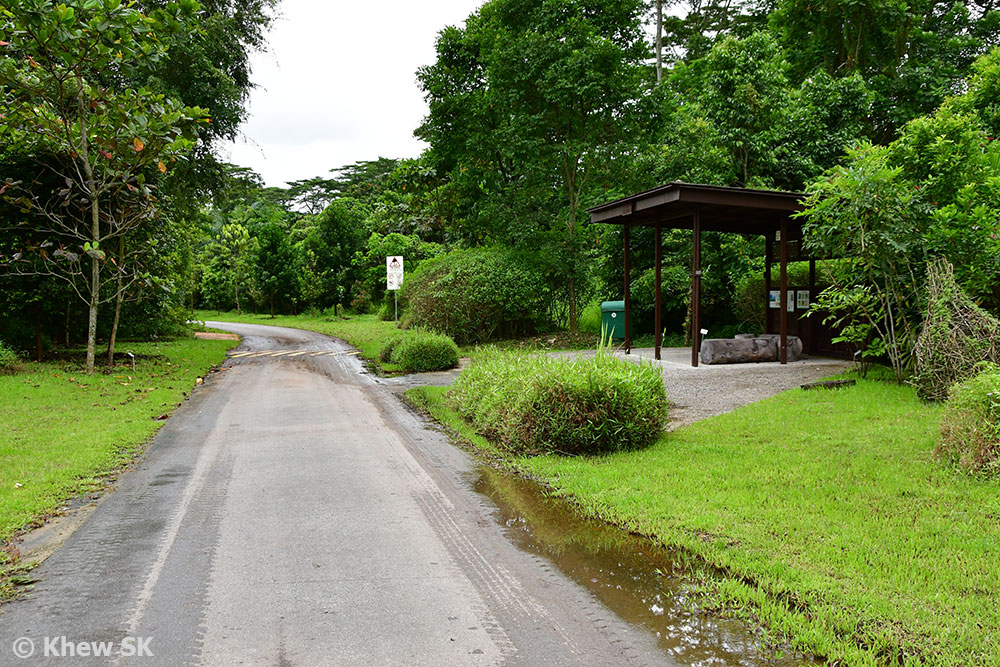
As you leave the Kranji Gate area, walk along the paved road along a narrow strip of land that is referred to as Neo Tiew Woods. The newly-planted trees that line this road do not offer much shade yet, and the walk along this stretch of road can be unpleasantly hot under the scorching mid-day sun. However, keep your eyes peeled on the roadside shrubbery and grasses where butterflies may be frolicking around.


Checking out the Bandicoot Berry shrubs at Neo Tiew Woods can sometimes yield a few surprises

There are several Bandicoot Berry (Leea indica) and Red Tree Shrub trees along this track that are attractive to butterflies. Other butterfly-attracting species like the Syzygium lineatum and Syzygium zeylanicum line the roadside and when these shrubs in flower, they would be quite busy with butterflies feeding on the flowers.


Two views of the Woodpecker Shelter

Proceeding further on, you will reach the Woodpecker Shelter before arriving at the Marsh Station. This area features a small pond, around which there is ample vegetation for all sorts of critters. The green-roofed Kingfisher Burrow hides an open-sided outdoor classroom. Opposite this is the 10m tall Raptor Tower. It is often a rewarding climb up the spiral staircase to catch the breath-taking view of the surrounding marshland environment.


The 10m tall Raptor Tower

Lining the edges of the water bodies are bird hides where you can spot some of the migratory and resident birds that forage for food at the water's edge. This is about as far as a normal visitor can go. Unless you are on a special guided walk, you will not have access to the Core Conservation Area that can be reached through a gate that crosses the Sedge Bridge into the marshland area.


Views from the Raptor Tower towards the larger area of Kranji Marshes

The freshwater marshland habitat and the vegetation in the area favours a higher bird diversity than butterflies. Although, a total of 54 butterfly species have been sighted in the area, there are usually fewer butterflies compared to some of the more butterfly-attractive parks elsewhere in Singapore.


The "signature" butterfly of Kranji Marshes, the Colonel (Pandita sinope sinope) feeding on the flower of the Red Tree Shrub.  A skittish butterfly, it is easier to approach when it is feeding


However, for the butterfly photographers who are pursuing their +1's in their collection of species, Kranji Marshes is home to a "signature" species that is more often found here than elsewhere in Singapore. This butterfly is the Colonel (Pandita sinope sinope). Its caterpillar host plant, an Uncaria sp. is probably found in abundance in the vicinity, but it is interesting that it prefers this habitat and sometimes several individuals can be seen at the flowers of the Red Tree Shrub and frolicking around the bushes.


Other species of butterflies found feeding at the Red Tree Shrub flowers at Kranji Marshes

As with Sg Buloh Wetland Reserve, some "resident" species like the Blue and Dark Glassy Tiger and the Sumatran Sunbeam can sometimes be spotted at the flowering shrubs. The Grass Yellows - usually Common and Three Spot, are regular visitors to the flowers of the Bandicoot Berry and Red Tree Shrub, and their caterpillars probably feed on the Albizia leaves that are common in the vicinity.


Keep a close watch on the flowers of the Red Tree Shrub, and one can often be rewarded with sightings of Leopard Lacewings (Cethosia cyane), Blue and Peacock Pansys (Junonia orithya wallacei and Junonia almana javana) and the Lycaenids like the Common Tit (Hypolycaena erylus teatus) and Ciliate Blue (Anthene emolus goberus).


Whilst this one is harmless, do look out for the occasional real crocodile that lurks near the water's edge 

Red Tree Shrub (on the right) features pretty red inflorescences that are attractive to butterflies

The presence of the Wild Cinnamon (Cinnamomum iners) will bring the species whose caterpillars feed on this plant - Common Bluebottle (Graphium sarpedon luctatius) and Common Mime (Papilio clytia clytia). Other large butterflies like the Jacintha Eggfly (Hypolimnas bolina jacintha) and Autumn Leaf (Doleschallia bisaltide bisaltide) sometimes make their appearance as their caterpillars feed on the leaves of the Chinese Violet (Asystasia gangetica). that grow wild in the area.


Tailless Line Blue (Prosotas dubiosa lumpura) feeding on the flower of the Mile-A-Minute at Kranji Marshes

The public-accessible part of Kranji Marshes is considered a small park and the 8Ha area can easily be explored in a couple of hours or less. The marshland habitat is probably more attractive to bird watchers and photographers than for butterfly watchers. However, if you would like a date with the Colonel, this is the place to visit! Although I should add that there are no guarantees and even if a Colonel or two show up, the species is exceedingly skittish and getting a good shot of it would be a challenge.

How to Get There :

Kranji Gate:
11 Neo Tiew Lane 2,
Singapore 718814

By public transport :
Take the Kranji Express bus from Kranji MRT Station which operates daily from 8.30 am to 5.45 pm. Alight at D’Kranji Farm Resort and take a short walk to Kranji Gate. From Kranji Gate, it is an approximately 1 km walk along Neo Tiew Lane 2 to the observation tower.

By car :
From Neo Tiew Road, turn into Neo Tiew Lane 2 and drive all the way to the end of the road where there is a 20-lot car park. Note that the operating hours of Kranji Marshes are from 7am to 7pm daily.

Text and Photos by Khew SK