17 November 2018

Butterfly of the Month - November 2018

Butterfly of the Month - November 2018
The Common Awl (Hasora badra badra)


A pristine Common Awl perches on a palm leaf

We are into the second last month of 2018 already! We can feel Christmas round the corner when colourful decorations, twinkling lights and the melodious songs of the season echo through the shopping malls and commercial complexes in Singapore. Websites and media scream of Christmas sales and offers of discounts of the holiday season.


The weather in Singapore has also been rather wet, with particularly extreme heavy rains on some days causing flash floods in various areas. Yet, in spite of the extra effort and engineering interventions by our utilities agency, floods can still happen in Singapore - often emphasising the inevitable outcome of man vs nature, when nature is in no mood to negotiate.


For those of us who travel by air regularly, the recent Lion Air crash with 189 fatalities brings a grim reminder to our over-dependence on technology. The anti-stall function and flight speed indicator had apparently malfunctioned, causing the almost brand new plane to plunge into the sea.


The fantasy world of super-heroes lost its iconic creator, Stan Lee, who passed away at the ripe old age of 95. Those who grew up in the era of comic books, waiting with bated breath for the next issue of Spider Man, Fantastic Four, Iron Man and so on, will appreciate the enjoyment of browsing through the pages of a comic book and fantasising about saving the world with our favourite characters.


A typical pose of the Common Awl, perched upside down beneath a leaf

Coming back to reality, this month's feature butterfly for November 2018 is the Common Awl (Hasora badra badra). This drab, medium-sized skipper can be considered moderately common in Singapore with a distribution across urban parks and nature reserves. It is most often found in mangrove areas where its caterpillar host plant, Derris trifoliata and Derris elliptica grows wild.


The Common Awl flies rapidly amongst heavily-shaded habitats where it is usually found, and is more often seen and photographed perched upside down on the undersides of leaves. When disturbed from its perch, it zips off quickly, and selects another perch under which it will try to conceal itself in its typical upside down position.


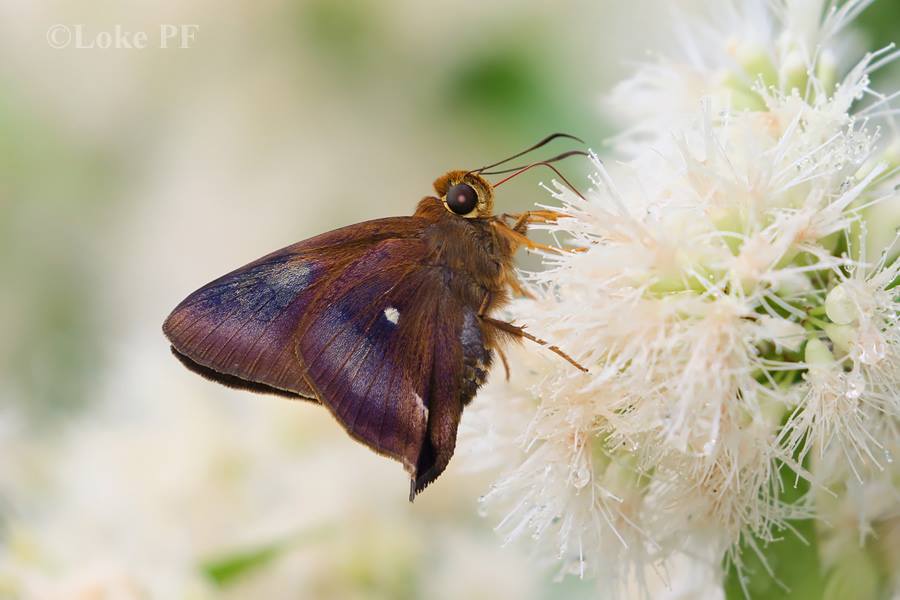
A Common Awl feeding at the flowers of a Syzygium tree

The species is known to puddle, particularly on damp organic matter or excretions of birds spattered on the top surfaces of forest vegetation. Other sightings of this species, besides being perched on the undersides of leaves, are when the Syzygium trees bloom. The Common Awl is seen feeding at the nectar-rich flowers together with other butterflies.


A newly eclosed female Common Awl showing the upperside hyaline spots on its forewing

The Common Awl is a drab brown on the upperside with the wings usually unmarked in the male. There may be a series of usually 2-3 small subapical spots on the forewing. The female has three large pale yellow hyaline spots in the discal area of the forewing, with the wing bases ochreous.


A Common Awl feeding on the minerals on the damp surface of a brick wall

The underside is brown, with a purplish glazed sub-marginal band that may appear more pronounced depending on the angle of incident light on the wings. A prominent white spot in the cell on the underside of the hindwing is characteristic of this species. There is usually a white streak at the tornal area of the hindwing.


Two female Common Awls, note the large pale yellow hyaline spots visible on the forewing

Sightings of the Common Awl are usually in the early morning hours before 9am and in the late evenings, when the species is more active. Its crepuscular habit makes the species rather elusive during the normal hours when other butterfly species are up and about. However, along mangrove trails and boardwalks, the Common Awl may be often seen at other times of the day if it is disturbed from its slumber.

Text by Khew SK : Photos by David Chan, Foo JL, Khew SK, Loke PF, Jonathan Soong and Horace Tan

11 November 2018

Butterfly Anatomy : Part 3

Butterfly Anatomy : Part 3
Interior Regions of Butterfly Wings


In Part 1 and Part 2 of the previous weeks' articles on butterfly anatomy, we learned about the naming of the various parts of a butterfly. In particular, the names of the external margins of the wings and the wing venation naming convention based on the Numerical Notation system. By now, we should be familiar with the terms like termen, costa, tornus and so on, which are descriptors of the external margins and angles of the wings.


In this article, we move into the interior regions of the wings and learn about the terminology that are associated with the different parts of the wings. As a recap to why these terms are important, even to amateur hobbyists, the following reasons come to mind :
  • An understanding of the naming convention means that the positions of the spots, bands, lines, and various features can be accurately described.
  • The descriptions of diagnostic features on a butterfly's wings in publications and scientific write-ups can be properly understood and the reader will know where to look and compare these markings if he/she understands the anatomical terminology.
  • Learning the names of various parts of the wings can also help an observer describe a feature properly so that these can be related to others to help ID a butterfly species. The proper names of these parts is likened to a "GPS" to locate different features on the wings e.g. "there are three sub-apical spots on the forewing", would immediately focus on the forewing, and spots that are just adjacent to the apex of the wing.


The basic internal regions of a butterfly's forewing and their associated anatomical names

Let us now take a look at the forewing of a butterfly, and familiarise ourselves with the names of the various parts of the interior regions of the wings. I will separate the forewing into 3 main regions so that each part is treated in installments to better focus on the areas under discussion. Then an actual butterfly photo is used as an example to illustrate the area concerned. However, it is important to note that these areas are not scientifically precise and is only a rough estimate of the part of the wing.


At this juncture, it is important to take note of the prefixes "sub-" and "post-". When the prefix "sub-" is used, it means the area that is closer or towards the body of the butterfly, and if "post-" is used, the area is further away from the body of the butterfly.


In many butterfly species, the apical area often contains important features that are diagnostic. This is the area that is near the apex of the forewing. Adjacent to the apical area is the sub-apical area where many features are also found which aid in the identification of butterflies.


Some examples illustrating apical and sub-apical features on the forewing of a butterfly

An example of a species with a diagnostic apical area is the Knight (Lebadea martha parkeri) which features "prominent white apical area" that distinguishes it from the female, which does not have its apical area whitened. In the 2nd example, the Common Three Ring has "a large yellow-ringed sub-apical ocellus".


The next region of interest would be the internal margins or "edge" areas of the wings. These are the costal area (at the costa of the forewing), the dorsal area (at the dorsum of the forewing) and the basal area (at the base of the forewing). The area next to the basal area is the post-basal area (further away from the body, hence "post-"). The outer wing edge is called the marginal area and the area next to it is referred to as the sub-marginal area.


Examples illustrating the various terms like marginal, sub-marginal, costal, basal and dorsal parts of the forewing of a butterfly

The examples shown of actual photos of various species showing the diagnostic costal spot of the Forget-Me-Not (Catochrysops strabo strabo), the creamy patch on the dorsal area on the forewing of the female Malay Lacewing (Cethosia hypsea hypsina) and the basal area of the Gram Blue (Euchrysops cnejus cnejus) a pale shining blue.  Note the features on the marginal and sub-marginal areas of the Malayan Lascar (Lasippa tiga siaka)


On the interior region of the forewing, are the areas that are associated with the wing cell. The cell (or disc) has been described in Part 2 with the wing venation. The areas around the cell is usually called the discal area. The area that is further away from the butterfly's body is referred to as the post-discal area, whilst the part that is nearer to the body is called the sub-discal area.


Features in the discal and post-discal parts of the butterfly's forewing

In the examples shown, the orange discal patch on the forewing above separates the male of the Dark Posy (Drupadia theda thesmia) from the females and other species of the genus. The Banded Yeoman features a broad orange-yellow post-discal band on the forewing.


The basic internal regions of a butterfly's hindwing and their associated anatomical names

Now let us take a closer look at the hindwing and the terminology of the various parts of the wing. As the wing surface of the hindwings of most butterflies is smaller than the forewing, there is no post-basal area on the hindwing.


Of particular interest is the tornal area of the hindwing. This area carries many diagnostic features like ocelli, tails and a series of markings that help in the identification of Lycaenidae butterflies. The tornal area is near the tornus of the hindwing.


The tornal area of Lycaenids usually have key distinguishing features that are used in the identification of butterflies

An example of the diagnostic feature of the orange-crowned ocellus and long tail at the tornal area of the Silver Forget-Me-Not (Catochrysops panormus exiguus), compared to the twin orange-crowned ocelli and short tail of the Gram Blue (Euchrysops cnejus cnejus).


Next, we look at the margins of the hindwing that are somewhat similar to the forewing, with the marginal, sub-marginal, costal, dorsal, and basal areas.


A few quick examples here are the Tawny Coster (Acraea terpsicore) with the white spots on a black marginal border, and the Dwarf Crow (Euploea tulliolus ledereri) with a row of white marginal and sub-marginal spots. In the Pointed Ciliate Blue (Anthene lycaenina miya), the large costal spot on the hindwing is a diagnostic feature to separate it from the similar-looking Ciliate Blue.


Finally, the interior region of the hindwing features the discal, sub-discal and post-discal areas of the wing that are associated with the section that encompasses the cell of the hindwing. Like in the forewing, this area often has many spots, stripes, bands and other features that help to identify a butterfly.


Focus on the discal features on the hindwing of these Neptis spp to better understand the differences between them


In the example shown here, the white discal band on the hindwing of the various Neptis spp. is diagnostic and helps to distinguish the various species found in Singapore. The post-discal band on the fore- and hindwing of the Bush Brown (Mycalesis spp) is an important feature that helps to separate the many lookalike species in the genus.


With the knowledge of these basic terminology used in a butterfly's anatomical features, a hobbyist can now combine the key descriptors in terms of wing margin names, venation (and spaces between veins) and interior regions of the wings to better understand how the physical features of a butterfly are described and where to look for specific diagnostic markings to help in the identification of different species of butterflies.  These 3 blog articles are by no means exhaustive and an enthusiast who is interested should continue to equip him/herself with a glossary of terms beyond these basic anatomical terminology of butterflies.

Text by Khew SK : Photos by Antonio Giudici, Khew SK, Bobby Mun and Jonathan Soong.  

Line diagrams of butterfly wings from Butterflies of West Malaysia and Singapore by WA Fleming.

Previous articles in this series :


03 November 2018

Butterfly Anatomy : Part 2

Butterfly Anatomy : Part 2
Wing Venation on a Butterfly's Wings


The prominently darkened veins on the hindwing of the Common Birdwing illustrates the wing venation and all the veins that originate from the cell

In the next article of our series on butterfly anatomy and scientific terminology, we take a closer look at the wings of the butterfly. The wings constitute one of the important parts of a butterfly in classification and identification work. The ability to understand the terms that are used to reference various parts of a butterfly's wings is critical to butterfly identification. This article focuses on the veins on the butterfly's wings and how they are named.


This backlit shot of a Lemon Emigrant shows the vein structure and arrangement clearly

The wings of a butterfly are membranous with veins running longitudinally from the base (where the wings are attached to the thorax) to the outer margins of the wings. The pattern and arrangement of these veins (wing venation) is an important diagnostic tool in the identification of butterflies. It is therefore important to understand the wing venation as a reference to locating features that are associated with the veins/spaces on a butterfly's wings. In some cases, the arrangements of the veins themselves will give important clues to the genus of the butterflies.


The raised veins are prominent in this Malay Lacewing and show clearly how the veins are arranged

The veins of a butterfly's wings gives the structural strength to the soft membranous wings onto which the scales are attached. These veins are tubular, in which a liquid 'blood', or haemolymph circulates within them.


The Comstock system of butterfly wing vein notation.  Whilst the system has a strong scientific basis, the numbering system requires a bit of understanding and is not easy for a hobbyist enthusiast to understand.  It is probably for this reason that, for butterflies, it is easier to understand the more intuitive Numerical Notation system.

A butterfly's wing venation has been used extensively in the classification and identification of butterflies and the nomenclature of the veins in insects usually follows the system adopted by JH Comstock (referred to as the Comstock, 1918 system). However, a simplified and more intuitive Numerical Notation system pioneered by Herrich-Schaffer is more commonly used. Basically, this system numbers the veins from 1, which represents the anal veins (1a and 1b) through to number 12 on the forewing, and 1a and 1b to 8 on the hindwing. Note however, that not all butterflies have the full set of veins on both wings, and may vary from species to species.


A typical wing venation of a butterfly based on the Numerical Notation system. Note the naming of the spaces between the veins 

In the Numerical Notation system, veins 2 to 11 on the forewing and 2 to 7 on the hindwing originate from the cell. The remaining veins originate from the wing bases. The interspace between two veins is known by the number of the lower vein. E.g. the space between veins 2 and 3 is referred to as "space 2".


In the identification of a Dingy Line Blue, the reference to the ocellus in space 2 being a diagnostic feature is clearer when one is able to find "space 2" on the hindwing by understanding the numerical naming of the wing venation and spaces between the veins.

This is an important convention to understand, as for example, the description of "the ocellus in space 2 of the hindwing is moved inwards" immediately directs the observer to that particular part of the wing to observe this diagnostic feature that distinguishes the Dingy Bush Brown (Mycalesis perseus cepheus) from its other lookalike cousins.


In the examples below, we illustrate how wing venation is used to refer to certain features of a butterfly. We will compare a few photographs of actual butterflies with the numerical system of naming the veins and how these wing veins appear in the actual individuals.


The Common Rose (Pachliopta aristolochiae asteris) - Species of the family Papilionidae tend to have the full complement of veins from 1a to 12 on the forewing and 1a to 8 on the hindwing (with vein 1b missing).


Diagrammatic representation of the wing venation of the Common Rose

For example, when a description of the Common Rose states "there is a spatulate (spoon-shaped) tail at vein 4 of the hindwing", it is now easy to look at the veins and understand where the location of the tail at vein 4 is.


The Striped Blue Crow (Euploea mulciber mulciber) - The Danainae feature species that have almost the complete complement of wing veins on both wings, with the exception of vein 1a on the forewing. In the case of this male Striped Blue Crow, the veins are clearly seen on the brownish base colour of the wings.


Diagrammatic representation of the wing venation of the Striped Blue Crow

Take a close look at the hindwing veins on the butterfly. Can you trace all the veins from vein 2 to vein 7 to the cell on the wing? On the hindwing in all butterflies, veins 2 to 7 always originate from the cell.


The darkened veins of the Painted Jezebel are helpful in locating and understanding the position of the veins on the wings.

The Painted Jezebel (Delias hyparete metarete) - Many species of the Pieridae feature the full complement of veins from 1a to 8 on the hindwing. However, several veins are missing from the forewing, where veins 1a, 8 and 10 are not present.


Diagrammatic representation of the wing venation of the Painted Jezebel

The Painted Jezebel, like several species in the Pieridae family, is also interesting in that the veins on the wings are darkened and it is quite easy to trace most of the veins in the butterfly when looking at its wings.


The Common Posy (Drupadia ravindra moorei) - A example of a Lycaenidae and the wing veins in this species. Many species in the Lycaenidae family have veins 8 and 9 are missing from the forewing.


Diagrammatic representation of the wing venation of the Common Posy

Looking at the hindwing veins, a description such as "the hindwing has three white tails at veins 1b, 2 and 3, of which the longest is the one at vein 2" becomes easier to understand.

In the next article, we will discuss the names of the different parts and zones on the wings of a butterfly and how we can use these references together with the wing venation and external margin names of the wings to find the diagnostic features in the identification of butterflies.

Text by Khew SK : Photos by Sunny Chir and Khew SK : Wing venation diagrams taken from Butterflies of the Malay Peninsula by Corbet and Pendlebury, 4th edition