13 October 2018

Butterfly of the Month - October 2018

Butterfly of the Month - October 2018
The Yellow Glassy Tiger (Parantica aspasia aspasia)


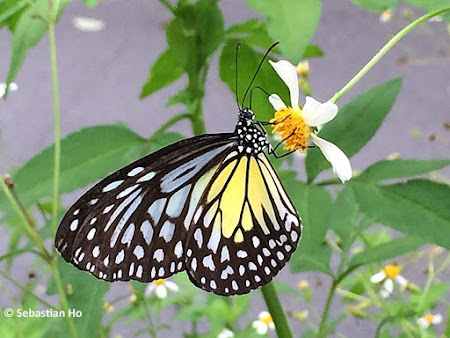
A female Yellow Glassy Tiger feeding on Lantana camara flower

The year 2018 crawls along into its tenth month and October is almost halfway through. It has not been a good year, both at the personal and at the work fronts, and I cannot wait for 2018 to end and to look ahead with greater optimism in 2019. It has been a year of ups and downs (mostly downs) and probably one of the more forgettable years in my life.


The local economy has not been favourable to the industry that I am in, and competition is rife and many companies are facing headwinds and a rather pessimistic outlook in the months to come. Throw in several unfortunate events directly affecting the company's branding and being in the news for the wrong reasons, it has been a year of hard knocks and bruised performances.


Health issues in the family also remind us of our mortality and vulnerability as we age. Time robs us of our youthful exuberance and leaves us a shell of what we used to be. But that's life, isn't it? No one gets younger or healthier as they age. But it is a grim reminder of the fear of losing a loved one, or facing major lifestyle changes due to negative impacts of the body's state of health. No one can say that they are prepared for such setbacks in their lives, because no matter how theoretically prepared we are, in reality, we aren't.


The global outlook is not that rosy either, with the US-China trade wars escalating in a tit-for-tat game of economic battles in the form of trade tariffs resulting in higher costs for some businesses causing overall global uncertainty in the near term. If we take a look back at history, the events preceding the two world wars started with economic crises. So let's hope that history won't repeat itself.


Even Mother Nature seems to be throwing out more extreme weather throughout the year and I don't recall back-to-back severe typhoons whipping Asian countries in recent history, resulting in multiple fatalities where these natural disasters struck. Add a couple of erupting volcanoes, a few earthquakes and tsunamis and hurricanes over in the western continents, it has been a particularly turbulent year for our world in the form of natural disasters too.


A male Yellow Glassy Tiger feeds on the flowers of a roadside White Weed (Ageratum conyzoides)

This month, we feature a seasonal visitor to Singapore, the Yellow Glassy Tiger (Parantica aspasia aspasia). Although recorded in Singapore by the early authors, the Yellow Glassy Tiger is very rare, and has not been seen for many years. Individuals have been irregularly observed from time to time, and these are believed to be strays from southern Malaysia making the occasional visits from across the Straits of Johor.


The Yellow Glassy Tiger's wings are predominantly bluish-grey with narrow black longitudinal streaks across both wings. Each wing has a bright yellow basal patch, with the yellow more extensive on the hindwing. It is this yellow colouration that gives the species its common name and distinguishes it from its all-grey cousins like the more common Blue Glassy Tiger and Dark Glassy Tiger found in Singapore.


The species flies with its characteristic slow and unhurried flight, which is typical of the "Tiger" butterflies of the Danainae subfamily. As the caterpillars of many of the Danainae species feed on lactiferous and toxic host plants, the adult butterflies display aposematic colouration and patterns, and are distasteful to predators.


A male Yellow Glassy Tiger feeding on the flowers of the Golden Dewdrop (Duranta erecta)

A female Yellow Glassy Tiger feeding on the flowers of the Indian Heliotrope (Heliotropium indicum)

The male Yellow Glassy Tiger has narrower and slightly more pointed wings, whilst the female has more rounded wings. The males also possess a conspicuous sex brand at the sub-tornal area of the hindwing. Females may be slightly paler in colour.


A male Yellow Glassy Tiger puddling at a damp streambank

Male Yellow Glassy Tigers have sometimes been observed to puddle at damp sandbanks near forest streams. Both sexes are frequently found feeding at flowering plants and wildflowers along roadsides and jungle trails. Although the species is relatively common in Malaysia but thus far, it is infrequently seen in Singapore.

A female Yellow Glassy Tiger spotted at Gardens by the Bay (Bay East), Singapore in Feb 2014

Locations where the Yellow Glassy Tiger was previously spotted included Hort Park, Alexandra Hospital Butterfly Garden, Pulau Ubin and Gardens by the Bay. Hopefully, this common species in Malaysia may one day make its home permanently in Singapore once again in the near future.

Text by Khew SK : Photos by Sebastian Ho, Khew SK, Loke PF, Anthony Wong and Mark Wong

06 October 2018

Butterfly Watch - Seasonality Study

Butterfly Watch - Seasonality Study
Butterfly Phenology in Singapore


I recently attended a talk by NParks' staff Zhou Boyi (Conservation Division) and Joy Wong (National Biodiversity Centre Division) on an advanced programme for the Butterfly Watch volunteers - Phenology or the study of annual seasonal or cyclical timing that affect butterflies in Singapore. Thus far, NParks' Butterfly Watch surveys, which were spun off from the BioBlitz activities, have received enthusiastic interest from many active members of the public.


Boyi informed me that the talk on butterfly phenological surveys was the next step to document more advanced studies on butterflies and encouraging the public to see and learn more about their observations of butterflies in Singapore. It was also important to collect data and records of various species, their seasonality and correlation with various events (e.g. haze, exceptional rainfall, drought, etc) over the course of the entire year.


The talk was held at the renovated bungalow at Dairy Farm Nature Park. The old bungalow was dilapidated for many years and was believed to be the residence of the staff, chief veterinarian and General Manager of the Cold Storage company that ran the dairy farm back in those days. After renovations, the bungalow is now used by NParks as a research and education centre. The layout of the bungalow was somewhat different from its original living room flanked by bedrooms. Today, the space has been reconfigured as a large lecture room complete with airconditioning.


Joy opened the talk with the background and purpose of the next phase of surveys which are intended to analyse the seasonality of the observations. She shared the various factors that affect phenology such as climate, differences in habitats, temperature, vegetation and a host of other factors.


A graphical analysis of the data that was collected over the many ButterflyWatch surveys by numerous volunteers was presented. It was interesting to see the trends across the various sites and the species distribution and diversity at different sites. Coincidentally, the site that recorded the highest number of species over the surveys was Dairy Farm Nature Park, where the talk was held.


There have not been many studies done on butterfly phenology in Singapore. The purpose of collecting more data would be to study the seasonal variations in the abundance of butterflies and understanding the conditions which cause these variations. Regular monitoring will add to the body of knowledge about the vulnerabilities of butterfly species and populations and devise management strategies to sustain Singapore's butterfly diversity.


Boyi then took over the next series of slides to introduce the various butterfly families found in Singapore. Each family's characteristics were discussed and their morphological attributes and differences highlighted. Lots of colourful pictures were shown to illustrate the features that Boyi was emphasising in his talk.


Boyi ended his talk with some quizzes on identification of butterflies and also featured a number of the more cryptic species that look very similar to each other. He also discussed the anatomical features of the butterflies and the scientific terms that are used to refer to different parts of a butterfly's wings.


Joy then summed up the day's presentation with the details on how the volunteers are expected to record and submit their results to NParks to collate and analyse the datasets.


It would be interesting to learn about some of our seasonal species like the Chocolate Albatross (which makes its appearance during certain months of the year) or why the Common Birdwing can be abundant during certain periods of the year but disappear completely from its favourite locations, only to reappear in numbers again cyclically. Are these seasonal appearances caused by plants, temperature, humidity, predators, parasites/viruses, environmental changes and a host of other factors? This is what longer term butterfly phenology studies can hope to give possible answers to these mysteries.

Text and photos by Khew SK.

Special thanks to NParks for organising the talk and to Joy and Boyi for delivering an interesting lecture on phenology.

29 September 2018

Proning - Getting Down on It!

Butterfly Photography
Proning Techniques - Getting Down on It!


Butterfly photography can be a very rewarding hobby where a photographer enjoys hunting, stalking and then 'shooting' his/her prey. The outcome of a beautiful butterfly photo on the sensor of the camera or viewing it on a PC monitor at home often makes it worth the while of tolerating a bit of inconvenience and hard work out in the field.


A butterfly photographer should have no lofty expectations of getting a NatGeo quality shot or a rare species each time he/she sets off on an outing. This is the "fun" of the hobby - that one can never predict for sure, what one will get at the end of a day out in the field. A lot of what ends up on the memory cards of a photographer's camera depends on choosing the right spots to look for butterflies, a little bit of skill in approaching the subject, an aesthetic eye, technical competency in handling the equipment and a large dose of luck!


With a bit of experience in the field, the butterfly photographer will know when to chase a butterfly, and when to leave it alone and find an easier target. A restless fluttering butterfly or a skittish one can often test one's patience to the limit. As the photographer's learning journey continues, he/she will come to be aware of the surroundings and behaviour of different species of butterflies in different habitats that offer the best chance of landing a good shot.


Very often, the challenge of locating, spotting, stalking and ensuring the butterfly stays still for a good shot can be quite tiring (and maybe even demoralising) for the photographer. However, it is also the thrill of the "hunt" that motivates many butterfly photographers to continue going out again and again in their quest for the "perfect" shot of a butterfly.


Hence it is quite important to even the odds by observing the behaviour of butterflies, and learning under which circumstances or situations when the butterfly is distracted or stops longer for a chance to photograph it. One such situation is when a butterfly stops to mud-puddle (or just simply puddling). This is where a butterfly is observed feeding at moist forest paths or sandy streambanks that may be contaminated with animal excretions or decomposing organic matter.


This week's blogpost discusses how some butterfly photographers deal with puddling butterflies. In the majority of cases, the butterfly is at ground level whilst it is puddling - whether along muddy forest paths or the banks of streams. For photographers using DSLRs and use the standard optical viewfinder to frame their shots, it would mean that, to get to the eye level of the butterfly, the camera has to literally sit on the ground.


An example of a puddling butterfly taken from a high angle.  Note that although the focus is on the butterfly's eye and it is sharp, the apical area of the forewing is out of focus as there is not enough depth of field to get the eye and the wingtip sharp at the same time.

Also, a puddling butterfly with its wings folded upright presents a two-dimensional object and shooting at it from a higher angle may mean that there will be parts of the butterfly that are out of focus due to the shallow depth of field. Hence to get parallel to plane of the butterfly's wings, the photographer needs to get down to the lowest angle possible, i.e. flat on the ground.


To get a sharp edge-to-edge shot of a puddling butterfly, a photographer has to get down really low at the butterfly's eye level

Some DSLRs with flip-screen backs may solve part of the problem, and the DSLR can sit on the ground whilst the photographer can compose using the preview screen. However, it may not be the most convenient means of photographing the butterfly, especially on a bright sunny day. In trying to get to an angle parallel to the butterfly, many photographers use their own techniques of getting down to the eye-level of the subject.


Various proning techniques used by photographers to get a low angle on a puddling butterfly


Over the years, we have collected many candid shots of our photographers at work, using their favourite pose for proning on the ground to capture their best shots of puddling butterflies. These vary from horizontal 'planking' positions to yoga poses and contortionist postures that defy gravity.


When the best angle to get a puddling butterfly is from the stream, you get INTO the water to get your shot!

At times, when the puddling butterfly is next to a stream and the best position to photograph the butterfly is from the middle of the stream, then a photographer who is tenacious and determined to get his/her shot ends up in the water! At times, watching a butterfly photographer at work can be quite amusing, and to the ordinary observer, a most inadequate cause for suffering such agony just to get a photograph of a butterfly!


When there isn't enough space to prone on the ground to get your shot and another photographer is in the way, then you prone ON the other photographer! 


Special humpback posture to get the camera down to the ground level

Proning on damp and muddy forest tracks to shoot butterflies may not be the most hygienic nor the cleanest of ways to get a good shot of a butterfly, but photographers will improvise and make the best out of the situation.


Going down in a flat prone position is the best way to get to the puddling butterfly's eye level

When placing the DSLR on the ground it is good to remember to switch off the vibration reduction function on your lens or camera. This is because the gyroscopic compensation afforded by the OS/VR/IS/etc system sometimes overrides a stable camera and you may end up with an out of focus shot instead.


Getting really low down for a shot


It is not often convenient to find nice flat ground to prone for a low-angled shot.  So make do with whatever space you have and go low!

For areas with sharp gravel, broken glass and other injury-causing material, a butterfly photographer should also invest in good elbow and knee-protection gear to minimise any wounds or cuts that he/she may get from proning on such hostile ground conditions.


Proning on a gravel road won't exactly give you baby smooth skin on your elbows!

Once you are able to get in plane with the wings of the butterfly when proning, it is possible to open up the aperture to get a smooth and pleasing out-of-focus background, whilst the subject butterfly is in sharp focus. Apertures of f/5.6 or even bigger are possible if the conditions are right.


And so, with the examples of how ButterflyCircle's photographers "get down on it" when shooting puddling butterflies, you can try out your own techniques and poses to get the best shot of a butterfly at 'ground zero'!

Text by Khew SK : Photos by Antonio Giudici, Sunny Chir and Khew SK

Special thanks to all my ButterflyCircle friends who have been shooting puddling butterflies over the years on our numerous outings. Whilst the identities of the photographers are not obvious in these photos, you know you who are!