16 September 2018

Taxonomic Classification in Butterflies

Taxonomic Classification in Butterflies
What is a Subspecies?


The Swedish naturalist, Carolus Linnaeus (Carl von Linne) pioneered the internationally recognised naming system for every creature and plant. Realising that every organism should be classified systematically according to its relationship with other organisms, he created the Linnaean system in his works, Systema Naturae in 1735 - a catalogue of the names of all known animals and plants. The 10th edition of Systema Naturae in 1758 is often adopted as the starting point for biological classification of animals and plants by family, genus and species.


According to the Linnaean system, all animals and plants are known by a combination of two names - the first indicating the genus, and the second, the species. This system, referred to as binominal nomenclature is also applied to the naming of butterflies. Furthermore, classification of butterflies used by many researchers and authors extend one more level to a rank below species. This is the subspecies. This method of naming the subspecies is known as the trinominal system and is now in general use for the scientific naming of butterflies.


A Pea Blue in Singapore is also known as a Long-Tailed Blue in Australia and Europe.  But its scientific name, Lampides boeticus, is consistent, wherever it is found.

I have sometimes been asked about what a subspecies is, and how a butterfly subspecies comes about. This blogpost discusses the definition of subspecies, and the way it is applied to the scientific naming of butterflies. Although most amateurs and hobbyists prefer to use English common names for butterflies, this can often be confusing, and common names tend to differ amongst different countries and published references. Scientific names, however, are adopted universally and Lampides boeticus is the name used for the species, whether in England or in Singapore. The English common name, however, may vary from Long-Tailed Blue to Pea Blue, depending on where the butterfly is sighted!


Before we examine the concept of subspecies, let's consider what makes a species. A species is a group of living things with very similar traits that can interbreed. For example, elephants can breed with each other, but not with hippopotamuses. Different species rarely interbreed. On the occasions when they do, either by human intervention or naturally, the offsprings of the interbreeding are typically sterile, and are unable to reproduce further.


By definition, a subspecies is an individual or a group within a species that has become somewhat physically different from the species. However, they are still biologically similar enough to interbreed with individuals of the same species. Now let's take a look at why some species branch into subspecies. One major reason for this is the geographic isolation of a particular population of that species e.g. by physical distance or geographical separation, like an island. They are still the same species, but the group that became isolated may take on some different physical features simply due to their location.


The southern Malaysian and Singapore subspecies malayana (left) has less dense striations on its wings than the northern Malaysian subspecies nina (right)

However, we need to understand that the science of taxonomy is ever-evolving. Scientists often find themselves in disputes about which genus a particular species belongs to, or whether two or more butterflies with very similar physical characteristics should be classified as separate species or as subspecies. With recent developments in microbiology, phylogenetics, DNA sequencing, and the study of the early stages of a butterfly often results in new insights on the relationships between species. This newfound knowledge regularly results in the necessity to make revisions to the adopted classifications of butterflies.


Scientific name of the Lime Butterfly is :
[Genus]Papilio [Species]demoleus [Subspecies]malayanus

In the trinominal system of naming of butterfly species, we have the [Genus] followed by the [species name] and then by the [subspecies name]. Hence for a Lime Butterfly, the scientific name would be Papilio demoleus malayanus. Note that only the genus name is capitalised. The species and subspecies name should never be capitalised.


Different subspecies of butterflies found in Singapore vs those found in Northern Thailand
Top : Moduza procris procis (Chiang Dao) vs Moduza procris milonia (Singapore)
Middle : Cheritra freja friggia (Singapore) vs Cheritra freja evansi (Chiang Dao)
Bottom : Lexias pardalis jadeitina (Chiang Dao) vs Lexias pardalis dirteana (Singapore)

For amateur observers (and even for the more knowledgeable enthusiasts), it is sometimes difficult to ascertain the physical differences between two subspecies of butterflies. Very often, purely due to geographical distances, a butterfly that shows very little perceptible physical differences is given a different subspecies name. Others, however, are more obvious where the physical differences are clear.


Examples of butterflies which has only the species name, suggesting that the physical appearance of these species have no significant differences irrespective of where they are found - Lampides boeticus (Pea Blue), Acreae terpsicore (Tawny Coster), Udaspes folus (Grass Demon) and Plastingia naga (Chequered Lancer)

Then what about butterflies with only species name given to it? This suggests that the species is consistent throughout its range and there are no discernible physical differences in its appearance, no matter where it is geographically found. Some examples of such butterflies that are extant in Singapore are the Pea Blue, Grass Demon, Tawny Coster and Chequered Lancer. Interestingly, quite a number of butterflies that have been described down to only species level are from the Lycaenidae and Hesperiidae families.


Left : Subspecies malayana and Right : subspecies parkeri are both found in Singapore

Left : Subspecies bolina and Right : subspecies jacintha are both found in Singapore

Left : Subspecies pratipa and Right : subspecies bisaltide are both found in Singapore. However, subspecies pratipa has not be reliably seen since 2007.

Left : Female subspecies bisalitide and Right : subspecies pratipa showing their differences on the upperside of their wings

In Singapore, there are 3 occurrences of butterflies of which there are two subspecies observed here over the years. These are the Knight (Lebadea martha parkeri and Lebadea martha malayana), the Great / Jacintha Eggfly (Hypolimnas bolina bolina and Hypolimnas bolina jacintha) and the Autumn Leaf (Doleschallia bisaltide bisaltide and Doleschallia bisaltide pratipa). Being an island separated from mainland Malaysia, it is likely that these subspecies' range overlap between Singapore and Malaysia and the evolution of the subspecies may continue until one is eventually eliminated.


Top : Caterpillar of the Autumn Leaf subspecies bisaltide and Bottom : subspecies pratipa

In the case of the Autumn Leaf, the subspecies pratipa which is usually found in Malaysia has a distinctively different caterpillar that is more obvious than the adult butterflies. However, subspecies pratipa was last seen in Aug 2007 at the Mandai Zoo and it is unknown if this subspecies still occurs in Singapore. The other two species continue to have sightings of their respective subspecies to this day.

As taxonomic science continues to evolve, technical methods and new knowledge are gained, it is inevitable that changes and updates to the scientific names of butterflies will continue.

Text by Khew SK : Photos by James Chia, Khew SK, Anthony Wong and Mark Wong

08 September 2018

Butterfly of the Month - September 2018

Butterfly of the Month - September 2018
The Chocolate Demon (Ancistroides nigrita maura)


A Chocolate Demon sends its exceedingly long proboscis deep into the flower of the Torch Ginger for nectar

Just into the ninth month of 2018, Chinese communities prepare for the Mid-Autumn or Mooncake Festival towards the end of September. Many Chinese/Asians all over the world - crazy, rich or otherwise, look forward to the sweet treats in the form of mooncakes. Even in early September, I have already had my first taste of mooncakes sold by ever-enterprising retailers who start selling these diabetes-inducing desserts way ahead of the Mooncake Festival.


Over in Jakarta and Palembang, the 18th Asian Games drew to a close on 2 Sep, with just over two weeks of competitions amongst the best athletes in Asia. The Games closed without any major hitches or security issues, as Indonesia showed its proficiency and confidence to host a major sports event and could be a contender for the Summer Olympics some time in the future. Little Singapore ended the games in 14th spot (out of 46 participating asian countries) securing 22 medals with 4 golds coming from swimming, sailing and contract bridge.


Over in Japan, Mother Nature's wrath came in the form of typhoon Jebi, the strongest winds to hit Japan in 25 years. Before it made landfall, the storm had sustained winds of 140 kilometers per hour and gusts of 165 kmh, the equivalent of a Category 1 Atlantic hurricane. And as the Japanese were recovering from Jebi, a 6.7 magnitude earthquake struck the island of Hokkaido. It is just the latest of a number of natural disasters to hit the country, continuing a summer of chaos that has seen deadly floods, typhoons, earthquakes and heatwaves. Not a good year for Japan.


A Chocolate Demon feeding on the flower of the Snakeweed

Back home in quiet, 'boring' but safe Singapore, the government had to settle for a deferment of the High Speed Rail (HSR) project that was originally touted to start operations in 2026. However, the deferment would mean that if the project will eventually happen, it would only start running in 2031. The new Malaysian government has also thrown a number of controversial bilateral proposals our way, one of which stirred the environmentalists' hornet's nest. The proposal of a 3rd terrestrial link via Pulau Ubin irked the nature community. Let us hope that this is just another 'distraction' thrown our way to mask the 'real' agenda that is yet to come.


A Chocolate Demon perches on a leaf under the shade with its wings folded upright

Let us turn to our Butterfly of the Month for September 2018. In our butterfly world, not every species is endowed with awe-inspiring beauty, colour, size or shape. Some butterfly species can appear drab and uninteresting to many observers. Our feature butterfly this month is one of them - the Chocolate Demon (Ancistroides nigrita maura).


One of the remarkable features of the Chocolate Demon is its very long proboscis

The Chocolate Demon is a relatively common species, often found in urban parks and gardens where its preferred caterpillar host plant, the Torch Ginger (Etlinger elatior) is cultivated. Several other of its caterpillar host plants are cultivated as garnishing or ingredients for our local cuisine, and hence found in urban areas.


The Chocolate Demon butterflies are often found in the vicinity of its host plant, the Torch Ginger.  They feed on the flower of this ginger, and sometimes many individuals are seen feeding together  How many Chocolate Demons can you count in the last photo?

It is a large skipper of the Hesperiidae family, and flies with an erratic and hopping flight amongst low shrubbery. It can often be observed to be feeding on various nectaring plants, and stops with its wings half-opened in a typical Hesperiidae fashion. Adults are also regularly seen in the vicinity of Torch Ginger groves, feeding on the large pink flowers of the plant. Sometimes up to half a dozen individuals can be seen together.


The Chocolate Demon is dark chocolate brown on the upperside and unmarked. On the underside, the marginal areas of both wings appear paler than the ground colour. A remarkable feature of this species is the extreme length of its proboscis, with which it uses to probe deep into flowers for nectar. The proboscis is more than twice as long as the butterfly's body.


Besides feeding on flowers for nectar, the Chocolate Demon can sometimes be seen to feed on bird droppings and other animal excretions, although it is rarely seen to puddle at damp forest paths. It can be skittish at times and sometimes 'jump' at the flash when photographed.


Caterpillars are usually found in leaf shelters on the preferred host plant, Torch Ginger. Other known host plants on which the caterpillars have been successfully bred in Singapore are Hedychium coronarium (White Ginger Lily, Butterfly Ginger), Zingiber officinale (Ginger) and Alpinia aquatica (Aquatic Ginger).

Text by Khew SK : Photos by Alan Ang, Goh EC, Federick Ho, Huang CJ, Khew SK, Michael Khor, Koh CH, Loke PF, Bobby Mun and Zhou Boyi

02 September 2018

Butterfly Photography at Our Local Parks - Windsor Nature Park

Butterfly Photography at Our Local Parks
Featuring : Windsor Nature Park


This weekend's blogpost features one of Singapore's nature parks, Windsor Nature Park. Located off Venus Drive in the Upper Thomson area, Windsor Nature Park is the sixth nature park in Singapore. As part of a holistic conservation approach, nature parks have been established on the margins of the Central Catchment and Bukit Timah Nature Reserves to act as green buffers.


© National Parks Board, Singapore

These nature parks buffer the Nature Reserves against developments that abut the Reserves. These parks will help to reduce visitorship pressure on the nature reserves by providing alternative venues for the public to enjoy nature-related activities. The habitats within these buffers are enhanced so that they remain rustic and forested, and at the same time, provide safe and convenient accessibility to visitors to these parks.


The 75-Ha Windsor Nature Park is located at the south-eastern boundary of the Central Catchment Nature Reserves (CCNR) and abuts the MacRitchie Reservoir Park. The entrance to Windsor NP is via Venus Drive, just off Upper Thomson Road. There is a 112-lot carpark for visitors who drive, and a conveniently located sheltered drop-off point along Venus Drive.


The trails from Windsor Nature Park intersects with the trails from MacRitchie Reservoir Park and is popular with nature and exercise enthusiasts.

I recall that, over 10 years ago, this area that butterfly and bird watchers refer to as Venus Drive, was a favourite place to look for forest biodiversity and rarities. Back then, the area was rustic and undeveloped and there were few visitors. The area was an access point to Sime Forest through the Singapore Island Country Club and we used to hike long distances to reach the nature reserves.


Boardwalks provide a safe and clean access with the nature parks and reduce the wear and tear on the forest trails

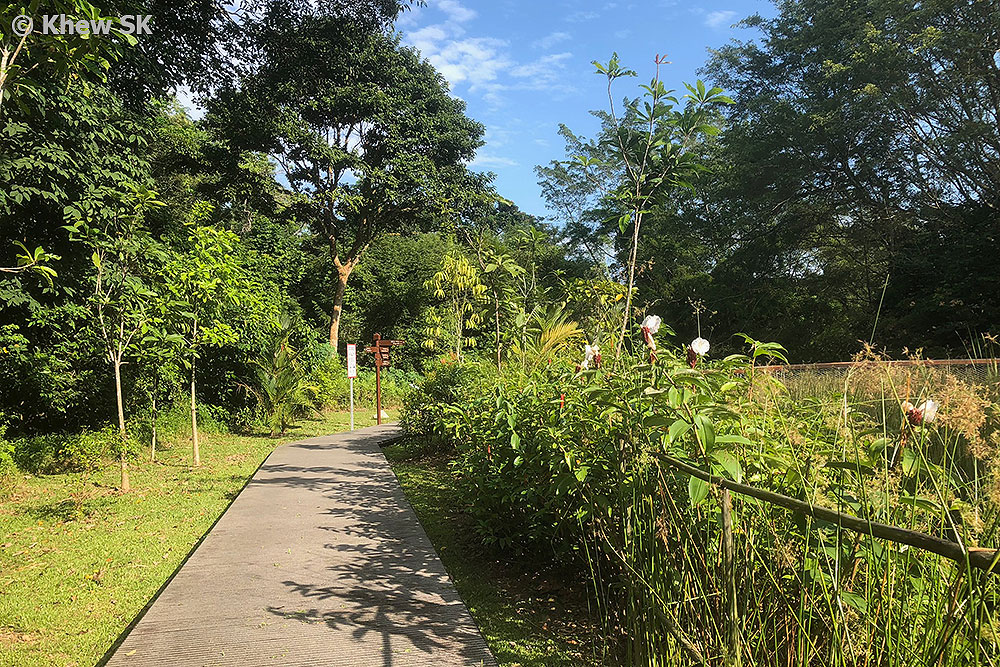
Today, the area is enhanced to provide proper boardwalks and safe accessibility to visitors. NParks' Conservation Division's Central Nature Reserve's office is also located here, where staff are on-site to conduct research, administrative work and field studies in the CCNR. Public amenities like restrooms, water-coolers, a gathering area and rest spots form part of the entrance facilities at Windsor Nature Park's visitor centre.


Biodiversity abound in the nature parks, so keep a lookout for all sorts of animals and insects around you!

The enhanced amenities and better accessibility have made Windsor NP a popular park with resident local visitors, nature enthusiasts, hikers and school groups out on educational tours. On my recent visit to Windsor NP on a weekday, I was surprised to see that the carpark was already about 70% full! There were many visitors around, and throughout my 3-hour walk around the park and into the MacRitchie area, I could hardly be alone for more than 5 minutes before meeting another visitor along the paths and boardwalks.


The marshland area at Windsor NP is conducive for bird and dragonfly observations

The entrance area of Windsor NP features a marshy wetland area where forest streams drain into. This area is great for dragonflies and teeming with many different species of our local Odonata. The landscaping around the NParks office and the public facilities includes many butterfly nectaring plants. On good days, a butterfly watcher should be able to see no fewer than 10 different species in the area, usually at the flowers of the Red Tree Shrub (Leea rubra).


Ample supply of butterfly nectaring plants around the visitor facilities at the entrance area of Windsor NP attracts many species of butterflies

The boardwalks lead a visitor towards the specially curated Hanguana Trail and the Drongo Trail. The Hanguana Trail is lined with rare native plants, some of which are named after Singapore. The Drongo Trail features a sub-canopy walk where visitors can catch a glimpse of the fauna that are found under the canopy level, in addition to examining the understorey of the regenerating secondary forest.


Natural forest streams run parallel to the boardwalks and trails showcase different habitats 

There are adequate signage and wayfinding is simple and straightforward. Many visitors walk from the entrance at Windsor NP to the TreeTop Walk, which is slightly over 2.5km away. Secondary trails like the Squirrel Trail, Venus Link and Venus Loop also allow visitors to experience different parts of the nature park featuring a variety of habitats around forest streams, thick vegetation and open grasslands.

Attention to Design Details


A simple sloping detail of the timber handrail minimises problems like visitors sitting on these handrails, leaving litter on top of them, and eliminates leaf litter and twigs from collecting on the handrails.

As a visitor walks along the boardwalk and trails, one should look at some of the design details that were incorporated into the amenities at the nature park. A casual observer may not notice these design details. One of these, is the simple handrail on the boardwalk. The chamfered top surface of the timber handrail may appear simple, but it serves to prevent visitors from sitting comfortably on the handrail and thereby creating a safety concern. The sloping surface also minimises litter like cups and other things from being left behind by inconsiderate visitors as these objects will just slide off. Leaves and other natural litter will also not collect on the top of the handrail.


Leaving a gap between the safety mesh and the boardwalk makes for easy maintenance by the sweepers to keep the boardwalk free of leaves.

The stainless steel mesh is also designed to be panelised to allow for easy replacement of damaged sections or for maintenance. A 100mm gap is provided at the bottom of the safety mesh to allow the cleaner to sweep leaves and other forest litter off the boardwalk easily. A detail that is very important for housekeeping!


Creating a different walking experience with granite rocks and at the same time allowing water to flow across on rainy days during the wet season.

Along the trails where water flow is likely to be impeded by the trail, the footpaths have been designed with granite rocks as a bioswale to allow water to pass through, creating a different experience for visitors whilst allowing water to flow downstream on rainy days.


A 'cheap and good' detail to create steps along the trails without massive and expensive concrete work

Where steep slopes require some form of steps, a simple and cost-effective design of using precast blocks secured with galvanised soil spikes or crampons, and then filled with compacted earth solves the problem. This also eliminates the need to construct expensive and high maintenance concrete steps in the nature reserves. Kudos to NParks Conservation Division (in particular, Sharon Chan) and the architects for paying attention to some of these details in the design of the nature park's amenities and facilities.

Butterflies!


A Great Imperial (Jacoona anasuja anasuja) feeding on Leea rubra at Windsor Nature Park


At the entrance area, look out for butterflies at the Red Tree Shrubs which line the trails and adjacent to the buildings. A favourite nectaring plant for butterflies, the attractive red flowers of this plant will often be visited by many species of butterflies.


The open grassy areas along the trails are also good hunting grounds for various Satyrinae species like the Bush Browns, Rings and many Hesperiidae sunbathing in the early morning hours of the day.


An uncommon open winged shot of the Common Faun (Faunis canens arcesilas)


Along the boardwalk and forest trails, one can encounter butterflies like the Branded Imperial, Malay Viscount, Archduke, Saturn, Common Faun and Dark Blue Jungle Glory. Mostly forest-dependent species, these butterflies are often seen foraging amongst leaf litter and muddy forest paths.

How to Get There :

By bus: 132, 163, 165, 166, 167, 855, 980
Alight at Upper Thomson Road (Opp Flame Tree Pk, Bus stop ID: 53071; Flame Tree Pk, Bus stop ID: 53069)

Or 52, 162, 162M, 410
Alight at Sin Ming Ave (Blk 454, Bus stop ID: 53369; Opp Blk 454, Bus stop ID: 53361)


By Car : From Upper Thomson Road. turn into Venus Drive.  The carpark entrance is quite obvious.  The gantry closes at 7pm and cars parked at the carpark will not be able to exit.  However, during the operating hours of 7am-7pm, carparking is free!  Note however, that due to the popularity of Windsor Nature Park on weekends, finding an available parking lot may be a challenge.

Text by Khew SK : Photos by Alan Ang, Basil Chia, Khew SK, Koh CH, Loh MY, Michael Soh, Soh KY, Jonathan Soong and Johnny Wee

Further reading :