07 April 2018

Butterfly Photography Series - Part 2

Butterfly Photography Series
Digital Post-Processing - Part 2 : Noise Reduction


In Part 1 of our Digital Post-Processing series, ButterflyCircle member Loh Mei Yee shared with us the basics of post-process editing by adding contrast, brightening, sharpening and cropping a shot. Mei Yee is back again in Part 2, where she takes us through a simple process of reducing 'noise' in a photo using a Photoshop Plug-in. Over to Mei Yee...


In my earlier article, I showed how you can enhance your photo with the use of Nik plug-ins – ‘Sharpener Pro’ and ‘Viveza 2’. In this continuing article of the series, I will touch on an issue that many of us often face – NOISE! Not the disturbing noise from annoying neighbours blasting loud music but digital noise in photography. I will be demonstrating how to reduce noise in photos using another Nik plug-in called ‘Dfine 2’.


What is noise? In digital photography, ‘noise’ is the commonly-used term to define aberrant pixels, or simply known as the “small dots” that are all over the image which causes a rough look or texture, making the photo unpleasant to look at. These small dots might not be very noticeable but they can be quite visible when you zoom in and view the image, or when your image is heavily cropped.
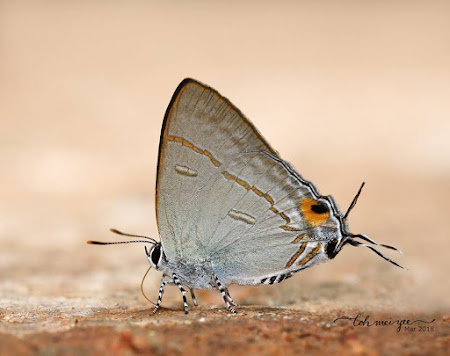


What causes digital noise? Higher ISOs which you may need when shooting in low light, is the main culprit in causing more noise. Another reason is the size of the sensor of your camera. If you compared a DSLR and a point and shoot camera (PnS), and both have 10 megapixel sensors, the DSLR would yield a much cleaner image with a lot less noise when compared to the point and shoot image. This is because DSLRs have much bigger sensors and therefore can accommodate larger *photosites compared to point and shoot.

*A photosite (photo/photon sensing site), as it is often termed around the web, refers to a sensor pixel in this context. Depending on the design of the sensor, a photosite or pixel may contain the necessary circuitry for a single coloured pixel, or it may contain the necessary circuitry for multiple colours of pixels

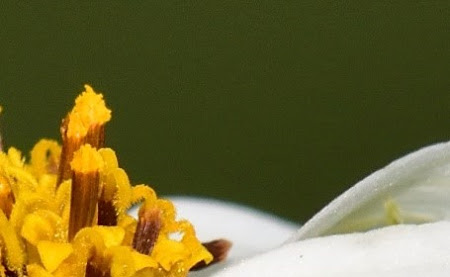
Take a look at the image below, you’ll notice that noise is more obvious on areas that are flat mid-tones (which is normally on the background) and less noticeable on areas that are bright and are with textures. What we want to do is to reduce the noise on the background.


In this tutorial, I have chosen a photo of the Common Tiger that I shot some time in September 2017. I will be using ‘Dfine 2’ to reduce noise mainly on the background whilst no noise reduction will be done on the butterfly. We want a smooth looking background but retain the details on the butterfly.
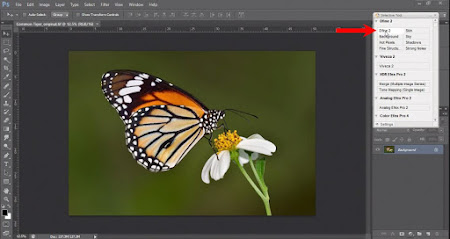

Once you are in Photoshop, go to your Nik Collection Plug-ins menu and launch DFine2
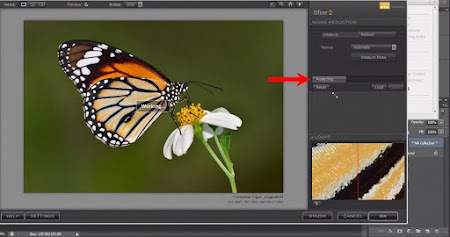

Dfine 2 will analyse the image and reduce the noise accordingly.
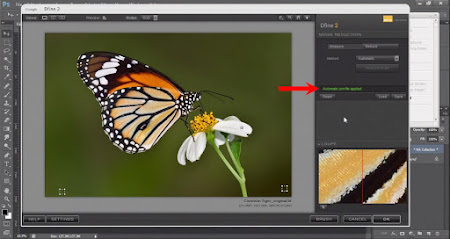

Automatic profile applied. Noise reduction has been applied to the entire image.
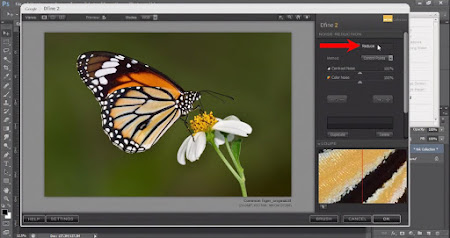


To further reduce the noise, click on the ‘Reduce’ button.


Increase the ‘Control Noise’ to 200%. Double click on the image to enlarge, click on ‘Split preview’ to have a look at the before and after effect. When you move the red line to the left and right, you’ll notice a significant difference in the green background.

Because noise reduction has been applied to the entire image, it means that some details on the butterfly have been lost. The next step is to bring back the details on the butterfly.
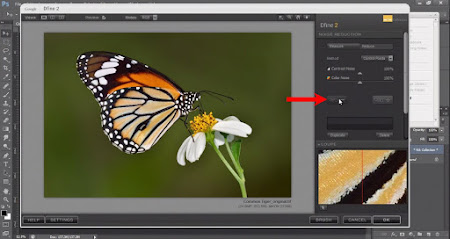

I am using this button (see red arrow) to add control points on the butterfly. This is to remove the noise reduction effect and bring back the details.
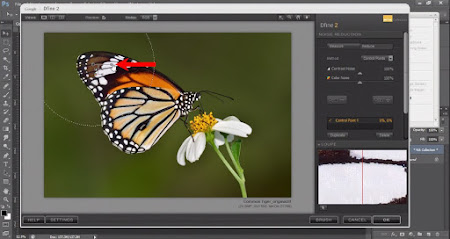

Start with adding a control point at the tip of the forewing (or anywhere you prefer), move the slider to the left, to cover only the area of the wing and not to affect the background.
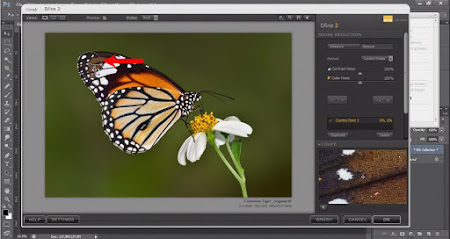

Continue adding more control points where needed.
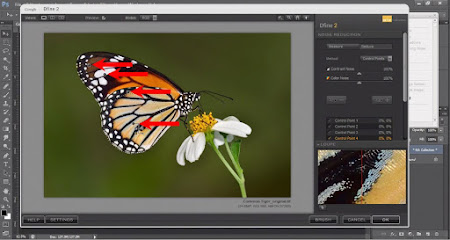

Continue adding more control points where needed.
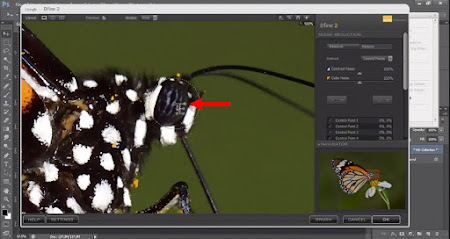

Double click to enlarge the image when adding control points on small areas. Double click again to reduce the image.
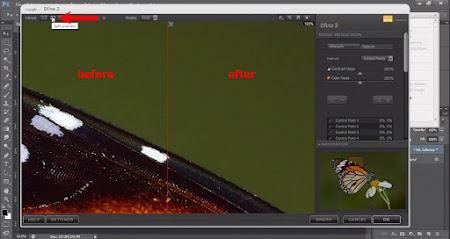

When you have finished adding control points, you can click on ‘Split preview’ to have a look at the before and after effect. Move the red line left and right, you’ll notice a significant difference in the green background but little to no changes on the butterfly.
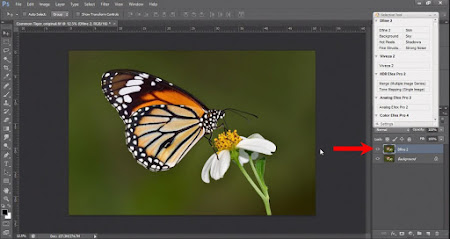

Click OK and a new layer is created. The original image is at the Background layer.
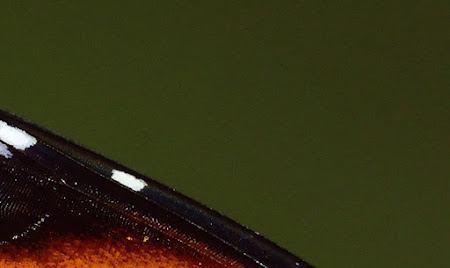

Original photo with noise
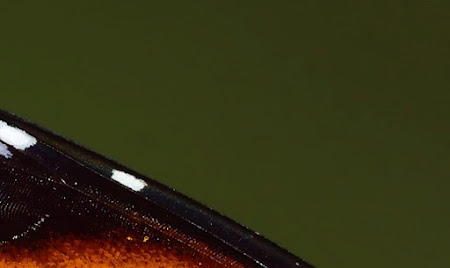

Photo after applying Dfine 2 noise reduction
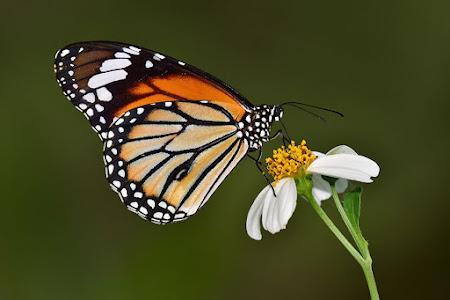

Original shot without post-processing
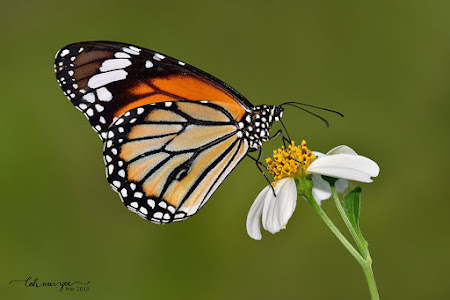

Final shot using post-processing techniques discussed in Parts 1 and 2 of this series

This brings us to the end of Part 2 tutorial. To further enhance your photo from here, you can also apply the steps that are shown in the Part 1 article. I have made a video tutorial of how I edited my photo using Dfine 2. See you again soon in the next article in my digital post-processing series!

Noise reduction using DFine 2

Remember to watch the video in HD for better quality

Text and Photos by Loh Mei Yee

Previous articles in this series :

Digital Post-Processing - Part 1 : Basic Post Processing

01 April 2018

Singapore's Judys

Singapore's Judys
Featuring the Abisara spp. (Judys) of Singapore


The family Riodinidae was previously classified as sub-family Riodininae of the Lycaenidae family (ref : Butterflies of the Malay Peninsula 4th Edition), but raised to family status subsequently in more recent publications. Many species in the family feature metallic markings on their wings, giving rise to their collective common English name of "Metalmarks".


Female Spotted Judy perched on a leaf

In the Southeast Asian region, the Riodinidae is characterised by small, reddish-brown butterflies that prefer deep forest shade habitats. They have a unique, short, hopping flight and alight on the upper surfaces of leaves with half-opened wings. When active, they will twist and turn on the leaf with jerky walking movements, often to the frustration of the butterfly photographer who is trying to get an ideal angle to shoot them.


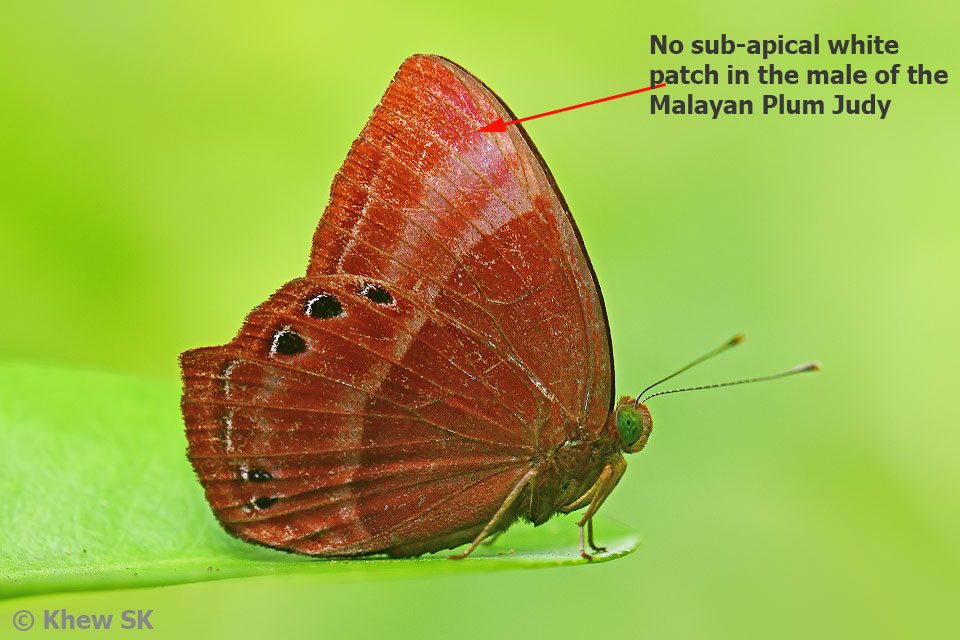
Male Malayan Plum Judy perched on a fern

Many species of the Riodinidae have yellow-green eyes. A special characteristic of the family is that the forelegs of the males are under-developed, appearing more like hair tufts. The females, on the other hand, have all six legs fully developed.


In Singapore, the Riodinidae is represented by five species in three genera. Of the five species, three belong to the genus Abisara. The species in this genus are collectively named Judy. It is interesting that the common names of the group of butterflies in the Riodinidae originate from the traditional beach puppet or marionette show of "Punch and Judy". The species of another Riodinidae genus, the Dodona, have all their species named after Punch. However, this genus is not extant in Singapore.


Male Spotted Judy

This article introduces the three Judy species found in Singapore. The extant species of the Abisara spp. in Singapore are the Malayan Plum Judy (Abisara saturata kausambioides), the Spotted Judy (Abisara geza niya) and the Malay Tailed Judy (Abisara savitri savitri). It was earlier thought that another Malaysian species, the Straight Judy (Abisara kausambi kausambi) also exists in Singapore, but further research showed that this species is not found here.

The Malayan Plum Judy (Abisara saturata kausambioides)


The most common of the three Abisara species found in Singapore, the Malayan Plum Judy is found at urban parks and gardens as well as in the forested areas of the nature reserves. It can also be found on the offshore island of Pulau Ubin. Males are more often seen, but both sexes display the typical Riodinidae behaviour of hopping from leaf to leaf and turning around with their wings half-opened.


The upperside of the male Malayan Plum Judy shows a deep purple-blue colour in angled lighting


The upperside of the male is a deep crimson brown without any markings. When viewed in a sidelight, the upperside may show a purple-blue colouration. The paler underside features a pair of diffused pale purplish post-discal bands. The outer band on the hindwing has a series of large black, white-edged submarginal spots.


The paler female has a diffused white sub-apical patch on the forewing, whilst the hindwing "tail" is prominently angled at vein 4 and appears to flare out wider than in the male. The Malayan Plum Judy has been successfully bred on two alternative host plants - Ardisia elliptica (Myrsinaceae), Embelia ribes (Myrsinaceae).

The Spotted Judy (Abisara geza niya)


The second of the Judy species found in Singapore is the Spotted Judy. This species is superficially similar to the Malayan Plum Judy in appearance. Also a deep crimson brown in colour, the male of the Spotted Judy differs from the Malayan Plum Judy in the whiter diffused subapical patch on the outer post-discal band.


Female Spotted Judy.  Note less extensive sub-apical white patch on the forewing and the dislocated post-discal band at vein 4 of the hindwing.

In the female, the diffused sub-apical patch is more restricted than in the Malayan Plum Judy. The hindwing "tail" is also prominently angled at vein 4 and displays the similar flare that is wider than in the male. Both sexes can be separated from the Malayan Plum Judy in their diagnostic characteristic hindwing post-discal band that is dislocated at vein 4.


Upperside of the male Spotted Judy.  The structural scales diffract light at certain angles where the wing colour shows a purple-blue.

The Spotted Judy is moderately rare, but can be found in generally the same habitats as the Malayan Plum Judy. Males are sometimes seen 'dog-fighting' in the late hours of the day. The species can be found in urban parks and gardens as well as in the forested nature reserves, preferring heavily shaded environments. It has been successfully bred on Embelia ribes (Myrsinaceae) and Embelia canescens (Myrsinaceae).

The Malay Tailed Judy (Abisara savitri savitri)


The third and rarest Judy found in Singapore is the Malay Tailed Judy. It is found mainly in the heavily shaded forested areas of the nature reserves. This forest-dependent species is generally larger than its previous two related species. It also differs from the other two in that, instead of the crimson brown wings, the Malay Tailed Judy is a pale beige with a light tinge of violet.


It cannot be mistaken for any other species in Singapore. The Malay Tailed Judy features two diffused white transverse sub-apical stripes on the forewing. It has a distinctly longer white tipped tail at vein 4 of the hindwing. It shares the behavioural characteristic of hopping on the upper surfaces of leaves with half-opened wings.


The Malay Tailed Judy has been successfully bred on the same host plants as the Spotted Judy - Embelia ribes (Myrsinaceae) and Embelia canescens (Myrsinaceae). The species can be occasionally observed feeding on overripe fruits on the forest floor.

Text by Khew SK : Photos by James Chia, Huang CJ, Khew SK, Nelson Ong, Jonathan Soong, Horace Tan and Benjamin Yam.

25 March 2018

Favourite Nectaring Plants #16

Butterflies' Favourite Nectaring Plants #16
The Peacock Flower (Caesalpinia pulcherrima)


In the 16th article in the series on our local butterflies' favourite nectaring plants, we feature an evergreen bush with attractively colourful flowers, the Peacock Flower (Caesalpinia pulcherrima). The Peacock Flower is often used in urban landscaping in Singapore and is a favourite amongst landscape architects looking to add colour to their palette of greenery and lush plants. It is also regularly cultivated in public parks and gardens.  


The Peacock Flower with its attractive flowers and pea pods

The Peacock Flower grows upright, attaining a height of 3-6 metres tall and a spread of 2-4 metres wide. The attractive shrub flowers throughout the year and usually does best in open areas in full sunshine. The orange-yellow flowers are pretty and uniquely shaped, with the stamens projecting well beyond the petals.  Although it is an exotic, it does not occur naturally and where it grows, it has been cultivated.


The genus name of this plant is in honour of the Italian physician, philosopher and botanist, Andrea Caesalpino. His most important publication, De plantis libri XVI (1583) is considered the first textbook of botany. He was the director of the Botanical Gardens at the University of Pisa. From 1592 he served as physician to Pope Clement VIII and taught at Sapienza University in Rome. The Latin species name pulcherrima means 'most beautiful', referring to the flowers.


The Peacock Flower is considered an exotic in Singapore. Its region of origin is the tropical Americas and was probably introduced to Singapore as a landscaping plant. Its use is limited to parks and gardens, usually cultivated an accent plant or as a boundary hedge. The brittle branches and sometimes thorny stems are considered negative attributes of cultivating the plant in urban gardens, and placing the plant adjacent to human traffic should be avoided.

Plant Biodata:
Family: Fabaceae (Leguminosae)
Genus : Caesalpinia
Species : pulcherrima
Synonyms : Poinciana pulcherrima
Country/Region of Origin : Tropical America
English Common Names : Peacock Flower, Barbados Flower Fence, Flower Fence, Cana, Barbados Pride, Red Bird of Paradise, Paradise Flower, Flamboyant Tree, Gold Mohur, Pride of Barbados, Dwarf Poinciana
Other Local Names : Jambul Merak, 金凤花, 洋凤花, 孔雀花


The bi-pinnate oval leaflets of the Peacock Flower and a young shoot

The Peacock Flower is a sprawling evergreen perennial shrub (or a small tree) reaching a maximum height of 6 metres, if left unpruned. Its deep green foliage is bi-pinnate, typical of Fabacea (Leguminosae) species. The leaves are fernlike and twice compound, with many small, oval leaflets.


The terminal racemes of the Peacock Flower, with the globular buds in a pagoda-shaped arrangement

The flowers are borne on terminal clusters of about 20-30cm tall. Each flower is bowl shaped, 2-3" across, with five crinkled, unequal red and orange petals, and ten prominent bright red stamens that extend way beyond the corolla. There is one modified petal which is smaller than the other 4 petals. The typical orange-yellow flower hybrid is the most common one cultivated in parks and gardens. However, there are other hybrids which feature all-yellow, pink-white and all-red flowers.


The pea pod is light green when immature, but turns a crispy chocolate brown when ripened

The fruits are oblong, with thin flat pods of up to 10 cm long and look like Snow Peas. The pods are light green when immature, turning to a dark brown when ripened. Each pod contains 8-10 flattened dark brown to black seeds which are ejected as the pod splits open at maturity.


A range of flower colours amongst the hybrids of the Peacock Flower

The Peacock Flower is only moderately attractive to butterflies, particularly the larger species. This may be because of the shape and design of the flower, which require longer proboscis of the larger butterflies to reach into the flower for nectar.


The very long stamens are a unique feature of the flower of this plant

In the field, there are occasions when no butterflies visit the flowers at all, especially when there are other preferred nectaring plants in the vicinity. However, on certain days and in the morning hours of the day, the flowers appear more attractive to butterflies and they will feed greedily at the flowers. Perhaps this could be due to the quantity of nectar produced by the flowers at specific times of the day? Or could there be some other explanation?


The larger Papilionidae feeding on the flowers of the Peacock Flower

Amongst the larger Papilionidae, the Common Birdwing, Great Mormon, Lime Butterfly, Common Mime and Common Mormon have been observed to feed on the flower of the Peacock Flower plant. We have not observed other species of the Papilionidae feeding on this plant's flowers.


Various Danainae feeding on the Peacock Flower.

The Danainae are sometimes attracted to the flowers of the Peacock Flower plant. Amongst these are the Common Tiger, Plain Tiger and Black Veined Tiger. On a single rare occasion, the extremely rare Mangrove Tree Nymph (Idea leuconoe chersonesia) was photographed feeding on the flowers of this plant at high level at Pulau Ubin's Butterfly Hill.


Some of the Pieridae also like the flowers of the Peacock Flower

Amongst the Pieridae, we have seen the Lemon Emigrant, Orange Emigrant and Mottled Emigrant attracted to feed on the flowers of the Peacock Flower plant. The Grass Yellows (Eurema spp.) are usually active around this plant, but more likely because it is one of their caterpillar host plants, and not to feed on the nectar from the flowers. There was one occasion when a Common Grass Yellow was observed to feed on the flower of this plant.


Thus far, there have been no observations of the other families of butterflies, particularly the smaller species, feeding on the flower of the Peacock Flower plant. Despite its attractive bright colours, it is strange that the Peacock Flower is not more attractive to a wider range of butterflies.


A male Great Mormon feeding on the flower of the Peacock Flower

Even though there is enough evidence to show that the Peacock Flower is a butterfly-attracting plant, the range of species that feed on its flowers is unfortunately rather limited. In the selection of nectaring plants for a butterfly garden, it would be probably wise to combine several other more preferred nectaring plants with the Peacock Flower to offer a wider range of nectaring plants to attract more species of butterflies.

Text by Khew SK : Photos by Bob Cheong, Huang CJ, Khew SK, Loh MY and Simon Sng.