06 August 2017

Butterfly of the Month - August 2017

Butterfly of the Month - August 2017
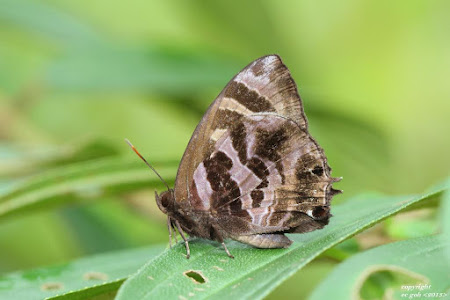
The Shining PlushBlue (Flos fulgida singhapura)


A Shining PlushBlue perched on a leaf in the nature reserves

August is always a special month for Singapore. This the the month where Singaporeans celebrate our National Day (our "Independence Day") on the 9th of August each year. This year, Singapore will be 52 years old. The city state has come a long way from independence in 1965, when it separated from Malaysia to stand alone as a sovereign nation. On 9 August 1965, the Malaysian Parliament voted 126 to 0 (with Singaporean delegates not present) to move a bill to amend the constitution providing for Singapore to separate from the Federation of Malaysia


© Mike Robbins 
Old Singapore River scenes - The Singapore River was the source of commerce in the old days, where ships unload their goods onto smaller 'sampans' which then move the goods to the godowns along Boat Quay for sorting, storage and eventual move to their end destinations. 

Back then, our pioneer generation must have worried about the survival of this little island, with no resources, no hinterland and a motley crew of labourers from Malaysia, India and China who had to build the future of Singapore with their enthusiasm, hope and conscientiousness. The early years after independence were turbulent, with labour and racial riots breaking out after periods of tension, conflict and social unrest.


Old map of Singapore : Source : https://storyoftwocities.com/

By common logic, Singapore should not have survived. Without any natural resources, land to cultivate its own food and having its own source of fresh water, many outsiders would have wagered that Singapore would fall and be re-absorbed into Malaysia after a short time. However, beating all odds and to the skeptics' surprise, the grit and determination of our pioneer generation built Singapore from 3rd world to 1st in two to three decades, rising to one of the world's highest GDP per capita.


I came to Singapore in 1979, the early years of a nation that was in a hurry to grow and reach for the stars. My first job in the civil service in the government's engineering authority allowed me to be part of Singapore's nation-building effort in the 1980's and 90's. As an architect in the now-defunct Public Works Department of Singapore, I had the opportunity to be involved in the design and implementation of many of Singapore's social infrastructure projects like schools, polyclinics, government buildings, army camps and even prisons!



Those were very special years for every architect and engineer in our industry because of the wealth of experience that each of us acquired through our projects. The wide variety of building typologies that we had to design (many from scratch, because of our own unique systems and operational policies) allowed us to build our professional experience that would be hard to replicate today in a matured and fully-developed Singapore.


From educational buildings to recreational facilities ; from Ministry headquarters to hospitals ; from airports to police stations, we did them all. There were not many foreign consultants involved in the 80's as we could not afford too many of them. Each government professional learnt by studying available literature, went on overseas study trips and interacting with more experienced seniors in our organisations. The experience gained was priceless, and embedded in each of us to this day, even though the government department that we were once part of, had been totally privatised.
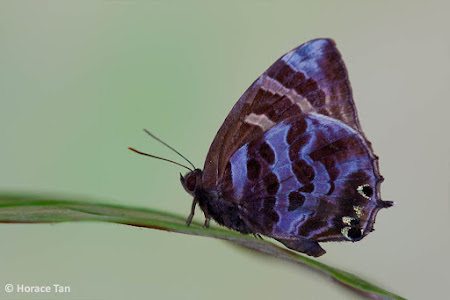

A newly eclosed Shining PlushBlue with a stronger purplish sheen on its wings

Back in those proud nation-building days, each Singapore National Day was special, as our late Prime Minister Lee Kuan Yew shared the accolades and the achievements that made Singapore grow stronger year after year. My favourite National Day songs were "Count on Me, Singapore" and "We are Singapore" and listening to them today still brings back memories of an era when we worked hard for, and contributed to Singapore's progress.
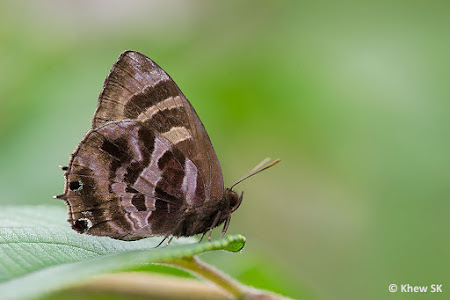


Our Butterfly of the Month is therefore aptly selected for its subspecies name that carries the Singapore name, on our 52nd National Day. This month, we feature the Shining PlushBlue (Flos fulgida singhapura). The English name for Singapore is an anglicisation of the native Malay name for the country, Singapura, which was in turn derived from Sanskrit Siṃhapura; siṃha is "lion", pura is "town" or "city").
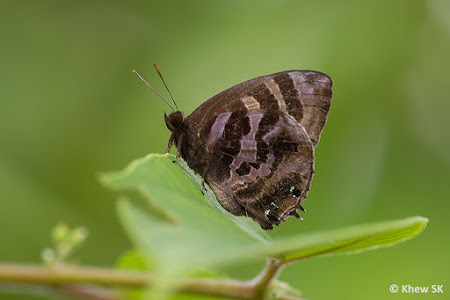


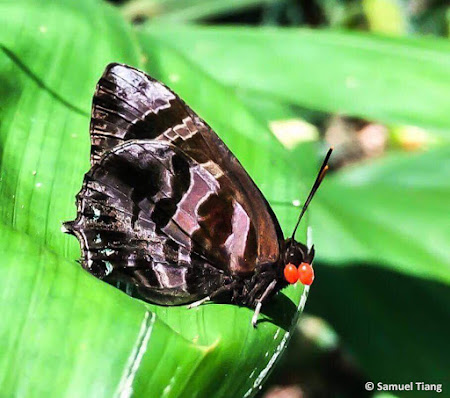
The Shining PlushBlue belongs to a small genus of butterflies called Flos. There are four species found in Singapore, of which three, including the Shining PlushBlue, are considered rare. The Shining PlushBlue is usually found in the shaded forest understorey, where it perches on the tops of leaves with its wings folded upright. The dark and cryptic underside markings give it a good camouflage amongst the leafy undergrowth.
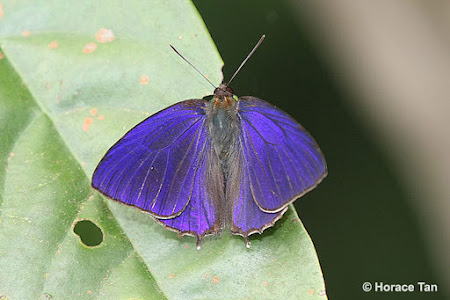

The attractive purple upperside of a male Shining PlushBlue

The Shining PlushBlue is dark blue on the upperside with thin indiscernible borders in the male, whilst the female is shining blue with broad black borders. The underside has the usual cryptic brown markings but there is no V-shaped spot at the costa but a band stretching from base to mid-costa. This distinguishes this species from the closely related Bifid Plushblue (Flos diardi capeta).
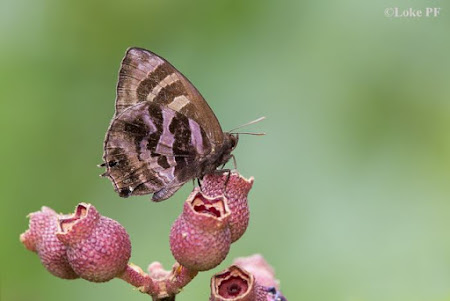


At the tornal area of the hindwing on the underside, there are bright coppery-green tornal spots encircling black eyespots. There is a short stubby tail at vein 2 and another stub at vein 3. The underside has a slight purplish wash in a sidelight.
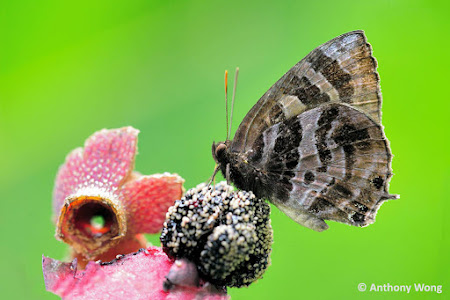
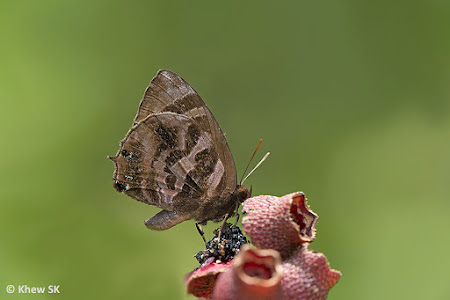

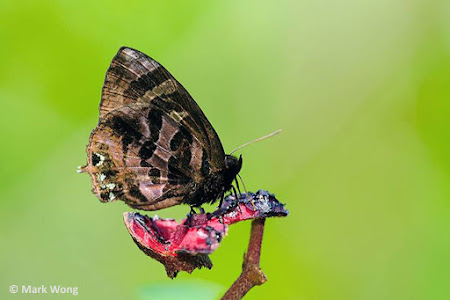
Shining PlushBlue feeding on the ripened fruit of the Straits Rhododendron


The butterfly is skittish, and takes off very quickly if alarmed. When it is settled and calms down, it can be approached stealthily for photography. The Shining PlushBlue can sometimes be seen feeding on the ripened fruits of the Straits Rhododendron (Melastoma malabathricum). The life history has not been fully documented yet. Its host plant is likely to be similar as the other species of the genus.


And so we are now acquainted with a butterfly species that carries the Singapore "brand". We would like to take this opportunity to wish all Singaporeans a Happy 52nd National Day!


Happy Birthday, Singapore! Majulah Singapura!

Text by Khew SK : Photos by Chng CK, Goh EC, Khew SK, Koh Cher Hern, Loke PF, Samuel Tiang, Horace Tan, Anthony Wong and Mark Wong


30 July 2017

A Whirlwind Weekend in Langkawi

A Whirlwind Weekend in Langkawi
Lee Kong Chian Natural History Museum Outing


Sunset from the top of Gunung Raya, Pulau Langkawi, Malaysia

Recently, I joined a group of professional scientists from the Lee Kong Chian Natural History Museum on a very short weekend outing to Pulau Langkawi, Malaysia. The trip was planned a few months earlier amongst Prof Peter Ng, Head of LKCNHM, Prof Francis Seow-Choen, one of the region's foremost experts on phasmids, and me. Our local 'spider man' Joseph Koh, unfortunately, could not make the trip due to prior commitments.


Our first lunch at Langkawi before heading up to Gunung Raya

We were joined by two other LKCNHM staff, Dr Hwang Wei Song, Curator of Insects & Other Terrestrial Arthropods Collections, and Foo Maosheng, Curator of Tissues in Cryogenic Collection of the museum. We met at the airport for our early morning flight to Langkawi, about 720km away from Singapore, which took us slightly over an hour. Upon arrival and settling our rental car, we took a quick lunch and headed up to Gunung Raya, where our 'home' for the weekend is located - D'Coconut Hill Resort.


Views from 881m above sea level - Gunung Raya.  Our hotel, D'Coconut Resort, perches at the peak of the mountain.

The hotel sat right on the top of the highest point in Pulau Langkawi and offered a breathtaking view of the island. The design of the hotel respected the mountain terrain, and getting up to one's room was a challenge in itself, especially with our heavy bags! The only elevator in the hotel chose the "right" time to break down and we were left to make the daily trudge up and down the staircases from our rooms to the main entrance of the hotel.


The environment at Lubuk Semilang Recreation Park

The first afternoon saw us heading down to a familiar place - Lubuk Semilang Recreation Park - a popular picnic spot for the locals and tourists beside a stream. The puddling ground that I remembered when I last visited this spot was inundated and there were few butterflies around. It had rained heavily that morning and the cool atmosphere was not particularly good for butterflies.


Fallen fruits attracted a number of species at Lubuk Semilang Recreation Park

However, some fallen fruits (including a mango-smelling fruit) attracted a number of butterflies like the Archduke, Knight, Banded Marquis, Great Marquis and a number of Satyrinae. The butterflies were particularly skittish and didn't offer much opportunities for good shots.


A Common Red Flash came out to play in the hot evening sun.  When we left the park at 5:45pm, a number of them were still dog-fighting amongst the late evening sun's rays

The sun came out by 3pm and shone strongly down on the forested areas at Lubuk Semilang. There was a bit more activity at the forest edge, but alas a bit too late in the afternoon to attract the butterflies out. The LKCNHM team were busy doing their own thing, as the hot humid forest air brought out the late afternoon critters. a sunlit spot, I spotted the familiar Common Red Flash basking in the late afternoon sun, a typical behaviour of this species. It was already almost 6pm as another two male Common Red Flash butterflies came out to frolic when it was time for us to call it a day.


Getting our dinner for the evening at the Night Market. The variety of local hawker food was good!

Dinner was a quick takeaway from the local 'pasar malam' (night market), where the local street food stalls were already doing a brisk business with the local community and tourists. With the 1:3 exchange to the ringgit, everything seems a lot cheaper too! We headed back up to our hotel on Gunung Raya. After dinner, the night surveys started as our phasmid expert went searching for the stick and leaf insects that are more active in the dark.


Early morning views from our hotel. The mist shrouded the top of Gunung Raya till mid-morning.

At 881m above sea level, the summit of Gunung Raya where our hotel sits, is shrouded in the early morning mist. The mist made the forests look sinister in the early morning hours as the chirping of birds and the call of the Banded Leaf Monkeys broke the silence of the dawn. After a sumptuous breakfast, we were all packed and ready to head out again. It was a pleasant coincidence to meet Kazuo Unno, a renowned Japanese nature photographer. I met him some years back in Penang, and it was nice to bump into him at a hotel where we were probably the only guests this weekend!


A male Archduke (Lexias pardalis) puddles on a rocky outcrop


The freshwater crab Stoliczia bella a species that was new to science and first described by Prof Peter Ng, thirty years ago, from Langkawi!

Kazuo-san joined us as we headed back to Lubuk Semilang Recreation Park again. Though it was a Saturday, there were not many local picnickers around. However, tourists from Middle Eastern countries thronged the Recreation Park. Butterfly activity was low, and the same species that I saw the previous day were still around. I encountered a freshwater crab along the footpath, and was pleased to find out later that this species, Stoliczia bella was first found in Langkawi and described by Prof Peter Ng back in 1987 as a species that is new to science!


Familiar species in the shady forested environment at the foot of Telaga Tujuh

We headed out to Telaga Tujuh (Seven Wells) another area that was familiar hunting ground to me on my previous visits. As soon as we entered the forested paths, we saw a Straight-Banded Catseye (Coelites epiminthia) a species that is often found in the area. The usual Arhopalas and forest habitat species were still around, but not all of them were cooperative and were skittish. By evening, the skies were cloudy and butterfly activity was rather low.


The waterfall at Temurung after a steep climb up

The next morning was our final day on Pulau Langkawi for this very short weekend trip. As we still had about half a day before our evening flight back to Singapore, the team decided to head out to Temurung waterfalls to check out the place. After breakfast, we drove to the north-western coast of Langkawi where Temurung was located. On my previous trip, a visit to the waterfalls proved quite fruitless as the steep terrain made it very difficult to do any butterfly photography.


This visit was not any more successful than my visit to Temurung Waterfalls, although a couple of more cooperative species like a female Colour Sergeant (Athyma nefte) and a Clavated Banded Demon (Notocrypta clavata) came out to greet me. A number of other Nymphalidae and Pieridae were fluttering around but the slippery rocks and steep slopes ended any hope of photographing them.


The trail at Kisap which yielded quite a few surprises

We then searched for a location called Kisap (which was recommended by our friend Kazuo-san). After driving around and with the help of our friend Googlemaps, we found a trail at the foothills of Gunung Raya. Besides a large clump of Spanish Needles (Bidens pilosa/alba) which attracted a number of butterflies, the shaded forest understorey also yielded a number of species that I had not spotted at the earlier locations that we explored.


The butterfly diversity had good potential in this area, and it will be a must-visit place on a future trip to Langkawi. I spotted a couple of rare skippers (which were totally uncooperative) and some larger Nymphalidae and Lycaenidae which will be worth investigating in future. The vegetation along the trails probably supported some of the rarer Hesperiidae and Satyrinae that I spotted in that area.


A feast of durians before we depart Langkawi

On our way back to the airport, our resistance to the local durians wore down and we made a beeline to the street-side durian vendor for a quick-fix to our durian cravings. The stall holder told us that these durians came from the state of Kedah and the aroma and flavour is different from the southern variety. Indeed the durians that we sampled tasted very nice and had a special fruity sweetness to it.


Our trusty SilkAir Airbus that brought us home safely

We reached the Langkawi International airport in good time, did our usual check-ins and lazed around in the waiting lounge. Our SilkAir flight was on time, and we were back in Singapore in a flash without any incident. It was an interesting trip although much too rushed, but the company and good food made up for the lack of butterflies.

Text by Khew SK : Photos by Khew SK and Francis Seow-Choen

Special thanks to Prof Peter Ng of the Lee Kong Chian Natural History Museum for arranging this research outing to Langkawi, and the fun company of Francis Seow-Choen, Wei Song and Maosheng (for his patient and careful driving over the 3 days). Thanks also to Kazuo Unno who drove me around and provided a good conversation about butterflies and his exciting adventures all over the world.


22 July 2017

Favourite Nectaring Plants #11

Butterflies' Favourite Nectaring Plants #11
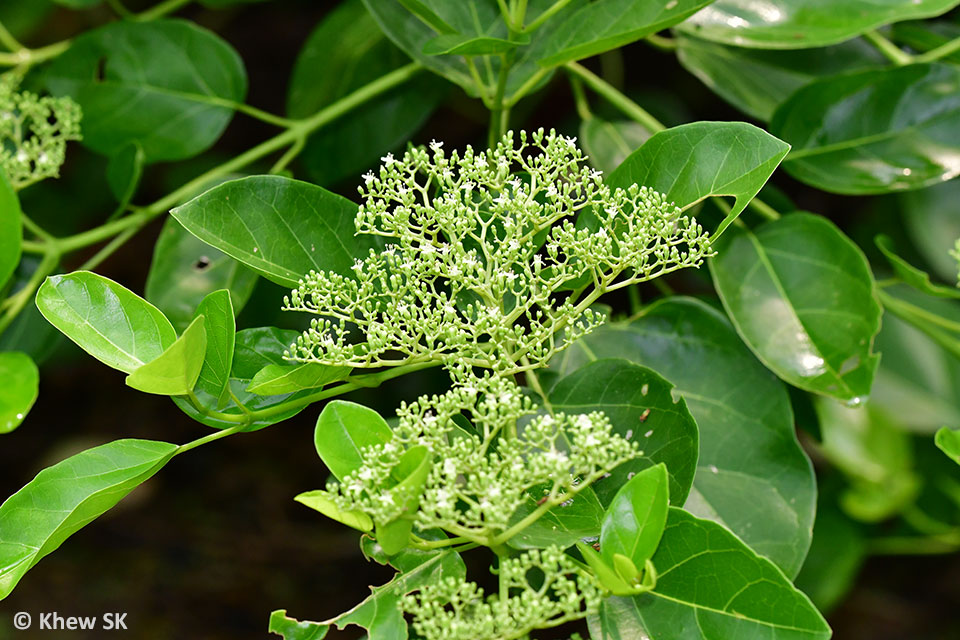
The Buas-Buas / Malbau (Premna serratifolia)


A Common Rose feeds on the flower of the Buas-Buas

In this 11th article of Butterflies' Nectaring Plants series, we feature a medium-sized tree that can grow up to at least 7-9m tall, the Buas-Buas / Malbau (Prema serratifolia). This plant is a native to Southeast Asia, including Singapore, but ranges from East Africa all the way to Australia and the Pacific Islands. The plant has a preference for terrestrial (Coastal Forest), shoreline (Mangrove Forest; Sandy Beach) habitats and can thrive in harsh environments near the sea. It grows along rocky and sandy coasts, in open country, near mangroves and other coastal sites.


A large Buas-Buas bush spreading extensively

The Malbau (locals in Southeast Asia call it Buas-Buas), is a spreading, evergreen multi-branched shrub or small tree with a low crown, with woody trunks when mature. It has green to brown bark which is smooth or scaly. The Malbau has the distinction of being named by the prominent Swedish botanist and 'father of taxonomy' Carl von Linnaeus in 1771.


In Singapore, Buas-Buas can be found in open wastelands, coastal reclaimed sand-filled sites, offshore islands like Semakau, Ubin, Hantu, St John's and Sisters Islands and even at the fringes of our nature reserves. As the plant is considered common and easy to propagate, either by seeds or cuttings, it has begun to find its way into community gardens, butterfly gardens and roadside planting as a butterfly nectaring plant. The Buas-Buas can also be found in the Healing Garden at the Singapore Botanic Gardens, where there are occasionally many visiting butterflies at the flowers of the plant.


A pristine bush of the Buas-Buas

Plant Biodata :
Family : Lamiaceae (Labiatae)
Genus : Premna
Species : serratifolia
Synonyms : Premna foetida, Premna obtusifolia var. serratifolia, Premna borneensis, Premna kunstleri
Country/Region of Origin : Eastern Africa, across the Indian Ocean and through tropical Asia to Australia and the Pacific Islands
English Common Names : Malbau, Bastard Guelder
Other Local Names : Buas-Buas, Bangkung Kayu, Sarunai, Singkel, Arani, 伞序臭黄荆


Close-ups of the Buas-Buas leaves - young leaves are glossy and light green

The leaves of the Buas-Buas are opposite, range between 5 to 18 cm long, 3 to 10 cm wide, broadly ovate with a smooth leathery texture. The simple, stalked leaves have leaf blades that are elliptical, glossy dark green above, light green below with prominent veins and the midrib raised on the underside of the leaf. The leaf margins are smooth (or rarely serrated) and hairless, and the crushed leaves apparently smell of cat's urine. The stems on which the leaves are borne are smooth and green when young, turning woody towards the base of an older plant.


Flower buds of the Buas-Buas where the white flowers have yet to bloom


A close up of the white flowers of the Buas-Buas

The numerous flowers are cream-green in colour, with rather an unpleasant odour, borne on spreading terminal panicles about 10–20 cm across. Its greenish-white or white flowers are 2.5 mm wide, and arranged in clusters that are 5–13 cm wide. The white flowers have five corolla lobes. It is interesting to note that despite the flowers' pungent and foetid odour, it may be this smell that attracts a variety of butterflies to feed on the flowers.


Fruits of the Buas-Buas.  Note the black/dark purple ripened berries

The fruits are more or less spherical, 3-8 mm long, 3-5 mm wide and hairless. They are green initially but turn black or dark purple when ripened. There is a single seed in the fruit. As the plant flowers all year round, the ripened fruits may be collected for easy propagation of the plant. The fruits can be found in clusters and are eaten by birds, which probably aid in the natural distribution of the Buas-Buas. The fruits and seeds can apparently be eaten by humans too.


The Buas-Buas has a variety of medicinal uses. The leaves and roots are used in traditional medicine as a diuretic and to treat rheumatic arthritis; colic and flatulence; coughs, headaches and fevers In various parts of Indonesia, an infusion of the leaves and roots is used against fevers and shortness of breath; women also eat the leaves in order to promote breast-milk production. In Australia, aborigines used this plant to treat the stings of stonefish and stingray, as well as spear wounds. Juice squeezed from the berries is used as nose drops to treat sinus headaches. Research is in progress on extracts from the bark and wood that contain alkaloids and iridoid glycoside, as these are believed to prevent cardiovascular disease.


Two Leopards feeding on the flowers of the Buas-Buas

The small pungent white flowers are attractive to butterflies. Due to the size of the flowers and probably the small amount of nectar, butterflies that feed on the flowers move very quickly from flower to flower and stopping for fleeting moments only. This makes photographing the feeding butterflies more challenging compared to those that feed for longer periods on other nectaring plants.


A variety of the fast-flying and larger Swallowtail butterflies (Papilionidae) feeding on the Buas- Buas flowers

Interestingly, despite the size of the flowers, we have seen many of the larger Papilionidae feeding on the flowers of the Buas-Buas. Even the large Common Birdwing (Troides helena cerberus) has been photographed fluttering and feeding on the flowers of the plant. Amongst the strong flyers, the Common and Lesser Jays, Tailed Jay, Common Bluebottle, Common Rose, Lime Butterfly and Common Mormon have been observed visiting the flowers of the Buas-Buas.


Some Danainae of the flowers of the Buas-Buas

Amongst the Danainae, the large Crows like the Spotted Black, Striped Blue and the King Crow have been seen amongst the flowers of the plant. On Pulau Ubin, where the Dwarf Crow has been reliably and regularly seen, it also feeds on the flowers of the Buas-Buas. The various Tigers also occasionally stop to visit the flowers of the plant for their nutrition.


Striped Albatross and Lemon Emigrants feeding on the Buas-Buas flowers

The larger Pieridae also seem to like the flowers and we have seen the Striped Albatross and Emigrants feeding. The Grass Yellows also flutter amongst the Buas-Buas, but I have not seen a confirmed shot of any of them feeding on the flowers yet, though I am quite sure that they would.


A variety of Nymphalidae butterflies feeding on the Buas-Buas flowers

Other species of the Nymphalidae also feed on the flowers of the plant, and the skittish Leopard, Rustic, Chocolate/Blue/Peacock Pansy and Malayan Eggfly have been observed at the flowers. Even the Ypthima have been spotted at the flower of the Buas-Buas, and there is a also particular bush near Lower Peirce Reservoir Park that is often popular with the Malayan Five Ring.


A Chestnut Bob feeding on a Buas-Buas flower

Some Hesperiidae have also been spotted on the Buas-Buas flowers, and there are likely to be many more that have been missed. A confirmed sighting of a Chestnut Bob feeding on the flowers suggests that other skippers may also find the nectar of this plant's flowers attractive.


Wasps and day-flying moths also enjoy the flowers of the Buas-Buas

Besides butterflies, the Buas-Buas flowers also attract a variety of other flying insects, from day-flying moths to bees and wasps. However, it is curious that at times, the flowers of the plant are totally devoid of any pollinating insects in certain locations. Could it be because there are other, more preferable nectaring sources, or the location of the plant in a particular habitat renders it unattractive to insects due to insufficient production of nectar?


When you are out butterflying, do look out for the Buas-Buas, which usually flowers quite prolifically all year round when the shrub matures. Keep track of the number of species of butterflies that feed on the flowers and send in your feedback on this post.

Text by Khew SK : Photos by Ang Wee Foong, Bob Cheong, Huang CJ and Khew SK

Butterflies' Favourite Nectaring Plants #10 : Mile-A-Minute