Pulau Ubin Butterfly Survey

Last weekend, ButterflyCircle and Nature @ Seletar Country Club members participated in the 24-hour biodiversity survey on Pulau Ubin. The survey coincided with a special event, "Celebrating Ubin's Heritage" on 3 Dec 2016, graced by Senior Minister of State, Desmond Lee. At the same event, NParks flagged off BioBlitz@Ubin, a community effort involving various biodiversity groups to survey the island’s fauna and flora over 24 hours. This will provide a snapshot of the fauna found on the island, and sets the ground for the Pulau Ubin survey in 2017.

The familiar portal welcoming all visitors to Pulau Ubin
BioBlitz is a popular citizen science movement worldwide. The term “BioBlitz” was coined by Susan Rudy, a naturalist with the US National Park service, in 1996. BioBlitz refers to a concerted effort by scientists and the community to record as many species of flora and fauna as possible within a specific location and timeframe. BioBlitzes have been conducted around the world, including the United Kingdom, Canada, Australia and Hong Kong. There is a community involvement component to many of these BioBlitzes, and members of the public are invited to join scientists and naturalists in a concerted effort to inventory species that exist within a designated area, such as an urban park or nature reserve.


The bumboat ride is an integral part of the experience of any outing to Pulau Ubin
Our survey group met at the Changi Point Ferry Terminal and took the NParks-chartered bumboat over to Pulau Ubin. After meeting at the registration point, and waiting for Mr Desmond Lee to ring the bell to start of the 24-hour survey, the group, together with a few other members of the public who had signed up for the survey, set off to Butterfly Hill.

Some of the survey members with Senior Minister of State, Mr Desmond Lee
The scheduled 2-hour survey of Butterfly Hill and the surrounding trails commenced with a quick briefing and the group started on the trail, counting the number of species that were seen along the transects.


After a quick briefing, the survey of Butterfly Hill commences
As the weather in the morning was cloudy and overcast, there were fewer butterflies up and about as would normally be expected on sunny days. However, as the early morning drizzle cleared up, our winged jewels started being slightly more active as the morning wore on. The interpretative signage on Butterfly Hill helped to inform the new members in the group about the butterfly-plant relationships.


Butterfly Hill survey and some of the butterfly species that came out to greet us
The group were entertained by the usual Danainaes like the Plain Tiger, Blue and Dark Glassy Tiger, Common Mormon, Painted Jezebel and the larger butterflies on Butterfly Hill. Of notable interest was a couple of Grass Demons (Udaspes folus) that were active around their host plants. There were several Common Rose fluttering amongst the Snakeweeds and other flowering plants, one female was even spotted ovipositing on its caterpillar host plant, Aristolochia acuminata.

At the mangrove boardwalk at Chek Jawa Wetlands
The group recorded about 30 species of butterflies on this first leg of the walk, which ended at around 1:45pm. After a short break at the registration point, two mini buses arrived and took the group to the starting point of the second leg of the survey - Chek Jawa. A short trip brought us to the start point at Chek Jawa and the survey started at around 2:15pm.

A friendly Spotted Black Crow perched on a palm leaf
The weather continued to be cloudy and overcast, and the group walked along the boardwalks leading to the mangrove swamp area. Other than the usual Common Palmfly which was active along the boardwalk, the group encountered a Spotted Black Crow that was perched on a palm leaf. The butterfly was cooperative and did not fly off from its perch even after everyone had their full share of photos of it.

Out at the coastal boardwalk
The group emerged from the mangrove boardwalk and spotted a few Lycaenidae like the Common Tit and what appears to be a worn-out Scarlet Flash. A school of mudskippers distracted the group for a while, as would a large White Bellied Sea Eagle, that flew overhead. The walk along the coastal boardwalk, as expected, did not turn up any butterflies.

Back at the entrance to Chek Jawa Wetlands
The survey ended around 3:45pm at the Chek Jawa Visitor Centre and the group headed back to the main village to take the bumboat back to Singapore island. Although the BioBlitz was a 24-hour survey, the butterfly survey ended after 4:30pm as generally, it would be less fruitful to survey butterflies in the late afternoon and evening, as most of them would be settling in for the night and would not be flying actively any more.

Part 2 of the BioBlitz survey starting at the Sensory Trail
The next day, Sunday 4 Dec 2016, the survey continued. A smaller group this time, members took the bumboat over to Pulau Ubin and started the survey at 10:00am. This time, the survey transect started at the Sensory Trail. The weather was more cooperative on this hot and sunny Sunday morning.


Forested walk at the Sensory Trail
There were many species of butterflies actively flying, and of note were the Common Jay (first discovered on Pulau Ubin, and is now a regularly seen resident), Malayan Plum Judy, Ancyra Blue (also first discovered on Pulau Ubin), Perak Lascar, Blue Nawab and residents of the mangrove area along with the transects brought us past.


Members of the survey looking out for butterflies
A cooperative Common Mormon was spotted puddling and allowed the group to take photos and videos of its puddling activity before it flitted off, having its fill of its liquid diet. With the sun almost overhead, the group reached the end of the transect along the Sensory Trail, and we saw some workers putting on the finishing touches to House 363B which was refurbished and conserved as a model of a Chinese kampung house.


Taking a closer look at a puddling Common Mormon
Built in the 1970s, the house was owned by Mr Chew Teck Seng, who used to operate a provision shop in the village centre known as ‘Teck Seng Provision Shop’. Renamed ‘Teck Seng’s Place’, the house features interpretive signs and specially-curated memorabilia to give visitors a glimpse into life on Pulau Ubin in the 1970s.


The bumboat ride is an integral part of the experience of any outing to Pulau Ubin
Our survey group met at the Changi Point Ferry Terminal and took the NParks-chartered bumboat over to Pulau Ubin. After meeting at the registration point, and waiting for Mr Desmond Lee to ring the bell to start of the 24-hour survey, the group, together with a few other members of the public who had signed up for the survey, set off to Butterfly Hill.

Some of the survey members with Senior Minister of State, Mr Desmond Lee
The scheduled 2-hour survey of Butterfly Hill and the surrounding trails commenced with a quick briefing and the group started on the trail, counting the number of species that were seen along the transects.


After a quick briefing, the survey of Butterfly Hill commences
As the weather in the morning was cloudy and overcast, there were fewer butterflies up and about as would normally be expected on sunny days. However, as the early morning drizzle cleared up, our winged jewels started being slightly more active as the morning wore on. The interpretative signage on Butterfly Hill helped to inform the new members in the group about the butterfly-plant relationships.
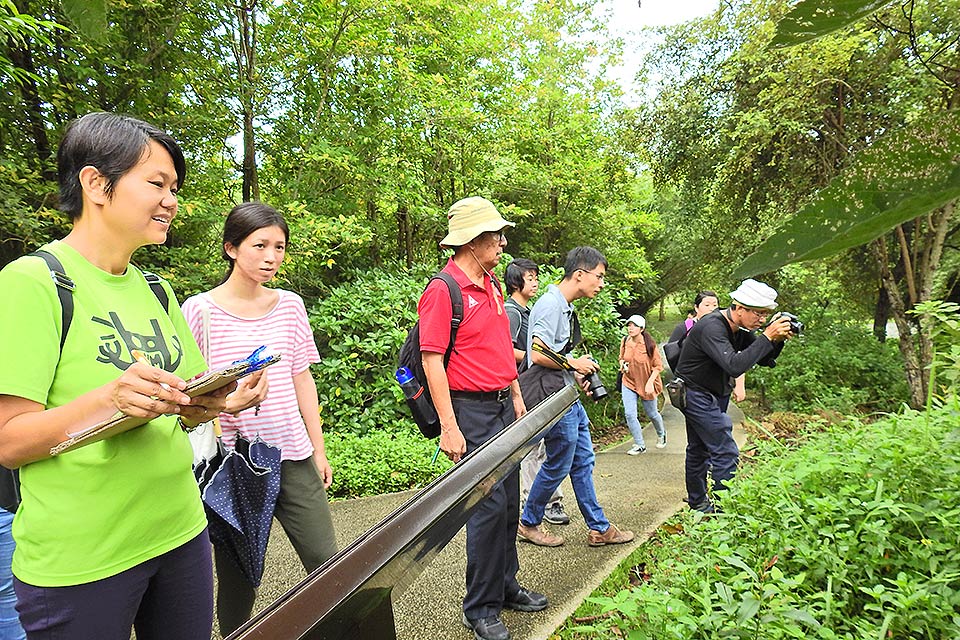


Butterfly Hill survey and some of the butterfly species that came out to greet us
The group were entertained by the usual Danainaes like the Plain Tiger, Blue and Dark Glassy Tiger, Common Mormon, Painted Jezebel and the larger butterflies on Butterfly Hill. Of notable interest was a couple of Grass Demons (Udaspes folus) that were active around their host plants. There were several Common Rose fluttering amongst the Snakeweeds and other flowering plants, one female was even spotted ovipositing on its caterpillar host plant, Aristolochia acuminata.

At the mangrove boardwalk at Chek Jawa Wetlands
The group recorded about 30 species of butterflies on this first leg of the walk, which ended at around 1:45pm. After a short break at the registration point, two mini buses arrived and took the group to the starting point of the second leg of the survey - Chek Jawa. A short trip brought us to the start point at Chek Jawa and the survey started at around 2:15pm.

A friendly Spotted Black Crow perched on a palm leaf
The weather continued to be cloudy and overcast, and the group walked along the boardwalks leading to the mangrove swamp area. Other than the usual Common Palmfly which was active along the boardwalk, the group encountered a Spotted Black Crow that was perched on a palm leaf. The butterfly was cooperative and did not fly off from its perch even after everyone had their full share of photos of it.

Out at the coastal boardwalk
The group emerged from the mangrove boardwalk and spotted a few Lycaenidae like the Common Tit and what appears to be a worn-out Scarlet Flash. A school of mudskippers distracted the group for a while, as would a large White Bellied Sea Eagle, that flew overhead. The walk along the coastal boardwalk, as expected, did not turn up any butterflies.

Back at the entrance to Chek Jawa Wetlands
The survey ended around 3:45pm at the Chek Jawa Visitor Centre and the group headed back to the main village to take the bumboat back to Singapore island. Although the BioBlitz was a 24-hour survey, the butterfly survey ended after 4:30pm as generally, it would be less fruitful to survey butterflies in the late afternoon and evening, as most of them would be settling in for the night and would not be flying actively any more.

Part 2 of the BioBlitz survey starting at the Sensory Trail
The next day, Sunday 4 Dec 2016, the survey continued. A smaller group this time, members took the bumboat over to Pulau Ubin and started the survey at 10:00am. This time, the survey transect started at the Sensory Trail. The weather was more cooperative on this hot and sunny Sunday morning.


Forested walk at the Sensory Trail
There were many species of butterflies actively flying, and of note were the Common Jay (first discovered on Pulau Ubin, and is now a regularly seen resident), Malayan Plum Judy, Ancyra Blue (also first discovered on Pulau Ubin), Perak Lascar, Blue Nawab and residents of the mangrove area along with the transects brought us past.


Members of the survey looking out for butterflies
A cooperative Common Mormon was spotted puddling and allowed the group to take photos and videos of its puddling activity before it flitted off, having its fill of its liquid diet. With the sun almost overhead, the group reached the end of the transect along the Sensory Trail, and we saw some workers putting on the finishing touches to House 363B which was refurbished and conserved as a model of a Chinese kampung house.


Taking a closer look at a puddling Common Mormon
Built in the 1970s, the house was owned by Mr Chew Teck Seng, who used to operate a provision shop in the village centre known as ‘Teck Seng Provision Shop’. Renamed ‘Teck Seng’s Place’, the house features interpretive signs and specially-curated memorabilia to give visitors a glimpse into life on Pulau Ubin in the 1970s.


ButterflyCircle photographers at work!
The group made its way back to the registration point and met other survey groups that had also completed their respective surveys of other taxonomic groups. The BioBlitz ended at 12 noon, and all the group leaders recorded their finds over the past 24 hours on their designated transects. The results will be consolidated by NParks and will be shared at a future Ubin forum.

Big group of BioBlitz @ Ubin participants covering bees and wasps, birds, butterflies, dragonflies, spiders, other insects, snakes, and many taxonomic groups!
The happy but tired group made their way back to the jetty and took the bumboats back to the mainland. It was a relatively fruitful survey for butterflies (despite the poor weather on Saturday), yielding 34 species over a four-hour survey of Butterfly Hill and Chek Jawa, and 31 species over a two-hour survey at Sensory Trail.


ButterflyCircle and Nature @ SCC members with other volunteers who joined us on Sat and Sun for the 24-hour biodiversity survey on Pulau Ubin
Members of the two groups, ButterflyCircle and Nature @ SCC, were happy to have participated in BioBlitz @ Ubin 2016 and look forward to the comprehensive biodiversity survey of Pulau Ubin in 2017.
Text by Khew SK : Photos by Bob Cheong, Chng CK, Goh EC, Huang CJ, Khew SK, Vanessa Lee, Soh KY and Jonathan Soong.
Special thanks to the members of ButterflyCircle and Nature @ Seletar CC who turned up to help with the survey, and the newbie members who also joined in. Thanks to members of the public who also joined as volunteers on the survey with us!
Special thanks to the members of ButterflyCircle and Nature @ Seletar CC who turned up to help with the survey, and the newbie members who also joined in. Thanks to members of the public who also joined as volunteers on the survey with us!


