02 July 2016

Butterfly of the Month - July 2016

Butterfly of the Month - July 2016
The No Brand Grass Yellow (Eurema brigitta senna)


As we cross the half-year threshold of 2016, unbearably hot and humid weather is upon us. The summer weather in the northern hemisphere warms up the environment quickly, as the mercury climbs past 30degC in cities as far north as Beijing and Tokyo. A friend who just came back from the Middle East reported temperatures hitting 40degC already, and rising!


Singapore's weather is no different, often touching 30degC and it is the humidity that gets to you, if you are out in the field. Fortunately, the rains that we get regularly in Southeast Asia have rejuvenated the environment, and the greenery from Singapore to Thailand have turned lush again. This is obviously good news for the butterflies, and it is the season for our flying jewels to be out in numbers again.


Our human world, on the other hand, appears to be as tumultuous as ever. For a while over the past two weeks, everyone from the taxi driver to the kopi uncle also had something to say about "Brexit". Though I wonder if they really understand what it is all about! The Internet seems to have reached a lot more people today than we would have thought possible, compared to the newspaper era.


Changes to the economic outlook in many countries are painfully unpredictable - mainly leaning on the side of bad news. Already, some countries are already talking about negative interest rates. To the layman, this means that you have to pay the bank to keep your money "safe" for you. I wonder if it would spur people to keep wads of notes in a Milo tin and hide it under the bed like my grandmother used to do!


Terrorist attacks on innocent people continue to strike mercilessly and unpredictably. Just a week ago, more than 40 people perished in a shooting and suicide bomb attack at Istanbul's international airport. This morning, terrorists struck a restaurant in Dhaka, Bangladesh, leaving 20 innocent victims dead. Both attacks were attributed to ISIS extremists. One wonders when all this madness will ever end?


A female No Brand Grass Yellow ovipositing on its host plant

Ironically, here in Singapore, the news that appears to have dominated mainstream and social media over the past few days, was about the raising of parking charges at public carparks. As usual, cost of living issues take centrestage when it comes to hot topics on our little island in the sun. Somehow, this pales in comparison, when we read of the troubles that our neighbours face, or the fatalities in terrorist attacks around the world. C'est la vie!
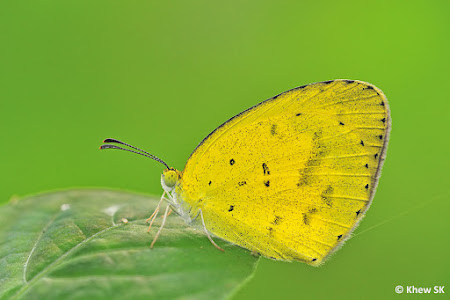

A newly-eclosed male No Brand Grass Yellow perching on a leaf

This month, we feature a bright and yellow butterfly to give a little bit of cheer to our world. But alas, even in this bit of optimism, we have a sad tale to tell. Our Butterfly of the Month is the No Brand Grass Yellow (Eurema brigitta senna). Pardon the rather unglamourous name, which originated some some literature from the region. Elsewhere, it is called the Small Grass Yellow, but then again, English Common names are never known to be a reliable source of indentification.

Another female No Brand Grass Yellow ovipositing on its host plant

The No Brand Grass Yellow was originally re-discovered in Singapore back in Oct 2006 at a wasteland on the northeastern part of Singapore. Its caterpillar host plant, Cassia mimosoides, had colonised a patch of cleared land awaiting development. For a short period, the butterfly was almost abundant in that area, due to its short life history.
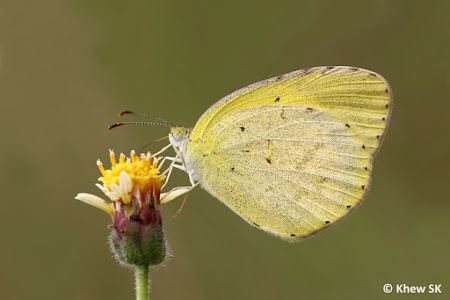
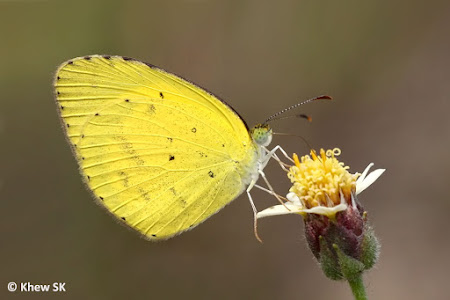

Top : Female No Brand Grass Yellow (note lighter coloured hindwing) Bottom : Male No Brand Grass Yellow (note brighter lemon yellow). Underside with more extensive brown freckles peppering both wings compared to the other species in the Eurema genus.

It was last photographed from that area in late 2008, just before the excavators descended on the site and the wasteland was no more. Several attempts to translocate the species to other areas failed. The host plant was cultivated and spread to other parts of Singapore, including Hort Park and other urban parks, but the No Brand Grass Yellow has not been seen since, except for an unvalidated sighting from Pulau Ubin in 2010.


Upperside of the No Brand Grass Yellow showing the scalloped black borders on both wings

The No Brand Grass Yellow appears like its other more common cousins when in flight. The upperside forewing black borders are regularly scalloped and not deeply excavated as in the other species of the Eurema genus. In terms of size, it is generally similar to the other species found in Singapore, averaging between 18-20mm on its forewing length.


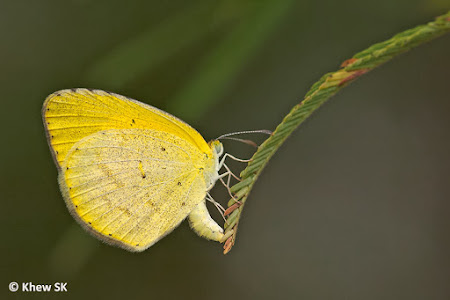
On the underside, there are no cell spots - a characteristic that is used to identify and distinguish the other species of the Grass Yellow species. The male does not possess a brand on the cubital vein (which is present in the other species). This could have given rise to the common name of this butterfly as having "No Brand".
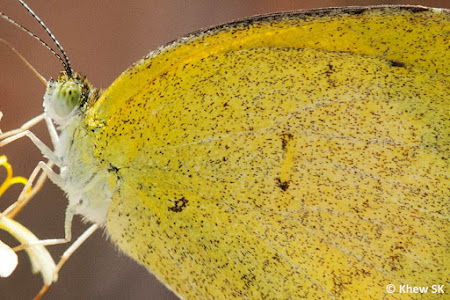

Note heavily freckled underside of the No Brand Grass Yellow

The underside of both sexes of the No Brand Grass Yellow is heavily freckled. The "peppered" appearance of the underside is distinctive, and readily separates this species from its lookalike cousins. The female of this species is also unique in that the hindwing is of a paler yellow than the forewing, giving it a two-tone appearance.
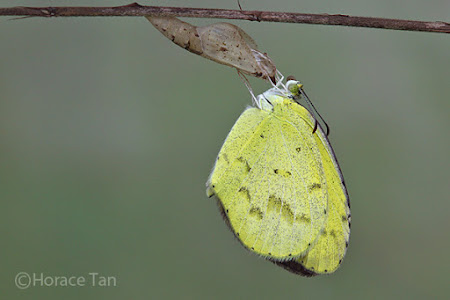

A newly-eclosed No Brand Grass Yellow holding on to its pupal case

Fortunately, the life history of the No Brand Grass Yellow was recorded on this blog before its disappearance from Singapore. If there are any sightings of this species in recent years, please inform us by posting on this blog article, or on our FaceBook "Butterflies of Singapore" Group. Ideally, you should have a photograph of it for validation.

Text by Khew SK : Photos by Sunny Chir, Federick Ho, Khew SK, Bobby Mun, Horace Tan, Tan BJ and Anthony Wong.

25 June 2016

Butterfly Photography at Our Local Parks - Fusionopolis North

Butterfly Photography at Our Local Parks
Featuring : Fusionopolis North @ One North Park


Another Butterfly Garden in Singapore has recently been completed by NParks and opened to the public on the western part of Singapore. A 5,800 sqm Butterfly Garden referred to as Fusionopolis North, it features a rain garden with bioswales, is cultivated with butterfly-attracting host and nectaring plants.


One-north Park is a 16-ha park consisting of 13 land parcels spanning across the entire length of JTC’s masterplan for one-north to create a work-live-play-learn environment. The park, when fully completed, serves as an integrated green corridor to link key developments such as Biopolis, Fusionopolis, Mediapolis and the one-north MRT station.


Last week, two of the parcels were completed - Fusionopolis North (flanked by Central Exchange Green, One North Link and Portsdown Road) and Fusionopolis South (flanked by One North Crescent, Portsdown Road and Central Exchange Green). The two adjacent parcels are rich with local biodiversity like birds, butterflies, dragonflies and even a snake or two.


I visited to the Fusionopolis North's Butterfly Garden during its opening ceremony last Saturday at around 4:00pm on a drizzly evening. Surprisingly, there were still quite a number of butterflies fluttering around, feeding on the flowering plants. In a short 30 minute survey, a total of 11 species of butterflies were spotted. Not bad, considering the time of the day and the weather.


Two more follow-up observation surveys were made over the weekends and the tally is now 26 species and counting! The Butterfly Garden was active with free-ranging butterflies on both the days that I visited. The most common species was the Lemon Emigrant (Catopsilia pomona pomona) and Tawny Coster (Acraea terpsicore). There were at least 20 individuals of both species fluttering amongst the flowering plants.


Top : Female Blue Pansy ovipositing on the leaves of the variegated Asystasia gangetica

Large numbers of butterfly-attracting plants have been cultivated on the 0.58Ha plot. The main concrete path winds around the patches of host and nectaring plants, with secondary paths of gravel providing alternative routes around the greenery. Look for the Tawny Coster caterpillars on the Yellow Alder (Tunera ulmifolia) plants. The low-lying Asystasia gangetica "Ivory Ribbons" plants attract the Blue Pansy to lay eggs on them, and their caterpillars can be found on these plants, if you look hard enough.


Common Mime feeding on the purple flower of the Golden Dewdrop

The other host plants like the Lime Bush (Citrus sp) and Indian Curry Leaf (Murraya koenigii) around the periphery of the Butterfly Garden are sure attractants to the females of the Common Mormon and Lime Butterfly to lay eggs on their favourite caterpillar host plants. There are also many other host plants like Asystasia, Ixora, Cratoxylum cochinchinense and Caesalpinia pulcherrima to attract their respective butterfly species.


Amongst the nectaring plants are the Yellow Alder (which attracts butterflies to feed on them in the early morning hours when their yellow flowers are open fully), Lantana, Ixora, and the Golden Dewdrop (Duranta erecta). The last-named plant, with its pretty purple flowers, seems to be the all-time favourite with the butterflies at this Butterfly Garden.


Female Blue Pansy feeding on the yellow variety of Lantana camara

The success of this small patch of greenery is dependent on its catchment area surrounding the park. Adjacent to the cultivated patches, large areas of greenery are left in their undisturbed natural state. These green 'backdrops' are functionally critical as buffer areas which also host rich biodiversity in the area. The network of Park Connectors (PCNs) then link up the larger parks like the Southern Ridges, Botanic Gardens, West Coast Park and Bukit Timah to this area.


Overview map of the Fusionopolis North Butterfly Garden

As the Butterfly Garden at Fusionopolis North is newly completed, it appears rather open and hot. When the vegetation is more mature, there may be patches of shadier habitats that may attract other species of butterflies besides those that prefer open and bright sunshine environments. Do take a walk to the adjacent Fusionopolis South, as there are also areas that are attractive to butterflies as well.


Signages and seating at Fusionopolis North Butterfly Garden

There are some interpretative signs to help introduce the types of plants that are cultivated at the Butterfly Garden. On a cloudy day or in the evenings, a visitor may be tempted to just take a seat at several seating areas along the walkways, just to enjoy the breeze and watch the butterflies flutter by.


Whilst nature enthusiasts often lament the loss of our natural urban greenery, the juxtaposition of cultivated plots with existing natural plots like what has been done at One-North Park, often offers a good conservation balance that may be just right for our biodiversity to thrive within our built environment. NParks and other government agencies like the JTC and URA have been making great strides in helping to maximise the potential of our urban greenery to attract and enhance our biodiversity despite the continuous need to develop our scarce land resources.


Fusionopolis North Butterfly Garden with the high-tech industrial buildings in the background

If you are a resident living in the south-western part of Singapore, pay a visit to this new Butterfly Garden at Fusionopolis North on a sunny day, and you will not be disappointed at the variety of butterflies that can be spotted at this small plot of greenery.


How to Get There :
By MRT : Fusionopolis North Butterfly Garden is about a 5-minute walk from the One-North MRT station, or about a 10-minute walk from the Buona Vista MRT station.

By Car : See map for details. Park at the various buildings opposite the park. The basement carpark at One-North Residences is the nearest carpark. Note that prevailing parking charges apply.

Text by Khew SK : Photos by Khew SK and Huang CJ

Checklist of Butterflies Observed at Fusionopolis North Butterfly Garden :
  1. Papilio clytia clytia (Common Mime)
  2. Papilio demoleus malayana (Lime Butterfly)
  3. Papilio polytes romulus (Common Mormon)
  4. Delias hyparete metarete (Painted Jezebel)
  5. Appias libythea olferna (Striped Albatross)
  6. Catopsilia pomona pomona (Lemon Emigrant)
  7. Catopsilia scylla cornelia (Orange Emigrant)
  8. Eurema hecabe contubernalis (Common Grass Yellow)
  9. Danaus chrysippus chrysippus (Plain Tiger)
  10. Ideopsis vulgaris macrina (Blue Glassy Tiger)
  11. Elymnias hypermnestra agina (Common Palmfly)
  12. Mycalesis mineus macromalayana (Dark Brand Bush Brown)
  13. Doleschallia bisaltide bisaltide (Autumn Leaf)
  14. Junonia hedonia ida (Chocolate Pansy)
  15. Junonia almana javana (Peacock Pansy)
  16. Junonia orithya wallacei (Blue Pansy)
  17. Acraea terpsicore (Tawny Coster)
  18. Phalanta phalantha phalantha (Leopard)
  19. Phaedyma columella singa (Short Banded Sailor)
  20. Euchrysops cnejus cnejus (Gram Blue)
  21. Zizula hylax pygmaea (Pygmy Grass Blue)
  22. Zizina otis lampa (Lesser Grass Blue)
  23. Hasora chromus chromus (Common Banded Awl)
  24. Potanthus omaha omaha (Lesser Dart)
  25. Polytremis lubricans lubricans (Small Branded Swift)
  26. Suastus gremius gremius (Palm Bob)
Further Reading and References :

NParks Website : One North Park : Fusionopolis North Butterfly Garden

18 June 2016

Life History of the Chestnut Angle v2.0

Life History of the Chestnut Angle (Odontoptilum angulatum angulatum)


Butterfly Biodata:
Genus: Odontoptilum  de Niceville, 1890
Species: angulatum C. Felder, 1862
Sub-species: angulatum C. Felder, 1862
Wingspan of Adult Butterfly: 35-40mm
Caterpillar Local Host Plants: Commersonia bartramia (Malvaceae, Common name: Brown Kurrajong, 山麻树), Talipariti tiliaceum (Malvaceae, Common name: Sea Hibiscus, 黄槿).


Physical Description of Adult Butterfly:
The forewing termen is sinuous, and the hindwing prominently stepped at vein 7. The upperside is chestnut-brown with a complex, cryptic pattern of white striae in the hindwing. The forewing has a dark sub-discal band, a crescentic hyaline spot in space 2, and a smaller spot above it near the base of space 3. In addition, two apical spots can be found in spaces 7 and 8. Hindwing has elongated tornal cilia. The male possesses a tuft of white hairs on the fore coxae, and the female has a thick anal tuft on the abdomen. The underside is predominantly whitish in the hindwing.


Field Observations of Butterfly Behaviour:
This species is rather rare in Singapore. The adults are usually found near its larval host plants, or when puddling on wet grounds and bird droppings. In Singapore, it may be found in urban wastelands where Commersonia bartramia grows, or in coastal wetlands where Talipariti tiliaceum (Sea Hibiscus) is common. They fly rapidly in bright sunshine in open spaces within forests or wastelands, and visit flowers for nectar. Other sighting locations include various parts of the nature reserves.


11 June 2016

Butterfly of the Month - June 2016

Butterfly of the Month - June 2016
The Dark Glassy Tiger (Parantica agleoides agleoides)


A Dark Glassy Tiger feeding on the purple flower of the Golden Dewdrop (Duranta erecta)

Almost half the year has already flown past us in 2016, as we ponder the road ahead. A group of seven ButterflyCircle members made a quick trip to Fraser's Hill in Malaysia for a short break to escape the hustle and bustle of our daily work life. If I recall correctly, our last trip as a group was four years ago back in 2012, and it would be nice to see how Fraser's Hill's butterfly diversity is like this year.


This time around, we stayed at the Shahzan Inn, a decently-priced hotel right smack in the town centre of Fraser's Hill. Our four-day stay was blessed with relatively good weather, other than a short drizzle on one of the mornings. We also met up with a few good old friends from Kuala Lumpur, who made a day-trip to join us on our butterfly-hunting outing.


A male Dark Glassy Tiger showing part of its hair pencil when alarmed

The butterfly activity was relatively ok for most of the trip, and we also managed to add a couple of species here and there to our personal tally of butterfly photos. Compared to the higher Cameron Highlands, I always thought that the temperature at Fraser's Hill was cooler and the environment less damaged by development and farming. Let's hope that the powers that be continue to keep Fraser's Hill this way for many more years to come.


Back home in Singapore, the weather appears to be much wetter on many days in May and June, as the intermonsoon winds brought respite from the hot dry weather in the early months of the year. The local scene also appears to be rather quiet, although the economy continues its lacklustre and gloomy outlook.


The Singapore public sector, however, is abuzz with a lot of debates regarding the government's announcement that public servants will have no internet access on their official workstations from May 2017. Whilst the social media critics will have a field day criticising the apparent knee-jerk reaction by the government, it is always important to keep abreast of the reasons why such an extreme measure has to be taken.


Dark Glassy Tiger feeding on the flowers of the Blood Flower (Asclepias currasavica)

Security risks are always around us as the world continues to develop and become highly dependent on information technology and the internet. As we become more and more connected and many countries are looking at becoming "smart" nations, the risks will continue to increase exponentially as far as cyber-attacks and technology-driven terrorism are concerned. Sci-fi and suspense movies have hypothesised and predicted what could happen when criminals take over IT networks and the chaos that they can cause. Will there be a possibility that such events can happen in the future? Only time will tell.


This month, we feature a relatively common butterfly in our environment, the Dark Glassy Tiger (Parantica agleoides agleoides). This species has a widespread distribution across the island - from urban parks and gardens to mangrove wetlands and the nature reserves. Its lookalike cousin, the Blue Glassy Tiger (Ideopsis vulgaris macrina) which was featured as last month's butterfly of the month, can be differentiated from the Dark Glassy Tiger by the forewing markings.


How to distinguish between the Dark Glassy Tiger and the Blue Glassy Tiger

The Dark Glassy Tiger has narrow black longitudinal streaks in the forewing cell that sets it apart from the Blue Glassy Tiger, which has a thick transverse bar in the cell. The Dark Glassy Tiger also appears "greyer" when in flight, although this is not a reliable way of distinguishing the two lookalike species. Both frequent similar habitats and are often seen together when feeding on flowering plants.


Dark Glassy Tigers feeding on the yellow flowers and seed pods of the Rattleweed (Crotalaria retusa and Crotalaria mucronata)

It has a slow and unhurried flight as it flies from flower to flower to feed on nectar. It is not difficult for a beginner to photograph, whilst it is feeding. The Dark Glassy Tiger is also attracted to the Indian Heliotrope as well as the False Dill, particularly dried parts of these plants. Like many of the related Danainae species, the Dark Glassy Tiger is partial to the Rattleweed (Crotalaria retusa) plant and can usually be observed feeding on the sap on the stems and seed pods of the plant.


The caterpillar of the Dark Glassy Tiger feeds on lactiferous vine Tylophora flexuosa which it shares with its cousin the Blue Glassy Tiger. Its complete life history has been successfully recorded in Singapore and can be found on this blog here.


Text by Khew SK : Photos by Sunny Chir, Goh LC, Khew SK, Loke PF, Bobby Mun, Billy Oh, Jonathan Soong and Mark Wong