17 October 2015

Larval Host Plant for Butterflies: Batoko Plum

Butterflies' Larval Host Plants #4
The Batoko Plum (Flacourtia inermis)


This 4th instalment of our Butterflies' Larval Host Plants series features Flacourtia inermis, a species formerly placed under Flacourtiaceae but has recently been moved to the Salicaceae (willow family) as a result of phylogenetic analyses using DNA sequence data.The species name refers to the fact that there are no spines on the trunk (unarmed).

Plant Biodata :
Family : Salicaceae
Genus : Flacourtia
Species : inermis
Country/Region of Origin : India to Malesia
English Common Names : Batoko Plum, lovi-lovi, lobi-lobi
Other Names : Rukam Masam, 紫梅, 罗比梅
Larval Host for Butterfly Species: Phalanta phalantha phalantha (Leopard), Cupha erymanthis lotis (Rustic).

Batoko Plum is native to the India and Malesia (a floristic region which includes the Malay Peninsula, Malay Archipelago, New Guinea and Bismarck Archipelago) regions. In Singapore, it is commonly planted in parks/gardens and on roadside for shade and ornamental purposes. Elsewhere, Batoko Plum is usually cultivated as a fruit tree.

Two roadside Batoko Plum trees in Singapore.

Batoko Plum is a small to medium-sized tree that grows up 15m, with trunk up to 35cm in diameter. It features simple, alternate leaves. Each leaf is ovate-oblong to ovate-elliptic in shape, about 8-12cm long and has toothed margin. Young, emerging leaves are red in colour. As the leaves grow to its mature size, they decolorise to reddish green and finally to green. The upper leaf surface typically has a glossy appearance.

The reddish young leaves of the Batoko Plum.

Maturing leaves as the reddish coloration fades away.

A mix of leaves in all stages of development of the Batoko Plum.

Mature leaves of the Batoko Plum.

Flowers of the Batoko Plum are small, creamy yellow and occur in short racemes (simple, unbranched inflorescene) which are up to 5 cm long. These flowers are dioecious (having separate male and female flowers). The unisexual flowers attract insects to act as pollinators in the reproduction process.

Racemes of flowers of the Batoko Plum rising from the stem/branch.

Close up view of the flowers.

Fruits occur in bunches and are spherical and berry like, 2 to 2.5cm in diameter. They are initially green but turning pink to red when fully ripened. They can be eaten raw but are sour and acidic in taste. Typically they are turned into jams, preserves and syrups.

Young fruits of the Batoko Plum.

Maturing fruits of the Batoko Plum.

A bunch of ripened fruits of the Batoko Plum.

In Singapore, the Batoko Plum also serves as the larval host plant for two butterfly species: Leopard and Rustic. Both are members of the Nymphalidae family, Heliconiinae sub-family.

A Leopard butterfly.

A Rustic butterfly.

Eggs of both Leopard and Rustic are laid singly on the young shoots of the Batoko Plum. Their caterpillars feed on the young and maturing leaves, and not on the fully matured leaves.

An early instar Leopard caterpillar found on a young shoot of the Batoko Plum.

A 3rd instar Leopard caterpillar resting on a against young leaf of the Batoko Plum.

A 4th instar Leopard caterpillar on the move.

A final instar Leopard caterpillar observed in the Japanese Garden.

Typically, caterpillars of both the Leopard and Rustic butterflies choose to pupate on the underside of a leaf of the host plant.

A pupa of the Leopard found on the underside of a leaf in the western part of Singapore.

A close-up view of a pupa of the Leopard found on a roadside Batoko Plum tree.

Next time when you are out for a walk/jog in our parks, gardens, park connectors or along the road outside your house, check for the presence of the Batoko Plum. A sight of this plant usually implies the existence of a colony of Leopard butterflies in the vicinity.

References:
  • 1001 Garden Plants in Singapore : Boo Chih Min, Kartini Omar-Hor and Ou-Yang Chow Lin, National Parks Board, 2nd Edition 2007.
  • Flacourtia inermis - Asianplant.net.
  • Chase, M. W., S. Zmarzty, M. D. Lledo, K. J. Wurdack, S. M. Swensen, & M. F. Fay. When in doubt, put it in Flacourtiaceae: a molecular phylogenetic analysis based on plastid rbcL DNA sequences. Kew Bulletin 57: 141-181, 2002
  • Flacourtia inermis, Wikipedia.
Text and Photos by Horace Tan.

10 October 2015

Two Lycaenidae to Make it 322!

Two Lycaenidae to Make it 322!
Featuring Transparent Sixline Blue and Mutal Oakblue


In my earlier update to the Singapore Checklist, we saw the inclusion of a Lycaenidae and a Hesperiidae added to the list after the species' life histories were recorded and the voucher specimens examined. This week's article introduces two more species that are not easy to identify in the field without careful scrutiny of the physical features of the butterfly.


The first species featured here is one of the Lycaenidae from the genus Nacaduba. This genus comprises several lookalike species known as the Fourline and Sixline Blues. A number of the species found in Singapore look very similar and only with careful examination of their diagnostic wing markings can one separate them. The fact that these species are also variable across different individuals and sexes can also prove challenging to identify them with a high level of confidence.


The scrutiny of many photos and specimens collected during official NParks surveys indicated that one species, the Transparent Sixline Blue (Nacaduba kurava nemana) is extant in Singapore. Over the years, this species had been mis-identifed as one of its two close cousins - the Opaque Sixline Blue and the Rounded Sixline Blue. Indeed, the species are so similarly marked that they may often be confused with each other, particularly with worn-out or tattered specimens shot in the field.


With the help of ButterflyCircle forums' resident expert, Dr Seow TL, (and many discussions on the forums), we are now confident of the existence of the Transparent Sixline Blue. Besides the ID keys described in our references, Dr Seow has also added certain key characteristics that are consistent in this species.


Voucher specimen of a male Transparent Sixline Blue showing all the typical characteristics of this species

The Transparent Sixline Blue is described to have violet blue upperside in the male with the underside markings visible through the wings by transparency. The female upperside is pale shining blue with white patches beyond the forewing cell. The underside has the post-discal striae inwardly bounded by darker lines and the space between them paler than the ground colour of the wings.


A Transparent Sixline Blue shot at Seletar Country Club's Butterfly Garden

From Dr Seow's observations, he has added the following ID keys to separate this species from the other lookalikes :

Males :

  • The termen of the forewing is fairly straight.
  • Large submarginal spots (may be band-like) with rounded or scalloped inner margins; HW submarginal spot 6 large and very often quadrate (squarish).
  • Underside forewing base not darkened.
  • Upperside markings visible through the wings by transparency (although this diagnostic feature is almost impossible to ascertain in field shots except if the butterfly is sunbathing with open wings)
Females are more difficult to ID although the general features are applicable.


We record the Transparent Sixline Blue (Nacaduba kurava nemana) as species #321 in the Singapore Checklist. In the references, four other Nacaduba species - N. pendleburyi pendleburyi, N. hermus swatipa, N. subperusia lysa and N. russelli - all very similar looking species, should be further investigated and looked for in Singapore, as they have been recorded as extant by the early authors.


The next species of interest comes from the frustratingly-difficult to identify genus, Arhopala. This genus, with over 80 recorded species in Malaysia and Singapore, often proves challenging to separate the individual species. New species are still being described when additional information becomes available. This genus would benefit greatly from DNA sequencing and a database should be collated when the opportunity arises.


After ButterflyCircle member Tan Ben Jin discovered caterpillars of an Arhopala feeding on Lithocarpus bennetii in the nature reserves back in 2010, a long debate ensued and discussions on tracing the ID of the specimen initially proved futile. A later attempt at breeding the same species on the same plant by Horace Tan yielded further voucher specimens for examination.


Even with specimens bred from the same host plant, the voucher specimens that resulted from breeding appeared to have differences between individuals that suggest the existence of more than one species! However, Dr Seow is fairly confident of the identity of the Mutal Oakblue (Arhopala muta maranda) for us to record the re-discovery of this species in Singapore.


The Mutal Oakblue is a small butterfly of about 30mm wingspan and described as shining blue on the upperside, with the marginal borders increasing from 1.5 mm to about 2.0 mm at the apical area of the forewing. The hindwing is paler and a brighter blue contrasting with the forewing in a sidelight.


Male voucher specimen of the Mutal Oakblue (Arhopala muta maranda)

The female is a shining blue with a purple tinge and broad black borders. The post-discal spots on the brown underside appear more squarish, giving it a banded appearance. The spot in space 2 of the forewing is out of line with the adjacent spots and moved towards the termen. The species is tailless.


Pupa of a male Mutal Oakblue on the night before eclosion

With the relatively conclusive evidence of voucher specimens of this species, we record the Mutal Oakblue (Arhopala muta maranda) as species #322 in the Singapore Checklist.  Further investigations continue, and it is highly likely that more species from the genus Arhopala will turn up sooner or later, depending on the availability of life history documentation and actual voucher specimens for examination.

In a forthcoming blog article, we will feature the addition of two more Hesperiidae to the Singapore Checklist after concluding early stages documentation and voucher specimens have confirmed the IDs of the skippers with a high level of confidence.

Text by Khew SK : Photos by Sunny Chir, Foo Jit Leang, Khew SK, Tan Ben Jin and Horace Tan.

Special thanks to Ben Jin for discovering the Arhopala and Horace Tan for his patience and effort in documenting the early stages of these species and to Dr TL Seow for his persistence in scrutinising the voucher specimens to identify the species with a high level of confidence, in particular the Arhopala muta maranda, which led to several dead-ends for some time.

References :

  • The Butterflies of The Plain Peninsula, A.S. Corbet and H.M. Pendlebury, 4th Edition, Malaysian Nature Society.
  • Butterflies of West Malaysia and Singapore, WA Fleming, 2nd Edition, Longmans, 1983
  • Butterflies of Thailand, Pisuth Ek-Amnuay, 2nd Edition, 2012

Special Note :
All voucher specimens, host plants and early stages collected within Parks or Nature Reserves under the jurisdiction of the National Parks Board are done with the permission of the National Biodiversity Centre Division of NParks. Specimens will be submitted to the Lee Kong Chian Natural History Museum's Lepidoptera Collection for reference.

03 October 2015

Life History of the Dingy Bush Brown

Life History of the Dingy Bush Brown (Mycalesis perseus cepheus)


Butterfly Biodata:
Genus: Mycalesis Hübner, 1818
Species: perseus Fabricius, 1775
Subspecies: cepheus Butler, 1867
Wingspan of Adult Butterfly: 35-45mm
Caterpillar Local Host Plants: Ischaemum ciliare (Poaceae, common names: Smut Grass), Axonopus compressus (Poaceae, common names: Wide-leaved Carpet Grass, Cow Grass).


Physical Description of Adult Butterfly:
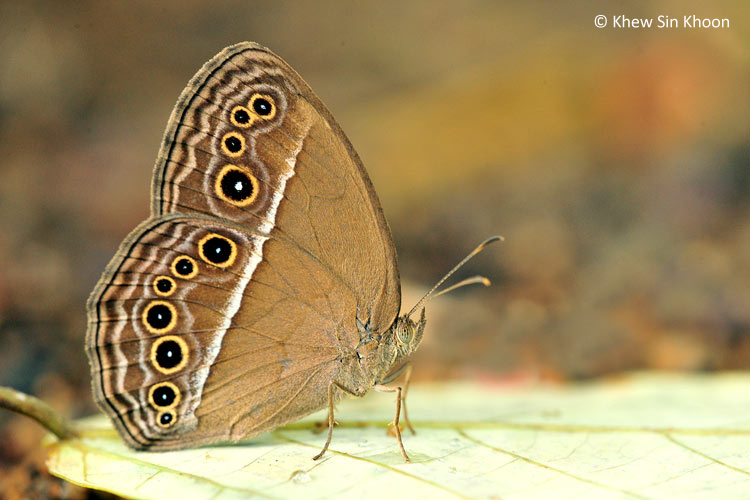
On the upperside, the wings are dark greyish  brown with a large but obscure ocellus in space 2 of the forewing. The male has a small, dark brown sex brand in space 1b of the forewing, and another one at vein 7 of the hindwing overlaid with a pale yellow hair tuff. On the underside, both wings are pale brown in ground colour (with the male in darker brown than the female) and have a clear-whitish post-discal band. There is a series of ringed ocelli in the submarginal area on both wings. In the forewing, the submarginal ocelli usually include only one ocellus in each of spaces 2 and 5, and two smaller ocelli in between.  In the hindwing, there is a thin, dark indentation line  stretching down to (but not beyond) vein 1b. Furthermore, the submarginal series of ocelli has an arched appearance with the ocellus in space 2 moved inwards and out of alignment with those in spaces 1b and 3.

A pair of Dingy Bush Brown. Left: male; Right: female.


Field Observations of Butterfly Behaviour:
The Dingy Bush Brown is a moderately common butterfly in Singapore. Adults can be sighted flying low, in and around grassy patches at several locations across the island. As with other Satyrinae members, the adults fly in an erratic and jerky manner as their wings are closed for a relatively long period during flights.

26 September 2015

Two Additions to the Singapore Checklist

Two Additions to the Singapore Checklist
Purple Broken-Band Oakblue and Linna Palm Dart


Over the years, there have been several additions to the Singapore Checklist of species that have either been seasonal visitors or some that have established viable colonies to be considered permanent residents in Singapore. In the families Lycaenidae and Hesperiidae, there are many lookalike species where just field shots of butterflies may prove challenging to identify.


This is where voucher specimens are required, or where opportunities arise, the documentation of the early stages of the butterfly can help to confidently identify the species. In this series of updates to the Singapore checklist, we feature a total of six new species that have taken time to reliably identify these butterflies. In this article, we feature two species that will now be added to the Singapore Checklist.


The first is a species from the genus Arhopala, a group of butterflies that are extremely challenging to identify from field shots alone. In several cases, the variability of the species in terms of its physical diagnostic features makes it even more difficult to ID the species accurately. At times, both the upper and under side of the butterfly's wings need to be examined for a higher level of certainty of the ID.
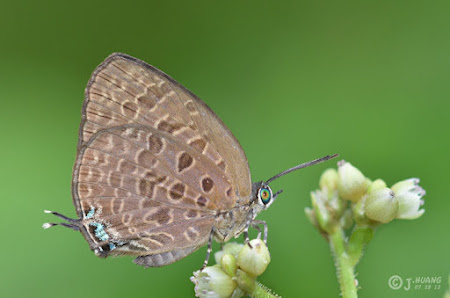


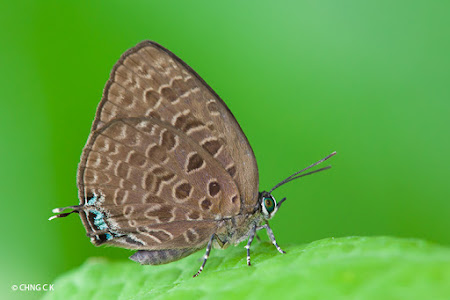
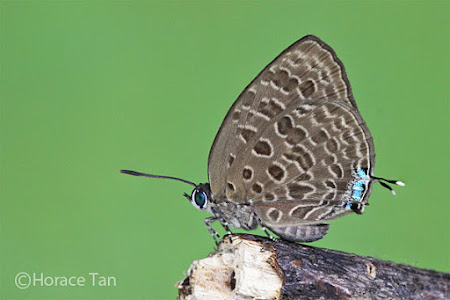
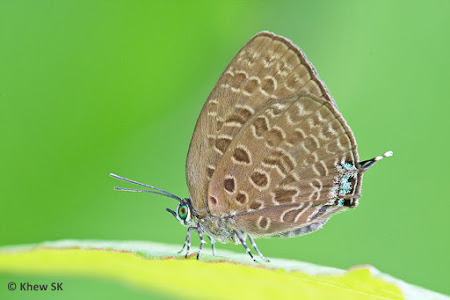
In the case of the Purple Broken-Band Oakblue (Arhopala alitaeus pardenas) the life history was documented and several voucher specimens examined before we recorded this as an extant species in Singapore. This species belongs to the alitaeus group of which there are at least nine species in Malaysia and Singapore. The diagnostic features to separate them require close scrutiny of specimens.
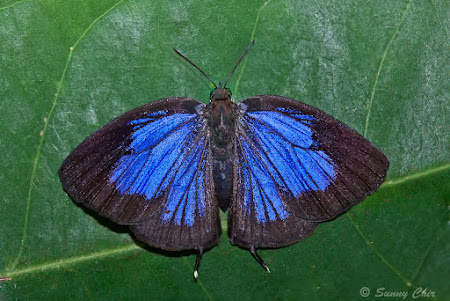


Based on the literature and records in C&P4*, two species of the alitaeus group, A. pseudomuta and A. alitaeus are extant in Singapore. All the others are found in Malaysia and a few subspecies are isolated to the island of Langkawi. With the voucher specimens and scrutiny of the diagnosic features, we now have a higher confidence to record A. alitaeus pardenas as a re-discovery in Singapore.
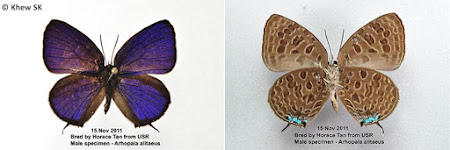


The Purple Broken-Band Oakblue (this name was taken from Pisuth's Butterflies of Thailand Book) is described as having a weak purplish glaze on the underside of its wings. On the upperside, the male has a consistent 1.0 mm wide border and having more annular (curved or somewhat round in shape rather than jagged) markings on the underside. The female has a broad black border on both the fore- and hindwings.
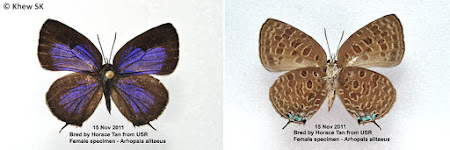


On the forewing underside, there is a spot at the base of space 10. The post-discal spot in space 6 of the hindwing is rounded and overlaps the cell-end bar. The submarginal spots on the hindwing are individual spots versus band-like in the Raffles' Oakblue (A. pseudomuta).


With voucher specimens and early stages record, we now document this as a re-discovery and add the Purple Broken-Band Oakblue (Arhopala alitaeus pardenas) as species #319 in the Singapore Checklist.
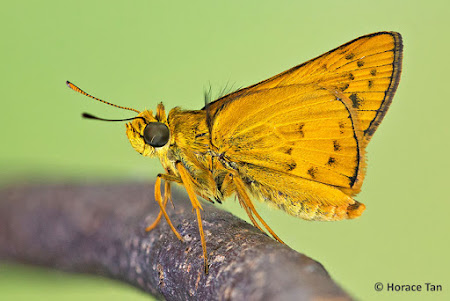


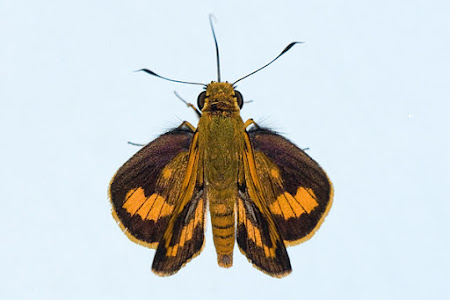
The second species to be recorded as a new discovery is the Linna Palm Dart (Telicota linna). This species was not included in the early authors' checklists. Even as early as back in 2007, Horace Tan, our early stages expert, had bred this species on Bambusae, but identification at that point was lumped together with the extant species, T. augias. Dr TL Seow, our resident expert, had then tentatively identified it as T. ohara, another allied species due to the lack of a proper set specimen to refer to.


There was another amateur who claims to have recorded this species three years later in 2010, but was not a trustworthy source as he had shown a propensity for posting untruths and slanderous accusations under fake accounts. It is also curious as to whether this character possessed the proper permits from NParks to take material out of areas under the legal jurisdiction of the Singapore authorities. It is regrettable that this unfortunate individual set up a so-called blog (obviously not credible nor widely read) to resort to his mud-slinging activities.
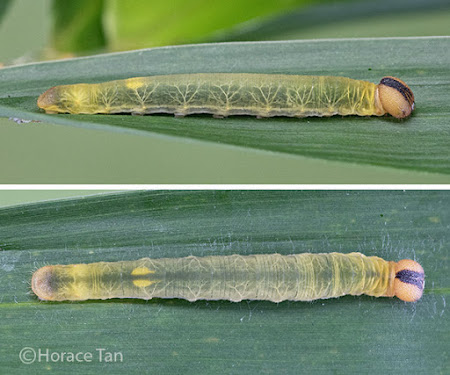


In recent years, Horace Tan had further opportunities to breed this species and several more voucher specimens were obtained for closer scrutiny. Based on the observations done by Dr Seow, the clues to identifying this species and to distinguish it from the other 3 Singapore-extant lookalikes - T, besta, T. augias and T. colon, are the following features :
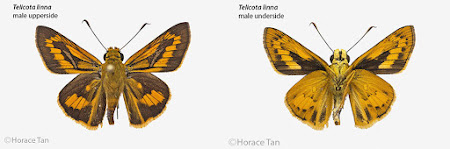

Male Telicota linna.

  • Forewing with the base of space 2 black or largely so (sometimes with a bit of orange shading).
  • Brand usually straight and not placed closer to the forewing cell or inner margin.
  • Underside hindwing veins across band not dark dusted.
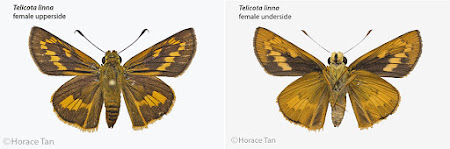

Female Telicota linna.

  • Forewing generally darker, with much of basal orange darkened.
  • Forewing two cell end spots usually separate and roughly about equal in size.
  • Underside hindwing veins across band not dark-dusted.

It should be noted that for many of these lookalike species, the ID keys need to be combined with other diagnostic features and should not be used in isolation. For example for the characteristic in the male where the base of space 2 is black, this feature is also present in the Malaysian species of T. ohara, T. bambusae and T. hilda. All of these species have yet to be observed in Singapore, although there is no particular reason why they will not appear here in future.


With the voucher specimens available, we now record the Linna Palm Dart (Telicota linna) as species #320 in the Singapore Checklist. From 2015, ButterflyCircle has been working with the Lee Kong Chian Natural History Museum by supplying DNA material to set up a DNA barcode database for Singapore butterfly specimens. This is to ensure that the DNA data will be available for future reference when the technology is more conducive for the use of DNA to reliably identify butterflies.
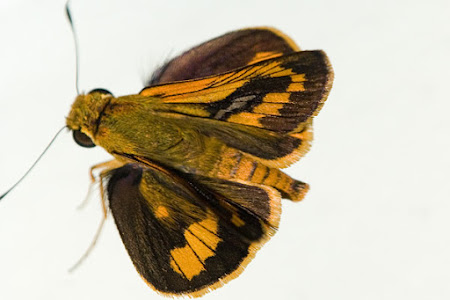


There are currently no fewer than 10 species that are still under investigation and for which voucher specimens are being sought to validate the identity of these butterflies. These are mainly lookalike species in the Lycaenidae and Hesperiidae families. In a forthcoming blog article, we will feature two more Lycaenidae species that will be added to the Singapore Checklist.

Text by Khew SK : Photos by Sunny Chir, Chng CK, Huang CJ, Khew SK and Horace Tan

Special thanks to Horace Tan for his patience and effort in documenting the early stages of these species and to Dr TL Seow for his persistence in scrutinising the voucher specimens to identify the species with a high level of confidence.
References :
  • *[C&P4] The Butterflies of The Plain Peninsula, A.S. Corbet and H.M. Pendlebury, 4th Edition, Malaysian Nature Society.
  • Butterflies of West Malaysia and Singapore, WA Fleming, 2nd Edition, Longmans, 1983
  • Butterflies of Thailand, Pisuth Ek-Amnuay, 2nd Edition, 2012

Special Note :
All voucher specimens, host plants and early stages collected within Parks or Nature Reserves under the jurisdiction of the National Parks Board are done with the permission of the National Biodiversity Centre Division of NParks. Specimens will be submitted to the Lee Kong Chian Natural History Museum's Lepidoptera Collection for reference.