05 September 2015

Larval Host Plant for Butterflies: Saga Seed Tree

Butterflies' Larval Host Plants #3
The Saga Seed Tree (Adenanthera pavonina )


This 3rd instalment of our Butterflies' Larval Host Plants series features Adenanthera pavonina, a species in Fabaceae (bean family) which is a family of flowering plants known for their nitrogen-fixation ability. With about 18000-old species, Fabaceae is the third largest land plant family, and its members take on a variety of growth forms (trees, shrub, herb, vine, liana). The Saga Seed tree is a perennial member which assumes the tree form.

The Saga Seed tree is native to India and Southern China, but it has been introduced to many countries in the tropics. In Singapore, it is commonly planted in parks/gardens and on roadside for shade and ornamental purposes. It is noteworthy that one particular Saga Seed tree in the Singapore Botanic Garden has even achieved the Heritage Tree Status. Different parts of the Sage Seed tree have been shown to serve useful purposes. For examples, the timber has been used in house and cabinet making, and the wood produces a red dye and used in tonics.

Plant Biodata :
Family:  Fabaceae
GenusAdenanthera
Speciespavonina
SynonymsA. gersenii, A. polita, Corallaria parvifolia
Country/Region of Origin:  India, South China
English Common Names:  Saga Seed Tree, Red Sandalwood, Red Bead Tree
Other Local Namezs:  孔雀豆 , 海红豆
Larval Host for Butterfly Species: Plain Nawab, Blue Nawab and  Common Imperial.

Two Saga Seed trees growing on the side of a jogging track in Jurong Lake Park.

A fast growing tree with spreading canopy, the Saga Seed tree can grow up to 20m. It features compound bipinnate leaves. Each leaf is about 10-40cm long with up to 6 pairs of side stalks each of which bearing 9-15 pairs of leaflets. The leaves are shed every 6-8 months, with the leaves turning from green to yellow before dropping off.
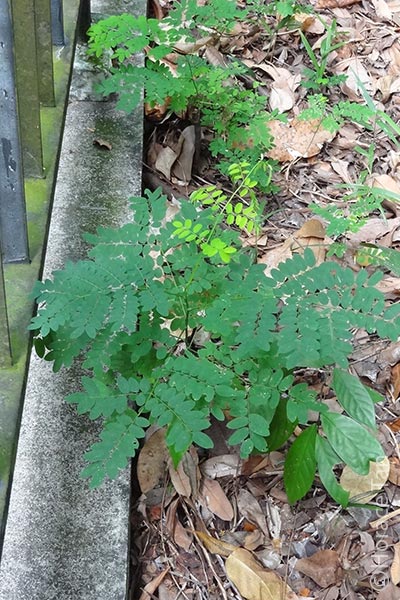
Saplings of the Saga Seed tree found alongside a pavement in the Mount Faber Park.

A young leaf in the early stage of growth.

The young developing leaves are yellow to yellowish brown, but turning yellowish green to dark green when they   mature. The young leaves are edible, and have been used with the bark to make a decoction in traditional medicine for treatment of diarrhoea.

Two side stalks of leaflets, with the lower one fully matured.

Mature leaves of the Sa.

Flowers of the Saga Seed Tree are small and creamy yellow. They occur in dense clusters on long stalks (8-12cm long). These flowers are faintly scented and turn dull orange when they age.

Stalks of flower buds of the Saga Seed Tree.

Stalks of flowers and flower buds of the Saga Seed Tree.

Close up views of a stalk of flower bud (left); flowers (centre, right).

Close up view of young flowers.

Close up view of individual flowers.

The fruits occur in long (10-20cm), curved pods. As a pod develops, bulges corresponding to the location of seeds grow in size. The pod turns brown when it is ripened, and it then splits open in two twisted halves to reveal the scarlet seeds. Each seed is hard and near heart-shaped. The ripened pods will eventually fall and litter the ground below the tree. Cooked seeds are edible although the raw seeds are toxic. The seeds have many other uses including being used as beads in jewellery (as beads),  as  industrial lubricants (oil extracts from seed), as unit of weights in ancient India and even as symbols of love in China (Chinese name: 相思豆).

Young fruits of the Saga Seed Tree with the bulges barely noticeable.

Fully developed pods of the Saga Seed Tree.

Ripened pods still attached to the mother tree.

Close-up view of a ripened pod fallen to the ground.

Close-up view of a seed of the Saga Seed Tree.

In Singapore, the Saga Seed tree also serves as the larval host plant for three butterfly species: Plain Nawab, Blue Nawab and  Common Imperial. The first two are Charaxinae (a nymphalid subfamily) species, while the last one is a lycaenid.

A Plain Nawab butterfly.

A Blue Nawab butterfly.

A Common Imperial butterfly.

Eggs of these three butterfly species are typically laid by the mother butterfly on the stem/leaves of a young plant of the Saga Seed Tree at low heights (knee height to chest level). The eggs of the two Nawab species are mostly found laid on the upperside of a leaflet, with a few on the underside.

A female Plain Nawab laying an egg on the underside of a leaflet of the Saga Seed Tree.

An egg of the Plain Nawab found a leaflet of the Saga Seed Tree.

Eggs of the Blue Nawab found on the upperside of leaflets.

Caterpillars of all three species feed   on leaflets of the Saga Seed Tree.  The two Nawab species have the habit of  building a "base camp" made from weaving several adjacent leaflets together.

A late penultimate instar instar caterpillar of the Plain Nawab resting in its base camp on a Sage Seed Tree in the Mount Faber Park.

An early 5th instar caterpillar of the Blue Nawab found alongside a park connector track in the west.

A final instar caterpillar of the Plain Nawab in its base camp found in the Telok Blangah Hill Park.

A final instar caterpillar of the Blue Nawab in its base camp found in the west.

Caterpillars of the two Nawab species typically pupate on the same Saga Seed Tree they have been feeding on. The pupation site is usually the underside of a stem or the rachis of a compound leaf. Likewise for Common Imperial, the pupation site is usually a spot on the stem of the same plant it feeds on.

A pupa of the Blue Nawab found in the vicinity of the Chinese Garden.

A pupa of the Plain Nawab found in the Dairy Farm Nature Park.

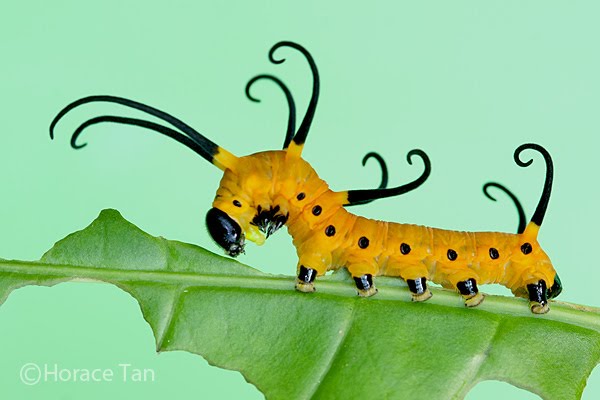
If you happen to encounter a young Saga Seed tree in your next outing in the field, try to look for the odd sight of a few leaflets weaved together. If you do find one, chances are you have found the base camp of a Nawab caterpillar and even the caterpillar itself. The most striking feature of Nawab caterpillars is their dragon-like head, hence it would be rather easy for you to know that you have found the real McCoy.


References:
Text and Photos by Horace Tan.

29 August 2015

NParks Butterfly Count 2015

NParks Butterfly Count 2015
Pre-Survey Training Sessions 


The NParks Butterfly Count 2015 is a citizen science initiative, organised by NParks in collaboration with ButterflyCircle, to get Singaporeans involved in collecting valuable information about the butterflies in our parks and gardens.


Butterfly class in progress!

With the data collected from many survey transects from the various parks around Singapore, information on the distribution about butterflies can be pieced together to enhance park management and conservation measures. For example, if a park has a low butterfly count, more host and nectaring plants could be cultivated at the park to attract more butterflies.


NParks' Zhou Boyi sharing the key features to look out for when trying to ID butterflies

Members of the public, corporate, community and school groups are encouraged to sign up to participate in the island-wide butterfly count, focusing mainly on parks and gardens in Singapore. For participants who are new to butterfly identification, three sessions of basic butterfly identification and survey methodology were held in August to help these participants familiarise themselves with butterflies and how to ID them.


After the basic one-day training, participants will then be assigned to a designated park nearest to their homes to conduct the butterfly survey. The survey period will be over a week from 5 - 13 Sep 2015. The data collected will then be submitted to NParks for analysis which will result in management strategies to improve butterfly diversity in our parks.


Attentive students in class

ButterflyCircle members were involved in two of these training sessions for the NParks Butterfly Count 2015. Each training session had about 60+ participants with knowledge about butterflies ranging from total beginner to intermediate. The first session was held on 2 Aug at Singapore Botanic Gardens. The session started with a lecture about butterflies - some background information, morphology, interesting features, behaviour, early stages, other interesting data, etc. NParks' Zhou Boyi also presented a series of slides on butterfly identification and the features to look out for in the different species of butterflies.


The audience ranged from young kids to senior citizens. Everyone listened intently and a few were curious enough to ask many questions about butterflies. As it was a hot sunny day, everyone was raring to go out to show off their newfound skills in identifying butterflies. Each group, led by ButterflyCircle facilitators, took two transects to record their sightings of butterflies. ButterflyCircle veterans Federick Ho, Koh Cher Hern, Loke PF and Chng CK led their respective groups with NParks staff.


Everyone look up!  There's a butterfly fluttering somewhere up in the trees!

It was fun as each group tried to record as many butterflies as they could. One comment from a participant was that, in the field, there was an added dimension of the characteristic of how different species have different flight patterns. Also, it was difficult to identify a fast flying butterfly or to be able to see the diagnostic features of the butterfly to ID it confidently.


Butterfly survey well under way

The second training session was held on 15 Aug 2015, also to another group of enthusiastic participants. Questions came fast and furious in the lecture room at Ridley Hall of the SBG. The younger participants were quick to pick up the differences between the lookalike butterflies, whilst the older members in the audience scrutinised their reference sheet carefully.


Mr Foo and the Seletar CC gang leading a group of 'students' on a survey transect

This session was facilitated by ButterflyCircle members Simon Sng and Huang CJ, but also in attendance was the founder of the Seletar Country Club's Butterfly Garden, Mr Foo Jit Leang and his enthusiastic bunch of knowledgeable lady members. The groups were assigned by NParks' Zhou Boyi, and off we went to our designated transects to start with the survey.


Basic rules of the Pollard Method of surveying butterflies. Image © NParks

Using the Pollard Method of survey, each group tried to document as many species of butterflies and the numbers of individuals spotted over each transect. Each short 200m transect took about 20 minutes to survey, and each group tackled two different transects at SBG to try their hand at surveying butterflies and recording the data in a simple format prepared by NParks.


NParks Zhou Boyi showing the group how to use the SGBioAtlas app

We hope that the short training session to identify about 20 common urban species would whet the appetites of the groups, enough for them to independently survey the parks in the vicinity of their homes. From 5-13 Sep, the official surveys will commence, and the participants who signed up for the survey can conduct their surveys on any of these days. Information to record include the weather, time of survey and the numbers and variety of species spotted.


SGBioAtlas app where field sightings of butterflies can be recorded by anyone! Image © NParks

Besides regular surveys conducted in the parks, NParks invites members of the public to submit photos of butterflies they have seen through the SGBioAtlas app (available on iTunes and Google Play Store) between 5 – 13 September to help us document the various butterfly species living around us. The SGBioAtlas app allows sightings to be geotagged and locations where the butterfly was encountered to be saved and subsequently submitted. It also has a comprehensive butterfly field guide to help users identify the species of butterfly spotted.


A happy group led by ButterflyCircle member Chng CK after their successful outing!

So to all the survey participants out there, go out and have fun and try your best to document all the butterflies that you spot in your nearby parks. A good day to be out there would be on Polling Day on 11 Sep. After casting your vote, head out to your nearby park and enjoy the extra public holiday whilst doing a bit of volunteer service to help NParks make our parks more butterfly-friendly for everyone to enjoy!

Text by Khew SK : Photos by Chng CK, Huang CJ, Khew SK, Loke PF, Simon Sng and Zhou Boyi.

22 August 2015

Life History of the Bamboo Paintbrush Swift

Life History of the Bamboo Paintbrush Swift (Baoris farri farri)


Butterfly Biodata:
Genus: Baoris Moore, 1881
Species: farri Moore, 1878
Sub-species: farri Moore, 1878
Wingspan of Adult Butterfly: 36-40mm
Caterpillar Local Host Plants: Bambusa_heterostachya (Poaceae; common name: Malay Dwarf Bamboo), Bambusa vulgaris (Poaceae, common names: Common bamboo, Buloh Minyak, Buloh Kuning).


Physical Description of Adult Butterfly:
On the upperside, the wings are dark brown. The forewing has hyaline spots in spaces 2-4, 6-8 and 2 cell spots. The female is usually fully spotted and has an additional non-hyaline spot in space 1b on the forewing. The hindwing does not bear any spot, but the male has a black hair tuft in the cell on top of a scent pouch (hence "Paintbrush" in its common name). On the underside, the wings are pale brown and similarly ``spotted'' as per the upperside.


Field Observations of Butterfly Behaviour:
The Bamboo Paintbrush Swift is moderately rare in Singapore. Sightings typically took place in parks, urban gardens and forested areas where clumps of bamboo are growing in the vicinity. The swift-flying adults are relatively large and have been observed to vist flowers for nectar and perching on leaves to sunbathe in sunlit conditions.


15 August 2015

Butterfly of the Month - August 2015

Butterfly of the Month - August 2015
The Blue Spotted Crow (Euploea midamus singapura)


It's the month of August already! We're into the 8th month of 2015, and it's a month of celebrations for our little red dot island in the sun. On 9th August, Singapore celebrates its 50th birthday after independence. How far we've come from being a sleepy colonial trading outpost to the vibrant economic powerhouse whose GDP per capita is one of the highest in the world.


Fireworks display at the National Day celebrations

There have been numerous articles and discussions about Singapore during the past week and leading up to the Golden Jubilee celebrations, highlighting the little island state that has punched way above its weight (or, in Singapore's case, size) in terms of economic success. A little island of just above 700 sq km with virtually no natural resources, it has recorded a stellar rise in the standard of living since its separation from Malaysia back in 1965.


Singapore night skyline showing the Marina Bay Sands complex

Today, Singapore boasts some of the most modern infrastructure in Southeast Asia, with its economy humming along relatively healthily for a developed country. Its order (things work efficiently!), security, clean & green environment are some of the attributes that residents of Singapore are thankful for. Despite a reputation for being the world's most expensive city to live in, there are many things going for this little island that makes Singapore the envy of many other cities around the world.


Black Knights flight display on National Day

Even as the spectacular fireworks, the screaming Black Knight jets and singing of nationalistic songs at our SG50 celebrations begin to just fade away, news of the coming General Elections and rumours about when Polling Day will be, fill the mainstream news portals and social media. It will be exciting months ahead as Singaporeans ponder about the future and which political party we will choose to govern and lead Singapore for the next five years.


As the sea of red-and-white continues to decorate Singapore in all manner of ways to remind us of our national flag's colours, we take a look at our feature Butterfly of the Month for August 2015. Readers may be wondering why a drab black-and-white butterfly is being featured during a month of celebrations? In an attempt to be less literal in terms of a visual treat featuring our national colours, there is a special reason why we are featuring the Blue Spotted Crow for this SG50 month on this blog.


The clue is in the scientific name of this butterfly. It is one of three of our local butterflies that make reference to "Singapore" in their subspecies names. In the case of the Blue Spotted Crow, its scientific name is Euploea midamus singapura. What can be more befitting than to celebrate Singapore's 50th birthday with a butterfly that bears the name of our beloved little island?


A Blue Spotted Crow puddling on a sandy streambank

The Blue Spotted Crow subspecies singapura has predominantly black wings with white spots arranged in a similar fashion as in the lookalike Spotted Black Crow (Euploea crameri bremeri). However, the subapical spots on the forewing of the Blue Spotted Crow is more quadrate rather than elliptical, and there are four spots instead of five in the Spotted Black Crow. These diagnostic characteristics of the white subapical spots distinguish between the two similar-looking species.


The subspecies singapura of the Blue Spotted Crow is described to be found only on Singapore Island, Pulau Tioman and Pulau Aur - the latter two islands on the eastern side of the Malay Peninsula. Up to date records of this subspecies on the two Malaysian islands are few, making the existence of this subspecies on Singapore island the most reliable records in recent years. Could it even be suggested that the population of this subspecies on Singapore island be considered "endemic", if no further sightings of singapura on the Malaysian islands are recorded in future?!


The Blue Spotted Crow has a slow and unhurried flight, and can be observed in urban as well as nature reserve habitats. It is usually spotted singly either feeding at flowers, or puddling. The butterfly is sometimes observed to puddle on concrete, brick and wood surfaces of buildings in the vicinity of forested areas. It is an alert butterfly, and takes flight at the slightest movement, even when it is feeding.


Caterpillar of the Blue Spotted Crow

As it feeds on lactiferous vines of the Apocynaceae family, it is likely to be distasteful to predators like the related species in the genus. The mature caterpillar is spectacular and unique, making it a very pretty caterpillar and almost "unreal".


Finally, we would like to wish all our Singaporean readers a Happy 50th National Day and Majulah Singapura!

Text by Khew SK : Photos by Chng CK, Khew SK, Henry Koh, Loke PF, Nelson Ong, Horace Tan, Wong Chee Ming and Mark Wong