10 January 2015

Butterfly of the Month - January 2015

Butterfly of the Month - January 2015
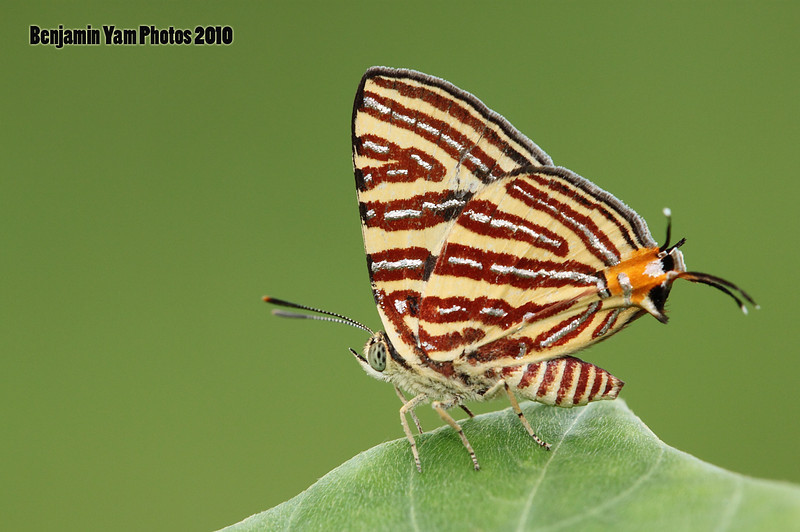
The Long-Banded Silverline (Spindasis lohita senama)


A new year has begun! 2015 has started cautiously for the global economy, with the falling oil prices threatening to dampen and even negatively affect many countries' economic recovery and growth. Whilst only certain countries are feeling the effect on their currencies, the world today is inextricably connected in terms of bilateral trade and economic cooperation, and when more countries are affected, it is likely that even those which appear unscathed will feel the strain. Oil is a mineral that affects practically every aspect of our daily lives and it is hard to escape any severe fluctuations in price - whether up or down.


Towards the end of an eventful 2014, a third plane disaster struck in our Southeast Asian region. Whilst we thought that two crashes affecting Malaysian Airlines Flights 370 and 17 was more than any country can take in terms of loss of innocent lives in civilian crashes, the AirAsia flight QZ8501 crash was something totally unprecedented for Malaysia in terms of a single country's flight safety record in a single year. The Airbus A320 plane carrying 162 passengers and crew from Surabaya to Singapore did not make it, and it is feared that everyone on board perished in the crash.


Murder (in whatever form you call it) in the name of religion continues to rear its ugly head even as the New Year celebrations to herald 2015 were still fresh in our minds. This time, extremists or terrorists, massacred 12 people in the unlikely city of Paris. Angered by the satirical cartoons of the the newspaper Charlie Hebdo, which purportedly pokes fun at Islam (and other religions and political leaders), two fanatical brothers stormed and shot dead a number of the cartoonists at the office of the newspaper, along with some police personnel as well.


"These madmen, fanatics, have nothing to do with the Muslim religion," France's President Francois Hollande said in a televised address. Indeed. Which religion's God teaches its subjects to murder innocent unarmed people? This form of extremism is not expected to go away in 2015. If anything, it will worsen as the world struggles with intolerance and human ego - driving fanatics to continue to eliminate people who do not subscribe to their way of thinking.


This month, January 2015, we continue with our long-standing series of featuring a butterfly species every month. Our 87th butterfly species to take the limelight on our blog is the Long Banded Silverline (Spindasis lohita senama). This small, but very attractive butterfly starts our new year with a bit of optimism and hope for the year ahead.


The Long Banded Silverline belongs to the family Lycaenidae, often known by its generic name of "Blues and Hairstreaks" - featuring many small sized butterflies with prominent tails. The tails and eyespots on the hindwings of the family Lycaenidae are often described to perform the function of a decoy which fools predators into attacking the "wrong" part of the butterfly, thereby allowing the butterfly to escape a fatal blow to its real head.


Our feature butterfly of the month is one of a few species which is attractive both on the upper and underside of the wings. There are many species showing beautiful bright colours and patterns on either the upper or underside, but not many species features such beauty on both.


The Long Banded Silverline is one of two species of the genus Spindasis found in Singapore. Both species are widely distributed, and can be found more regularly at urban parks and gardens than in the forested nature reserves of Singapore. The Silverlines are characterised by their banded appearance on the undersides of their wings, centred with silvery markings. The hindwing bears a pair of delicate filamentous white-tipped tails.


The butterfly is moderately common, and at times, several individuals are spotted together. The Long Banded Silverline is a fast-flyer, but often stops to perch at its favourite leaf or branch repeatedly. At rest, they often stop with their wings folded upright. However, when conditions are right at certain hours of the day, they can be observed to open their wings to sunbathe.


A male Long Banded Silverline showing off its upperside

The male of the Long Banded Silverline is deep blue above with broad black apical borders on the forewing. The female is a plain brownish-blue above and generally unmarked, although the underside markings can often be perceived through the wings. The underside is an yellowish-cream ground colour with red streaks infilled with silvery streaks.


The distinguishing markings between this species and its closely-related cousin, the Club Silverline (Spindasis syama terana) can be found in the basal area on the underside of the forewing. The basal streak is L-shaped in the Long Banded Silverline, but club-shaped in the Club Silverline. The hindwing has two white-tipped tails emerging from a prominent orange tornal patch.


Long Banded Silverlines feeding on the Mile-A-Minute flowers (top) and Red Tree Bush (Leea rubra) (bottom)

The Long Banded Silverline can often be observed feeding on the flowers of the Bandicoot Berry (Leea indica) and the Red Tree Bush (Leea rubra). In other areas, we have seen a number feeding on the inflorescence of the Mile-A-Minute creeper (Mikania micrantha).


The butterfly is often observed to rest with its head facing downwards

When disturbed, the butterfly flies rapidly and hides under a leaf. At times, it also displays this habit of perching on the underside of a leaf, upside down. When at rest, individuals are also often observed to stop on a vertical perch with its head facing downwards. This may be related to a defensive behaviour of posing with its "false head and eyes" facing upwards to fool predators into attacking that part of the wings.


This species' caterpillars have been successfully bred on a number of host plants that include the guava and Singapore Rhododendron. It is also believed to be able to breed on the exotic Australian tree, Acacia auriculiformis which can be found growing wild in many parts of Singapore, where a female of the species was observe to be ovipositing on a leaf of the tree.

Text by Khew SK : Photos by Sunny Chir, Chng CK, Koh CH, Khew SK, Loke PF, Nelson Ong, Jonathan Soong, Mark Wong, Benjamin Yam and Zhuang YY

03 January 2015

Life History of the Three Spot Grass Yellow

Life History of the Three Spot Grass Yellow (Eurema blanda snelleni)


Butterfly Biodata:
Genus: Eurema
Hübner, 1819
Species: blanda Boisduval, 1836
Subspecies: snelleni Moore, 1907
Wingspan of Adult Butterfly: 35-45mm
Caterpillar Local Host Plant: Falcateria moluccana (Fabaceae, common name: Albizia).


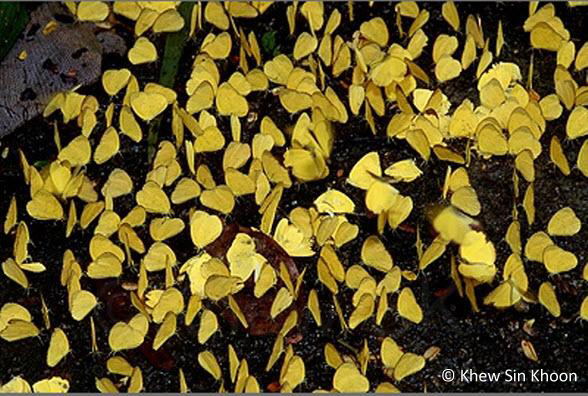
A large group of puddling Three Spot Grass Yellow adults.

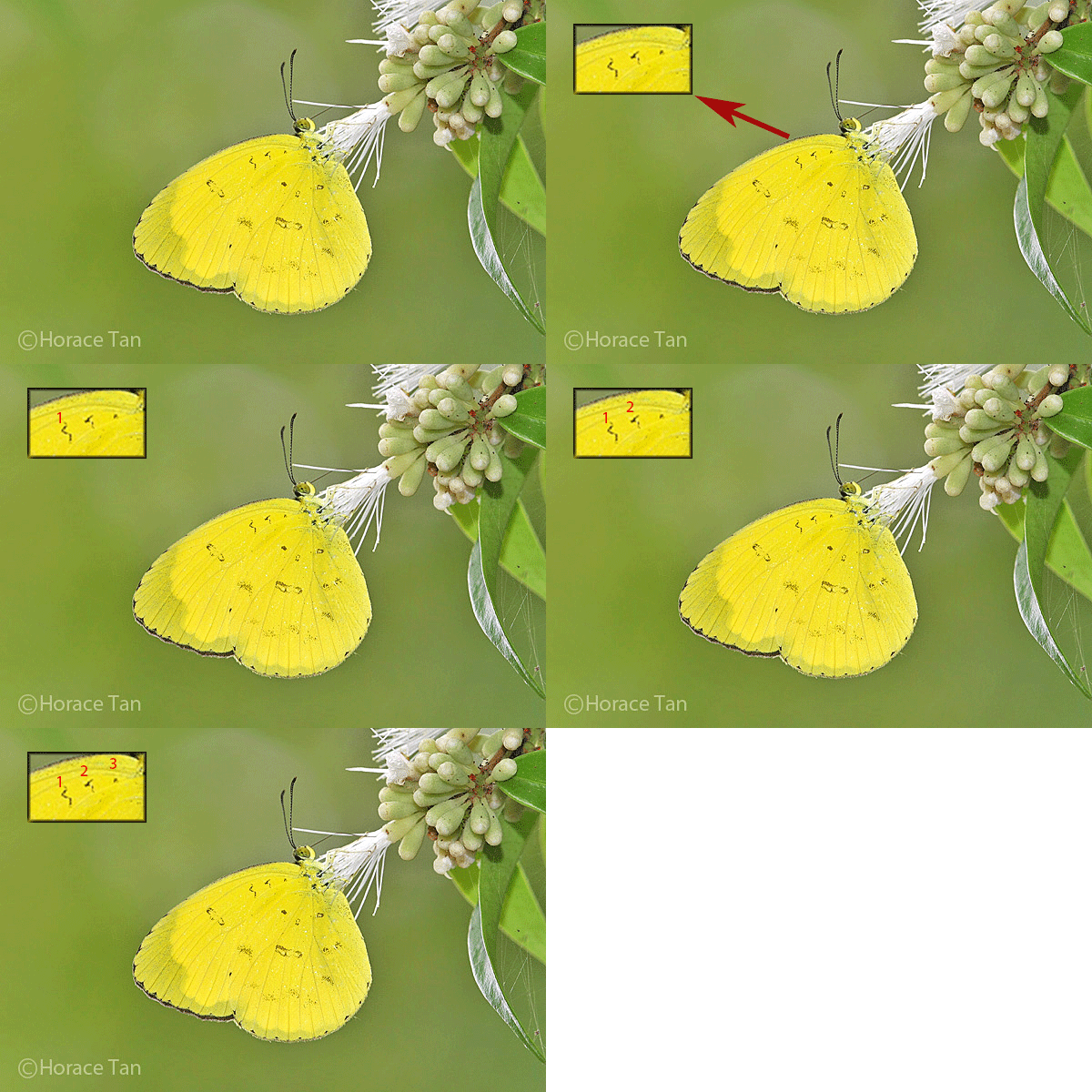
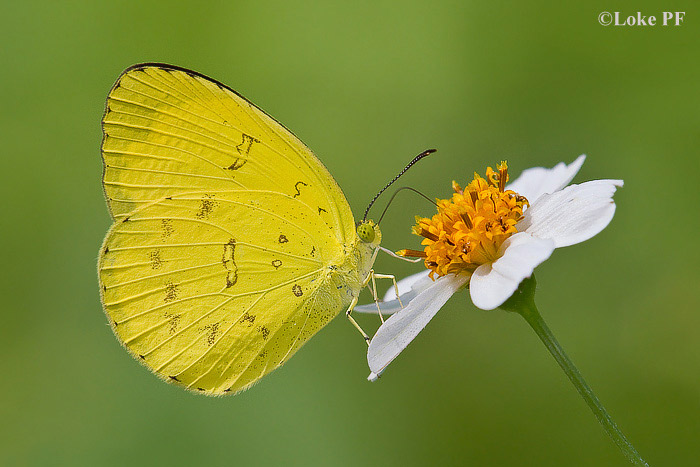
A Three Spot Grass Yellow with the "three spots" illustrated.

Physical Description of Adult Butterfly:
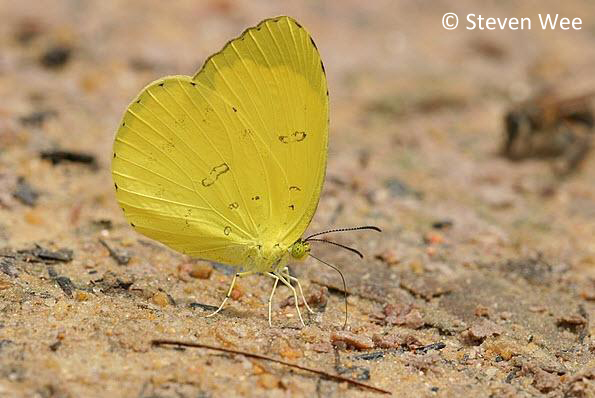
Above, the wings are deep lemon-yellow. The forewing has a black border which is regularly scalloped and deeply excavated between veins 2 and 4 (more so in the female than in the male). Underneath, the wings are yellow with freckled brown spots. There are typically three cell spots on the forewing and a black spot at the base of space 7 on the hindwing. It is not uncommon for some individuals to have a large brown apical spot/patch on the forewing. Males have a brand lying along the cubital vein on the forewing underside.


Field Observations of Butterfly Behaviour:
The Three Spot Grass Yellow is common in Singapore and can be found both inside and outside the nature reserves. The adults can be seen fluttering in their habitatss in the company of other Grass Yellow spp. leading to difficulty in identifying them correctly. They regularly visit flowers for nectar and puddle on wet grounds for minerals. There have been records of population outbreaks when hundreds of them can be seen together in various locations across Singapore.

27 December 2014

2014 - Looking Back...

ButterflyCircle 2014 - Looking Back...
The Year in Review


Another twelve months have whizzed by, and we are already on the threshold of a new year. As we look back at 2014, it was a year where ButterflyCircle members made more trips beyond the shores of our little Red Dot than in previous years. Exploring further afield in the past years also paid good dividends when Dr Laurence Kirton needed field shots of live butterflies from Malaysia, Singapore and Thailand for his new book.


In this final blog article for 2014, we share some of the key events that ButterflyCircle members were part of, and news-worthy snippets of our winged jewels in Singapore (and also a few stories from the region). It was another eventful year for discoveries and re-discoveries on the Singapore butterfly scene as some new species made their appearance for the first time here. Undoubtedly, these may be seasonal or accidental migrants, but with clear evidence of the sightings of these species, we have included them in the Singapore checklist.


All in all, we posted a total of 132 entries on this blog, with articles ranging from new finds, butterfly attracting plants, events, and other butterfly news from Singapore. Though not as many articles as our bumper year in 2013, where we logged a total of 188 posts, 2014 was an awesome year nevertheless.


Our forums continued to remain active, as a platform for serious discussion as well as learning the finer points of butterfly identification from our resident guru, Dr TL Seow, who deserves more than a few kudos for his sharp eye for detail and also responsible for adding quite a number of 'lifers' to ButterflyCircle members' photographic tally.


With the FaceBook 'Butterflies of Singapore' (which should notably be known better as 'butterflies without borders') group very active, the reputation of Singapore's butterfly photographers has spread regionally and well beyond our little island in the sun. With a total membership of over 4,750, the FB group has a following of members from all around the world. Not bad for a group that specialises only in the sharing of photos and information about butterflies!


Our regular feature articles series, the Butterfly of the Month, is now into its seventh year and going strong, with a total of 86 butterfly species featured every month from Dec 2007 to Dec 2014. Each article features multiple butterfly photos from the excellent portfolio of ButterflyCircle members.


Horace Tan, our life history expert, continued with his peerless detailed documentation of the early stages of Singapore's butterfly species. In 2014, Horace's butterfly life histories series delivered a total of 22 full documentation from egg to adult with amazing detail - a testimony to his exceptional patience and determination to capture the early stages of butterflies.


ButterflyCircle member Mark Wong with HKLS members in Chiangmai, Thailand

We started the year with a short travelogue by ButterflyCircle member Mark Wong, who joined a team of Hong Kong butterfly shooters in Chiangmai, Thailand. Mark shared his adventures in Chiangmai and the surrounding areas that were rich in butterfly biodiversity. This sparked off several other 'expeditions' to Chiangmai by ButterflyCircle members in Apr/May, Oct and Nov/Dec this year to capture the awesome beauty and biodiversity of Thailand's butterfly fauna.


ButterflyCircle members in action - Thailand 2014.  At Chiang Dao and Doi Pha Hom Pok

Our members' forays into Thailand yielded so many excellent butterfly photos from the northern Thailand region that would fill a good coffee table book! Amongst some of the notable species encountered are featured here - showing the diversity of species and subspecies just a couple of hours' flight time from Singapore!


Butterfly species from beyond the Red Dot

ButterflyCircle members also made trips up to Malaysia - Gopeng, Lata Kinjang, Kuala Woh, Gua Tempurung and Penang to get our fill of 'capturing' more species on our cameras' sensors and enjoying the beauty of butterflies in our Southeast Asian region. It is likely that in the coming years, we will be taking our hobby to more exotic locations, like our friends from Hong Kong.


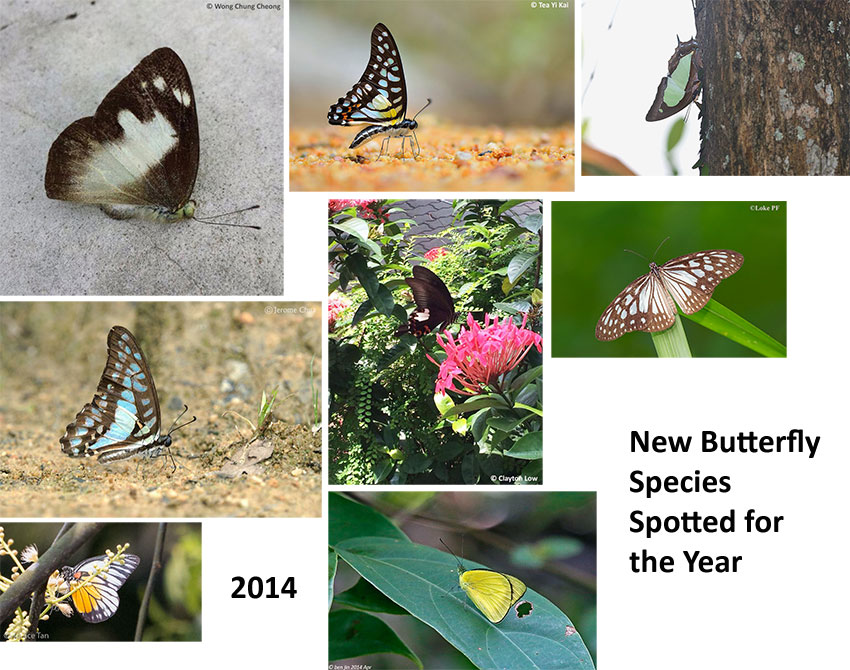
In terms of new discoveries in Singapore, we recorded a total of nine species added to the Singapore Checklist. The record now stands at 317 species for Singapore, with the documentation and maintenance of the Singapore Checklist starting from 1990. The new additions to Singapore for 2014 are :

  1. Barred LineBlue (Prosotas aluta nanda
  2. Striped Jay (Graphium bathycles bathycloides)
  3. Great Jay (Graphium euryplus mecisteus)
  4. Red Helen (Papilio helenus helenus)
  5. Lesser Albatross (Appias paulina distanti)
  6. Malaysian Albatross (Saletara panda distanti)
  7. Red Spot Sawtooth (Prioneris philonome themana)
  8. Grey Glassy Tiger (Ideopsis juventa sitah)
  9. Malayan Nawab (Polyura moori moori)


Two recent visitors in 2014 - Plain Lacewing (top) and Yellow Glassy Tiger (bottom)

A number of other Lycaenidae and Hesperiidae are under investigation and validation and will be added to the Singapore checklist in due course. During the year, we also recorded two species that are probably migratory but appears in Singapore once in a while. These were the Plain Lacewing (made an appearance in the Central Catchment area and several individuals were seen for a period of about a month) and the Yellow Glassy Tiger (which was photographed at Bay East of Gardens by the Bay)


ButterflyCircle members with author Dr Laurence Kirton at the launch of his book at Gardens by the Bay

April was an eventful month when Dr Laurence G Kirton launched his book, A Naturalist's Guide to the Butterflies of Peninsular Malaysia, Singapore and Thailand on 24 Apr at Gardens by the Bay. It was the first attempt by any author in the region to write a book about butterflies covering three countries of Southeast Asia. Though the book featuring about 280 species is just an appetiser to the large number of species in these three countries, it is a good introduction to the rich biodiversity of the region. ButterflyCircle members contributed about 75% of the photographs in Dr Kirton's book.


ButterflyCircle members with CEO/NParks and MOS Desmond Lee at the Festival of Biodiversity 2014

Our youngest ButterflyCircle member, Brian Goh, sharing his knowledge about butterflies with a visitor to our booth at Festival of Biodiversity 2014.

ButterflyCircle participated in the 3rd Festival of Biodiversity at VivoCity. Having been involved in the first two festivals, the 3rd instalment of this annual event proved to be even bigger and ButterflyCircle had a dedicated booth to feature our members' work and to promote the group. Special thanks to all our regulars who contributed their time and effort to volunteer at the FOB 2014 and to the National Parks Board for inviting us to the FOB 2014.


Two butterflies whose English common names have been updated

In an effort to standardise the English Common Names of butterflies in Southeast Asia, we also wrote several articles on this blog to rationalise the adoption (or otherwise) of current common names and propose some new ones. In our hobbyist and amateur world of trying to appreciate butterflies, it is often easier to coin common names than to use the tongue-twisting scientific names. However, the use of common names often run into problems when different countries' butterfly enthusiasts come up with new names for similar species. This will be an ongoing attempt to try to at least standardise the common names across Malaysia, Singapore and Thailand.


ButterflyCircle members with PM Lee at Butterfly Hill, Pulau Ubin

November was an exciting month for Pulau Ubin, a small offshore island of Singapore which is a hotbed of biodiversity, and where nature groups are working with the government to conserve as much of the island's natural heritage. ButterflyCircle was one of the groups featured and where our Prime Minister Lee Hsien Loong made a special stop at Butterfly Hill to enjoy our fluttering beauties with us.


Favourite Nectaring Plants for Butterflies

We also continued with our series of Butterflies' Favourite Nectaring Plants with two new additions for 2014. We featured Bandicoot Berry (Leea indica) and Red Tree Shrub (Leea rubra), as ideal plants which should be cultivated to attract butterflies (and birds) to our parks and gardens.


Happier times at Ye Olde Smokehouse, Fraser's Hill.  Irene and Sunny Chir on the extreme right

In ending this eventful year for ButterflyCircle and our very supportive members, I would like to pen a few words in memory of the late Irene Khoo, the wonderful wife of one of our senior members, Sunny Chir. We had many memorable outings with Irene, who was a great supporter of our group and was a excellent cook for us hungry butterfly photographers during our overseas trips. We miss Irene, and know that she is now in a much better place, watching over us and our butterflies...


A group of puddling Lamproptera (Dragontails) at Chiang Dao, Thailand

We look forward to 2015 and even more stories about our beloved flying jewels in the year ahead.

We would like to take this opportunity to wish all our readers, near and far, a HAPPY NEW YEAR!

Text by Khew SK : Photos by Sunny Chir, Chng CK, Jerome Chua, Antonio Giudici, Federick Ho, Sebastian Ho, Khew SK, Loke PF, Clayton Low, Jonathan Soong, Tan Ben Jin, Horace Tan, Tea Yi Kai, Wong Chung Cheong and Mark Wong